ROBERT A. WALLACE
This
well-known contractor and builder in one of Cedar Rapid’s native sons
and a worthy representative of one of her old and honored families,
being a son of Leroy Wallace, who for many years was a prominent
business man of the city. The father was born in Vermont, February 24,
1831, a son of Austin and Mary Wallace, and the second in order of
birth in a family of four children, the others being Mary, who died
when about fifty-five years of age; William, who died in Tennessee; and
Mrs. Minnie Storms, a widow of Fort Madison, Iowa. The Wallace family
is of Scotch origin and was founded in Vermont in early colonial days.
Our subject’s paternal great-grandfather was a soldier of the
Revolutionary war, and took part in the battle of Bennington. The
grandfather, Austin Wallace, was an old time tradesman, who about 1835
removed to Pagetown, now Columbus, Ohio, and became identified with the
building interests of that locality, working at the carpenter’s trade,
when it was the custom of those following that pursuit to go into the
woods, hew down the trees and prepare their own building material
before erecting a house. His death occurred at Columbus.
Leroy Wallace was reared under the paternal roof and after
reaching the age of twelve years worked in the timber cutting wood. He
learned what he could of the carpenter’s trade with his father, and
through his own unaided efforts bettered the knowledge thus acquired.
He was a self-educated man and a great reader even in early life, thus
becoming a broad-minded, well-informed man. On the 8th of January,
1835, he was married at Columbus, Ohio, to Miss Mary Barnes, who is
also of Scotch lineage and a native of the District of Columbia, where
her family had large land holdings. She is now the only survivor in a
Cedar Rapids. In 1855 Leroy Wallace brought his family to Cedar Rapids,
the journey being made by stage from Davenport. At that time this
region was mostly wild and unimproved, and as a contractor and builder
he became prominently identified with its development. During his long
residence here he erected many of the buildings of Cedar Rapids, and
the excellence of his work was a convincing test of his own personal
worth. He met with success in business affairs, and his course was ever
such as to commend him to the confidence and esteem of those with whom
he was brought in contact. By his ballot he supported the Republican
party, though he never took any active part in politics aside from
voting. extensive book bindery in Helena, Montana; He was a great
church worker and an official member of the First Baptist church, to
the support of which he gave liberally. Although a very conservative
man he always kept up with the times in all things, and in his death
the community lost a valued and useful citizen, his family a devoted
husband and father, and his associates a stanch friend. He departed
this life on the 20th of December, 1898.
Unto Leroy and Mary (Barnes) Wallace were born nine children,
all of whom reached years of maturity with exception of one son. In
order of birth they were: Virginia, wife of Frank Listenwalter, of
Cedar Rapids; Robert A., the subject of this sketch; Gertrude, who
lives with her mother in Cedar Rapids; Leroy, who was drowned in 1873
at the age of fourteen years; Lincoln, who was drowned in 1892;
Florence, wife of Colon B. Leibkicher, who has an extensive book
bindery in Helena, Montana; William, of the Cedar Rapids Paving &
Construction Company; and Bertha and Eurydice, both at home. All
received good common-school educations.
Robert A. Wallace was born in Cedar Rapids, November 13, 1856,
and was educated in its schools. He learned the carpenter’s trade with
his father, and in 1883 became associated with him in business under
the firm name of L. Wallace & Son. They did general contracting in
both stone and carpenter’s work, and were interested in and operated
what was known as the Cedar Rapids Planing Mill. They also engaged in
railroad construction, their first contract being with the Illinois
Central Railroad. Our subject still carries on the business under the
name of L. Wallace & Son, and is doing a large amount of work
throughout the state, being recognized as one of the most reliable, as
well as one of the best contractors and builders in this section. He
has put up a number of the larger blocks in the city, and is spoken of
as the pioneer contractor. November 15, 1893, Mr. Wallace led to the
marriage altar Miss Kate Hughes; who was born in Galena, Illinois, in
1861, a daughter of John Hughes and wife. Her father was a native of
Wales, and on coming to this country, first located in Illinois, but
later became a resident of Scotch Grove, Jones county, Iowa, where he
died at the age of sixty-six years. He was a very active man throughout
life. His wife died in 1898. They were the parents of two children:
Leroy Austin and John Hughes.
Although not a politician in the sense of office seeking, Mr.
Wallace is a strong Republican, and is now acceptable serving his
second term as alderman of the third ward. He is a member of the
Baptist church and also a Star of the West Lodge, No. 1, K. of P. He
has a wide circle of friends and acquaintances, and is held in high
regard wherever known.
Source: The Biographical Record of Linn County Iowa,
Illustrated, Chicago: The S. J. Clarke Publishing Company, 1901, pages
118-119.
Submitted by: Carrie J. Robertson of Marion
LEMUEL J. WALN
Linn county has
many well-to-do and successful farmers who have been the architects of
their own fortunes, and by their well-directed efforts have acquired a
comfortable competence. Among these is the subject of this personal
history, who now owns and operates a good farm on section 19, Franklin
township, He was born in that township, May 26, 1858, and is a son of
William and Fannie (Burge) Waln, the former a native of Ohio, the
latter of Greene county, Pennsylvania. He is great-grandfather on the
paternal side was a Mr. Barnard, who was drafted and served forty years
in the Swiss army before coming to America, and in this country took
part in the War of 1812. He had two daughters, both of who married
Walns. The parents of our subject were married in this county and made
their home on what was known as the William Waln farm until the
father’s death, he being killed in a tornado in 1860. The following
four years she conducted the farm alone and in 1864 she married Silas
Bailey, and they continued to make their home on the farm one year,
when they sold their property and moved to Creston, Iowa, where they
lived till 1879, when the property was sold, and she returned to Linn
county and remained one year. At the end of that period she rejoined
her husband and moved to Nebraska, where they purchased a farm. There
she died December 13, 1892.
The subject of this sketch is the seventh in order of birth in
a family of eight children, the others being as follows: Margaret A.,
born October 20, 1848, is the wife of James McLaughlin, of Franklin
township, a sketch of whom appears in this work; Samuel J., born April
8, 1850, married Ida Patmore and lives west of Mt. Vernon; Martha Jane,
born June 11, 1851, died in childhood; Eliza J., born December 5, 1852,
is the wife of Emanuel Welty, of Winterset, Iowa; William Henry, born
June 4, 1854, married Cynthia Hill and resides in Ravenden, Arkansas;
John E., born February 24, 1857, married Hattie Russell and makes his
home north of Mt. Vernon; and Milton B., born February 8, 1860, married
Emma Maybower and lives in Mt. Vernon.
Being only two years old when his father died Lemuel J. Waln
had few advantages during his boyhood and youth, and received very
little schooling except that gained in the school of experience. He
profited by the lessons received, however, and has a good practical
knowledge of men and affairs. Prior to his marriage he worked as a farm
hand by the month. On the 20th of February, 1884, at Marion, Iowa, he
wedded Miss Lavina Burge, and they now have two children: Milton B.,
born May 29, 1891; and Clara Ethelda, born October 9, 1895.
The Burge family originated in Hull, Yorkshire, England, and
came to America with Lord Baltimore in early colonial days, settling in
Maryland. Some of its members took part in both the Revolutionary war
and the war of 1812. The branch of the family to which Mrs. Waln
belongs came to Muscatine, Iowa, in 1837, and two years later took up
their residence in Linn county, where they entered quite a large amount
of land.
Jeremiah Burge, the grandfather of Mrs. Waln, was born in
Pennsylvania, in 1800, and was a son of William and Priscilla (Long)
Burge, also natives of that state. He married Hester Morford and to
them were born seven children, namely: James M., the father of Mrs.
Waln; Fannie, the mother of our subject; Jeremiah, deceased, who
married Sarah Archer; William, who married the widow of his brother
Jeremiah and lived in Franklin township; John, who married Harriet
Harles, deceased, and resides near Cedar Rapids; Jane, who married
Robert Maxwell, of Cedar county, Iowa, and both are now deceased; and
Martha, who married first Washington Turner, who was killed in the
Civil war, and is now the widow of Elijah Rundel and resides in Clyde,
Nebraska.
James. M. Burge, Mrs. Waln’s father, was born in Greene
county, Pennsylvania, and came to this county with the family in 1839.
Here he married Elizabeth McRoberts, a native of Kentucky, and a
daughter of Michael and Mary (Smith) McRoberts, who was born in
Virginia. The McRoberts family came from Scotland to America in the
early part of the Eighteenth century, and it has been well represented
in the wars of this country. William Smith, the maternal grandfather of
Mrs. Burge, was in the secret service under General Arnold in the war
of 1812, was present at the surrender of Detroit, and was massacred at
the battle of River Raisin. Mrs. Burge was fifth in order of birth in a
family of eleven children, the others being William, who married and
lives at Watsonville, California; Russell, who also married and resides
in Greene county, Iowa; Mary Jane, who married John Prather, and after
residing far a time in Linn county, Iowa, moved to Kansas and later to
Oregon, where both died; George, who married Sarah Black, and makes his
home in Mound City, Missouri; Frank and James, twins, both of whom
entered the Union army during the Civil war, and died at Maitland,
Missouri, from the effects of their army life; Lucinda, who married
Henry Rogers. She died in California and he died in Greene county,
Iowa; Elsina, who died in infancy; Duncan, a physician, who was killed
in the Civil war; and Margaret E., who died at the age of twenty years.
After his marriage James M. Burge located on a farm on section 21,
Franklin township, where he spent the remainder of his life, his death
occurring May 5, 1891. His wife died April 21, 1886, and both were laid
to rest in Mt. Vernon cemetery. Unto this worthy couple were born
twelve children, as follows: Frances married Jeremiah Thomas, a farmer
of Franklin township, and died in 1878. Jerry was killed in a tornado
on the home farm in Franklin township in 1860. Hester M. married Joseph
Moore, who died in Linn county, in 1877, while her death occurred in
Greene county, this state, in 1885. Their sons are now engaged in the
cattle business in Tillamook, Oregon. John W. married Hannah Clark and
is engaged in farming in Bertram, Iowa. Ellen married Andrew Dill, a
farmer of Franklin township, this county, who died December 22, 1877,
and she died August 21, 1879. Elizabeth is the wife of John Hoffman, a
farmer of Franklin township. James R. married Alvena Minich and is
engaged in the ice business in Mt. Vernon. Elmer married Kate Heller
and resides on his grandfather’s old homestead in Franklin township.
Ethelda is keeping house for her brother George H. Anson S. married
Lula Davis and resides in Spokane, Washington. George H., a farmer of
Franklin township, is represented on another page of this volume.
For one year after his marriage Mr. Waln lived on the
McCafferty farm where his wife was born, and spent the following year
on the Jerry Burge farm. His wife owned forty aces of land which they
traded for the Chris Conrad place on section 19, Franklin township, and
Mr. Waln has added to this until he now has one hundred and five acres
of well improved and highly cultivated land, supplied with a good set
of farm buildings. He is a most progressive, up-to-date and successful
farmer, and raises considerable stock, including horses, cattle and
hogs. In his political affiliations he is a Republican, and he has
efficiently filled the office of school director.
Source: The Biographical Record of Linn County Iowa,
Illustrated, Chicago: The S. J. Clarke Publishing Company, 1901, pages
204-7.
Submitted by: Carrie J. Robertson of Marion
HON. CHARLES WEARE
 Not
all men gain state or national prominence or perhaps become widely
known in their home locality, but there is no individual who does not
leave his impress for good or evil upon those with whom he comes in
contact, and well it is if at the close of his career his name is
mentioned with respect and honor as the proof of a useful and upright
life. For almost sixty years Charles Weare was a resident of Cedar
Rapids and though he did not seek to figure in any prominent public
relation his course was characterized by a devotion to duty that might
well make his example one worthy of emulation. Not
all men gain state or national prominence or perhaps become widely
known in their home locality, but there is no individual who does not
leave his impress for good or evil upon those with whom he comes in
contact, and well it is if at the close of his career his name is
mentioned with respect and honor as the proof of a useful and upright
life. For almost sixty years Charles Weare was a resident of Cedar
Rapids and though he did not seek to figure in any prominent public
relation his course was characterized by a devotion to duty that might
well make his example one worthy of emulation.
He was born in Derby Line, Vermont, January 29, 1828, and was
a son of John and Cynthia (Ashley) Weare, pioneer settlers of Linn
county, of whom extended mention is made in the sketch of John Weare on
another page of this volume. At an early age he accompanied his parents
on their removal to Allegan, Michigan, where he made his home from 1835
until coming to Cedar Rapids in 1848, other members of the family
having preceded him to this county. Here he engaged in the lumber
business for four years and then turned his attention to railroad
construction, taking large contracts from various roads for several
years. He was a man of exceptional business ability and usually carried
forward to successful completion whatever lie undertook.
On the organization of the republican party, Mr. Weare became
one of its stanch supporters, though previously he had voted with the
democratic party, as did his father before him. He became a recognized
leader in the republican party and one to whom Linn county looked for
guidance in political matters. He was gifted with those qualities which
make for leadership and his clear presentation of his political
position won a strong following for the cause which he advocated. He
was a close personal friend of Senators Allison and Henderson and
contemporaneous national and state officials, his interests centering
largely in political matters, and his opinion constituted a guiding
factor in the course of his party in this state. He served one term in
the state legislature of Iowa and was county supervisor for several
years. He also filled the office of marshal and was alderman and mayor
of Cedar Rapids for some time. The last official position he held was
that of chairman of the board of public works. in which capacity he
rendered the city great service. It was here that his incorruptible
honesty, integrity and business-like methods stood the city in good
stead and the public contract work that was done while he was serving
as chairman will stand the test of time. Dr. Carroll in his “Pioneer
Life,” says of Mr. Weare: “Under the administration of General Grant
Mr. Weare was appointed postmaster of Cedar Rapids, and held that
office for eight years, from 1871-1879. During the administration of
Benjamin Harrison he was appointed consul to Aix-la-Chapelle, Germany,
a position which in many respects was very pleasant and desirable, but
which he felt compelled to relinquish after ten months’ service,
circumstances being such as to demand his return to America. But even
in that short time he made many friends among the Germans, with whom
his intercourse was very pleasant and lasting. In his business
relations he was connected with the First National Bank, the Republican
Printing Company, the Cedar Rapids Water Company and various other
branches of enterprise, in all of which he held offices of trust.’’ Mr.
Weare was also interested in farm lands in Linn county and in city
property in Cedar Rapids and at one time was a member of the company
operating the gas works at Marshalltown, Iowa, and Streator, Illinois.
On the 24th of March, 1857, Mr. Weare was united in marriage
to Miss Catharine L. Carroll, who died October 13, 1902, and after his
death her niece, Mrs. Carrie Carroll Cook, who had, made her home with
him since childhood, took charge of his home and remained with him
until he, too, was called to his final rest on the 19th of June, 1906,
at the age of seventy-eight years. During his last illness he was
lovingly remembered by his fellow pioneers and at the semi-centennial
celebration his name was spoken often with expressions of tenderness
and sympathy at the public exercises in George Greene Square. On
historical day a resolution was passed expressing sympathy and good
will for him and at tile republican county convention held at Marion
during his illness a similar resolution was passed.
Mr. Weare was a man whose manner at times seemed gruff to
those who knew him but imperfectly, and in the discharge of the duties
of various public offices which he held his absolute integrity and
uncompromising honesty led some to criticize him as being autocratic,
but he lived long enough for all men to see that his honest, faithful
service in public affairs was a blessing to the community and to
realize the tenderness of heart that lay beneath his apparent austerity
of demeanor. He was thoroughly understood and appreciated only by those
who knew him best. The Germans have a proverb which says “you often
find a golden room in a wooden house.” Mr. Weare gave the impression
that he was ungracious and austere to some people, but he was as tender
as a woman. Within the seemingly rough exterior there was a series of
golden rooms, as all those who knew him speedily found out. He was
loyal to every cause, principle and individual that had claim upon his
loyalty, and was true to every trust that was reposed in him. If he was
your friend and opportunity presented itself to help you it was not
necessary to remind him of the opportunity. Very often he saw
the opportunity for such service before anyone else had seen it and, as
always is the case with men of his type, he had the keenest
appreciation of whatever was done for him. He was tenderness
personified. He loved little children, he honored womanhood. He was
constant in watchfulness after the welfare of those who were near and
dear to him and he visited the sick, helped the needy and encouraged
those who were cast down.
Mr. Weare was not the product of the schools but he had
unusual common sense. Few men there are who are possessed of such
native wit and wisdom and so trained by experience that they develop
marvelously without any special training. Mr. Weare was one of these.
He had a remarkable memory, almost infallible as to events and dates.
He took special interest in young men and was instrumental in aiding
many in their attempt to get a start in life. His interest in public
affairs was proverbial and his judgment in matters political was well
nigh perfect. It was always safe to go to him for counsel on any
subject and he was seldom in error. Those things that he hated most in
life were pretense and hypocrisy and his keen insight seldom failed him
in discerning the motives of men. Few, indeed, were those who could
deceive him. His services to his city, his state and his country were
of the highest order and he never attempted anything he did not do
honestly and well. Frank and fearless in the expression of his views
and trustworthy in every relation of life men came to know and esteem
him as a man of his word, in whom the sterling principles of integrity,
of diligence and of helpfulness found ready expression.
Source: History of Linn County Iowa, From Its Earliest
Settlement to the Present Time, Vol. II, Chicago, The Pioneer
Publishing Company, 1911, p. 16-20.
Contributed by: Terry Carlson
CHARLES WEARE (by George R. Carroll)
Mr. Charles Weare was born in Derby Line, Orleans Co., Vermont January
29, 1828. He removed to Allegan, Michigan in 1835, and in 1848 he came
to Cedar Rapids where he has resided ever since. For four years he was
in the lumber business here, and then for several years after, he
engaged in the construction of the different railroads then being
built, upon whose lines he had taken contracts. He has always taken an
active part in politics having been connected with the Republican Party
since its organization. He served one term in the legislature of the
state, has served his county as supervisor for several years and has
held the offices of Marshal, Alderman and Mayor of the city.
Under the administration of Gen. Grant he was appointed to
postmaster of this city, an office which he held for eight years.
During the administration of Benjamin Harrison he was appointed Consul
to Aix-la-Chapelle, Germany, a position which in many respects was very
pleasant and desirable, but which he felt impelled to relinquish after
about ten months of service, circumstances being such as to demand his
return to America. In his business relations he has been connected with
the First National Bank, the Republican Printing Co., the Cedar Rapids
Water Co., and various other branches of enterprise, in all of which he
has held offices of trust.
Mr. Weare was united in marriage to Miss Catharine L. Carroll,
March 24, 1857. Mrs. Weare has for many years been a member of the
First Presbyterian Church. Coming here with her parents in 1839 she is
one of the oldest residents of this place.
Source: Carroll, Rev. George R., Pioneer Life In and Around Cedar
Rapids, Iowa from 1839 to 1849, pages 173-4, Times Printing and Binding
House, Cedar Rapids, Iowa, 1895.
Contributed by: Terry Carlson
GEORGE WEARE
Mr. George
Weare, the youngest son of Mr. John Weare, Senior, came to Cedar Rapids
with his father in 1848. He was born in Allegan, Mich., December 3,
1834. His name will be recognized as among the students of Mr. Jones’
school, and he continued in the school a year or two longer, when under
the management of Mr. Blakely. He then went to Dubuque and spent one
year in Alexander College, after which he took a course in a commercial
college. In December, 1855, he went to Sioux City, and established the
banking house of Greene, Weare, Graves & Co. This firm being
dissolved in the spring of 1858, Mr. Weare carried on the business
alone until September 6, 1860, when he entered into partnership with
Mr. J. P. Allison, the style of the new firm being, Weare &
Allison.
From that date to the present, this banking house has
continued in business, making it the oldest bank in Iowa under one
continuous management. By fair and honorable dealing, and the
application of strict business principles in the conduct of its
affairs, it has become one of the most substantial and reliable banking
houses in the state.
Mr. Weare was married August 11, 1857, to Miss Mary Carpenter, of Cedar
Rapids. The children of these parents are as follows: Henry G. Weare,
now residing in South Dakota; Miss Susanna H., residing with her
parents; Mrs. Kitty C., wife of John H. Nason; and Mrs. Mary E., wife
of Mr. Howard G. Pierce, all of whom reside in Sioux City.
I think it is safe to say that few men have done more towards
developing Sioux City in all that goes to make up its proud record than
Mr. George Weare.
Source: Carroll, Rev. George R., Pioneer Life In and Around
Cedar Rapids, Iowa from 1839 to 1849, pages 170-172, Times Printing and
Binding House, Cedar Rapids, Iowa, 1895.
Contributed by: Terry Carlson
HENRY WEARE
In 1844 Mr. Weare
came to Cedar Rapids with the intention of making it his home. He
boarded with his sister, Mrs. Shearer, while they were still living in
the log house on the bank of the river below Fourth avenue. He came
here directly from Allegan, Mich., although his native state was
Vermont.
He was a man of medium height and of rather slender build. He possessed
a clear, keen intellect and was very fond of reading. He was an easy
and pleasant conversationalist, and could talk intelligently on any
subject, although he seemed especially at home in the realm of
politics. He was always gentlemanly in his manners and kindly disposed
towards those with whom he mingled. He was a man of good judgment, and
had a clear insight into business affairs, and had he lived, I have no
doubt, would have occupied a prominent place in the business circles of
our city.
He was a frequent visitor at our house and we were always glad to
welcome him to a seat around our ample fireside. During the first year
that he was here my father had a business transaction with him which
was to us of great importance, and which left an impression on my mind
that has never been effaced. The land had recently come into market,
but as yet we had been unable to get money enough with which to pay for
ours.
In the meantime our neighbor, Mr. John Stambaugh, who then owned the
Bever place, secretly entered that part of our claim on which the house
stood. It was a most villainous act and our neighbors were up in arms
about it, and they made it so uncomfortable for Mr. Stambaugh that he
was glad to give it up upon my father’s paying the entrance money,
which was fifty dollars for the forty acres upon which our improvements
had been made. But the question was how could we raise even that small
amount of money? It was no easy matter in those days to raise even one
dollar, much less the amount necessary to pay for forty acres of land.
We brought with us from Canada, a very valuable black mare which we
considered one of the finest in the territory. She seemed to be the
only available piece of property that we could spare at that time, and
so she was offered for sale, although it seemed almost like putting
upon the market a member of the family. Mr. Weare decided to buy her,
but as money was so scarce, and horses so low in value, she brought
only fifty dollars. It was sufficient, however, to pay for the land,
and so we readily gave her up that we might relieve ourselves from the
pressing embarrassment that had been thrust upon us by a man who was
devoid of any sense of true manhood.
About a year later we sold to Mr. Weare the eighty acres lying on the
west part of our claim for seventy-five dollars in gold. The sale of a
yoke of steers which we had raised, for twenty-five dollars, made out
the one hundred dollars with which we paid for the eighty acres
adjoining the forty acres we had already purchased. The one hundred and
twenty acres of land, paid for in this way, were all that we were able
to secure out of the three hundred and twenty acres that composed our
original claim.
This detailed account of our business transactions, in those early
years, is here recorded in order to give the reader a little glimpse of
what the pioneers of this now rich commonwealth had to endure, in
laying the foundations for its future prosperity.
Mr. Weare died very suddenly at the house of Mr. Ramsey, near Polo, in
Illinois, June 2d, 1846, at the age of 29 years. He was on a business
trip when the fatal disease overtook him that terminated his life. His
death was so sudden that we were greatly shocked by the sad news, and
our house became one of true mourning for one who had become to us more
than a neighbor, or any ordinary friend.
Source: Carroll, Rev. George R., Pioneer Life In and Around
Cedar Rapids, Iowa from 1839 to 1849, pages 146-148, Times Printing and
Binding House, Cedar Rapids, Iowa, 1895.
Contributed by: Terry Carlson
JOHN WEARE
 An
enumeration of those men of Linn county who have won honor and public
recognition for themselves and at the same time have honored the state
to which they belonged would be incomplete were there failure to make
prominent reference to John Weare, who at an early day became
interested in the banking business in Cedar Rapids and elsewhere. lie
was also prominently identified with various other enterprises and
through well directed energy and intelligent effort achieved notable
success. There was no esoteric phase in all his career, but rather the
gradual unfolding of powers that have enabled him to grasp and master
each situation and bring his interests to prosperous conclusions. An
enumeration of those men of Linn county who have won honor and public
recognition for themselves and at the same time have honored the state
to which they belonged would be incomplete were there failure to make
prominent reference to John Weare, who at an early day became
interested in the banking business in Cedar Rapids and elsewhere. lie
was also prominently identified with various other enterprises and
through well directed energy and intelligent effort achieved notable
success. There was no esoteric phase in all his career, but rather the
gradual unfolding of powers that have enabled him to grasp and master
each situation and bring his interests to prosperous conclusions.
Mr. Weare was born on the 5th of October, 1815, in Stanstead,
province of Quebec, Lower Canada, his parents being John and Cynthia
(Ashley) Weare. The family is of English origin and the name Weare in
America can be traced back to 1638, where it appears in the town
records of Hampton, New Hampshire, spelled by the town clerks in
various ways, such as Ware, Wire, Wear, Weir, Weare and Wyer. Nathaniel
Weare is the first of whom there is any mention. In 1659 he removed to
Nantucket, where he died March 1, 1680, leaving a son, Nathaniel, who
was born in England in 1630 and became an influential man of the
Province of New Hampshire. He held many minor offices, serving as chief
justice from 1674 to 1696, as councilor of the government of New
Hampshire from 1692 to 1699 and again from July 31, 1699, to December
24, 1715, when he resigned in consideration of his great age. He died
May 13, 1718, when in his eighty-seventh year. His son, Hon. Nathaniel
Weare, sometimes called Deacon and at other times called Judge, was
born August 29, 1669, and had two Sons, Captain Peter Weare and Mishech
Weare. The latter, who was a graduate of Harvard in the class of 1735,
became a very prominent and influential citizen of his community,
holding many offices. In 1853 New Hampshire erected a monument to his
memory at Hampton Falls, that state. His brother, Captain Peter Weare,
was drowned April 13. 1743. His son, Elijah Weare, was born October 29,
1729, at New Yarmouth. Maine, and married Susanna Bangs. His son, Peter
John Weare, born December 3, 1752, in Hampton, New Hampshire, married
Hannah Nason and settled in Brome county, Canada, in 1793, but ten
years later removed to Stanstead, where he died on the 20th of January,
1829, at the age of seventy-seven years. His second child was John
Weare, Sr., the father of our subject.
John Weare, Sr., was born in Andover, New Hampshire, on the
28th of March, 1791, and was about three years of age on the removal of
his parents to Canada. There he grew to manhood and was married August
1, 1811, to Miss Cynthia Ashley, whose birth occurred in Claremont, New
Hampshire, in August, 1791. Her father was Colonel Ashley, an officer
serving under the colonial government. She was a most noble woman and
it was her influence that gave our subject his great respect for
womankind and deferential manner in the presence of all ladies, which
was one of his marked characteristics. His mother’s splendid physique,
rare mental endowment and character gave the son a standard to which he
ever referred in the presence of his children. She passed away in
Allegan, Michigan, on the 16th of January, 1842, and the father died in
Cedar Rapids, Iowa, April 6, 1856. He was a veteran of the war of 1812
and a man honored and respected by all who knew him. The children born
to John and Cynthia (Ashley) Weare were as follows: Betsey Ann, born
April 11, 1812, was married May 3, 1836, to John Little Shearer, who
died February 20, 1859, while her death occurred December 9, 1859.
Samuel Ashley Weare, born September 9, 1813, died March 8, 1816. John
Weare, Jr., the subject of this sketch, is the next in order of birth.
Henry [see above], born April 22, 1817, died June 2, 1846. Mary Ann,
born February 25, 1819, was married December 25, 1835. to Alexander L.
Ely, who died in Cedar Rapids, July 9, 1848, and on the 19th of
January, 1853, she married John F. Ely, who died March 14, 1902, while
her death occurred March 16, 1908. Lydia Baxter, born June 22, 1822,
was married June 27, 1838, to Elisha D. Ely, who died January 18, 1849.
She is still living in Boston, Massachusetts. Sarah, born May 7, 1823,
died October 16, 1823. Sarah, born January 11, 1825, was married July
6, 1850, to Seymour David Carpenter and died in St. Louis, Missouri,
March 8, 1889. Charles, born January 29, 1828, was married March 24,
1857 to Catharine Lavina Carroll and in 1848 became a resident of Cedar
Rapids, where he died June 18, 1906. Harriette, born August 1, 1829,
was married October 11, 1854, to Lowell Daniels, who died November 7,
1876, and on the 26th of July, 1882, she married Lawson Daniels, who
died June 16, 1906. She is still living. George, born December 3, 1834,
was married in Cedar Rapids, August 11, 1857, to Mary S. Carpenter, who
died February 22, 1910. He died November 5. 1908, at Sioux City, Iowa,
where he had become a prominent banker and business man, highly
respected and esteemed by all who knew him.
In his youth John Weare, of this review, endured more
privations than befall the average boy of the times. The condition of
the country and circumstances of the family were such that he could
devote but a few months each year to attending school, yet through the
assistance of his mother and intelligent observation he became a well
informed boy at the age of thirteen years. At that early age he began
his business career as a clerk in the general store of his cousin,
Portus Baxter, of Derby Line, Vermont. who afterward was a member of
congress from that state from 1861 to 1867. It was there that Mr. Weare
made his first venture in business, buying and selling cattle. In the
spring of 1835 he accompanied his parents on their removal to Michigan,
locating near the present city of Allegan, where he and his father
bought land and engaged in the lumber business. It was while thus
employed that his father met with an accident, having his leg crushed
by a falling tree, and this placed the burden of flue support of the
family upon the son, During their residence in that state both took a
very active part in territorial affairs and John Weare, Jr., cast his
first presidential vote for Henry Clay, the Whig candidate.
On the 1st of February, 1841, was celebrated his marriage to
Miss Martha Parkhurst, who belonged to an old and influential family of
Vermont, and who had removed to Michigan. She died on the 11th of
August, 1858, at the early age of thirty-seven years. There were eight
children born of that union, five sons and three daughters. Portus
Baxter Weare, eldest son of John Weare, early developed great business
ability. He made his home in Chicago and was a factor in the upbuilding
of that enterprising city. He was a pioneer in the development of
Alaska’s riches, being interested in the Klondike mines, and many of
the vast fortunes made in that country are indebted to his enterprise
and untiring energy. In the summer of 1892 his steamboat, the P. B.
Weare, was taken in pieces to the mouth of the Yukon at St. Michael
island and put together by native workmen, superintended by P. B. Weare
and his son W. W. Weare. It was the first boat to go up this great
river into the untold riches of this vast country. He died in Los
Angeles, California, February 23, 1909. Laura, born May 19, 1843, was
married September 7, 1864, to William W. Walker, who died in Chicago,
September 23. 1893, and further mention of whom is made on another page
of this volume. Alexander Ely, born April 15, 1845, died July 4, 1848.
Mary Lucy, born February 23, 1847, died June 26, 1848. Ebenezer Ely,
born May 16, 1849, died July 22, 1904. He married Miss Mary Fellows at
Dawson, Yukon Territory, Alaska, on the 15th of February, 1899, and had
two children, Martha and Buell Weare. Mrs. Weare and children now
reside in Cedar Rapids. Charles Ashley, born September 7, 1852, was
married May 26, 1880, to Lillie Compson and resides in Chicago. Edward,
born February 27, 1855, died in November, 1856. Martha Parkhurst, born
July 15, 1858, was married January 20, 1887, to Mark Morton and resides
in Chicago.
During his early married life Mr. Weare removed to Otsego,
Allegan county, Michigan, where he made his home for several years,
engaged in agricultural pursuits. Believing that he might better his
condition by a removal farther west, he came to Iowa in 1845, being
attracted to this state by his sister, Mrs. John Shearer. He finally
entered one hundred and sixty acres of land on the west side of Cedar
river, opposite Cedar Rapids, and became identified with the early
development and improvement of this region. He brought the first steel
plow into Linn county, buying this at the Deere plow factory at Grand
Detour, Illinois. In the year of his arrival here he took an active
part in building a permanent dam in the Cedar river and also in the
erection of a saw and grist mill, which became known as the Alexander
Ely mill, named for his brother-in-law. In 1846 Mr. Weare brought his
family to this county and his pioneer home here became the regular
stopping place for the temperance lecturers and itinerant preachers who
visited this region. His fellow citizens soon recognized his worth and
ability and from 1845 until 1849 lie had large sums of money entrusted
to his care by immigrants, and this suggested to him the establishment
of a bank and land office here. He therefore opened the first bank in
Linn county, which was started during the rush of the gold seekers to
California. In 1855 Mr. Weare, in company with others, established a
chain of banks throughout the state, at Cedar Rapids, Sioux City, Des
Moines, Fort Dodge and Iowa City, the last named being then the capital
of the state. This firm did business under the name of Greene, Weare
& Sherman, the senior member being the Hon. George Greene,
mentioned elsewhere in this volume. All of Mr. Weare‘s business
associates were men of worth and integrity and in this enterprise they
met with most excellent success. In 1858 he assisted in the
establishment of the railroad from Clinton to Cedar Rapids, giving it
his financial support, and it became known as the Chicago, Iowa &
Nebraska Railroad, now a part of the Chicago & Northwestern
Railroad system. He provided the money for the first labor done along
the line and as a railroad promoter was instrumental in opening up this
state for settlement.
It was about this time that Mr. Weare lost his first wife and
she was laid to rest in Oak Hill cemetery. Not many years prior to her
death they had become interested in organizing a cemetery company in
Cedar Rapids, which finally developed what is now Oak Hill, and to John
Weare more than to any other man does this city of the dead owe its
establishment and for thirteen years he served as president of the
company. On the 26th of December, 1861, he was again married, his
second union being with Miss Martha Campbell Rogers, a daughter of Dr.
Rogers, of Clinton, Iowa, formerly of Buffalo, New York. Three children
blessed this union. Susan Campbell, born April 9, 1863, is now the
widow of William Hammond Hubbard, whom she married on the 15th of
October, 1884. John, born November 7, 1866, died October 7, 1867.
Sophie Rogers, born August 30, 1871, was married in October, 1893, to
Eli Alexander Gage, now deceased. In the qualities which add to the
attractiveness and comfort of the home Mrs. Weare is richly endowed. As
wife and mother she has always done her full share in making the home
attractive and hospitable throughout the community she is held in the
highest esteem, enjoying the warm regard of friends and neighbors. In
1864 the national banking system was introduced and Mr. Weare was not
long in adopting it, his bank becoming the First National Bank of Cedar
Rapids. He filled the offices of cashier and president successively for
a quarter of a century and on his determination to retire from the
business he liquidated the affairs of the bank most creditably. He then
turned his attention to agricultural pursuits and to stock raising,
trading his city home for a country place overlooking the city. There
he spent his remaining days, surrounded by a loving family and many
friends. The poor and needy were always sure of his assistance and the
struggling young men always found in him a friend, many of these owing
their start to “Uncle John Weare,” as he was familiarly called. His
influence and capital were factors in the establishment of many
important business enterprises, which were carried forward during his
life time in Cedar Rapids. He believed in making the town a railroad
center and became financially interested and also an officer in several
railroad companies. When the city aspired to the improvements of a city
he was foremost in investing his money and exerting his influence in
its behalf. He advocated and gave substantial support to the paving of
the streets and his plans were accepted for the water works. Many
factories also owe their presence in Cedar Rapids to Mr. Weare and it
is safe to say that during the development of the city no man bore a
more active or prominent part. He never cared for official honors,
though he once served as a trustee of Linn county and as a member of
the board of education, always taking an active interest in educational
affairs, and was a helpful friend of Coe College. At one time he
purchased an interest in the Daily Republican in order to save it and
it has since become one of the leading newspapers of the state. An
earnest and consistent Christian gentleman, he became one of the first
members of the Young Men’s Christian Association in Cedar Rapids and
always remained one of its most helpful friends. He was also greatly
interested in the Home for the Friendless, which often received his
support, and no worthy enterprise was ever neglected that needed his
financial support or influence. He was an ideal gentleman of the old
school, dignified yet genial and approachable, was a fine horseman and
very fond of music. During the last ten years of his life his winters
were spent mostly at resorts, where he went with the hope of benefiting
his rheumatism, and his death occurred at Hot Springs, Arkansas, on the
10th of March, 1891. His remains were brought back to Cedar Rapids for
interment, and here he was laid to rest four days later. During the
funeral services the banks of the city were closed in honor of one who
for many years was so prominently identified with the banking interests
of Cedar Rapids and the state. Those who knew him best speak in the
highest terms of his business ability, integrity and honor, and the
important part he bore in the development of Iowa can never be
estimated. The Republican, in speaking of him, said “he was genial,
affable, courteous and obliging in manner, a gentleman of the old
school, of which Sir Roger de Coverley is in literature the best type.
He was a careful and shrewd observer of social and business movements
and a thorough student of men and motives. In early years he was by
nature and education a leader among the pioneers. Long before many of
us who are now engaged in active work were residents of the state this
man of affairs had done enough work as a commonwealth builder to have
earned the right to ‘rest and dignity,’ which of late years he had in a
large measure enjoyed.”
Source: History of Linn County Iowa, From Its Earliest
Settlement to the Present Time, Vol. II, Chicago, The Pioneer
Publishing Company, 1911, p. 66-72.
Contributed by: Terry Carlson
CHARLES B. WEBB
The
improvement and cultivation of a farm of one hundred and five acres
claims the time and attention of Charles B. Webb, who is a native son
of Linn county, born February 21, 1857. He is a worthy representative
of a pioneer family, his parents, John W. and Elizabeth (Tracy) Webb,
having located in Linn county in 1853. The father was born in Kentucky,
while the mother was born in Virginia. As above stated, they came to
Linn county in 1853 and the father purchased land here, on which he
erected a log cabin, in which the family lived for many years. He soon
placed his land under cultivation and as the years passed and the
country became more thickly settled and numerous improvements were
being made, he replaced his crude home with a more modern structure and
erected substantial outbuildings on the place. He was identified with
the agricultural interests of this section of Iowa for almost four
decades, or until his demise, which occurred June 24, 1891. His wife
survived for a number of years, when in 1902 she, too, was called to
the home beyond. In their family were twelve children, but only seven
are now living.
Charles B. Webb remained under the parental roof until, he
reached the age of twenty-nine years. In the meantime he had been
trained to the work of the fields as he assisted his father from the
time of early spring planting until the crops were harvested in the
late autumn, so that when he started out in life on his own account he
understood thoroughly the best methods of agriculture.
It was at the period in life above mentioned that Mr. Webb
established a home of his own by his marriage to Miss Anna Adams, who
was born in Linn county in 1866, a daughter of John and Myra J. Adams,
whose sketch appears elsewhere in this work. Following his marriage Mr.
Webb took his bride to a farm near Center Point, which he had
previously purchased and there he lived for fifteen years, when he
disposed of that tract and purchased his present homestead comprising
one hundred and five acres in Marion township. He is here engaged in
raising the cereals best adapted to the soil but he keeps much of his
land for pasturage, as he raises considerable stock, and in this branch
of business he is meeting with gratifying success.
The home of Mr. and Mrs. Webb has been blessed with three
children, but the second in order of birth died in infancy. The
surviving members are Lindley and Marjorie M., both at home. The
parents are members of the Methodist Episcopal church. Mr. Webb is a
democrat in his political views and affiliations but aside from serving
on the school board as a director, he has never held public office.
Both he and his wife are natives of Linn county, where they have spent
their entire lives and they are thus well known in this section of the
state, being numbered among the esteemed residents of Marion township.
Source: History of Linn County Iowa, From Its Earliest
Settlement to the Present Time, Vol. II, Chicago, The Pioneer
Publishing Company, 1911, p. 51-2.
Contributed by: Terry Carlson
HENRY WERNER
Henry Werner,
who has won a gratifying measure of success in his operations as a
market gardener, is the owner of a tract of fifteen acres in Cedar
township. His birth occurred in Salem, North Carolina, on the 13th of
April, 1853, his parents being Charles and Catherine (Bryld) Werner. In
1851 they crossed the Atlantic from Germany to the United States,
locating in North Carolina, where they made their home until 1859. That
year witnessed their return to the fatherland but later they once more
came to America, taking up their abode in Linn county, Iowa, in 1880.
During the remainder of their lives they resided on a farm in Monroe
township, Charles Werner passing away in August, 1899, while his wife
was called to her final rest in 1892. Their children were six in
number, as follows: Henry, of this review; Emily, the wife of F.
Keller, of Brooklyn, New York; Edward, who is a resident of Monroe
township, this county; Marie, who is the widow of Peter Ark and makes
her home in Cedar Rapids, Iowa; Elizabeth, the wife of George Cummins,
of Cedar Rapids; and David, who passed away in 1858.
Henry Werner, who was a lad of six years when he accompanied
his parents on the voyage to Germany, received the advantages of a high
school education in that country. He remained at home until eighteen
years of age and then went east to New York, where he remained until
1876. After returning to Linn county, Iowa, he worked for two years as
a farm hand and then gave his attention to the cultivation of rented
land for several years. Subsequently he purchased a tract of fifteen
acres in Cedar township, improved the place and has since operated it
as a truck farm, his garden vegetables finding a ready sale on the
market.
In October, 1875, Mr.. Werner was united in marriage to Miss
Annie Hanson, a daughter of Christopher and Catherine (Peterson)
Hanson, who spent their entire lives in Denmark. Mrs. Werner came to
Linn county in 1876 and by her marriage became the mother of twelve
children, namely: Charles, who is a resident of North Dakota; Katie, at
home; Mary, the wife of R. H. Turner, of Buchanan county, Iowa; Edward,
likewise living in North Dakota; Anna, Harry H., Esther and Martha, all
of whom are at home; Sarah, who died when seventeen years of age;
Matilda, who passed away at the age of seven; and Elizabeth and Harry,
both of whom died when a year old.
Since age conferred upon him the right of franchise Mr. Werner
has supported the men and measures of the republican party, believing
its principles most conducive to good government. He is the present
assessor of Cedar township and has held that office for ten years,
while for sixteen years he has been on the school board as secretary.
His religions faith is indicated by his membership in the Evangelical
church. He has long resided in this county and his life, ever upright
and honorable, has gained for him the warm esteem and unqualified
confidence of those with whom business or social relations have brought
him in contact.
Source: History of Linn County Iowa, From Its Earliest
Settlement to the Present Time, Vol. II, Chicago, The Pioneer
Publishing Company, 1911, p. 21-2.
Contributed by: Terry Carlson
DAVID McKAY WEST
David McKay West, for many years a highly
esteemed and well known resident of Linn county, passed away at Cedar
Rapids on the 15th of September, 1906, in St. Luke’s hospital, whither
he had been conveyed from the family home for surgical treatment.
Throughout his active business career he devoted his attention to the
pursuits of farming and stock-raising and in these branches of activity
met with a gratifying measure of success.
His birth occurred near Washington Court House, Fayette
county, Ohio, on the 14th of November, 1856, his parents being Wesley
and Polly Ann (McKay) West. The father, a native of Kentucky, was
reared in Ohio and in 1859 brought his family to this county, spending
the remainder of his life on a farm in Franklin township. He passed
away in 1894 at the age of eighty-five years, and thus the community
lost one of its most worthy and respected pioneer settlers. His widow,
who still survives him, now resides with a daughter at Ponca, Nebraska.
Their children were ten in number, five sons and five daughters, all of
whom reached years of maturity. The record is as follows: Sarah, the
wife of J. T. Oldham, of Eldorado, Kansas; Margaret, who is the widow
of Jeremiah Thomas and resides in Lisbon; Isaac, who is a neighbor of
Mrs. David West; Thomas, living in Guthrie, Oklahoma; Harriet, the
deceased wife of Homer Harper, of Minneapolis, Minnesota; Elijah, who
makes his home in Pierre, South Dakota; Ely, who is a resident of
Franklin township, this county; David McKay, of this review; Flora, the
deceased wife of George Waln; and Mary, the wife of Rev. Charles Kirk,
of Ponca, Nebraska.
David McKay West was but three years of age when brought by
his parents to Linn county and here he continued to reside throughout
the remainder of his ‘life, living on the home farm during practically
the entire period. His preliminary education, obtained in the public
schools, was supplemented by a course of study at Cornell College. The
old homestead property comprised one hundred and seventy-one acres of
land, partly within the corporation limits of Mount Vernon and partly
adjoining the town on the south. In the fall of 1877 Wesley West
erected a handsome and commodious brick residence, which in 1897 was
remodeled by our subject. The latter made a specialty of the feeding of
stock and his efforts in this direction were rewarded with gratifying
results. In addition to the home farm he likewise owned a quarter
section of land in Greenfield township, Jones county, which is now in
possession of his widow.
The following is an excerpt from an obituary appearing in one
of the local papers at the time of his demise. “Mr. West succeeded to a
good estate, but was in addition one of the industrious, thrifty and
substantial residents of the community. His farming operations were
always conducted upon the improvement policy and steadily advanced
until in every particular he became an example of the highest character
of that honorable following in one of the finest agricultural sections
of the nation.”
On the 15th of February, 1885, at Van Horn, Iowa, Mr. West was
joined in wedlock to Miss Maria Louise Pfautz, who was born in Lisbon,
Linn county, on the 27th day of November, 1860, her parents being
Samuel and Mary (McAllister) Pfautz. The father, whose birth occurred
at Lancaster, Pennsylvania, in 1819, came to Lisbon, Iowa, in 1847,
first residing with the Hon. J. E. Kurtz for a time. Later he embarked
in the mercantile business at Lisbon in association with his brother
Jacob, while subsequently he purchased a farm north of the town. It was
in 1855, at Marion, that he wedded Miss Mary McAllister, who was born
in Kingston, Ontario, in 1830, and who came to Mount Vernon, this
county, in 1852, with her parents. She is a daughter of Enos and Nancy
(Craig) McAllister, her mother being a sister of Thomas Craig, who took
up his abode here in the ‘30s and received a deed from President Polk.
Samuel Pfautz passed away in Cedar Rapids at the age of eighty-five
years, and his widow now resides there with a daughter. They reared a
family of six children, as follows: Anna, who lives in Cedar Rapids
with her mother; Margaret, the wife of Sherman Riddle, of Eldon, Iowa;
Mrs. West; John, living at Knife River, Minnesota; Ella, the wife of J.
Strouse, of Phoenix, Arizona; and Alice, who is the wife of Newell
Whitsell, of Chicago.
Mrs. David M. West remained in the place of her nativity until
two years prior to her marriage, when she accompanied her parents on
their removal to Van Horn. She attended Cornell College for two years
and afterward taught school for several years, proving a capable and
successful educator. By her marriage she has become the mother of three
daughters, namely: Grace, who is a high school graduate and also
attended Cornell College for two years; Gail, who won the degree of A.
B. in Cornell College, also pursued a course in oratory and is now
studying oratory in Columbia University of New York city; and Vera, who
is a junior in Cornell College. Miss Gail West has won local renown as
a reader, having taken part in college plays and also in the
entertainments furnished by the college glee club. She was awarded
first honors in a high school oratorical contest and won second place
at the academy here.
Mr. West was a stanch republican in politics and took an
active interest in public affairs, shirking none of the duties of a
patriotic, loyal citizen. As a member of the board of education at
Mount Vernon he labored effectively to advance the best interests of
the schools. In 1891 he was converted and became a member of the
Methodist Episcopal church and for a number of years served on its
board of trustees. His Christianity found expression in his daily life
and his faith in the Savior remained unshaken to the end, so that his
passing was serene and beautiful. His remains were interred in the
Mount Vernon cemetery. He was companionable by nature, devoted to his
home and family and happiest always in furthering their interest and
comfort. In the community where practically his entire life has been
spent the news of his death brought a feeling of deep bereavement, for
lie had won a high place in the regard and esteem of many. Mrs. West,
who still resides on the farm in Franklin township, is likewise widely
and favorably known, her many good traits of heart and mind having
endeared her to all with whom she has come in contact.
Source: History of Linn County Iowa, From Its Earliest
Settlement to the Present Time, Vol. II, Chicago, The Pioneer
Publishing Company, 1911, p. 287-9.
Contributed by: Terry Carlson
T. G. WHITE
Among the
prominent representatives of the business interests of the city of
Marion, and one who is doing much to promote its leading enterprises s
the subject of the sketch, the proprietor of the Steam Roller Mills,
where are manufactured the various cereal specialties of Mr. White. He
is a native of the Hawkeye state, born in Muscatine county, March 21,
1861, and is a son of William G. and Sarah (Hopkinson) White, the
former a native of Boston, Massachusetts, and the latter of Ohio. In
his native city William g. White engaged in the mercantile business,
and there remained until 1855, when he came west and located in
Muscatine, Iowa, where he was later married, and where the parents of
his wife had located two years previously. On settling in Muscatine he
engaged with G. A. Garretson, a wholesale grocer, and for some years
was a traveling salesman. In 1862 he enlisted in Company A,
Thirty-fifth Iowa Volunteer Infantry, and with his regiment went south.
Unfortunately he was captured by the enemy, and for a time was held a
prisoner at Vicksburg, being later transferred to Libby prison,
Richmond, Virginia, where he was confined for some time. His
imprisonment ruined his health, and his death occurred at the military
hospital, Annapolis, Maryland.
The subject of this sketch was the only child born to William
G. and Sarah White. His boyhood and youth were spent in his native
county, and his education was obtained in the common schools and at
Wilton Junction, where he was graduated in the class of 1879. At the
age of nineteen years he went to Butte City, Montana, where for about a
year he worked at the carpenter's trade, and for two years was employed
in a flouring mill. In 1883 he located in Marion, Iowa, where he has
since made his home, ad where he has met with success in a business
way. On his arrival in Marion he rented a building and started the
Steam Grist Mill, and two years later purchased his present property.
In due time he made an extensive addition to the plant, and changed the
method of grinding to the roller process. Other improvements were made
from time to time, until today it is one of the best equipped mills in
this section of the state. For some years he has been engaged in the
manufacture of various cereal specialties, among which are what is
known to the trade and the general public as T. G. White's Wheat
Flakes, an article of breakfast food made from wheat carefully selected
for its nutritive qualities, and which contain the fourteen necessary
elements for health. This food is especially recommended by all
reputable physicians, and it is favorite with all who have used the
same. It can be prepared for table use in more ways than any other
preparation on the market. Many who have discarded the use of oatmeal
as manufactured by certain mills, and who became prejudiced against all
cereal products, after a trial of the rolled wheat flakes manufactured
by Mr. White, became the most enthusiastic advocates of this ideal
food, which is at the same time wholesome, nutritious, easy of
preparation and very palatable. His trade extends as far west as
Denver, Colorado, and east to Chicago.
In 1894 Mr. White took part in the organization of what is
known as the W. W. Gray Creamery Company, of Marion, and became the
owner of one-half the stock. With this company he retained his
connection for four years, when he sold out that he might devote his
entire time to his cereal products, the demand for which had been
constantly increasing.
At Muscatine, Iowa, in 1883, Mr. White was united in marriage
with Miss Clara Tenney, and by this union four children have been born,
namely: Helen, Muriel, Dorothy and Walter T., all of whom are at home.
The family occupy a pleasant residence at No. 1555 Seventh Avenue.
Fraternally Mr. White is a member of Camp No. 129, M. W. A.,
with which he has been connected for fourteen years. It is not as a
member of a fraternal order that he is best known, however, but as an
up-to-date business man, one who has been successful in his
undertakings, and who gives to his business his best thoughts. He has
always made the most of his opportunities in life, and by
straightforward, honorable dealing has secured the public confidence
and the public patronage. He is popular in the community with which he
has been identified for the past seventeen years, and has many friends
throughout the entire county.
Source: The Biographical Record of Linn County Iowa,
Illustrated, Chicago: The S. J. Clarke Publishing Company, 1901, pages
227-8.
Submitted by: Terry Carlson
ADAM WHITLATCH
Adam
Whitlatch, a retired farmer and highly respected citizen of Mt. Vernon,
was born in Perry county, Ohio, October 16, 1837, and is a son of John
W. and Annie (Mann) Whitlatch, who were born, reared and married in
Pennsylvania. He was only two years old when, in 1839, the family came
to Linn county, Iowa, and located on a farm in Linn township, seven
miles northwest of Mt. Vernon, being among the earliest settlers of
this region. Later his parents removed to Hardin county, Iowa, where
the mother died. The father’s death occurred in Nebraska. In their
family were the following children: Jennie, widow of Adam Mann and a
resident of Linn township, this county; Mary A., widow of David Mann
and a resident of Steele county, Minnesota; William who married Hulda
Phillips, now deceased, and lives in the state of Washington; Rebecca,
wife of Peter Mann, of Steele county, Minnesota; Polly M., widow of
William Wood and a resident of Mt. Vernon, Iowa; David, who married
Almira Sammons, now deceased, and makes his home in California; Adam,
the subject of this sketch; Rachel, widow of George Rundall and a
resident of Genoa, Nebraska; Sarah, wife of Amos Stevens, of St.
Edward, Nebraska; and Mahala, wife of Scott Willard, of St. Edwards.
After the family located in Linn county it was quite a while
before a school-house was built in their neighborhood, but one was
finally built of logs, and supplied with seats made of split logs with
pegs for legs. At first there were no desks, and those made consisted
of a board laid across pins driven into the wall. Our subject had
little opportunity to attend school, as his father was not able to pay
the subscription and there were no public schools at that time, but his
training at farm work was not so meager and he assisted in the labors
of the home place until twenty-four years of age.
During the Civil war Mr. Whitlatch enlisted October 11, 1861,
in Company A, Thirteenth Iowa Volunteer Infantry, which was mustered
into the United States service at Davenport, and then sent to St.
Louis, and later to Jefferson City, Missouri. On their return to St.
Louis they boarded the steamer Hiawatha and were conveyed to Shiloh,
taking part in the battle at that place, April 6 and 7, 1862. They
participated in the siege of Corinth and the battle at that place
October 4 and 5, and then went to Ripley, where they defeated the
rebels. Returning to Corinth, they remained there for a time, and then
went down through Mississippi to get in the rear of Vicksburg, but at
Holly Springs the rebels got in behind them and blew up their base of
supplies, so that they had to return to La Fayette on the Memphis &
Charleston Railroad. They next went down the river from Memphis to
Milliken’s Bend, just above Vicksburg, from there to Lake Providence,
and then back to Milliken’s Bend. They marched round Vicksburg to Grand
Gulf, and then crossed the river and took their stand opposite
Vicksburg. They were next sent to prevent Johnston from crossing Black
river, and at the time of the surrender of Vicksburg it was their duty
to keep Johnston from going to the relief of the fort. After spending
some time at that place they went up the Yazoo river to Yazoo City, and
then back to Vicksburg, where they went into winter quarters. While
there Mr. Whitlatch re-enlisted for three years, and went with his
command on the Meridian raid. He was then granted a furlough and spent
one month at home. Taking a boat at Clinton, Iowa, he then went down
the river to Cairo, and up the Tennessee to Clifton, from which place
his command marched across the country to join General Sherman’s army,
which they avertook at Big Shanty, Georgia. During the following
forty-eight days they were almost constantly under fire. On the 2d of
July, 1864, they drove the enemy across the Chattahoochie river, and
then fell back, fighting for three days. On the 22d of that month Mr.
Whitlatch was captured at Atlanta, and for two months was confined in
the noted Andersonville prison. While en route from the place of his
capture to Andersonville the train was wrecked between East Point and
Macon, Georgia. He was then taken to Charleston, South Carolina, and a
month later to Florence, that state, from which place he was
transferred to Wilmington, was later sent to Goldsboro, then back to
Wilmington and again to Goldsboro. He was finally turned over to the
Union forces at Wilmington, February 27, 1865, but was ill at that time
from the effects of his imprisonment, and was taken by a steamer to a
hospital in New York, where he remained until able to travel. He was
then sent to Newburn, North Carolina, but as his regiment had started
on the march he was taken to Alexandria, Virginia. He participated in
the grand review at Washington, D.C., May 24, 1865, and was mustered
out of service at Louisville, Kentucky, on the 21st of July, being paid
off at Davenport.
In history we read of the spring of pure water that so
suddenly burst forth inside the stockade of Andersonville prison, when
the thousands of prisoners were dying from thirst. Our subject was
there at the time and can vouch for the truth of the miracle.
On his return home Mr. Whitlatch resumed farming. He was
married, on the 31st of October, 1866, the lady of his choice being
Miss Philomela Carnahan, who was born in Muskingum county, Ohio,
February 1, 1848, and is a daughter of Jacob and Mary (Phillips)
Carnahan, natives of Pennsylvania and Ohio, respectively. They were
married in the latter state and in 1849 removed to Ivanhoe, Iowa, where
the father worked at the carpenter’s trade for a short time, and then
went to Jones county, making his home there for eight years. He next
came to Linn county, but afterward removed to Jasper county, Iowa,
where he remained until the breaking out of the Civil war, when he
enlisted in Company D, Fortieth Iowa Volunteer Infantry, and served
three years. In the meantime his family removed to Springville, Linn
county, where he lived for ten years, but for the past twenty-eight
years has been a resident of Colorado, his home being at Palmer Lake,
fifty miles south of Denver. He had seven children, namely: Mary,
deceased wife of Frank McShane, of Brown township, this county;
Philomela, wife of our subject; John, who married Margaret Brockman,
now deceased, and lives in Springville, Iowa; Electa, wife of Daniel
Winchell, of Colorado Springs, Colorado; Jennie, wife of Lorenzo
Lamkins and resides in Texas; Adelaide, deceased wife of Horace Bemis,
of Pasadena, California; and Leston, who is supposed to have lost his
life in the Rocky mountains.
Unto Mr. and Mrs. Whitlatch were born nine children, of whom
the oldest, born September 2, 1867, died in infancy; Delcina, born
August 31, 1868, is the wife of John Belk, of Buchanan county, Iowa;
John, born May 3, 1870, lives on a farm in Franklin wife of James
Hoffman, of Franklin township; Dora, born April 3, 1872, is the
township [should probably say: John, born May 3, 1879 lives on a farm
in Franklin township; Dora, born April 3, 1872 is the wife of James
Hoffman of Franklin township]; Anna, born December 5, 1875, resides
with her parents; Mattie, born February 26, 1877, is the wife of Alvin
Russell, of Franklin township; Ida, born July 13, 1881, Otis Howard,
born July 24, 1882, and Hazel, born June 2, 1886, are all at home.
After his marriage Mr. Whitlatch located on a farm of fifty
acres on section 16, Linn township, which he had previously purchased,
and made that his home for seventeen years. On selling that place he
bought a farm of eighty acres on section 36, Franklin township, and
continued his residence there until his retirement from active labor,
March 4, 1901, when he removed to Mt. Vernon. In time of war he was a
brave and fearless soldier, and in time of peace is an excellent
citizen, taking a deep and commendable interest in public affairs. By
his ballot he supports the Republican party, while religiously he is a
member of the United Brethren church.
Source: The Biographical Record of Linn County Iowa,
Illustrated, Chicago: The S. J. Clarke Publishing Company, 1901, pages
148-150.
Submitted by: Carrie J. Robertson of Marion
I. H. WHITMAN
The subject of
this sketch is a practical and enterprising farmer who owns and
operates a valuable farm on section 26, Franklin township, and in its
management is meeting with excellent success. A native of Linn county,
he was born in Lisbon October 30, 1863, and is a worthy representative
of an old and honored family of this county. His father, Henry Whitman,
was born in Dauphin county, Pennsylvania, December 13, 1823, and in
early life married Miss Mary Dewey, also a native of that state, who
died in 1854, leaving three children, namely: Mary, wife of William
Connor, of California; Kate, wife of William Gorwel, of Nevada, Iowa;
and Lucinda, wife of William Humphrey, of Ripley, Oklahoma.
In the spring of 1856 Henry Whitman came west and located in
Lisbon, Iowa, where he worked at the mason’s trade for some time. In
1864 he bought a farm of forty acres on section 26, Franklin township,
and four years later added to it a tract of fifty-five acres. In 1880
he purchased forty acres more, making a farm of one hundred and
thirty-five acres, which he operated for many years, but is now
practically living retired, while his son carries on the place. He was
again married, in the fall of 1857, his second wife being Catherine
Stucker, also a native of Pennsylvania, who died in 1888, and was laid
to rest in the Lisbon cemetery. Two children were born of this union,
namely: Malinda, wife of Michael Abel, of Lisbon; and I. H., our
subject. The Republican party has always found in Mr. Whitman a stanch
supporter of its principles, and for a number of years he most capably
filled the office of road supervisor. He is an active and prominent
member of the Lutheran church at Lisbon, with which he has long been
officially connected, serving as deacon for many years.
I.H. Whitman attended the public schools of Franklin township
until fifteen years of age, and then worked with his father upon the
home farm until he attained his majority, when he went to Laramie,
Wyoming, to engage in railroad work. He also drove a stage coach from
that place to Rawlins, and led the life of a cowboy for a time.
Returning home in 1888 he leased his father’s farm for four years, and
then purchased the same, later adding to it a tract of forty-five
acres, so that he now has one hundred and eighty acres of very valuable
and productive land. He has made many improvements upon the place,
including the erection of a fine barn, erected at a cost of fourteen
hundred dollars. It is one of the best improved and most desirable
farms in that section of the county. In connection with general farming
Mr. Whitman is very successfully engaged in the breeding of short horn
cattle, of which he has a fine herd upon his place. He also breeds
Norman horses, and raises mules, hogs and sheep for market, and feeds
all the grain which he raises to his stock. Like his father, he is a
stanch supporter of the Republican party, and he has served as school
director for a number of years.
At Lisbon, November 28, 1889, Mr. Whitman was united in
marriage with Miss Nettie C. Cantrell, who was born in Carroll county,
Illinois, November 12, 1865. Her father, David P. Cantrell, was a
native of Ohio, and was twice married, his first wife being Miss
Eleanor McLemore, a native of Illinois, by whom he had four children,
namely: Young, who married, first, Eveline Busell, and after her death
wedded Emma Hubband, and now resides in Milledgeville, Illinois; Katie,
wife of George Riddle, of Rushville, Nebraska; Erastus, who died at the
age of seventeen years; and Sarah, who died in infancy. The mother of
these children died in Illinois, and for his second wife Mr. Cantrell
married Ursulla Bull, who was born in Pennsylvania. Three children
blessed this union: Edie, wife of A.C. Kirkpatrick, of Lisbon; Wiott,
who married Maggie Snyder and lives in Sanburn, Iowa; and Nettie C.,
wife of our subject. In 1873 Mr. Cantrell brought his family to Iowa,
and settled on a farm east of Lisbon, where he engaged in agricultural
pursuits until 1889, when he sold his place and removed to Lisbon,
living retired until his death, which occurred in January, 1892. His
second wife died in August, 1894, and both were buried at Lisbon.
Mr. and Mrs. Whitman have an interesting family of six
children, whose names and dates of birth are as follows: Clara,
November 24, 1890; Frank, December 3, 1892; Laura, October 16, 1894;
Louie, June 8, 1896; Harry, October 17, 1898; and Carl Clare, November
5, 1900. Those who reached a sufficient age are now attending school.
Source: The Biographical Record of Linn County Iowa,
Illustrated, Chicago: The S. J. Clarke Publishing Company, 1901, pages
175-177.
Submitted by: Carrie J. Robertson of Marion
EDWARD E. WILCOXE
Edward E.
Wilcox, secretary of the Cedar Rapids Commission Company, was born in
Tipton, Iowa, August 12, 1874. His father, William Wilcox, who died in
1902, was one of the distinguished educators of the state and for two
different years was honored with the presidency of the Iowa State
Teachers Association. He was for many years connected with the public
schools and his labors were a most potent force in advancing the
standard of public instruction in this state. He also served as a
member of the National Educational Council about 1897. His wife, Mrs.
Anna Wilcox, was a daughter of J. C. Betts, who at one time occupied
the bench of the Cedar county court and at different times filled the
positions of county treasurer and county clerk. He was long the
incumbent in public office, his duties being discharged with a
promptness, capability and fidelity that made his record an
irreproachable one.
Edward E. Wilcox was educated in the public schools of Mason
City, Iowa, and in Cornell College, from which he was graduated.
Following in his father’s footsteps he took up school work as a
profession in 1897, devoting three years to teaching. But believing
that he would find commercial pursuits more congenial and profitable,
he turned his attention to the clothing business at Mount Vernon, Iowa,
in which he continued from 1900 until 1906. In the latter year he sold
out and went upon a ranch which he owned in North Dakota, there
remaining for two years. He came to Cedar Rapids about a year ago, or
in the early part of 1909, and purchased the interest of T. C. Munger
in the Cedar Rapids Commission Company, in which he now holds the
position of secretary. His previous experience in different lines, his
ready adaptability and his keen insight into every situation enable him
to carefully control the interests which are now under his direction
and contribute in substantial measure to the success of what is now one
of the leading enterprises of this character in Cedar Rapids.
Mr. Wilcox was married on the 30th of October, 1901, to Miss
Marian Bailey, a daughter of Laura F. Bailey, of Marion, Linn county.
Mr. Wilcox belongs to the Masonic fraternity in which he has taken the
degrees of the chapter. He is also a member of the University Club and
cooperates in the organized movements instituted by the Commercial Club
for the development of the city along the lines of material upbuilding
and of civic virtue and pride.
Source: History of Linn County Iowa, From Its Earliest
Settlement to the Present Time, Vol. II, Chicago, The Pioneer
Publishing Company, 1911, p. 222-3.
Contributed by: Terry Carlson
William K. Wild (also includes biographical information about his father, David Wild)
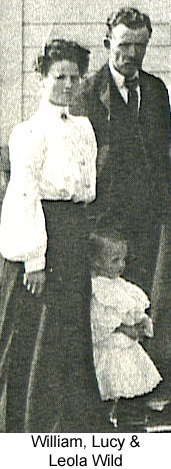 One
of the valuable farm properties of Linn county is that owned by William
K. Wild. It is situated in Brown township and comprises one hundred
acres of land naturally rich and arable. Moreover, the methods he has
employed in its cultivation have added to its productiveness and the
appearance of the farm is further enhanced by its excellent buildings,
in keeping with the most modern and progressive ideas concerning
agricultural development. Mr. Wild is a native of Grant county,
Wisconsin. He was born December 24, 1867, and is a son of David and
Mary Ann (Kay) Wild, who were natives of England and Wisconsin
respectively. The father was born in Cumberland county, England,
September 15, 1836, and was a son of Joseph and Jane (Southward) Wild,
who were also natives of that country, the former born in Lancashire
and the latter in Cumberland. They spent their entire lives in England,
Joseph Wild there following the blacksmith's trade. One
of the valuable farm properties of Linn county is that owned by William
K. Wild. It is situated in Brown township and comprises one hundred
acres of land naturally rich and arable. Moreover, the methods he has
employed in its cultivation have added to its productiveness and the
appearance of the farm is further enhanced by its excellent buildings,
in keeping with the most modern and progressive ideas concerning
agricultural development. Mr. Wild is a native of Grant county,
Wisconsin. He was born December 24, 1867, and is a son of David and
Mary Ann (Kay) Wild, who were natives of England and Wisconsin
respectively. The father was born in Cumberland county, England,
September 15, 1836, and was a son of Joseph and Jane (Southward) Wild,
who were also natives of that country, the former born in Lancashire
and the latter in Cumberland. They spent their entire lives in England,
Joseph Wild there following the blacksmith's trade.
David Wild acquired his education in private schools and had
reached the age of thirteen years and five months when he was
apprenticed to the joiner's and wagon maker's trade, devoting his time
thereto until his emigration to the United States in 1858. On leaving
England it was his intention to go to Australia but on landing at New
York he was persuaded by the companion with whom he had worked in the
shops in England and who had a brother in Minnesota, to visit in that
state. They crossed the ocean on a sailing vessel, being forty-two days
on the voyage. The ship on which they made the trip from Prairie du
Chien, Wisconsin, to St. Paul carried the first message ever sent
across the Atlantic cable - a message of congratulation from Queen
Victoria to President Buchanan. They remained in Minnesota for only
about a month and then came west in search of work. On reaching
Dubuque, Iowa, David Wild secured employment at making doors and there
remained for about a year and a half, when he went to Georgetown, Grant
county, Wisconsin, where he opened a wagon shop. He served as a bridge
builder in the Civil war, after which he returned to Wisconsin, there
remaining until 1868, when he came to Iowa, settling on a farm in Brown
township, Linn county. His first purchase made him owner of eighty
acres, to which he afterward added another eighty-acre tract. For many
years he carried on general agricultural pursuits but in the spring of
1910 retired from active life and removed to Springville, where he is
now living. His wife died August 31, 1909. David Wild is a member of
the Episcopal church, gives his political allegiance to the democratic
party and is identified with William Carbee Post, G. A. R. Unto Mr. and
Mrs. David Wild were born thirteen children, as follows: Mrs. James
Pearson; Mrs. George E. Calvert, who is a resident of Jones county;
William K. of this review; Mrs. Vinton Smith, living in Cedar Rapids;
John, a resident of Marion; Charles S., who makes his home in Maine
township, Linn county; Alice, the wife of W. S. Cooper, of Edmunds
county, South Dakota; Rosa M., who is the wife of Wilbur Hakes and
resides in Marion; George and Fred, who operate the home farm on
section 6; Edward, an agriculturist of Jones county; Leona, a teacher
of Brown township; and Bertha, at home.
 William
K. Wild spent his youthful days in his parents' home. He was only about
a year old when brought from Wisconsin to Iowa and in the public
schools of the state he acquired his education. He remained at home
until his twenty-first year, when he went to Jones county and opened up
a general store at the small town of Cass, there conducting business
for five years. He then sold out and went to Delaware county,
purchasing a store in the town of Delaware, of which he remained
proprietor for two years. At the end of that time the building and
store were destroyed by fire and retiring from the mercantile field, he
came to Linn county, and purchased his present valuable farm of one
hundred acres in Brown township, upon which he has since carried on
general agricultural pursuits. His is an excellent property and in its
splendid appearance gives every indication of the careful supervision
and practical methods of the owner. William
K. Wild spent his youthful days in his parents' home. He was only about
a year old when brought from Wisconsin to Iowa and in the public
schools of the state he acquired his education. He remained at home
until his twenty-first year, when he went to Jones county and opened up
a general store at the small town of Cass, there conducting business
for five years. He then sold out and went to Delaware county,
purchasing a store in the town of Delaware, of which he remained
proprietor for two years. At the end of that time the building and
store were destroyed by fire and retiring from the mercantile field, he
came to Linn county, and purchased his present valuable farm of one
hundred acres in Brown township, upon which he has since carried on
general agricultural pursuits. His is an excellent property and in its
splendid appearance gives every indication of the careful supervision
and practical methods of the owner.
Mr. Wild was married on the 15th of June, 1898, to Miss Lucy
Day, of Anamosa, Iowa, a daughter of Simon Day, a prominent farmer
living near Anamosa. By this marriage two children have been born,
Bessie Leola and Opal Izetta. Mr. Wild is a member of Elpidon Lodge,
No. 241, K. P., and Springville Camp, No 3346, M. W. A. He has followed
in his father's political footsteps and gives his support to the
democracy. In the various things which he has undertaken he has
manifested unfaltering diligence and determination and has made
continuous progress, so that he is now one of the substantial citizens
of Brown township. His strongly developed traits of character are such
as have won him the highest regard and he has many friends in the
county.
Source: History of Linn County Iowa, From Its Earliest
Settlement to the Present Time, Vol. II, Chicago, The Pioneer
Publishing Company, 1911, p. 767-8.
Transcribed by: Terry Carlson
Col. John Q. Wilds
John
Q. Wilds was born at Fort Littleton, Pennsylvania, October 24th, 1822.
His ancestors, who were among the earliest settlers in the Keystone
State, belonged to the old line whig school of politics. When seven
years of age, death deprived him of the counsel and advice of a kind
and indulgent father. This threw him, comparatively, upon his own
resources, and he was tossed like a foot-ball upon the world’s great
highway, to battle with he stern realities of life. Although unable to
obtain a classic education, he secured for himself by perseverance and
hard study, a general knowledge of the common English branches, which,
combined with sound judgement and good business tact, was the talisman
of his success in after life. His earlier years were spent as a tiller
of the soil – one of the most honorable and independent avocations in
which man can embark. From 1850 to 1854, he was engaged successfully in
mercantile pursuits at his native town. But he soon became restless.
“No pent-up Utica” like the crowed cities of the east afforded charms
for him longer, and bidding farewell to home, friends, and the scenes
of his childhood, he turned his gaze westward. Iowa was his choice
among all the north-western states, and he soon found himself within
her borders, without the remotest thought that future events would at
one day lead him to add lustre to her reputation, and defend her honor
and integrity with his heart’s blood. Settling in the thriving and
pleasant village of Mount Vernon in Linn County, he engaged in selling
goods and speculation in lands, and as every honest man will do, he met
with almost unbounded success.
It was at Mount Vernon where the
writer of this sketch became acquainted with John Q. Wilds. When a
small boy I was employed in his store, and it was then I learned to
love and respect him for his kind manner and gentle disposition, the
recollection of which can never be eradicated from my memory. During
the Kansas troubles, I well remember the interest he manifested in
behalf of the cause of freedom and humanity, and it was with the
greatest difficulty that his friends dissuaded him from rushing to the
arena of combat. For a time he was engaged in merchandizing with
Messrs. Waln and Griffin – two estimable gentleman at Mount Vernon;
after which, if I remember rightly, he was alone in business again. In
1857, he was united in marriage to Miss Rowena Camp, a young lady of
excellent qualities of head and heart, who, with their two pledges of
married life, passed away to the land of shadows in the fall of 1864.
The war came and John Q. Wilds’ patriotic impulses would not permit him
to stand aloof when the liberties of his country were in peril.
Sometime during the summer of 1861, he was elected captain of company
“A,” 13th Iowa Infantry – the regiment being commanded by the lamented
Crocker. Serving with this regiment a short time, he resigned to accept
the Lieut. Colonelcy of the 24th Iowa Infantry, which was raised under
the President’s proclamation of July 2nd, 1862, calling for three
hundred thousand volunteers. This regiment was sometimes called “The
Iowa Temperance Regiment” or “Methodist Regiment,” because of the
strict piety of so many of its members, and their supreme contempt for
the god Becchus. The regiment rendezvoused near Muscatine with the 35th
at Camp Strong. When medical inspection took place it was ascertained
that the regiment was more than full, and the excess was transferred to
the 35th. On the 20th of October, Lieut. Col. Wilds proceeded with the
regiment to Helena, Arkansas, where they remained during the winter,
going out occasionally on expeditions in search of the enemy. On the
morning of January 11th, 1863, the regiment embarked with Gen. Gorman’s
White River Expedition, enduring great trials and hardships. After the
return to Helena a general re-organization took place preparatory to
active spring operations, and the 24th was attached to the 13th corps.
Having been subjected to the skillful instructions of Lieut. Col.
Wilds, it added materially to the efficiency and discipline of the
corps. Lieut. Col. Wilds took part in the battle of Port Hudson; after
which, himself and command did much “marching, skirmishing, and
foraging.” In the battle of Champion Hills, which was fought on the
16th of May, and undoubtedly one of the hardest-fought battles of the
war, the officers and men composing the 24th, displayed a bravery and
gallantry unexcelled – losing one hundred and ninety-five killed,
wounded and captured, out of the four hundred and seventeen who entered
the contest. In the siege of Vicksburg – no less famous than was that
of Antwerp – the regiment acquitted itself nobly. About this time the
Colonel of the regiment – E.C. Byam – an excellent gentleman and fine
officer, “was compelled to leave the service by reason of ill health.”
Lieut. Col. Wilds then “took faithful conscientious charge,” and led
his command through the Red River Expedition and battle of Sabine Cross
Roads. However, in the conflict only a portion of the regiment was
engaged. After this battle, which occurred on the 8th of April 1864,
the regiment went by sea to Fortress Monroe, thence by steamer to
Washington City, thence to Shenandoah Valley, where it joined Gen.
Sheridan and fought the battle of Winchester. In this contest, Col.
Wilds, Major Wright, and in fact, all the officers and men fought with
the most undaunted courage. Among many others who were wounded, was
Adj. Daniel W. Camp of Mount Vernon, brother-in-law to Col. Wilds. The
next engagement in which the regiment was slight, although it was in
the thickest of the fight, with Col. Wilds cheering lustily at its
head. On the 19th of October the battle of Cedar Creek was fought, and
in which the subject of this sketch was mortally wounded. He was
removed immediately to Winchester, where after much suffering, death
closed his earthly career on the 18th of November 1864. Speaking of the
part taken by the 28th Iowa in the battle of Cedar Creek, Mr. Ingersoll
in his well written “Iowa and the Rebellion,” says: “In this engagement
there were two regiments besides the 28th from Iowa, - the 22d, Col.
Harvey Graham, and the 24th Col. John Q. Wilds. There were prominent in
the action and lost many officers and men kors du combat. Col. Wilds on
this field received the wound from which he soon afterward died. It is
in melancholy fact that soon after his death, his wife and children
died of disease, so that his name can only live in the grateful
recollection of his countrymen, who can never forget his long career of
usefulness and gallantry.” His regiment, by which he was almost
idolized, held a meeting at Camp Russell, Va., on the 22nd day of Nov.
1864, to take action concerning his death. Lieut. Col. Wright having
been called upon to preside, T.L. Smith was elected Secretary. Brief
and appropriate remarks were made by several persons, while many shed
bitter tears of anguish over the loss of their fallen chief. The
following resolutions were presented and unanimously adopted:
Resolved,
That the death of Col. Wilds has filled our hearts with grief; has torn
asunder associations of respect and affection, which, extending back
through the period of our organization has only deepened and
strengthened as time has passed. In Col. Wilds, we remember an officer
who was always at his post, and ever filled his position with true
soldierly dignity. During the existence of the regiment he has had but
few days of relief from duty, and in the severest of its campaigns, and
in the bloodiest of its engagements, his skill and courage have
inspired its action. In addition to these qualities of the soldier, we
remember especially those kindly feelings, that warm personally
interest and sympathy which he extended to every member of his command.
Truly unselfish and delicately sensible to the trials and hardships of
the soldier, he has left in the hearts of us all, indelible impressions
which will ever cluster gently around the memory of our commander and
friend.
Resolved, That we accord to the relatives and friends of
the deceased our deepest sympathy in their loss, and the sorrow it must
cause; while at the same time we would remind them that the death of
our mutual friend was one of honor; that he gave his life, as he had
his service, to his country for the preservation of those institutions
and that government through whose instrumentality our freedom and
happiness can alone be secured.
John Q. Wilds was considerably
above the medium height – tall and wiry in form – very much after the
Lincoln style of man. Possessing a keen scrutinizing eye, he never
failed to observe all that was transpiring around him, and being an
excellent judge of human nature he was enabled to form accurate
opinions of those with whom he was thrown in contact. Frank and free in
his manner, yet reserved on all proper occasions when discretion
demanded reticence. He was one of those men who would never knowingly
wrong his fellow man, and his generosity led him to sympathize with all
those in misfortune. In truth, he was beloved and respected by all who
were fortunate enough to make his acquaintance. No man was more
thoroughly imbued with the spirit of patriotism than he. But he has
gone! A brave and noble spirit has passed away to the land of the
Hearafter. A record has been left behind pure and spotless, untarnished
by any dishonorable act during his eventful career. In order to aid in
the preservation of the fairest and noblest fabric of constitutional
freedom ever erected by man, he has lain down his life with that same
sublime heroism which renders man almost immortal in every age and
clime where human liberty is revered.
As the bird to its sheltering nest.
When the storm on the hills is abroad,
So his spirit has flown from this world of unrest,
To repose on the bosom of God.
By James P.C. Poulton
Washington City, May 10th, 1866
Source: State Historical Society of Iowa The Annals of Iowa Volume 1866 Number 3 (1866) pps. 702-706
Transcribed by Misty Christner
MARVIN WILSEY
Marvin Wilsey,
who has won a gratifying measure of prosperity as a tiller of the soil
and a raiser of stock, is the proprietor of Orchard Grove Farm, a tract
of land comprising two hundred and four acres on section 14, Washington
township. His birth occurred in New York on the 9th of January. 1842,
his parents being Otis and Louisa (Coffin) Wilsey, who were likewise
natives of the Empire state. The father, whose natal year was 1811,
there passed away in 1891, and the mother was called to her final rest
in l896. Unto them were born eight children, five of whom are yet
living.
Marvin Wilsey remained at home until he had attained his
majority and is indebted to the common schools for the educational
advantages he enjoyed in his youthful years. After leaving the parental
roof he worked in the lumber camps for a year and on the expiration of
that period came to Linn county, Iowa, purchasing forty acres of his
present home farm in 1865. As the years passed by and his financial
resources increased, owing to his untiring industry and capable
management, he extended the boundaries of the place by additional
purchase until it now embraces two hundred and four acres of rich and
productive land. He has placed many substantial improvements on the
property, which in its neat and thrifty appearance indicates the
supervision of a practical and progressive owner. In addition to the
cultivation of cereals he makes a specialty of raising shorthorn cattle
and Poland China hogs and his undertakings in both connections have
proved profitable.
On the 7th of February, 1865, Mr. Wilsey was united in
marriage to Miss Calphurnia V. Rowley, who was born in New York, July
27, 1843, her parents being William and Jane (Barton) Rowley, natives
of New York. They came to Linn county in May, 1865, and here the father
passed away, his demise occurring in 1899. The mother still survives
and now makes her home with our subject. Mrs. Wilsey, who was one of a
family of four daughters, is a high school graduate and taught school
in early womanhood. By her marriage she became the mother of seven
children, as follows: Nathaniel P., who was called to his final rest
November 13, 1889; Lucretia C., the wife of William Servison, of
Washington township; George W., who resides in Canada; Otis, living in
Soldier, Idaho; Laura, the wife of Oliver Reynolds, of Soldier, Idaho;
and Silas R. and Herrick, both at home.
In his political views Mr. Wilsey is a democrat and is now
ably discharging the duties devolving upon him in the capacity of
township trustee. He likewise held the office of assessor at one time.
Fraternally he is identified with the Masons, belonging to the lodge
and chapter at Center Point and having filled all of the chairs in the
lodge. Both he and his wife are consistent and faithful members of the
Methodist Episcopal church, doing all in their power to promote its
growth and extend its influence. They have continuously resided in
Washington township during the past forty-five years and their lives
have been such as to commend them to the confidence and esteem of all
with whom they have been associated.
Source: History of Linn County Iowa, From Its Earliest
Settlement to the Present Time, Vol. II, Chicago, The Pioneer
Publishing Company, 1911, p. 37-8.
Contributed by: Terry Carlson
Amos Witter, M.D.
 In
the early days there was probably no one in Linn County more widely or
favorably known than Dr. Witter, who was not only a successful
physician of Mt. Vernon, but also took a very prominent and influential
part in public affairs. He was born in Phelps, Ontario county, New
York, March 24, 1807, a son of Alfred and Deborah (Dunwell) Witter,
natives of Connecticut. The father was born at Preston, in 1779 and
during his youth removed to Peru, Massachusetts, and later to Ontario
county, New York, where he died in 1864. He became a Master Mason in
1801, and later took the Royal Arch degrees at Painesville, Ohio. In
the early days there was probably no one in Linn County more widely or
favorably known than Dr. Witter, who was not only a successful
physician of Mt. Vernon, but also took a very prominent and influential
part in public affairs. He was born in Phelps, Ontario county, New
York, March 24, 1807, a son of Alfred and Deborah (Dunwell) Witter,
natives of Connecticut. The father was born at Preston, in 1779 and
during his youth removed to Peru, Massachusetts, and later to Ontario
county, New York, where he died in 1864. He became a Master Mason in
1801, and later took the Royal Arch degrees at Painesville, Ohio.
Dr. Witter was the third in order of birth in a family of
thirteen children, and was ten years of age when he accompanied his
parents on their removal to Lake county, Ohio. Although he was taken
from the advantages of a more settled community to the wilds of Ohio,
this did not prove a misfortune as it tended to develop the latent
genius of a high-minded and noble boy. He lived with his parents at
Kirtland until fifteen years of age, when he commenced the study of
medicine with Dr. Chapman, of Middlebury, Ohio, having already obtained
a good common-school education. Although his educational privileges
were meager, he made the best use of the good books to which he
obtained access, and became competent to teach, by which pursuit he
secured the money with which to pay his way through college. He
attended a course of lectures at the medical college in Cincinnati, and
was considered the best scholar in the class. After graduating from
that institution he also received a diploma from the medical board of
Cleveland, Ohio, and began the practice of his profession at Attica,
Seneca county, Ohio.
In the meantime Dr. Witter had married, and on account of
the failing health of his wife he removed to Seville, Ohio, where she
died, and he afterward located at Chagrin Falls, that state, where he
made his home until going to Belvidere, Illinois. He built up quite a
good practice at that place. In 1849 he started for California with his
family in a wagon drawn by three yoke of oxen, and they carried their
cooking utensils and provisions with them, but on their arrival in
Clinton county, Iowa, he traded his team for a tract of land near the
Wapsipinicon river, where he remained one year, and then sold his
property and removed to Tipton, Cedar county, where he was engaged in
the practice of his profession with good success for four years. In
1854 he became a resident of Dixon, Scott county, where he lived for
three years, and then in order to give his children better educational
advantages he came to Mt. Vernon, where he continued to make his home
throughout the remainder of his life.
 On
the 24th of January, 1830, Dr. Witter was united in marriage with Miss
Mary Anne Burr, who was born in Harrisville, Medina county, Ohio, May
18, 1814 and died October 31, 1843. The only child born of this union
died in infancy. The Doctor was again married, August 28, 1844, his
second union being with Miss Jerusha Nelson, who was born in Suffield,
Hartford county, Connecticut, March 13 1815 and was a daughter of
Philip and Rowena (Stiles) Nelson, natives of Connecticut and
Massachusetts, respectively. Five children were born to them. Mary A.
B., born July 9, 1845, is the principal of the high school at Denver,
Colorado. Emma A., born November 10, 1846, was married on the 29th of
December, 1871, to Thomas B. Hutson, who was born in Henry county,
Indiana, February 6, 1846. For nine years after their marriage he was
engaged in farming and well drilling at Union, after which they removed
to Dexter, Iowa. On account of failing health, Mr. Hutson then started
west, but died at Burr Oak, Kansas, March 13, 1882. He was in the one
hundred days’ service during the Civil war, enlisting May 18, 1864, in
Company C, Forty-fourth Iowa Volunteer Infantry, and being discharged
September 15, 1864. Mr. and Mrs. Hutson had five children: Edna, born
May 23, 1873, died July 29, 1874; Daisy M., born August 28, 1887, at
home; Thomas E., born March 24, 1880, a soldier in the regular army,
being a member of Company I, Tenth United States Infantry, is now with
his command in the Philippines; and Josephine L., born January 29,
1882, at home. Franklin Eberle, born April 7, 1848, married Frances E.
Foster, who owns and conducts a large cattle ranch at Roscoe, South
Dakota. They are the parents of six children, as follows: Mary, born
June 18, 1877; Marvin, born July 29, 1879, died November 14, 1900;
Ruth, born May 30, 1881; Eva, born September 25, 1885; Clara, born June
20, 1887; and Florence, born January 5, 1894. Clara, born January 11,
1851, is the widow of William Hauser, and lives on the old home farm
near Mt. Vernon. She became the mother of three children: Amos W., born
November 12, 1874; Irvin, April 23, 1879; and Carl, November 4, 1880.
Amos Nelson died at the age of five months. On
the 24th of January, 1830, Dr. Witter was united in marriage with Miss
Mary Anne Burr, who was born in Harrisville, Medina county, Ohio, May
18, 1814 and died October 31, 1843. The only child born of this union
died in infancy. The Doctor was again married, August 28, 1844, his
second union being with Miss Jerusha Nelson, who was born in Suffield,
Hartford county, Connecticut, March 13 1815 and was a daughter of
Philip and Rowena (Stiles) Nelson, natives of Connecticut and
Massachusetts, respectively. Five children were born to them. Mary A.
B., born July 9, 1845, is the principal of the high school at Denver,
Colorado. Emma A., born November 10, 1846, was married on the 29th of
December, 1871, to Thomas B. Hutson, who was born in Henry county,
Indiana, February 6, 1846. For nine years after their marriage he was
engaged in farming and well drilling at Union, after which they removed
to Dexter, Iowa. On account of failing health, Mr. Hutson then started
west, but died at Burr Oak, Kansas, March 13, 1882. He was in the one
hundred days’ service during the Civil war, enlisting May 18, 1864, in
Company C, Forty-fourth Iowa Volunteer Infantry, and being discharged
September 15, 1864. Mr. and Mrs. Hutson had five children: Edna, born
May 23, 1873, died July 29, 1874; Daisy M., born August 28, 1887, at
home; Thomas E., born March 24, 1880, a soldier in the regular army,
being a member of Company I, Tenth United States Infantry, is now with
his command in the Philippines; and Josephine L., born January 29,
1882, at home. Franklin Eberle, born April 7, 1848, married Frances E.
Foster, who owns and conducts a large cattle ranch at Roscoe, South
Dakota. They are the parents of six children, as follows: Mary, born
June 18, 1877; Marvin, born July 29, 1879, died November 14, 1900;
Ruth, born May 30, 1881; Eva, born September 25, 1885; Clara, born June
20, 1887; and Florence, born January 5, 1894. Clara, born January 11,
1851, is the widow of William Hauser, and lives on the old home farm
near Mt. Vernon. She became the mother of three children: Amos W., born
November 12, 1874; Irvin, April 23, 1879; and Carl, November 4, 1880.
Amos Nelson died at the age of five months.
When the Civil war broke out Dr. Witter offered his services
to his country, and was at once commissioned surgeon of the famous
Seventh Iowa Infantry. Through the campaign in Missouri he passed many
trying ordeals, and especially distinguished himself at the battle of
Belmont. He was brave and fearless on the field of battle and was
always found at his post of duty, caring for the sick and wounded
wherever they might be. Shortly after entering the army he was
appointed post surgeon, and a little later was made brigade surgeon of
Louman’s brigade in General Wallace’s division. His brigade was in the
thickest of the fight during the battles of Forts Henry and Donelson,
and nowhere was greater courage displayed than in the conduct of Dr.
Witter, although he had arisen from a sick bed to take part in the
engagements. He was on duty day and night for a period of four days,
during which time he had no rest, and becoming completely exhausted he
was sent home on furlough, where he died ten days later, on the 13th of
March, 1862. After her husband’s death Mrs. Witter took charge of and
managed the farm of eighty acres, and paid off the mortgage thereon. In
her efforts to provide for her family she displayed a heroism equaled
by few. She was a well-read woman, who was not only familiar with the
best literature, but was also well posted on agricultural topics, and
met with success in the operation of her farm, to which she added
seventy-two acres. She also sent her children to college, and was
entirely devoted to her family. She died May 30, 1893, mourned by all
who knew her as a lady of many noble traits of character who endeared
herself to those with whom she came in contact.
During his residence in this state, Dr. Witter became
prominently identified with political affairs, and in 1851 was elected
to the legislature while a resident of Tipton. Four years later he was
chosen to represent Scott county in the general assembly, and during
that term he presented a bill for the suppression of the liquor
traffic, as he had also done in the previous session. In 1860 he was
elected to represent Linn county, and served two extra sessions besides
the three regular sessions. He was a natural orator and stumped the
county, district and state on various causes which he represented. He
was a strong abolitionist and a temperance man who labored earnestly
for the principles which he believed would aid the cause of justice and
right. He was also greatly interested in educational matters, and gave
his support to any enterprise calculated to advance the moral,
intellectual or material welfare of his community. For a time he served
as trustee of the State University at Iowa City. The character of Dr.
Witter presented the happy combination of great refinement of mind and
the practical adaptation of the qualities which enabled him to carry on
his life pursuits with dignity and honor and at the same time made him
financially successful and a favorite with the common people. He was a
model man, who was ever willing to lend a helping hand to those in need
or distress, and will be affectionately remembered in the community
long after those who knew him most intimately have passed away. In
religious belief he was a member of the Methodist church.
Source: The Biographical Record of Linn County Iowa,
Illustrated, Chicago: The S. J. Clarke Publishing Company, 1901, pages
852-8.
JAMES W. WOLMUTT
James W.
Wolmutt, who devotes his time and energies to the operation of a fine
farm of one hundred and sixty-one acres in Buffalo township, has spent
his entire life within the borders of Linn county, his birth having
here occurred on the 4th of February, 1867. His parents, James and Mary
(Benish) Wolmutt, were both natives of Bohemia and emigrated to the
United States in 1853, locating in Cedar Rapids, Iowa. They worked out
until their marriage, which was celebrated in 1865, and then located
upon a tract of rented land in this county, the father operating the
same until 1881. In that year he purchased a farm of one hundred and
twenty acres in Buffalo township and gave his attention to its
cultivation and improvement until he passed away in 1885. His widow and
children operated the place until 1905, since which time Mrs. Wolmutt
has lived retired on the old homestead with her youngest daughter. She
is well known and highly esteemed throughout the county which has
remained her home for more than a half century.
James W. Wolmutt, who was one of a family of ten children,
remained under the parental roof until he had attained his majority and
then started out in life on his own account, operating rented land for
ten years. On the expiration of that period he bought a tract of
sixty-three acres in Buffalo township and at the end of two years
traded the property for a farm of one hundred and twenty acres in the
same township. He has since extended the boundaries of the place to
include one hundred and sixty-one acres, constituting one of the
attractive and finely improved farms of Buffalo township. The well
tilled fields annually yield golden harvests in return for the care and
labor which is bestowed upon them by the owner.
On the 9th of December, 1897, Mr. Wolmutt was united in
marriage to Miss Gertrude Reed, a daughter of Levi and Martha
(Williams) Reed, both of whom were natives of New York. On leaving the
Empire state the father took up his abode in Illinois and in 1857 came
to Linn county, Iowa. It was on the 19th of August, 1858, that he
wedded Miss Martha Williams, who had come to this state in 1855. Levi
Reed was first engaged in the operation of rented land and afterward
purchased a farm. After several years, however, he disposed of the
property and again cultivated rented land. He put aside the active work
of the fields in 1876 and spent the remainder of his life in honorable
retirement at Prairieburg. His demise occurred on the 17th of February,
1904, and his widow makes her home with our subject, Mrs, Wolmutt, who
was one of a family of eight children, taught school for some time
prior to her marriage. She has become the mother of four children,
namely: Otto and Roy, both at home; Cleone, who died on the 9th of
June, 1906; and Leone.
In politics Mr. Wolmutt has ever been a stanch republican and his
fellow townsmen, recognizing his worth and ability, have called him to
public office. For two years he served as constable of his township,
while for four years he capably discharged the duties devolving upon
him in the capacity of trustee. Having resided in Linn county from his
birth to the present time, he has gained a circle of friends that is
almost coextensive with the circle of his acquaintances, and his
salient characteristics are such as have gained him the confidence and
good will of all with whom he has been associated.
Source: 1911 Linn Co., IA History Vol. 2 pgs. 49-50
Submitted by Becky Teubner
|
|