GEORGE DALE (From 1901 Linn Co. history)
As a brick and stone mason George Dale has been identified with the
building interests of Cedar Rapids for over thirty-five years, and for
half a century he has been a resident of Iowa. His home is now at No.
1323 First avenue, Cedar Rapids. He was born on the 28th of December,
1835, in Union county, Pennsylvania, of which state his parents, Philip
and Mary Ann (Wiley) Dale, were also natives. About 1839 the family
removed to Ohio, and were among the first settlers of Crawford county,
where the father opened up a farm, making his home there for about
eight years. In 1846 he went to Kosciusko county, Indiana, where he
died the following winter. His wife survived him many years and reared
their family, and later married again. Her death also occurred in
Kosciusko county, Indiana
The subject of this sketch accompanied his parents on their
removal to Ohio and later to Indiana, and until seventeen years of age
made his home in Kosciusko county. He had but meager school privileges,
and is therefore mostly self-educated since arriving at mature years.
In 1852 he and his brother started overland for California, but on
arriving in Cedar county, Iowa, found their funds exhausted and
resolved to locate permanently in this state. During the winter of
1852-3 George Dale engaged in chopping cord wood, and the following
spring commenced driving a stage from Muscatine to Tipton and Iowa
City, which pursuit claimed his attention for one year. He next spent
one year and a half as an apprentice to the brick and stone mason's
trade with his brother at Tipton, and later in partnership they engaged
in contracting and building in different sections of the state for
several years.
In Cedar county, Iowa, November 12, 1857, Mr. Dale was united
in marriage with Miss Ruth Doty, daughter of James M. and Susan B.
(Anderson) Doty, her father being one of the early settlers of Linn
county, locating here in 1839. Mr. Doty laid out the town of Westport,
six miles down the river from Cedar Rapids, where he built a warehouse,
and with flatboats shipped produce down the river. After his death the
town site was abandoned. He was also the owner of one hundred and sixty
acres in what is now Brown's addition in the west side of Cedar Rapids.
He was born and reared near Middletown, Ohio, but died in Linn county ,
Iowa, January 17, 1846. After his death his wife and family returned to
Ohio, where Mrs. Dale was principally reared, but later they returned
to Linn county, Iowa. Mr. and Mrs. Dale have five children living:
Curtis David, who has been a contractor and brick mason of Denver,
Colorado, for the past ten years; Lizzie, at home; Edmund G., an
architect now with the Burlington, Cedar Rapids and Northern Railroad
as a draftsman in the engineers' department; John, who now has charge
of the plant of the electric light and power company of Oklahoma City;
and Robert Burdette, a student in the high school of Cedar Rapids. One
daughter, Nina, died at the age of four years.
After his marriage Mr. Dale located on the west side of Cedar
river in Cedar county, where he resided for a short time, and in the
spring of 1865 removed to Boone, where he carried on business for one
summer, but in the fall of that year came to Cedar Rapids, where he
worked at his trade for two or three years. Subsequently he was in the
employ of T. M. Sinclair & Company, meat packers, having charge of
their mason work for nine years, during which time most of the plant
was erected, and since that time has engaged in contracting and
building in this city. In addition to contracting he has held and
improved a large amount of property by buying lots, erecting houses
thereon, and then selling the same. In this way he has built about
fifteen residences in the city, and has added materially to the
prosperity of the city, as well as to its beauty. Although he began
life for himself without capital he has by his own industry,
persistency and good management accumulated a valuable property, and is
now one of the prosperous and substantial citizens of Cedar Rapids. In
his political affiliations he is a stanch Republican, and for two years
he efficiently served as the second alderman from the fourth ward, but
has never cared for official honors, preferring to give his undivided
attention to his business interests. He and his wife attend the Baptist
church, and enjoy the respect and esteem of all who know them.
Source: Biographical Record of Linn County, Iowa. Chicago: The S. J. Clarke Publishing Company, 1901, p. 224-225.
Contributed by: Terry Carlson
GEORGE DALE (From 1911 Linn Co. history)
For thirty-seven years George Dale, who is now numbered among
the honored dead of Cedar Rapids, was a resident of this city and he
made a splendid record in business circles as a contractor and builder,
who was held in equally high esteem in social circles and indeed among
all who knew him for throughout his life he manifested the sterling
qualities that devolved upon him. He was born in Union county,
Pennsylvania, on the 28th of December, 1835, and was a son of Philip
and Marie Dale, of German and English descent. In the year 1837 the
parents left the Keystone state and removed to Ohio, where they lived
for some time after which they went to Indiana, where their last days
were passed.
George dale was a lad of only twelve yeas when left an orphan.
he continued to reside in Indiana until he attained the age of nineteen
years, and then walked from his home in that state to Cedar county,
Iowa, where he med his uncle and soon afterward secured a position as a
stage driver between Tipton and Davenport. This was in 1855 - a period
antedating the era of rapid railroads in this state. He continued to
drive stage for a year, after which he learned the mason's trade which
he followed during the greater part of his life. Soon becoming an
expert workman, he began contracting and building and erected many of
the substantial structures of this city and always enjoyed an extensive
patronage which he well merited. He was ever faithful to the terms of a
contract, prompt and reliable in its execution and by honorable
business methods won his success.
In 1857 Mr. Dale was married in Cedar county, Iowa, to Miss
Ruth Doty, a native of Butler County, Ohio, born in 1838. Her parents
were James M and Susan (Anderson) Doty, natives of New Jersey and Ohio
respectively. In the year 1839 her father arrived in Linn county, Iowa,
with his family and here resided until his death, which occurred in
1846. He and his brother Elias built a saw mill on Indian creek near
Bertram, and there the brother was killed. James Doty afterward sold
the mill in 1841 and laid out a town called Westport, which at the time
was larger than Cedar Rapids. He was closely associated with the
pioneer development and progress of the community and Linn county lost
a valuable citizen at his death. Following her husband' demise in 1846,
Mrs. Doty returned with her family to Indian and there resided until
1854, when she again came to Linn county. Subsequently she removed to
Cherokee county, where she lived until her death in 1908, passing away
at the remarkable old age of ninety-three years.
Mrs. Dale was one of a family of six children, all of whom are
yet living with the exception of one sister. After her marriage she
resided for a short time at Wilton Junction, and then they removed to
Boone county, Iowa, where they resided for a year. In 1865 they became
residents of Cedar Rapids and here Mr. Dale began contracting and
building as a brick mason, being thereafter identified with the
building operations and the substantial improvement of this city up to
the time of his death.
The marriage of Mr.. and Mrs. Dale was blessed with six
children: David C., now living in Golden, Colorado; Elizabeth, at home;
Edmond G., who is located in Topeka, Kansas; John Allen, now at Nichols
Junction, Iowa; Nina Laura, who has passed away; and Robert Burdette,
and instructor in mechanical engineering in the State University at
Iowa City. The death of the husband and father occurred March 20, 1902,
and was deeply regretted by many friends as well as his immediate
family. All who knew him respected and honored him for his sterling
worth, for his life was in harmony with high and honorable principles
of manhood and citizenship. He inspired the regard of his fellowmen
because he was considered just and reliable, adopting as his rule of
conduct those principles which in every land and clime awaken
confidence an regard. Mrs. Dale now owns an attractive home at 1323
First avenue. She is a member of the Baptist Church, her well spent
life being in harmony with its teachings.
Source: "History of Linn County Iowa - From its earliest
settlement to the present time" Volume II, The pioneer publishing
company 1911.
Contributed by: cralbrec@wi.rr.com
MAJOR JOHN DANCE
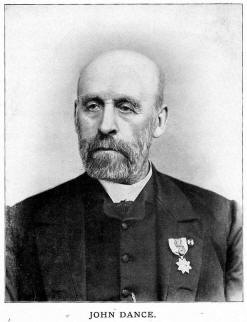 Although
born on the other side of the Atlantic, Major Dance is thoroughly
American in thought and feeling, and his patriotism and sincere love
for the stars and stripes was manifested by his distinguished service
in the Civil war. He is now an honored resident of Lisbon. A native of
England, he was born in Sapperton, Lincolnshire, November 24, 1823, and
is a son of Henry and Mary (Winslow) Dance, the former a native of
Barram, Rutlandshire, the latter of Somerby, Lincolnshire. She was a
grand niece of General Winslow of Revolutionary fame. Both parents died
in England. In their family were nine children, of whom our subject is
the eldest son, but all are now deceased with exception of the Major
and two sisters, both residents of England. Although
born on the other side of the Atlantic, Major Dance is thoroughly
American in thought and feeling, and his patriotism and sincere love
for the stars and stripes was manifested by his distinguished service
in the Civil war. He is now an honored resident of Lisbon. A native of
England, he was born in Sapperton, Lincolnshire, November 24, 1823, and
is a son of Henry and Mary (Winslow) Dance, the former a native of
Barram, Rutlandshire, the latter of Somerby, Lincolnshire. She was a
grand niece of General Winslow of Revolutionary fame. Both parents died
in England. In their family were nine children, of whom our subject is
the eldest son, but all are now deceased with exception of the Major
and two sisters, both residents of England.
Major Dance attended first the primary schools of his native
land, and later the Brasby school, and the Newton subscription school,
his education being completed at the age of twelve years. During the
following two years he assisted his father on the home farm, and then
commenced working for others as a farm hand, receiving fifteen dollars
the first year and twenty-five dollars the second, out of which he
saved enough to buy himself a good watch. He continued to work in that
way for ten years.
On the 28th of May, 1849, Major Dance was married at his
native place to Miss Phoebe Harriet Hodson, who was born at Handly
Green, Staffordshire, England, January 23, 1819, a daughter of Jonathan
and Ann (Moss) Hodson, also natives of England, the former born in
Mecklesfield, while the latter was reared in Handly. The father was
twice married and had fifteen children, none of whom came to America
with the exception of Mrs. Dance. Unto our subject and his wife were
born four children, namely: John Henry, born July 12, 1850, died the
same day. Mary E., born July 12, 1851, is the wife of Captain James
Treichler, of Orient, Adair county, Iowa. John Henry, born July 12,
1854, died August 7, 1860. Franklin W., born August 16, 1857, married
Lizzie E. Beese and lives on the old homestead in Linn township, Cedar
county, Iowa.
On the 4th of October, 1849, Major Dance and wife sailed from
Liverpool, England, on the Old Java, a sailing vessel, which was seven
weeks in crossing the Atlantic. On their arrival in New York they took
a steamboat up the Hudson river to Albany, thence by railroad to
Buffalo, and by the steamer Anthony Wayne to Cleveland. They then went
to Kenton, Hardin county, Ohio, and located ten miles west of that
place at Huntersville, where the Major operated a rented farm for a
time. On the 3rd of October, 1851, he and his wife started for Iowa in
a covered wagon, and reached Rochester on the 4th of November. There he
rented a part of the George Moore farm until the following spring, when
he entered eighty acres of wild land in Linn township, Cedar county,
which he placed under a high state of cultivation, and to which he
later added another eighty-acre tract. There he successfully engaged in
agricultural pursuits until three days after the presidential election
in November, 1888, when he removed to Lisbon, and has since lived a
retired life.
Major Dance’s farming operations, however, were interrupted by
his service in the Civil war. On the 24th of September, 1861,he
enlisted in Company K, Eleventh Iowa Volunteer Infantry, which was
mustered in at Davenport, and then sent to St. Louis, and later to
Jefferson City and California, Missouri, where they did patrol and
scout duty for a time. Returning to St. Louis, they next went down the
Mississippi and up the Ohio and Tennessee rivers to Pittsburg Landing,
where they joined General McClernand’s division March 28, 1862. In the
battle at that place on the 6th of April, Major Dance was wounded in
the right arm by an ounce rifle ball, and was taken to the surgeon’s
tent; but when he enemy began shelling the camp he and the other
wounded were placed on a steamboat and taken to Evansville, Indiana,
where he remained in the hospital for one month. He then received a
furlough and returned home, where he remained until September 30, 1863.
He was then made captain of Company K, Eight Iowa Calvary, and on the
17th of October was ordered to Louisville, Kentucky, where the regiment
remained twelve days. They were then ordered to march to Nashville, a
distance of two hundred and twenty miles, which they covered in twelve
days, and there guarded the Nashville Railroad, which was being built,
and patroled from that place to Waverly Landing, where the command went
into camp, remaining there until March, 13, 1864. They then marched
back to Nashville, where they were refitted with horses, arms and
accoutrements, and then proceeded to Cleveland, Tennessee. On the 1st
of May, 1864, the regiment was assigned to the First Brigade, First
Division, commanded by General E. M. McCook, and started on the
Atlantic campaign, being in almost constant action until the 27th of
July, when they started on the McCook or Stoneman raid in the rear of
Atlanta. They marched to Jonesboro, where they waited for the return of
General Stoneman, but as he failed to appear General McCook had to
fight his way out as best he could. They next went to Mariette,
Georgia, which place Major Dance and seventeen men reached in safety,
but four hundred of the command were either killed, wounded or captured
by the rebels. They remained in camp at that place for six weeks,
during which time four companies were collected under our subject’s
command. Later they took part in the battles of Pulaski,
Campbellsville, Florence, Columbus, Spring Hill, Franklin and
Nashville, and then followed General Hood to Waterloo, Alabama, where
they went into winter quarters, remaining there until March 22, 1865.
They next went on the Wilson raid. At Montgomery, Alabama, the command
was divided, and Major Dance’s brigade was detached and sent to
Tuscaloosa, that state, to decoy General Jackson and West Adams so that
General Wilson could succeed in his raid on Selma, Alabama. They found
themselves between two rebel brigades, but fought their way to
Tuscaloosa, where they destroyed a large amount of rebel property. They
then continued on their way to Macon, Georgia, and meeting General Hill
they captured his battery and three hundred men, besides destroying
other rebel property. It was while on this march that they received the
news of President Lincoln’s assassination. They reached Macon May 1,
1965, where they awaited the result of the armistice until the 13th of
August, when they were mustered out of service. Major Dance then
returned home with an army record of which he may be justly proud. He
has always held some office in the Grand Army of the Republic, and is
now an honored member of John A. Buck Post, No. 140, of Lisbon, and is
also a member of Crocker’s Brigade of Iowa. Since the time he was
wounded in battle the Major has always been a stanch supporter of the
Republican party.
Source: Biographical Record of Linn County, Iowa. Chicago: The S. J. Clarke Publishing Company, 1901, p. 120-124.
Contributed by: Carrie J. Robertson of Marion
Daniels Brothers:
Addison Daniels
Preston Daniels
Lowell Daniels
Lawson Daniels
There is probably no family in Cedar Rapids that has been more
prominently identified with its development along many lines than the
Daniels family, who have not only been actively connected with its
business prosperity but have borne an important part in beautifying and
upbuilding the city. There were four sons who came to Linn county at an
early day, their father being Otis Daniels, who was born in Medway,
Norfolk county, Massachusetts, April 14, 1786, and continued to make
his home in his native state throughout life, his time and energies
being devoted to agricultural pursuits. His ancestors, who were from
Wales, became residents of Massachusetts in colonial times, and the
family was well represented in the Revolutionary war. His father was
one of the early settlers of Medway. In early manhood Otis Daniels
wedded Jerusha Day, who was born in Wrentham, Massachusetts, May 13,
1790, and died in North Brookfield, that state, on the 14th of January,
1832. He also passed away at that place, October 24, 1843. They were
the parents of nine children, all of whom are now deceased.
Addison Daniels, the
oldest of the four brothers who became prominent business men of Linn
county, Iowa, was born in Medway, Massachusetts, November 13, 1813, and
was reared and educated in his native state, early becoming interested
in mercantile pursuits there. When a young man he contracted the
western fever and in the spring of 1840 started for St. Louis,
Missouri, with a stock of goods, preparatory to establishing a store
some place in the Mississippi valley. Having heard favorable reports of
the territory of Iowa, he decided to look over the country while
waiting for his goods to arrive and at Muscatine gained some knowledge
of Linn county. He then proceeded to Iowa City, where he hired a horse,
leaving his gold watch with the liveryman for security. Then on
horseback he proceeded to Marion and, being pleased with the prospects
of that place, contracted for the erection of a log building, and then
returned to St. Louis for his goods, which had arrived in the meantime.
It was in March, 1840, that he located here, opening the second store
established in the place, the first being Conducted by the firm of
Woodbridge & Thompson. The Daniels store was a rude log structure
on the west side of Market street. His judgment, however, proved
correct, and here he laid the foundation for a large fortune. As he
prospered in his undertakings he invested largely in real estate in
Marion and Cedar Rapids, having great faith in the future of these
cities. He was one of the nine original proprietors of Cedar Rapids and
is, therefore, deserving of honorable mention among its pioneers. He
was the first postmaster of Marion and also served as the first county
recorder of Linn county, entering upon the duties of that position in
1841. He was enterprising, sagacious and prudent in business
transactions, and energetic and active to a remarkable degree. He was
not addicted to tobacco or stimulants. and found the greatest
excitement in his business ventures, which were many. As long as the
name of Marion is remembered in history his name will endure, for it
was largely to his influence and enterprise that the city owes its
development. For forty-four years he was prominently identified with
the business development and substantial upbuilding of Linn county and
he was actively identified with railroad interests and many public
enterprises. In his mercantile enterprise he was associated with his
three brothers. The firm at Marion was known as A. Daniels &
Brothers. In business affairs he was prompt and reliable, was pleasant
in speech and manner and polite and cordial to all. After a useful and
well spent life he passed away at his home in Marion in June, 1883. See
additional biography from Rev. George R. Carroll's book. See additional biography from Rev. George R. Carroll's book.
ADDISON DANIELS
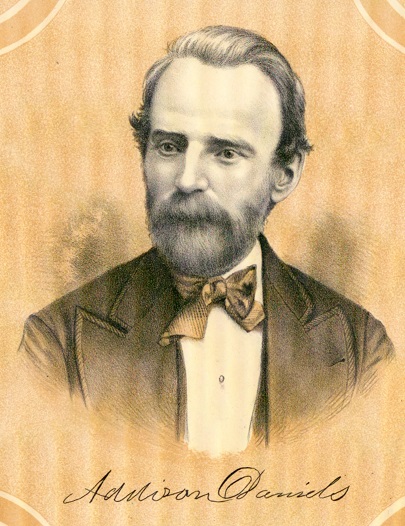 ADDISON DANIELS, deceased, was a prominent pioneer merchant of
Marion. He was born in Medway, Mass., Nov. 13, 1813, and his
early life was passed in his native State, engaged in mercantile
pursuits. He came to Iowa in March. 1810. and locating at Marion,
he opened the second store that was established at that place, the
first being by Woodbridge & Thompson. Mr. Daniels' storeroom
was a log structure, situated a few doors north of the northeast corner
of the square, and on the west side of Market street. There he
sold large stocks of general merchandise for a liberal profit, and laid
the foundation for the large fortune that he eventually
accumulated. The old log storeroom has been boarded over since
those days, and is at present occupied as a cigar factory. Mr.
Daniels had great faith in the development of the country, and also of
Cedar Rapids and Marion, and invested largely in real estate in those
places, which rapidly increased in value and brought him large
profits. He started a large general store at Cedar Rapids, and
also became extensively interested in milling.
ADDISON DANIELS, deceased, was a prominent pioneer merchant of
Marion. He was born in Medway, Mass., Nov. 13, 1813, and his
early life was passed in his native State, engaged in mercantile
pursuits. He came to Iowa in March. 1810. and locating at Marion,
he opened the second store that was established at that place, the
first being by Woodbridge & Thompson. Mr. Daniels' storeroom
was a log structure, situated a few doors north of the northeast corner
of the square, and on the west side of Market street. There he
sold large stocks of general merchandise for a liberal profit, and laid
the foundation for the large fortune that he eventually
accumulated. The old log storeroom has been boarded over since
those days, and is at present occupied as a cigar factory. Mr.
Daniels had great faith in the development of the country, and also of
Cedar Rapids and Marion, and invested largely in real estate in those
places, which rapidly increased in value and brought him large
profits. He started a large general store at Cedar Rapids, and
also became extensively interested in milling.
Mr.
Daniels was appointed the first Postmaster at Marion, and he was also
the first County Recorder of Linn County, holding that position in
1841. He was enterprising, sagacious and prudent in his business
transactions, and was energetic and active to a remarkable degree,
never consulting his ease and comfort to the detriment of his
business. He was not addicted to the use of tobacco or
stimulants, but lived a temperate life. His greatest excitement
was found in his business ventures, and they were many. At one
time, it is said, he owned a large share of the original plat of Cedar
Rapids. He improved and retained much of it, which formed a
material part of his wealth at the time of his death, and it is
estimated that his estate aggregated at that time upward of $200,000.
Mr.
Daniels saw the unbroken prairie transformed into beautiful farms, and
the wigwams of the savage give place to the industrious homes of an
intelligent and civilized yeomanry. By his death the connecting
link between the present citizenship and business of Marion and the
wild, unbroken savagery of the unknown past is broken. As long as
the name of Marion shall be remembered in history his name will
endure. He was never married, but so greatly did he endear
himself to his large circle of relatives that they readily accorded him
all the household loves and titles of three generations, and were bound
to him by ties as strong and endearing as domestic love can be.
His most distinctive characteristic was his love of business, and for a
period of forty-four years lie was prominently identified with the
business history of Linn County, its railway interests and public
enterprises. Probably no man played a more important part or
achieved greater results than he in that direction. He continued
in mercantile pursuits up to the time of his death, having his brother
Preston, and nephew, Addison L., as partners. In May, 1882, in
company with his brother Preston, and nephew, he organized the
banking-house of A. Daniels & Co., which is now one of the solid
monied institutions of the State, he died at his home in Marion, June
18, 1883.
Source: portrait and
biographical sketch (verbatim transcription): “Portrait and
Biographical Album of Linn County, Iowa”, 1887, pages 237 - 238,
portrait on page 236
Submitted by: Eric & Marcia Griggs
Preston Daniels, who was in business with his brother Addison,
was born in North Brookfield, Massachusetts, December 16, 1819, and
remained a resident of his native state until twenty-five years of age,
receiving in the meantime a good common-school education. It was in
1846 that he came to Marion, Iowa, and joined his brother in the
mercantile business, also establishing a branch house at Cedar Rapids
with his brothers Lowell and Lawson as partners. In May, 1883, in
company with A. L. Daniels, he organized a private bank under the name
of A. Daniels & Company, of which Preston became president. On the
12th of February, 1849, he was united in marriage to Miss Mary A. Keys,
a daughter of Amory and Lovisa (Cheadle) Keys, the former a native of
Massachusetts and the latter of Windsor, Ohio. Three children blessed
this union, a son and two daughters, namely: Addison L., manager of the
Central Park Fuel Company; Caroline, the wife of B. F. Mentzer, a
merchant of Marion; and Adeliza, who resides in Marion with her mother.
By his ballot Preston Daniels supported the men and measures of the
republican party, and, although he took no active part in political
affairs, was recognized as one of the most publicspirited and
enterprising citizens of the community. In religious faith he was a
Congregationalist and his earthly career was ended December 22, 1897,
at Marion. See additional biography from Rev. George R. Carroll's book.
See additional biography from Rev. George R. Carroll's book.
Lowell Daniels, the third brother of this quartet, was born in
North Brookfield, Massachusetts, on the 25th of February, 1822, and
passed away November 7, 1876. He was conspicuous among the early
merchants of Cedar Rapids, where he began business with his oldest
brother, Addison, in 1846, later being joined by Lawson, the firm
becoming famous under the title of L. Daniels & Company. They had
one of the first brick stores west of the Mississippi river. Lowell
Daniels was a born merchant, possessing a quick and discerning mind and
ready and willing hands to meet the many varied wants of his customers.
He also possessed great tact and diplomacy, combined with shrewd
sagacity, and to these characteristics may be attributed his success.
In 1854 he married Miss Harriette S. Weare, the youngest daughter of
John and Cynthia (Ashley) Weare, who is still living, being now one of
the oldest pioneers of Linn county. Mr. Daniels was a man of excellent
taste, a model of propriety and always maintained good order in both
his home and store. He was naturally an optimist, who brought sunshine
wherever he went, and was a great admirer of fine homes, always keeping
several of the best, which he treated as pets. His death was the
occasion of deep and widespread regret, both in business and social
circles and outside the family there were many who felt stricken with a
personal bereavement when he passed away. See additional biography from Rev. George R. Carroll's book.
Lawson Daniels, 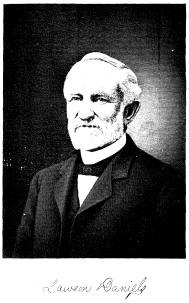 the
youngest of the four brothers, was one of the men who were most active
in inaugurating and shaping the business policy and commercial
development of Cedar Rapids. His demise, therefore, removed from the
city one whom it could ill afford to lose, a man whose strength of
purpose and undaunted energy found expression in the development of
business concerns whose magnitude made them not only a source of
individual profit but also an element in the city’s growth. Lawson
Daniels was also born in North Brookfield, on the 4th of October, 1827,
and was reared and educated in the east. At the age of fourteen years
he went to Springfield. Massachusetts, where he attended school for two
years and then obtained a position as clerk in the book store and
publishing house of G. & C. Merriam, remaining there two years. He
then returned to Brookfield, where he was employed as clerk in a
general store until the fall of 1848, which witnessed his arrival in
Iowa. He settled in Cedar Rapids, where he joined his brother Lowell in
a general store. This was the second mercantile firm in the city and
their place of business was located on what is now First avenue, where
the Masonic Temple stands. At that time the store was considered the
finest in Linn county. As time passed he became identified with other
business enterprises of importance and in 1883, in company with others,
organized the Cedar Rapids Savings Bank, of which he became one of the
heaviest stockholders, and up to the time of his death served as vice
president of the bank, he was also the first postmaster of the city,
serving in that office from 1849 to 1854. See additional biography from Rev. George R. Carroll's book. the
youngest of the four brothers, was one of the men who were most active
in inaugurating and shaping the business policy and commercial
development of Cedar Rapids. His demise, therefore, removed from the
city one whom it could ill afford to lose, a man whose strength of
purpose and undaunted energy found expression in the development of
business concerns whose magnitude made them not only a source of
individual profit but also an element in the city’s growth. Lawson
Daniels was also born in North Brookfield, on the 4th of October, 1827,
and was reared and educated in the east. At the age of fourteen years
he went to Springfield. Massachusetts, where he attended school for two
years and then obtained a position as clerk in the book store and
publishing house of G. & C. Merriam, remaining there two years. He
then returned to Brookfield, where he was employed as clerk in a
general store until the fall of 1848, which witnessed his arrival in
Iowa. He settled in Cedar Rapids, where he joined his brother Lowell in
a general store. This was the second mercantile firm in the city and
their place of business was located on what is now First avenue, where
the Masonic Temple stands. At that time the store was considered the
finest in Linn county. As time passed he became identified with other
business enterprises of importance and in 1883, in company with others,
organized the Cedar Rapids Savings Bank, of which he became one of the
heaviest stockholders, and up to the time of his death served as vice
president of the bank, he was also the first postmaster of the city,
serving in that office from 1849 to 1854. See additional biography from Rev. George R. Carroll's book.
On the 26th of July 1882, Mr. Daniels married his brother’s widow, Mrs.
Harriette S. Daniels, a daughter of John and Cynthia (Ashley) Weare,
natives of New Hampshire. (See Weare family record.) Her father was the
first justice of the peace of Cedar Rapids and the family was
prominently identified with the early development and upbuilding of the
city. Mrs. Daniels now resides at No. 627 Second avenue, but spends her
winters in California. She is an active member of the First
Presbyterian church of this city, to which her husband also belonged.
She is still a very active, bright and vivacious woman, with a great
fund of interesting reminiscences and has a delightful way of narrating
them. She was born in Derby Line, Vermont, August 1, 1829, and is today
the oldest surviving pioneer of Linn county. She was educated in the
celebrated Mount Holyoke Female Seminary at South Hadley,
Massachusetts, and, having enjoyed the advantages of the most
cultivated society since she completed her education and having
traveled extensively in her own country and abroad, her mind is well
stored with information and anecdotes which make her a welcome and
entertaining visitor and hostess. Her home is comfortable and
attractive within and without and there hospitality reigns supreme. It
was the lifelong scheme of Lowell and Lawson Daniels to present the
city with a park, which was accordingly done and is now known as the
beautiful Daniels Park, Mrs. Daniels recently adding five and a half
acres to its extent. This act makes the park complete and will long
perpetuate the name of Daniels as a synonym for noble deeds, actions
and thoughts.
Lawson Daniels was one of the stockholders in the company that
gave the city its water works and by taking stock he also assisted in
completing the Chicago, Iowa & Nebraska Railroad, now a part of the
Northwestern system, from Clinton to Cedar Rapids. He was secretary of
the Cedar Rapids Bridge Company and also secretary of the Cedar Rapids
Transportation Company during its existence. having firm faith in the
development and prosperity of his adopted state, he bought large tracts
of land in various counties throughout Iowa.
In his political views Mr. Daniels was a republican and up to
the time of his death was an ardent admirer of Theodore Roosevelt. He
was ever public-spirited and progressive, willing to give aid to any
object which he believed would advance the interests of his city and
county, and was a tireless worker in the interests of Coe College. He
was a heavy stockholder in the Oak Hill cemetery and served as
secretary of that company from its organization until in later life he
was made president of the same. The new entrance to the cemetery was
one of his pet schemes and it was carried out after his death by a
provision in his will and it now stands as a memorial to a long and
honorable career. He was one of the board of trustees of the Old Ladies
home, which he substantially aided a great many times. After a useful
and well spent life, he passed away on the 16th of June, 1906, leaving
a host of friends and acquaintances to mourn his loss. As one of the
pioneer business men of Cedar Rapids he bore a very prominent part in
its development and prosperity, and in his death the community realized
that it had lost a valued citizen.
In speaking of him Mr. Weare, the esteemed pioneer of Cedar
Rapids, said: "You don’t know how much good that brother-in-law of mine
does in the world. He doesn’t advertise his benevolences, but he gives
away much more money than you or most people know.’’ One of his closest
friends said in telling of his many acts of charity and helpfulness, of
his patience and self-restraint under unjust criticism: ‘‘After
twenty-four years of intimate association with Mr. Daniels I deeply
feel his death. His was a quiet nature but his friendship was enduring.
To his friends and all those in need he was generous, to all others
just. He was a man with no resentment in his make-up, uncomplaining,
with a belief that time evened all differences better than man can do
it. In all these years I never heard him unkindly criticize anyone, yet
in his reserve he was misunderstood. A close acquaintanceship with such
men is a privilege. There will be the sincerest sorrow over his death
in the hearts of those who knew him best.” See additional biography
from Rev. George R. Carroll's book.
Source: History of Linn County Iowa From Its Earliest Settlement to the Present Time, Vol. II, Chicago, 1911. Pages 60-65.
Contributed by: Terry Carlson
A. K. DAVIS
This gentleman, who is now spending the closing years of a long
and useful life free from business cares at his pleasant home in
Marion, was for over thirty years prominently identified with railroad
contracting, and was also engaged in mercantile pursuits in Marion for
a time, but is now living retired. He was born in York county, Maine,
on the 30th of July, 1829, and is a son of Thomas and Mary (Durgin)
Davis, both natives of Newfield, that state. Throughout life the father
followed the occupation of farming and continued to make his home in
the old Pine Tree state until called to his final rest in August, 1852,
at the age of fifty-two years and five months. He was widely and
favorably known and was a worthy representative of an old Maine family.
His father, Daniel Davis, served as a private in the Revolutionary war
for several years. The mother of our subject died at the home of her
son Thomas M. in Missouri in 1871, at the age of sixty-five years. Of
the ten children of the family our subject is second in order of birth.
The others who are still living are Thomas M., of Missouri; and Osborn,
of the state of Washington.
During his early life A. K. Davis pursued his studies in the
district schools of Maine, and aided in the work of the farm until
after reaching manhood. Coming west in 1856, he located on a farm in
Clinton county, Iowa, which he operated for several years. At the same
time he also engaged in railroad construction in Illinois, and later
rented his farm and gave his entire time and attention to the latter
business. He helped build the Chicago & Northwestern road; the
Sioux City road in 1867; and in 1870 built the first thirty miles of
the Sabula, Ackley & Dakota Railroad, now part of the St. Paul
system. Later in 1870 he built the first ten miles of the Iowa Midland,
from Clinton to Lyons; and a part of the road from Ottowa to Hedrick in
1882, employing many operatives. In 1887 he built a part of the branch
of the B. & M. road in Cheyenne and Rawlins counties, Kansas, but
since then has largely lived retired. In 1875 he removed to Marion and
has since made this place his home. He first engaged in the hardware
business, in which he continued for four years, when he sold out, and
has practically since lived retired.
Mr. Davis was married, in 1857, the lady of his choice being
Miss Octavia Challies, also a native of York county, Maine, and a
daughter of Sumner and Susan Challies, life-long residents of that
state. The father, who was a farmer and miller by occupation, died in
1871, aged sixty-four years, and the mother passed away in 1895, aged
ninety-seven. They had seven children, of whom only two now survive,
these being Mrs. Davis, and Albion, a resident of Maine. Mr. and Mrs.
Davis have two children: Arathusa S., at home; and Tulliar J., a sketch
of who appears on another page of this volume. He married Nellie
Elliott, of Mariona, and they have four children, Laverna, Esther,
Priscilla and T.J. Elliott.
Mr. Davis is a prominent Mason, having taken the thirty-second
degree, and his wife holds membership in the Congregational church. His
active business life shows him to have been a man of enterprise and
public spirit, and as a pioneer railroad builder he materially aided in
opening up a large amount of territory for civilization. After a
well-spent and useful life he can well afford to lay aside all business
cares and enjoy the fruits of former toil, surrounded by a loving
family and a large circle of friends and acquaintances who appreciate
his sterling worth.
Source: Biographical Record of Linn County, Iowa. Chicago: The S. J. Clarke Publishing Company, 1901, p. 65-66.
Contributed by: Carrie J. Robertson of Marion
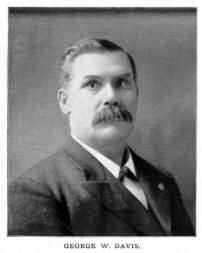
GEORGE W. DAVIS
Just across the line in Greenfield township, Jones county,
Iowa, in a quiet cottage behind an evergreen grove, we find the subject
of this biography, who is now living a retired life. He was born in
County Donegal, Ireland, December 23, 1843, a son of George and
Susannah (Fisher) Davis, natives of the same county, where they
continued to make their home until their emigration to America in
October, 1854. The family took passage at Londonderry, Ireland, on the
sailing vessel Creole, and were upon the water for twelve weeks, during
which time they encountered some terrific storms and it was supposed
that the vessel would go down.
 In
fact the vessel was reported lost. They lost two passengers, but the
others landed safely in Philadelphia. The Davis family settled in that
city, where the father of our subject died in April, 1856. In the fall
of the same year the mother and children came to Iowa and took up their
residence in Jones county, where she made her home for many years,
dying there in 1895, aged eighty-six years. Her remains were interred
in the Linn Grove cemetery. She was a devout member of the Presbyterian
church, to which her husband also belonged. In
fact the vessel was reported lost. They lost two passengers, but the
others landed safely in Philadelphia. The Davis family settled in that
city, where the father of our subject died in April, 1856. In the fall
of the same year the mother and children came to Iowa and took up their
residence in Jones county, where she made her home for many years,
dying there in 1895, aged eighty-six years. Her remains were interred
in the Linn Grove cemetery. She was a devout member of the Presbyterian
church, to which her husband also belonged.
Of the eleven children born to this worthy couple nine are
still living, namely: James, a retired farmer and veteran of the Civil
war, wedded Mary Ann Clark and resides in Mt. Vernon, Iowa; Thomas F.
married Jane Kepler, and is also a retired farmer of Mt. Vernon;
William married Ruth Fisher and is living retired in Cedar Rapids;
Martha was the wife of John McPherson, of Jones county, Iowa, who is
now deceased; Ruth is the wife of John W. Fink, of Lisbon; George W.,
our subject, is next in order of birth; Belle is the wife of Daniel
Connor, who lives near Mechanicsville, Cedar county, Iowa; Jane is the
wife of John F. Oldham, of Pierre, Oklahoma; and John A. wedded Jude
Chapman, who was born in the old court house at Marion, and resides in
Dorchester, Nebraska.
Mr. Davis of this review attended the national schools of
Ireland until the family came to the United States, and for one year
pursued his studies in the schools of Philadelphia. He then worked in a
cotton and woolen factory for the same length of time. When the family
came to Iowa in 1856, he found employment with Samuel Pfoutz, two and
one-half miles north of Lisbon, where he worked for his board and
clothes until the following spring, and then went to Linn Grove, where
he worked for Abner Lacock for forty dollars per year and his clothes,
remaining with him two years. The following year he was in the employ
of Ed Clark, and then returned to his former employer, for whom he
worked until the Civil war broke out.
In July, 1861, at the age of seventeen years, Mr. Davis
offered his services to the government, joining the boys in blue of
Company I, Second Iowa Veteran Volunteer Cavalry, under command of
Captain D. E. Coon, of Mason City, Iowa. Owing to the age of our
subject he was obliged to tell a patriotic fib in order to be mustered
in. After being mustered into the United States service at Davenport,
the regiment was sent to Benton Barrack, St. Louis, in December, 1861,
where they remained until February, 1862. While here they were on scout
duty and sixty of the members died from measles.
They were then ordered to Island No. 10, under command of General John
Pope, which they assisted in capturing and they were the first troops
on the Kentucky side of the river. There were captured six thousand
prisoners, one million five hundred thousand dollars worth of stores,
and the Second Iowa captured a rebel flag on which was the inscription
"Mississippi Devils, presented by the ladies." After the defeat at
Shiloh they were sent up the Tennessee river to Pittsburg Landing,
where they were placed under the command of General Hallick, who was
advancing on Corinth, and they made the charge on the rebel army at
that place under General Hatch, May 9, 1862. The opposing force was so
great that they were driven back, but saved Paine's division.
They were the first troops to enter Corinth after the evacuation of the
city, May 19. At twelve o'clock one night that summer they made the
first cavalry raid of the war, under Colonel Washington L. Elliott, who
was a graduate of West Point and had served seventeen years in the
regular army. They also took part in the battle of Booneville, where
Sheridan with the Second Iowa and Second Michigan Cavalry defeated
eight thousand rebels, and was there made brigadier general. After this
engagement the Second Iowa Cavalry moved back to Rienzi, and our
subject was detailed as orderly for General Sheridan, having previously
been messenger boy for General Elliott and General Granger, being
chosen out of twenty-seven hundred men in his command, which was quite
an honor. Three months later he rejoined his command, and on the 5th of
September they broke camp at Rienza and returned to Corinth, where
General Rosecrans was then in command.
They next went to Payton's Mills in pursuit of General Faulkner, where
they participated in the battle at that place, and then moved back to
Iuka to support the Fifth Iowa Infantry. There they stood to horse all
night in a drenching rain. About midnight General Rosecrans called a
council of brigade commanders, and gave the command to move at
daybreak, the infantry with bayonets fixed and the cavalry with drawn
sabers, not a shot to be fired. It was expected that General Grant
would support them. The rebels retreated during the night, and the
Union troops followed them twenty miles and made a stand at two o'clock
next day. After this engagement Generals Price and Van Dorn united
their armies and moved north.
The result was the two days battle at Corinth on October 1 and 2, 1862,
and the rebels were defeated. Here Mr. Davis was wounded in the ankle
and sent to the Keokuk, Iowa, hospital, where he remained thirty days.
Deserting the hospital, he went down the Mississippi river on a steamer
to Vicksburg, and rejoined his regiment, which formed Grant's advance
guard on Vicksburg at Grant Junction. They were next in an engagement
with Colonel Faulkner at Holly Springs, November 29, and captured
thirty horses and sixty men. On the 2d of December they crossed the
Tallahatchee river and moved on Springdale, Mississippi, and from there
went to Water Valley, where they lost three men and six horses. They
next proceeded to Oxford, Mississippi.
After landing at Ponnetock they went back to Holly Springs, and
retreated northward December 22, as Colonel Van Dorn had burned the
supplies. The brigade to which our subject belonged returned to
Coffeeville, participating in the battle there, after which they
commenced destroying the Mississippi Central Railroad, being the rear
guard of General Grant's army. They retreated as far as the
Tallahatchee river and then went into winter quarters at La Grange,
Tennessee, where they built log houses. In the spring of 1863 they went
to Waterford, Mississippi, where they were surrounded by the Texas
Legion, but were rescued by citizens who notified the brigade and they
escaped back to La Grange. In March our subject's regiment marched
three hundred and sixty miles, and were placed under the command of
General B. H. Grierson, who started to cut the railroad communication
of the rebels.
On the 21st of April they went to Palalto, and from there to Columbus.
Mr. Davis' regiment returned to La Grange, where they remained all
summer. On the 5th of June they went on a raid down the Mississippi
river and nine days later marched into Panola, Mississippi, where they
burned fifteen million dollars worth of property. On the 1st of July
they were ordered to Jackson, and after taking part in the battle at
that place returned to La Grange. Later they captured six locomotives
and twenty-five cars at Granada, which town the rebels surrendered
August 27, 1863. Two months were then spent in camp at Memphis,
Tennessee, and in November went to Colliersville, taking part in an
engagement at that place, defeating the rebels under General Gorge.
They went to Oxford, Mississippi, December 4, and subsequently took
part in the battle at Moscow, where their commander, General Hatch, was
shot through the right lung. Here the rebels numbered five thousand and
the Union forces only thirteen hundred. Marching back to La Grange, a
distance of about thirty-five miles they broke camp January 1, 1864,
and two days later reached Memphis, where they slept that night on the
frozen ground. They remained there until February 5, when they joined
General W. S. Smith at Germantown, Tennessee, and started to join
General Sherman's command at Meridian, it being their intention to form
a large cavalry force to march through the Confederacy, but they were
met and defeated by the rebels. they were soon in a part of the
Confederacy which was still rich with provisions.
At West Point, Mississippi, February 21, General Smith ordered a
retreat to Okolona, and the fighting became severe, the rebels having
eight thousand soldiers and the Union troops numbering only four
thousand. As Mr. Davis' time had expired he re-enlisted in the same
regiment at Germantown, being determined to see the end of the war. He
then returned to Davenport by way of St. Louis and was given a
thirty-day furlough. He rejoined his command May 15 at Davenport, Iowa,
and returned to St. Louis, where they received new equipment, whence
they went to Memphis. They were then armed with the Spencer seven-shot
carbines. They took part in the battle of Tupalo under General A. J.
Smith and Brigadier-General B. H. Grierson and several skirmishes, and
then returned to Memphis, where they remained until the 2nd of August,
and from there went to Grand Junction and Waterford to rebuild the
railroad to Oxford, Mississippi.
After their return to Memphis they were ordered to join General Sherman
on his march to the sea. At Clifton, however, the order was
countermanded, and they were ordered to report to General Thomas, who
was sent to repel General Hood, and joined his forces near Columbia,
Tennessee. General Hood advanced on Nashville with forty-five thousand
infantry, fifteen thousand cavalry and ninety pieces of artillery,
while the Union forces had only four thousand cavalry in his front, and
a small army of infantry and artillery. Our subject's regiment on its
retreat to Nashville took part in the engagements at Campbellville,
Linnville, Mt. Carmel, Duck River, Shelbyville, Pike, and Franklin, on
the 29th of November, when the rebels lost five generals and six
thousand troops.
The cavalry forces retreated across the Cumberland river to Edgefield,
where the mercury was ten degrees below zero, with no wood. On December
2 they re-crossed to Nashville, and for three days camped in two feet
of mud. On the morning of December 15 the battle of Nashville was
opened and our subject's regiment captured a fort which Hood had left
fifteen minutes previous with the instructions to hold the fort at all
hazards, and later captured another fort. On the 25th of December
General Spaulding of the Twelfth Tennessee, called for two hundred
volunteers to follow Hood and harass the rear of his army, and Mr.
Davis was among the number to respond and go with Major Horton, of the
Second Iowa Cavalry.
On the 1st of January 1865, the regiment was ordered to Huntsville, and
later to Eastport, Mississippi. It was very cold fording the rivers and
the troops suffered severely. They went into winter quarters at
Gravelly Springs, Alabama. On the 11th of April they received news of
General Lee's surrender, and five days later came the sad news of
President Lincoln's assassination. Mr. Davis was finally mustered out
September 17, 1865, at Selma, Alabama, and returned to Davenport, where
he was honorably discharged October 9, 1865. During the entire time he
was in the service he was never reprimanded by an officer, and was
offered a commission in a colored regiment at Memphis, Tennessee, but
declined, as he did not want to leave his comrades.
In October, of the same year, we again find him a resident of
Linn county, where he worked by the month one year. In 1867 he bought
the farm which he now occupies, it being at that time, however, an
eighty acre tract of unbroken prairie land in Greenfield township,
Jones county, which he at once proceeded to place under cultivation. He
has added to his landed possessions until he now has three hundred and
sixty five acres of very valuable and productive land, on which he has
erected two good houses and three immense barns, together with other
outbuildings. He raises Durham cattle and Poland China hogs, and also a
high grade of horses. He not only feeds all of the grain raised on his
own land to his stock, but one year was forced to buy ten thousand
bushels for the same purpose.
At Anamosa, Iowa, September 16, 1868, Mr. Davis married Miss
Anis Jones, who was born in Indiana September 2, 1850, and came to Iowa
in 1863 with her parents, Thomas and Jane Jones, who were reared and
married in Lawrence county, Indiana. The family settled in Jones
county, Iowa, where Mr. Jones died in May, 1880, his remains being
interred at Walnut Grove. He had nine children, namely: Elmira, wife of
Riley Jones, of Wall Lake, Calhoun county, Iowa; Mary, a resident of
Doniphan, Nebraska, who first married Joseph McDowell and second
Ephraim Jones; Henry, who married Jane Barnett, now deceased, and
resides in Montezuma, Iowa; Cenith, wife of Amerson Johnson, of
Jefferson, Iowa; Anis, wife of our subject; Manford, who married Martha
De Walt and lives at Grand Junction, Iowa; Millie, wife of John Young,
of Laporte City, Iowa; Amy, who died at the age of twenty-four years;
and Della, wife of Frank Griffith, of Grand Junction, Iowa.
Unto Mr. and Mrs. Davis were born six children, as follows:
(1) Thomas U., born September 13, 1869, assists his father in the
operation of the home farm. (2) Harry E., born November 14, 1870, in
Jones county, was educated in the district schools, and now conducts a
part of the old homestead farm. He was married, at Climax, Michigan,
December 19, 1900 to Hattie E. Card, who was born at that place
December 13, 1871, and is the oldest in a family of four children, her
parents being Daniel W. and Rose (Eldred) Card, natives of New York.
Harry E. and his wife attend the Reformed church of Lisbon. (3) Lottie
Jane, born September 20, 1872, is the wife of Philip Mohn, a farmer of
Greenfield township, Jones county, Iowa, and they have two children,
Ora R. and Conrad D. (4) George, born December 20, 1874, married Mina
Weston and lives in Greenfield township, Jones county, (5) Ira L., born
November 3, 1876, is also a resident of that township on a part of our
subject's farm. He married Ida Abel and they have one son, Harold. (6)
Ora May, born August 29, 1883, is at home with her father. The mother
of these children, who was a most estimable woman, died September 4,
1898, and was laid to rest in the Lisbon cemetery.
Religiously Mr. Davis holds membership in the Reformed church,
and socially is a member of John A. Buck Post, No. 140, G.A.R., of
which he is past commander, and Franklin Lodge, Iowa Legion of Honor,
of Lisbon. As a Republican he has always taken an active part in local
politics; has filled a number of township offices, including that of
road supervisor and president of the school board; while serving in
that capacity he raised the first flag on the school house that was
ever raised in Greenfield township, and has been the candidate of his
party for the legislature.
He was one of the charter members of the Farmers Institute at Lisbon
and served as president for two terms. He also bought the first toll of
barbed wire that was ever sold in Lisbon, for which he paid seventeen
cents per pound. He is one of the most prominent and influential men of
his community, and is held in the highest esteem by all who knew him.
At the reunion of the Grand Army of the Republic at Washington, D. C.,
in 1892, he commanded a platoon as the parade passed down Pennsylvania
avenue, in which marched three congressmen.
Source: Biographical Record of Linn County, Iowa. Chicago: The S. J. Clarke Publishing Company, 1901, p. 382-389.
JAMES DAVIS
Among those who valiantly fought for the preservation of the
Union during the dark days of the Civil war were many who were only
adopted sons of America. To this class belonged James Davis, who is now
living a retire life in Mt. Vernon. He was born in County Donegal,
Ireland, August 12, 1829, his parents being George and Susannah
(Fisher) Davis, natives of the same county, who emigrated to America in
October, 1854. They landed in Philadelphia, and made their home in that
city until the father’s death in the spring of 1856. The following fall
the mother and children removed to Jones county, Iowa, where she died
in 1894. Both parents were faithful members of the Presbyterian church.
Of the eleven children born to them nine are still living, namely:
James, of this review, is the oldest; Thomas F. married Jane Kepler and
is a retired farmer of Mt. Vernon; William married Ruth Fisher and is a
retired farmer of Cedar Rapids; Martha is the wife of John McPherson,
of Jones county, Iowa; Ruth is the wife of John Fink, of Lisbon; George
W. is represented on another page of this volume; Belle is the wife of
Daniel Connor, who lives near Mechanicsville, Cedar county, Iowa; Jane
is the wife of John Oldham, of Pierre, Oklahoma; and John A., born in
the old court house at Marion, wedded Jude Chapman and resides in
Dorchester, Nebraska.
James Davis received but a limited education in the public schools of
his native land. In 1848, in company with his brother Thomas, he came
to the United States, and spent some time in Philadelphia, where he
engaged in teaming. He then came to Mt. Vernon, Iowa, in 1852, and was
engaged in farming upon rented land until the Civil war broke out.
Mr. Davis enlisted in Company F, Thirteenth Iowa Volunteer Infantry,
and after being mustered in at Davenport went to Jefferson Barracks,
St. Louis, and from there to Cairo. With his command he next went up
the Tennessee river by steamboat and landed at Hamburg Landing. They
took part in a number of skirmishes and the battle of Corinth under
General Halleck. They were next in the engagement at Jacinto, and then
marched back to Corinth, and later went into winter quarters at La
Grange. In the spring they were with General Grant in Mississippi,
proceeding as far as Abbeyville, and then returned to La Grange, where
they remained four months. They next joined little Phil Sheridan, and
took part in the battles of Bonneville and Johnstown. On the 11th of
October, 1864, Mr. Davis received an honorable discharge and returned
to Mt. Vernon and resumed farming. After his marriage he operated a
farm belonging to his wife, three miles west of Mt. Vernon, and
remained there for twenty years. On selling the place at the end of
that time he removed to Mt. Vernon, and has since lived retired on
account of ill health.
At Springville, Iowa, January 23, 1868, Mr. Davis was united in
marriage with Miss Mary Ann Clark, who was born in Loraine county,
Ohio, December 7, 1837. Her parents, Oliver and Electa (Wilcox) Clark,
were born, reared and married in Connecticut. Later they spent some
time in Ohio, and in 1840 came to Iowa, locating on a farm in Franklin
township, Linn county, two miles west of Mt. Vernon, making their home
there until death. The father died January 13, 1871, and the mother
passed away January 13, 1881. They had twelve children, namely: Julia
married Elisha Williams, and both died in Franklin township; Julius was
killed in the war of the Rebellion; Oliver, deceased, married Barbara
Brice, who lives on a farm in Franklin township; Jane married Chauncey
Neal of Linn township, and both are now deceased; Luther, deceased,
married Mildred Wilhoit, a resident of Franklin township; Elizabeth
married Thomas Maclehenny, and both are now dead; Huldah married Dennis
Tryon of California, and both are now deceased; David wedded Mary Ann
Boxwell, and resides in Linn Grove; Edwin married Margaret Jordan and
resides near Marion; on died in infancy; Mary Ann is the wife of our
subject; and Caroline is the wife of Jacob Easterly, of Kossuth county,
Iowa.
Politically Mr. Davis is identified with the Republican party, and
socially is a member of W. C. Dimmick Post, G. A. R., of Mt. Vernon. He
and his wife attend the Presbyterian church, and are people of the
highest respectability who have a large circle of friends and
acquaintances in Linn county.
Source: The Biographical Record of Linn County Iowa,
Illustrated, Chicago: The S. J. Clarke Publishing Company, 1901, pages
92-4.
Submitted by: Carrie J. Robertson of Marion
TUILLAR J. DAVIS
In proportion to its population, Linn county has within its
borders as large a number of prominent business and professional men as
any county in the state, and among the representative business men none
stand higher in the estimation of the public than the subject of this
sketch, who is the manager and proprietor of the T. J. Davis Lumber
Co., and vice president of the Farmers and Merchants State Bank of
Marion. He was born in York county, Main, July 26, 1864, and is the son
of Albion K. and Octavia (Challis) Davis, both of whom were natives of
the same state.
In his native state Albion K. Davis was first engaged in
agricultural pursuits, and later was manager of a saw and grist mill,
at which occupation he continued until his removal to Clinton county,
Iowa, where he purchased a farm and for five years was engaged in
farming. Selling his farm, he then returned to Maine, and as is
generally the case with those who once coming west and partaking of its
spirit, he was not content, and so he came again to Iowa, and for ten
years was engaged as a railroad contractor, his first work being in the
construction of the Sabula, Ackley & Dakota Railroad, which was
then principally owned and controlled by Alexander Mitchell and S. S.
Merrill, afterwards long connected with the Chicago, Milwaukee &
St. Paul Railroad, and who succeeded in building up that system.
The portion constructed by Mr. Davis is now known as the Savannah and
Marion division of the Chicago, Milwaukee & St. Paul Railroad.
After the close of his ten years in railroad building, he went into the
mercantile business at Marion, Iowa, in which line he continued for
many years. He is now, at the age of seventy-two years, living a
retired life in the city of Marion, and with his wife and daughter,
Artheusa, attend the Congregational church, of which they are each
members. Fraternally he is a thirty-second-degree Mason. During almost
his entire life he has been a hard working and industrious man, and it
was not until he was seventy-one years old did he lay aside business
cares.
The subject of this sketch was the youngest of two children,
and in the public schools of Marion received his education. Leaving
school at the age of sixteen years, he went into the First National
Bank of the late R. D. Stevens, in the spring of 1881, and there
remained six years, serving in various capacities, and getting a
thorough knowledge of the banking business. From the bank he went into
the grocery business with W. J. Collar, and under the firm name of
Collar & Davis the business was continued for two years.
Selling his interest in the grocery store, Mr. Davis then embarked in
the lumber trade as a member of the Elliott & Davis Lumber Co., his
partner being Johnston Elliott, his father-in-law. That business
relation was continued for five years when Mr. Elliott sold his
interest and Mr. Fulkerson became a partner, and the business was
continued under the firm name of the Davis & Fulkerson Lumber Co.
Three years later Mr. Fulkerson retired and Mr. Davis became sole
proprietor, the business being continued under the name of the T. J.
Davis Lumber Co.
In 1894, the Farmers and Merchants Bank was organized, Mr.
Davis being one of the principal men in its formation. For two years he
gave much of his time to the active management of the bank, and is now
serving as vice-president. He is the largest stockholder in the bank,
which is one of the best in Linn County. At the time the bank was
organized a Building and Loan Association was also incorporated, and
for the first two years Mr. Davis was its president, since which time
he has served as treasurer. He is also treasurer of the local telephone
company, which has been in existence for three years.
On the 14th of December, 1887, Mr. Davis was united in
marriage with Miss Nellie Elliott, a native of New York, and daughter
of Johnston Elliott, Jr., and by this union four children have been
born - Laverna E., aged twelve, Esther P., aged ten, Priscilla M., aged
seven, and J. Elliott, aged one. The parents are members of the
Congregational church, in which Mr. Davis has served at different times
in various official positions.
Fraternally Mr. Davis is a Mason of high degree, and is now
serving as worshipful master of the blue lodge, of Marion. He has at
different times served his lodge as delegate to the Grand Lodge of the
state and is now a member of the Finance Committee, of the Grand Lodge.
Since its organization in 1894, he has been secretary of the Masonic
Temple Association. He is also a member of the Independent Order of Odd
Fellows.
Mr. Davis is a very busy man, enterprising in the highest
degree. While his lumber interests requires the greater part of his
time he gives much attention to the real estate business in which he is
quite extensively interested, and also to the banking business. As
administrator of the estate of Johnston Elliott, Jr., he has had much
labor to perform. No man in Marion has done more for its business and
commercial interests in the past twenty years than Mr. Davis. No
enterprise calculated to advance the interest of his adopted city and
county but finds in him a steadfast friend. His pluck, push and energy
has brought him to the front in business circles, and his friends are
numerous throughout Linn and adjoining counties.
Source: Biographical Record of Linn County, Iowa. Chicago: The S. J. Clarke Publishing Company, 1901, p. 533-534.
BURT R. DAY
Burt R. Day, general manager for the Cook-Lawrence Company,
wholesale dealers in crockery, glassware, etc., of Cedar Rapids, was
born at Oak Creek, now South Milwaukee, Wisconsin, August 26, 1866. His
father was E. T. B. Day, a native of Massachusetts, born in 1835. He
married Miss Laura E. Packard, a native of Milwaukee, Wisconsin, who is
now residing in Janesville, that state.
Burt R. Day pursued his education in the country schools and
public schools at Appleton, Wisconsin, and at an early age began work
on the farm but after three years decided to learn a trade and selected
that of book-binding, beginning at Waterloo, Iowa. After six months,
however, he gave up the idea and turned his attention to merchandising,
entering the employ of the Cook-Lawrence Company of Cedar Rapids, Iowa,
in 1884, as errand boy at five dollars per week. He has continuously
remained with this house to the present time, covering a period of
twenty-six years, his fidelity and industry winning him promotion as
the years have passed until he now has entire management of what is one
of the largest wholesale crockery and glassware houses in Iowa. No
further comment need be made upon his ability and his fidelity for
those facts are self-evident. He has watched every opportunity pointing
to success and with untiring effort and devotion has labored to promote
the interests of the house which he represents, at the same time
winning for himself a creditable name and reputation in the business
circles of the city.
In 1890 Mr. Day was married to Miss Carrie L. Laphin of Cedar
Rapids and unto them have been born five children: Margaret, Pauline,
Helen A., Burton H., Dorothy E., all attending school; and John D. Mr.
Day votes with the republican party where national issues are involved
but is allied with the independent movement at city elections, a
movement which is one of the hopeful signs of the times, indicating
that thinking men will no longer submit to party rule when the question
is only one of the capability of the candidate to perform the business
of
the office. He holds membership in the Presbyterian church but attends
the services of the Episcopal church with his wife who is a member
thereof. Fraternally he is connected with the Elks, the Woodmen of the
World and Commercial Club, and he possesses that quality of good
fellowship which makes for popularity.
Source: History of Linn County Iowa, From Its Earliest
Settlement to the Present Time, Vol. II, Chicago, The Pioneer
Publishing Company, 1911, p. 27.
Submitted by: Terry Carlson
THOMAS J. DECK
Thomas Jefferson Deck, a well-to-do citizen of Linn township,
who owns and operates a good farm of eighty acres on section 36, was
born in Northampton county, Pennsylvania, March 30, 1835, and is a son
of Daniel and Catherine (Stam) Deck. The father was a native of the
same county, and a tailor by trade, following that occupation
throughout his active business life. He was a prosperous and
progressive man of his day, and a consistent member of the Reformed
church. He died at his home in Pennsylvania in 1854, at the age of
fifty-two years. Subsequently his widow came to Iowa and made her home
with our subject until her death, which occurred in March, 1896, when
she had reached the advanced age of eighty-five years. Her remains were
interred at Lisbon. She, too, was a faithful member of the Reformed
church, and a most estimable lady. There were only two children in the
family, our subject being the older. His sister, Louisa, still resides
on the old homestead in Northampton county, Pennsylvania, having
purchased it from the estate. The paternal grandfather of our subject,
George Deck, was a native of Pennsylvania, where he lived and died.
When the Mexican war broke out he was a young man, and feeling that the
country needed his services he enlisted and served all through the war.
Thomas Deck was reared and educated in the county of his
nativity, and remained there until coming to Iowa in 1869, when he took
up his residence in Jones county. There he engaged in farming upon
rented land for one year, but in 1870 came to Linn county and purchased
forty acres in Franklin township, where he lived for seven years. On
the expiration of that period he sold the place and purchased his
present farm on section 36, Linn township, it being his home ever
since. He has made nearly all of the improvements upon the place,
including the erection of a large and pleasant residence, which is
surrounded by a well-kept lawn and enclosed by a beautiful cedar hedge.
Religiously he is a member of the Reformed church, and politically is
identified with the Democracy.
In September, 1861, was celebrated the marriage of Mr. Deck
and Miss Mary Reese, who was also born in Northampton county,
Pennsylvania, and was a daughter of Joseph and Sarah (Heller) Reese.
Her parents spent their entire lives as farming people in that county,
and both died at an advanced age. In their family were six children,
three of whom are now living. Mrs. Deck died on the home farm in Linn
township June 28, 1897, and was laid to rest in the Lisbon cemetery.
She was an earnest member of the Reformed church, a devoted wife and
loving mother. Unto Mr. and Mrs. Deck were born five children, namely:
(1) Lilly is the wife of Elmer Daubeumier, of Mt. Vernon, and they have
two children, Oleto and Earl. (2) Ida is the wife of Phillip Kafer, a
farmer of Springville, Linn county, and they have one child, Edith. (3)
Sarah is the wife of Grant Kafer, a brother of Philip, and a farmer of
Franklin township. (4) Victor is aiding his father in the operation of
the home farm. (5) Mabel is also at home.
Source: The Biographical Record of Linn County Iowa,
Illustrated, Chicago: The S. J. Clarke Publishing Company, 1901, pages
369-370.
Submitted by: Terry Carlson
AMOS DIEHL
It was in the fall of 1867 that Amos Diehl came to Cedar
Rapids, and with its interests he has since been closely identified. In
business affairs he has prospered during his residence here and is now
able to spend his last years in east and comfort, free from the worries
and trials of business life.
Mr. Diehl was born near Gettysburg, Pennsylvania, January 25,
1825, and is a son of George and Elizabeth (Mickley) Diehl, also
natives of that state and worth representatives of two of its prominent
old families. The father, who was a soldier of the war of 1812, lived
to the ripe old age of seventy-eight years, and both he and his wife
died in Pennsylvania. In their family were six sons but only two are
now living, these being Amos, our subject and Hamilton, who married and
reared a family, and is now living retired on the west side of Cedar
Rapids.
In early life Amos Diehl was given the advantages of a common
school education. He grew to manhood on the home farm and worked at the
carpenter’s trade. When the Civil war broke out he enlisted in 1862 for
nine months in Company D, One Hundred and Sixty-fifth Pennsylvania
Volunteer Infantry, which was assigned to the Army of the Potomas, and
he participated in the battle of Weldon Railroad, Virginia; a skirmish
at Black Water; and the siege of Suffolk. He had several narrow escapes
but fortunately was never wounded and when his term of enlistment
expired was honorably discharged at Gettysburg, in July 1863, soon
after the battle at that place.
After the war Mr. Diehl engaged in the manufacture of lumber
in Adams county, Pennsylvania, where he carried on the milling business
for eight or ten years. Disposing of his interests in that tate he came
west in the fall of 1867 and located in Cedar Rapids, where he was
engaged in teaming for several years. He purchased property on the west
side and built thereon a house which he subsequently sold. Later he
improved other property, and in this way did much toward the
development of the city, always taking an active interest in its
prosperity. By his ballot he supports the men and measures of the
Republican party, but has never cared for official honors. He is well
known and is held in the highest esteem by his fellow townsmen.
Source: The Biographical Record of Linn County Iowa,
Illustrated, Chicago: The S. J. Clarke Publishing Company, 1901, pages
115-116.
Submitted by: Carrie J. Robertson of Marion
DOTY BROTHERS
James Doty
Elias Doty
Daniel C. Doty
A note:
The biography information presented below is a
compilation of a couple of separate descriptions from the 1911 Linn
County History. There are some discrepancies found between the two;
namely that one record lists the name of the Father as Daniel C. Doty,
and another lists one of the sons as Daniel C. Another record found on
page 35 of the 1911 history lists one of the earliest settlers as
"Daniel J. Doty." What does seem likely is that there were three sons
named James, Elias & Daniel Jr., born to Daniel Doty, Sr. who
traveled to Iowa, but remained a resident of Ohio. His sons became very
early pioneers of Iowa: Daniel, Jr. involved in steam boating and
residing in Davenport; James & Elias residing in Linn County and
manufacturing pottery. At this time [2004] there is still a small, very
worn marker for James & Elias Doty found in the little pioneer
Craig Cemetery a few miles west of the town of Mt. Vernon. Terry
Carlson
From the 1911 History, p. 145:
We have pretty good
evidence that later during the summer [1836] came Daniel C. Doty, his
two sons, James, and Elias, and nephew, Jacob Crane, as far as Bertram
and viewed the country expecting to locate when land was thrown open
for settlement. Mr. Doty was born in Essex county, New Jersey, in 1764,
had early drifted west to Cincinnati, and by boat had come down the
Ohio and up the Mississippi, landing at what is now Muscatine. His
children were born in Ohio. They followed the Cedar River until they
struck what became later Linn county to locate claims. There were no
settlers here, and they found no people with whom to converse, but
figured that here would be a good location to get cheap land when this
land was opened for settlement. They returned to Ohio for their
families, expecting to return the following spring, but they did not,
in fact, return for three years on account of the financial depression.
Israel Mitchell staked out he town first called Westport in July, 1838,
which town was later called Newark, named in honor of Newark, New
Jersey, where the family originally came from. Here Elias Doty, Jr. ,
was born in October, 1841. Elias Doty, Sr., erected the first sawmill
on Big creek in 1841, in the erection of which mill he was killed in
the raising of the timbers. Daniel Doty, Sr., had the following sons,
to-whit: James, Elias, John, and Daniel, all young men who early
drifted west. Daniel C. Doty, the father of these sons, was never a
resident of this county, but simply came here to find homes for his
children. He died in Ohio in 1849; the widow died in Ohio in 1863 at
the advanced age of ninety-eight.
James Doty, born in 1809, was the first real pottery maker in
Iowa. He had learned the trade in Ohio. This crude pottery building was
standing on the old homestead up to within a few years ago. At the time
of his death, January 17, 1847, he had over three hundred jars, jugs,
crocks, etc., ready for delivery. In this early day there was a great
demand for such merchandise as it was something every farmer had to
have, and it could only be obtained in a few places and at high prices
on account of the transportation.
From the 1911 history, page 482:
Mrs. Ruth A. Dale, of
Cedar Rapids, sister of Elias Doty, now [1911] living near Bertram,
where the family settled in the early days - 1839 - has distinct
recollections of pioneer life in the county. She states that Aretas
Crane and Daniel C. Doty, brothers of Elias and James M. Doty, the
pioneers, settled at Ft. Stevens, now Davenport, in 1836 or 1837 - 1836
she believes is the correct date. Daniel Doty and his son, J. M. Doty,
and his son-in-law, Aretas Crane, passed over the ground on which Cedar
Rapids now stands in 1837. This being the fact, it is evident that
these people were the first white men to look upon the present site of
the city, with a view to finding a permanent settlement for themselves.
They, however, after looking over the ground concluded that the site
afterwards known as Westport, and somewhat later as Newark, was the
preferable location. They returned to their home at Middletown, Butler
county, Ohio, and arranged their affairs. James M. Doty and Elias Doty,
sons of Daniel Doty, returned to the county in 1839 and took up a claim
at Westport. There they started what was without question, the first
manufacturing plant within the limits of the county, was probably in
1840. Later the same year Elias Doty began the erection of the first
saw-mill in the county.
The Dotys were induced to come to Iowa through the fact that
their brother, Daniel C. Doty, was at the time engaged in steam boating
on the Mississippi, his headquarters being at Davenport.
In this connection the following extracts from a letter
written by Elias and J. M. Doty to their parents and dated May 2, 1841
are of interest:
"I have my mill frame up, that is, the lower frame. The upper
farm is almost ready to raise. The millwright work can be done in about
six weeks from the time we raise the frame. I have commenced the race.
I have three hundred feet in length of a race and two hundred feet dam.
As soon as I get water to it, it will be ready to run.
"There are hard times enough here for anybody. There is
nothing that will bring cash that I know of. For my part I am hard run
to live. I would like to have some money. It has not come yet.
"I cannot say that we are all well, but we are able to keep
about. We had a great deal of sickness last fall. I cannot say that I
like this country, it is too cold for me, the ground freezes from two
to four feet deep. The frost is hardly out yet. The trees look like
winter time. I think I will leave this place as soon as I can get my
business settled, and money enough to carry me away. I have between two
and three hundred dollars coming but can't get enough to buy myself a
shirt. I bought corn last fall at three cents per bushel. I have three
claims and want to sell them.
"Last night was a pretty moonlight night. Parmelia kicked up a
fuss and after all night's watching about six o'clock this morning
after a bright sunrise she was delivered of a prosperous looking son,
weight nine pounds, seven ounces."
Source: Brewer, Luther A., & Wick, Barthinius L. History
of Linn County Iowa From Its Earliest Settlement to the Present Time,
Vol. I, Chicago, 1911. Pages 145 & 482.
Contributed by: Terry Carlson
JOHN DOUGHERTY
John Dougherty is one of the natives of Ireland who have been
prominent in the development and success of Linn County, where he has
resided from its early days. He owns a good homestead situated on
section 7, Buffalo Township, and to the improvement of this property he
has devoted the past quarter of a century. The birth of our subject
occurred in the northern part of the Emerald Isle in 1836. He is a son
of Michael and Anna Dougherty, who like him were natives of Ireland,
where they passed their entire lives.
The boyhood and youth of our subject were passed near the place of his
birth and he received such school advantages as the neighborhood
afforded until he was fifteen years of age. He was a great reader and
an ambitious young man and early made up his mind that he would try his
fortunes in America. Accordingly in 1851, when in- his sixteenth year,
he took passage on a sailing-vessel bound for New York City. On
reaching his destination he proceeded to Cambria County, Pa., and
secured employment for a time near Johnstown. As he was possessed of
industrious and persevering qualities, and was ready to work at
whatever came to hand by which he could make an honest dollar, he
managed to lay aside regularly a small sum, and five years after
landing in the United States a stranger without any means, he came to
Iowa and secured a contract on railway construction work.
In that line of business he acted as a foreman for some years and made
a good success of his undertakings. During this time his home was
mainly in Cedar Rapids, Iowa, but he kept his eyes and ears open to
opportunities, and becoming confident that Jones County was an ideal
location for enterprising farmers, he came here in 1867 and became the
owner of a small tract of land. To this as the years have passed he has
continually added adjoining land until his farm now numbers two hundred
and eighty acres. This property, which is very fertile, is finely
adapted for the raising of certain crops and brings in the owner a
steady income, amply sufficient for the needs of his family; he is also
enabled to lay aside a certain sum for his declining years. The
property is well improved with good barns and a substantial residence
and the owner takes great pride in keeping everything about the place
in good order.
July 3, 1861, Mr. Dougherty was married in Cascade, Iowa, to
Miss Mary Hayes, who was born in Ireland. The worthy couple have had
born to them nine children, four sons and five daughters, who in the
order of their birth are as follows: Maggie, John, Annie, Mary, Barney,
Sadie, Tressa, Grace and James.
Mr. and Mrs. Dougherty were reared in the faith of the
Catholic Church, to which they still adhere and are regular attendants
of the congregation of Buffalo. Politically our subject is a Democrat
and takes great interest in all matters relating to the affairs of his
party, He lives in Linn County but owns land in Jones County, where he
carries on business.
Source: Dubuque, Jones, and Clayton Counties History 1894 pg. 186
Submitted by Becky Teubner
JAMES ORVILLE DOWNING, D.D.S.
Now serving the people of Cedar Rapids and Linn County, Dr
James Orville Downing, traces his record back to World War II, in which
he added to his skill in the hard school of experience. In the war he
was an office in the Navy and today he is active in veteran's affairs
in Cedar Rapids He also occupies a leading position among dental
surgeons of that city and, active in civic work, is known for hsi
sponsorship of Boy Scout programs.
Dr Downing was born in Eldon, Wapello County, on September 20,
1912. His parents are Ross L and Nina Noel Downing, now residing in
Marshalltown. His father, born in Van Buren, on May 18, 1872, is a
retail hardware merchant prominent in the Democratic politics of Van
Buren County and former holder of various public offices there. Active
in the Methodist church at Marshalltown, Ross Downing is former
superintendent of his church's Sunday School. Nina (Noel) Downing was
born in Davis County on October 22, 1878, the daughter of Phillip and
Cynthia (Parker) Noel. Her father, a native of Ohio, died in
Bloomfield, Iowa, where he had been a farmer many years; her mother,
also born in Ohio, died in Van Buren County, Iowa. Ross Downing's
parents were John and Nancy (Hilard) Downing; the former a native of
Ohio who died in Van Buren County, the latter a native of Pennsylvania
who died in Aurora, Illinois.
Dr Downing was graduated from High school at Cantril, in 1930.
He then attended Parsons College at Fairfield, for 2 years. For another
2 years, he was at Iowa State College of Agricultural and Mechanic
arts, at Ames, and for a year thereafter studied at the State
University of Iowa, Iowa City. In 1945 he was graduated from the School
of Dentistry at Saint Louis University, with the degree of Doctor of
Dental Surgery.
In the next 18 months he was with the United States Navy, from which he
emerged in 1946 with the rank of lieutenant. In the fall of the same
year, Dr Downing established himself in practice in Cedar Rapids. In
recognition of his position in the profession, Dr Downing has been
elected to the board of directors of the Cedar Rapids Dental Society.
He is also a member of the University District Dental Society and the
American Dental Association.
He is a member of the advisory board of the Linn County
Council, Boy Scouts of America, and is active in the Veterans of
Foreign Wars at Cedar Rapids. Other organizations to which Dr downing
belongs are the Mizpah Lodge No. 639, Ancient Free and Accepted Masons,
the Cedar Rapids Chamber of Commerce, the Kiwanis Club, the Elmcrest
Golf and Country Club, and Psi Omega, the dental fraternity. He is a
member of st Paul's Methodist Church. His favorite recreations are
fishing, hunting and golf.
On December 21, 1942, Dr Downing married Mrs. Thelma (Easter)
Lappen, widow of Horace Lappen and daughter of Frank and Minnie Easter
of Decatur, Illinois. Her father is in the oil business in Washington,
Illinois. Mrs. Downing, a graduate of the Archie (Missouri) High
school, Stephens College at Columbia, Missouri, and of the Central
State teachers College of Missouri, also attended the University of
Kansas at Lawrence. She received her degree of Master of Science in
Home Economics at the Iowa State College at Ames. She taught at the
Indiana State Teachers College, Indiana, Pennsylvania, and at the State
University of Iowa, Iowa City. Mrs. Downing has served as national
president of Alpha Xi Delta sorority and is well known in Kappa Omicron
Phi, the national honorary home economics sorority. She is now
president of the Cedar Rapids dental Society Auxiliary. She is also
active at St Paul's Methodist Church, where she teaches a Sunday school
class. By her former marriage Mrs. Downing has a daughter, Dolores
Phyllis, who was born on January 14, 1961, and who in 1948 was a
student at the Franklin High School in Cedar Rapids. Adopted by Dr
Downing, the young woman has taken his name.
Source: The Story of Iowa, Petersen, Vol. III, Lewis Historical Publishing Co., Inc., 1952; Pgs 99-100
Contributed by:iadavis@mchsi.com
Col. William G. Dows
One of the truly representative citizens of Linn county is the
subject of this sketch, who has ably served his district in the
twenty-seventh and twenty-eighth General Assemblies of the state and
who has an honorable record in the Spanish American war. He is a native
of the Hawkeye state, born in Clayton county, August 12, 1864, and is a
son of Hon. S. L. Dows, who is represented on another page of this
volume.
Col. Dows received his primary education in the public
schools, after which he was a student in Coe College, Cedar Rapids, for
a time, and then entered Shattuck School, at Faribault, Minnesota,
taking the English course. On the completion of his college life, he
entered the office of his father in a clerical capacity, and being
later admitted as a partner in the business, he has remained with him
ever since.
On the 9th of October, 1890, Col. Dows was united in marriage
with Miss Margaret B. Cook, daughter of J. S. Cook, deceased, who is
represented on another page of this volume. By this union two children
have been born - Sutherland Cook, born July 3, 1891, and Margaret
Henrietta, July 6, 1895.
In 1883, Col. Dows became identified with the Iowa National
Guards, enlisting as a private, since which time he has filled nearly
every position in the organization up to and including colonel of the
regiment - the First Regiment Iowa National Guards. When the war with
Spain commenced he offered his services to the government and April 26,
1898, at Des Moines, Iowa, he was mustered in as colonel of the
Forty-ninth Iowa Volunteer Infantry. During his term of service he
served with his regiment the greater part of the time in Cuba, and his
regiment was one of the last to leave the island. After his regiment
had been mustered out he was appointed into the army by the President
for service in the Philippines against the insurgents, but on account
of his extensive business interests he was obliged to decline the same.
For some years Col. Dows has been very active in politics, and has
exerted a wide and beneficial influence in the councils of his party.
At present he is serving as chairman of the Linn county central
committee. In 1897 he was elected representative from his district and
re-elected in 1899. His ability was at once recognized by his
associates in the legislature, and during his service he has been upon
most of the important committees, serving as chairman of the
appropriation committee, and a member of the ways and means committee,
printing and building and building and loans.
In the various fraternal societies the Colonel has been
somewhat interested, being a member of Mt. Hermon Lodge, No. 263, A.F.
& A.M., Trowel Chapter, No. 49, R.A.M., Apollo Commandery, No. 26,
D. T., El Kahir Temple of the Mystic Shrine, Cedar Rapids Lodge, No.
141, I.O.O.F., the naval and military order of the Spanish-American
war, and of the military order of the Loyal Legion of the United
States.
Col. Dows is one of the most popular men in Linn county, and
stands high in social, business and political circles. He is one of the
foremost younger men of the state of Iowa, and his influence for good
is felt in various ways. Quick to discern the good in every enterprise
projected, he is ever willing to aid anything meritorious calculated to
advance the interest of Cedar Rapids and Linn county, as well as the
state at large.
Source: Biographical Record of Linn County, Iowa. Chicago: The S. J. Clarke Publishing Company, 1901, p. 972-973.
HON. STEPHEN L. DOWS
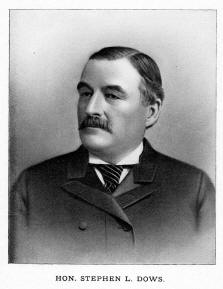 The
Dows family, from which Stephen Leland Dows descended, originally
spelled the name Dowse. They were among the early settlers in
Massachusetts, coming from England only a few years after the Plymouth
colony arrived. They located near Boston. The great-grandfather of
Stephen L. resided in Charleston at the outbreak of the Revolution, and
at the time of the battle of Bunker Hill his property was destroyed. He
is one of the brave men who aided in gaining our independence. Thomas
Dows, the eccentric and celebrated bibliopolist, of Cambridgeport, was
a great-uncle of Stephen. The
Dows family, from which Stephen Leland Dows descended, originally
spelled the name Dowse. They were among the early settlers in
Massachusetts, coming from England only a few years after the Plymouth
colony arrived. They located near Boston. The great-grandfather of
Stephen L. resided in Charleston at the outbreak of the Revolution, and
at the time of the battle of Bunker Hill his property was destroyed. He
is one of the brave men who aided in gaining our independence. Thomas
Dows, the eccentric and celebrated bibliopolist, of Cambridgeport, was
a great-uncle of Stephen.
He was a self-made man, largely self educated, and collected one of the
largest libraries in the United States, giving it, at his demise, to
the Massachusetts Historical Society. According to the conditions of
the gift, this library is kept in a fire-proof building, and no book is
allowed to go out of the building. He left property set aside
especially for the endowment of the Dows course of lectures, which is
given annually at Cambridge, the best talent in the country being
employed for that course. In the town of Sherborn he caused a town hall
to be erected at his expense, on which he placed an astronomical clock.
The paternal grandmother of Stephen L. was a Leland, a family
equally as distinguished as the Dows family. The pedigree of the family
is traced back distinctly to John Leland, born in London, England, in
1512, an accomplished scholar flourishing during the reign of Henry
VIII. Among his descendants in the old world were Rev. John and Thomas
Leland, eminent authors of the eighteenth century. Henry Leland, the
progenitor of all who bear the name except by adoption, in this
country, is supposed to have emigrated to the United States about 1652,
and settled in what afterwards became the town of Sherborn,
Massachusetts.
His children, who lived to grow up, were Experience, Hope Still,
Ebenezer and Eleazer, from whom has spring a numerous family, many
members of which are quite distinguished, as American biographical
history shows. All left issue but Eleazer. Amond the prominent men in
this family was "Elder" John Leland, many years a resident of Cheshire,
Massachusetts. He lived a short time in Virginia, and in 1789, in a
Baptist general conference, he boldly denounced slavery as a "violent
deprivation of rights of nature." The prominent professional men and
eminent scholars of this name are numbered by the hundred. There are
eleven generations of the Leland family in this country.
Stephen Leland Dows was born in New York city, on the 9th of
October, 1832, his parents being Adam Dows, a merchant in early life,
and Maria Lundy, a daughter of Captain Lundy, of New York city. His
grandfather, James Dows, was a soldier in the war of 1812-15, and was
killed at the battle of Ottawa while on picket duty.
At fourteen years of age the subject of this sketch went into
a machine shop at Troy, New York, where his parents then lived. At the
end of two years he left the city of Troy, and started westward with a
cash capital of seven dollars and fifty cents, and a pass to Buffalo on
a line boat. He landed in Milwaukee with seventy-five cents in his
pocket; after a little delay proceeded to Green Bay; where he spent one
year in lumbering; then went to Lake Superior, and was one of the first
winterers in the then new town of Marquette; worked there in the first
machine shop built, and ran the first engine ever started there; at the
end of two years returned to Green Bay, acting as engineer until the
spring of 1853, when he went to Muskegon, Michigan, and superintended a
lumbering establishment.
In 1855 the health of Mr. Dows failed, and he came to Cedar
Rapids and became engineer and superintendent of the Variety
Manufacturing Works. In company with other men connected with these
works, in 1860, he conveyed a quartz mill to Gold Hill, in the Rocky
Mountains, and with two young men returned overland the next winter,
driving a pair of mules from Denver to Omaha in seventeen days, and
having on one occasion a narrow escape from Indians, being saved from
robbery, and perhaps murder, by the coolness and self-possession of Mr.
Dows.
After superintending the Variety Works another season, in
August, 1862, he went into the army as first lieutenant of Company I,
Twentieth Iowa Volunteer Infantry; in a short time was promoted to
acting brigade quartermaster of the First Brigade, second division,
army of the frontier; from exposure and overwork became disabled, and
was obliged to leave the service in one year.
Since 1863, Mr. Dows has been engaged in public works and
manufacturers. He has been a successful and an extensive railroad
contractor, building more miles of railroad than any other man in the
state of Iowa. He was one of the men instrumental in building the
Burlington, Cedar Rapids & Northern Railroad, and was instrumental
in bringing the Illinois Central into Cedar Rapids. He started, in
connection with Mr. J. H. Shaver, an extensive cracker factory in Cedar
Rapids, which they operated for many years, but which has since gone
into the trust, and is now called Continental Biscuit Company.
Mr. Dows owns a large share of this property. He built, with Dr. J. F.
Ely, the Dows and Ely Block, better known as the old post office block,
at the corner of Second avenue and Second street. This was for years
the finest building in this city. Mr. Dows has other property in the
city and outside of it, and has always been a great encourager of
manufacturing and other industries tending to advance the material
interests of Cedar Rapids, and in this work probably no man has done
more than he. In 1875, Mr. Dows was elected state senator to represent
Linn county, and in the sessions of the General Assembly held in 1876
and 1878, he was chairman of the committee on public buildings and on a
number of other committees including railroads, manufacturers,
appropriations, penitentiary.
In 1878, he was chairman of the committee appointed to visit the
penitentiary at Fort Madison. His practical turn of mind, his solid
good sense, his sound judgment and great industry made him a valuable
legislator. On matters pertaining to the mechanical arts he was
regarded as the nester of the upper house. He has always been a
Republican from the organization of the party.
Mr. Dows is a member of the Second Presbyterian church of
Cedar Rapids, and has been an elder of the same for over thirty years.
For many years he was superintendent of the Sunday-school. He is a man
of benevolent disposition, very generous to the poor, dispensing his
charities in a most sacred manner.
On the 31st of October, 1855, Mr. Dows was united in marriage
with Henrietta W. Safely, daughter of Thomas Safely, of Waterford, New
York, and by this union six children were born: Minnie Maria died at
the age of fifteen years. Elizabeth is the wife of Thompson McClintock,
of Pittsburg, Pennsylvania. Elma is the wife of Benjamin Thaw, of the
same city. William G. is represented on another page of this work.
Stephen Leland, Jr., died July 5, 1899, at the age of thirty-two years.
Henrietta is the wife of James E. Blake, of Cedar Rapids. Mrs. Dows
passed to her reward August 7, 1893, and her remains were interred in
Oak Hill cemetery. She was a noble Christian woman and thoroughly
devoted to the interests of her family. Like her husband, she was very
social, abounding in hospitality, and many of the poor families in
Cedar Rapids have reason to bless her memory and mourn her loss.
Mr. Dows is purely a self-made man. Cast upon his own
resources at an early age, he educated himself, developed into a
skilled mechanic, and later in life into an eminently successful
railroad contractor, and a legislator with few peers in the
commonwealth. He has been unusually successful in business, but at the
present time he is living retired, although he retains his interests in
several business enterprises, and is a stockholder and director in
several banks.
Interested in the cause of education, he is a trustee of both
Coe College at Cedar Rapids and Cornell College at Mt. Vernon.
Fraternally he is a Knight Templar Mason and an Odd Fellow.
Source: Biographical Record of Linn County, Iowa. Chicago: The S. J. Clarke Publishing Company, 1901, p. 958-962.
A. B. Dumont
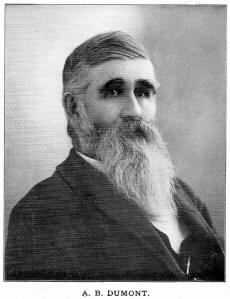 For
over half a century this gentleman has been a resident of Linn county,
and has been prominently identified with its commercial and political
interests. He is now a leading business man of Marion, where he is
engaged in the undertaking and furniture business. His life has been
one of industry, and his business interests have been so managed as to
win for him the confidence of the public and prosperity which should
always attend honorable effort. For
over half a century this gentleman has been a resident of Linn county,
and has been prominently identified with its commercial and political
interests. He is now a leading business man of Marion, where he is
engaged in the undertaking and furniture business. His life has been
one of industry, and his business interests have been so managed as to
win for him the confidence of the public and prosperity which should
always attend honorable effort.
Mr. Dumont was born near New York city, July 19, 1824, a son of John B.
and Elizabeth (Welch) Dumont, both of whom were natives of Greene
county, New York, and of French Huguenot extraction. In 1845 the family
came to Iowa and settled near Martelle, Jones county, Iowa. At that
time Cedar Rapids contained only three or four houses and a sawmill,
and most of the land was still in its primitive condition. The father
died at the age of eighty-two years and the mother passed away two
years later at the same age. They were the parents of five children,
three of whom are still living: A. B., of this review; Frederick S.,
who resides on the only homestead near Martelle; and Elida, wife of W.
J. Patterson, of Cedar Rapids. Those deceased were Waldron B., who died
in Cedar Rapids; and Sarah, who died in the early ‘30s.
Our subject was adopted by his father’s sister and was reared near
Auburn, New York. At the age of fourteen he commenced learning the
carpenter’s and millwright’s trades, to which he devoted his attention
for some years. At Baldwinville, New York, he was married, October 13,
1844, to Miss Julia A. Leffingwell, who was born near Rutland, Vermont,
and the following year they removed to Marion, Iowa. The same year her
parents, Joseph and Bethia Leffingwell, also came west, and first
located five miles east of town, and in 1849 took up their residence in
Marion.
During his early residence in Marion Dumont worked at his trade, and
erected many of the early buildings of the town but since 1860 has
engaged in his present business. He drafted the frame work for the old
court house, for which he never received any pay, though it was not the
fault of the county. When he first came to Marion the place contained
about a dozen houses which were widely scattered, and he has therefore
witnessed almost its entire growth and development.
During the gold excitement in California, in 1849, Mr. Dumont, in
company with four other men, started from Marion with an oxen team, on
April 27, and in October they made their first stop near Portland,
Oregon, where he worked for six months, receiving five dollars per day
and board. On arrival at Fort Vancouver they disposed of their cattle.
Six miles above Portland he erected a saw and gristmill for a large
firm, and continued in their employ till June, 1850, when he went by
water to San Francisco, as a passenger on a lumber vessel. It was a
very unpleasant trip as the weather was stormy, and it required six
weeks to make the voyage. After spending a few days in San Francisco,
Mr. Dumont went to Sacramento on a prospecting tour, but not being
pleased with the country he decided to return home. He then took
passage at San Francisco, and on reaching the isthmus walked across to
the Schagris river, a distance of twenty four miles, thence by canoe to
the eastern coast. He then proceeded by boat to New York, and after
visiting friends in the Empire state for a few weeks returned to Marion
after an absence of two years. He had been fairly successful while in
the west and had no occasion to regret his trip.
Unto Mr. and Mrs. Dumont were born four children: Elizabeth married
Emory Eggleston and died six months later at the age of twenty-one
years; James W., and employee of the Chicago, Milwaukee & St. Paul
Railroad, residing in Marion, married Rhoda E. Lake, and they have one
child, Elizabeth, who was married on Thanksgiving Day, 1900, to Charley
Frantz; John E., also a resident of Marion, wedded Julia E. Waters, and
they have one child, John E.; and Charles W., who is with his father in
the store, married Rebecca E. Reicherd, and they have five children:
Maude A., May, Amasa B., Jr., Frederick S. and Dorotha.
Mr. Dumont and his family are all members of the Methodist Episcopal
church and he has been officially connected with the same for years.
Since 1846 he has affiliated with the Masonic fraternity; has filled
all the offices in the blue lodge, including that of worshipful master;
is also a member of the chapter and commandery; a thirty-second degree
Mason, and has been a delegate to the grand lodge many times, being
well know in Masonic circles. Politically he is an ardent supporter of
the Republican party, and with his fellow citizens recognizing his
worth and ability have called upon his to fill important official
positions. He was elected county judge and while serving in that
capacity the law was passed creating an auditor’s office, and all
county judges then in office were appointed to fill the position, as
our subject was the first auditor of Linn county. From 1858 to 1866 he
was connected with the county recorder’s and county treasurer’s
offices, and served as justice of the peace from 1858 until 1864. His
official duties were always most capable and satisfactorily discharged,
winning for him the commendation of all concerned. He studied law and
was admitted to the bar in 1862, but has never engaged in the practice
of that profession. However, he has never employed an attorney in his
own affairs, but has attended to his own legal business. He is a man of
more than ordinary ability, sound judgment and keen discrimination, and
generally carries forward to successful completion whatever he
undertakes.
Source: The Biographical Record of Linn County Iowa, Illustrated,
Chicago: The S. J. Clarke Publishing Company, 1901, pages 96-100.
Submitted by: Carrie J. Robertson of Marion
JOHN DUNLAP
This well-known and honored citizen of Springville, who is
familiarly called Uncle John by his numerous friends throughout Linn
county, was born in County Antrim, Ireland, May 12, 1817, a son of John
and Mary Ann (Bell) Dunlap, natives of the same country and of Scotch
descent. They were the parents of seven children, five sons and two
daughters, of whom our subject is no the only survivor. The father
dying in 1828, the mother was left to provide for her children. In 1832
she brought her family to the new world and settled in Allegheny
county, Pennsylvania, where she continued to make her home throughout
the remainder of her life. She lived to the advanced age of
ninety-three years.
John Dunlap grew to manhood upon a farm in Pennsylvania, and
when only nineteen years of age was married at Philadelphia in 1836 to
miss Ann Eliza Johnson, who was of Scotch parentage. After his marriage
he was employed at farm work in that state until 1841, when he removed
to Athens county, Ohio, where he had previously purchased eighty acres
of land without seeing it. Clearing away the trees, he burned the brush
and placed forty acres under cultivation. His first home was a rude log
house, which was replaced two or three years later by a more
substantial dwelling built of hewed logs. He also built a good barn and
continued the improvement and cultivation of that farm for seven years.
Selling his property in Ohio, Mr. Dunlap came to Linn county,
Iowa, in 1851, and with a land warrant entered one hundred and sixty
acres of land three miles from Springville, which village at that time
contained only the residence of Colonel Butler. He at once commenced to
break and improve his land, first building a log cabin, in which the
family lived while he opened up the farm. Later he erected a more
commodious frame residence and built one of the best barns in the
township. He added to his original purchase from time to time until he
owned nearly a section of land, divided into three farms, but later he
disposed of these, though he continued to own and operate two hundred
acres of land in Brown township until 1895. in connection with farming
he also carried on stock raising, and in his undertakings met with
marked success. Being a man of industry, enterprise and good business
ability he accumulated a valuable estate, and is to-day one of the
substantial citizens of Springville, where he purchased a residence in
1895 and has since lived retired from active labor.
Mr. Dunlap has been called upon to mourn the loss of his
estimable wife, who passed away in November, 1891, and was laid to rest
in the Linn Grove cemetery. They had nine children, namely: John was in
the Union army during the civil war and later removed to Nebraska,
where he died, leaving a wife and several children; Elizabeth married
Thomas Kerns and died in Maine township, this county; Mary Ann wedded
James Keenin and died in Nebraska; Ellen, deceased, was the wife of
William Butler, of Linn county, who served through the war of the
Rebellion and went with Sherman on the march to the sea; Rebecca is the
wife of George Bolton, of Nebraska; Thomas is a resident of
Springville; Margaret is the wife of James Wallace, of New Virginia,
Warren county, Iowa; William is a farmer of Brown township; Hugh
completes the family.
Mr. Dunlap cast his first presidential ballot for W. H.
Harrison in 1840, but for many ears has been identified with the
Democratic party. Religiously he is a member of the Presbyterian church
of Linn Grove, with which his wife was also connected, and is a man of
sterling worth and exemplary character, who has the confidence and
respect of all who know him.
Source: The Biographical Record of Linn County Iowa,
Illustrated, Chicago: The S. J. Clarke Publishing Company, 1901, pages
553-4.
Submitted by: Terry Carlson 9/15/2010
JOHN E. DUNN
John E. Dunn, owning and operating a well improved farm of one
hundred and sixty acres on sections 8 and 9, Jackson township, is
widely recognized as one 0f the successful agriculturists and
substantial citizens of his community. His birth occurred in Jones
county, Iowa., on the 1st of October, 1864, his parents being T. H. and
Mary (Farnham) Dunn, who were natives of Pennsylvania and Massachusetts
respectively. The year 1855 witnessed their removal to Minnesota, where
they resided for four years, on the expiration of which period they
came to Iowa, settling on a farm in Jones county. The mother still
resides there, but the father passed away on the 7th of May, 1906.
Their children were eight in number, namely: W. E., who makes his home
in South Dakota; Henry, living in West Bend, Iowa; John E., of this
review; Grace, the wife of W. W. Wallace, who purchased land in Canada.
and now resides there; Clara, the wife of George Grebe, of Stickney,
South Dakota; Leslie, who is a resident of Jones county, Iowa; and two
who died in infancy.
John E. Dunn supplemented his preliminary education by a
college course and remained at home until he had attained the age of
twenty-six years. Going to South Dakota, he spent four years on a farm
which he had purchased in that state and then returned to his home in
Jones county, living with his parents until the time of his marriage
four years later. Following that important event in his life he
purchased and located upon a farm of one hundred and sixty acres on
sections 8 and 9, Jackson township, in the cultivation and improvement
of which he has since been actively engaged. He has shown good business
judgment in the conduct of his agricultural interests and his labors
are fittingly rewarded.
As a companion and helpmate on the journey of life Mr. Dunn
chose Miss Jennie S. Moore, who was born in Jones county in 1871, her
parents being Joseph and Jennie (Sloan) Moore, both natives of Ireland.
Mr. and Mrs. Moore crossed the Atlantic to the United States in 1857
and for two years made their home in the state of New York. In 1859
they came to Cedar Rapids, Iowa, but when a year had passed went to
Jones county, where they resided for twenty years. At the end of that
time they again took up their abode in Cedar Rapids, where Mrs. Moore
passed away in November, 1901. Joseph Moore, who has now attained the
age of seventy-five years, still makes his home in that city. Unto him
and his wife were born ten children. Mrs. Dunn enjoyed the advantages
of a high school education and taught school for nine years prior to
her marriage. Four children have been born unto her, as follows: Joseph
M., whose natal day was December 15, 1899; Kathryn M., whose birth
occurred May 6, 1901; Jeanie M., Who first opened her eyes to the light
of day on the 16th of January, 1904; and May V., who was born October
3, 1908, and died August 27, 1909.
Mr. Dunn is a republican in his political views and is now
ably serving in the capacity of township trustee, while for four years
he held the office of assessor. Fraternally he is identified with the
Modern Woodmen of America at Coggon. A successful farmer, an exemplary
citizen and a man of high moral standards, he enjoys the respect of all
who have come in contact with him.
Source: History of Linn County Iowa From Its Earliest
Settlement to the Present Time, Vol. II, Chicago, The pioneer
Publishing Company, 1911, pages 47-8.
Submitted by: Terry Carlson
WILLARD WILLIAM DURLIN
This well-known railroad man who has been in the employ of the
Burlington, Cedar Rapids & Northern Railroad since coming to Cedar
Rapids in 1881, was born on the 20th of April, 1853, in Meadville,
Crawford county, Pennsylvania, of which county his parents, James W.
and Harriet E. (Littlefield) Durlin, were also natives. The town of
Meadville was named for the mother's grandparents, and her Grandmother
Meade was the first white child born in the county. Mrs. Durlin's
father and mother lived to be ninety-seven and ninety-four years
respectively. Our subject's paternal grandmother was connected with the
Lee family, to which the famous Confederate general of that name
belonged.
In early life James W. Durlin, the father of our subject, was
a pattern maker, draftsman and engine builder, and he also ran boats on
the Erie canal for a time. In 1857 he came to Iowa and took up his
residence in Anamosa, Jones county, where he conducted a grocery store
until the Civil war broke out. In 1861 he enlisted in Company C,
Thirty-first Iowa Volunteer Infantry, and remained in the service until
Lee's surrender. Soon after his return home he moved to Omaha,
Nebraska, where he engaged in business as a contractor and builder
until 1879, when he commenced teaming across the plains. He died in
Huron, South Dakota, in 1899, at the age of seventy-four. They were the
parents of six sons and three daughters, of whom two daughters are now
deceased. The others are Eugene, Frank, Willard W., Charles, Emmett and
Fred, all railroad engineers with the exception of the youngest, who is
a conductor; and Mary, the surviving daughter. They were educated in
the schools of Council Bluffs and Creston, Iowa. Their parents both
received collegiate educations, and their mother taught in a college
for a time.
During his boyhood and youth Willard W. Durlin attended the
common schools of Anamosa, and remained at home until sixteen years of
age, when he began his railroad career at Council Bluffs as wiper on
engines of the St. Joseph & Council Bluffs Railroad, taking care of
engines for two years. For a time he was employed as fireman and later
as brakeman. After spending two years at Ottumwa, Iowa, he removed to
Creston and found permanent employment, working as fireman on the
Burlington & Missouri Railroad, now a part of the Chicago,
Burlington & Quincy system. In 1874 he was given an engine, and
continued in the employ of that road until coming to Cedar Rapids in
1881, when he entered the service of the Burlington, Cedar Rapids &
Northern Railroad as engineer. He was first given a freight run, but
for the past sixteen years has been running specials and passenger
trains on the northern division of the road, being engineer on the fast
mail and passenger train since 1895, running to Albert Lea, Minnesota
each day. As a railroad man he has been very fortunate and successful,
but has met with some accidents, his train going through the bridge at
Cedar Falls in 1888, and being wrecked at Waterloo in 1899.
At Ottumwa, Iowa, May 13, 1872, Mr. Durlin married Miss Eliza
A. Corrick, who was born in Bloomfield, Davis county, Iowa, in 1854 and
was living in Ottumwa at the time of her marriage. Both her parents are
now deceased. Mr. and Mrs. Durlin have one daughter, Florence Mae, who
was graduated at the high school of Cedar Rapids in 1892, and engaged
in teaching physical culture for five years. The family are prominent
members of the Universalist Church, of which Mrs. Durlin is one of the
officers and the daughter is organist. Fraternally Mr. Durlin
affiliates with the Independent Order of Foresters of America, the
Brotherhood of Locomotive Engineers, and the blue lodge of Masonry. In
politics he is independent, but takes a deep and commendable interest
in public affairs, and gives his support to every enterprise for the
public good.
Source: Biographical Record of Linn County, Iowa. Chicago: The S. J. Clarke Publishing Company, 1901, p. 440-441.
JOSEPH DUSILL
Among Cedar Rapids’ honored residents is this well-known
gentleman, who came to this city in 1856, and as a wagon and carriage
manufacturer was actively identified with its industrial interests for
many years, but has now laid aside all his business cares to enjoy a
well-earned rest at his pleasant home, No. 703 Fourth avenue. He was
born in Bohemia, on Christmas day, 1830, a son of Frank Dusill, whose
life was devoted to the blacksmith’s trade in his native land. There
our subject acquired a fair education in the German and Bohemian
languages, but his knowledge of English has been obtained through his
own unaided efforts since coming to this country. In early life he
learned the wagon and carriage maker’s trade, working two years as an
apprentice, and twelve years at his trade the later part of the time as
boss, having charge of a factory at Borno.
In 1855 Mr. Dusill emigrated to the new world and in 1856 took
up his residence in Cedar Rapids, Iowa, which was then little more than
a crossroads village. After working at his trade for two years, he
commenced the manufacture of wagons and carriages for himself, making
carriages principally. He began business in a small way, but enlarged
his facilities from year to year until he had a large factory located
on Third avenue and Third street, and employed on an average of eight
men for several years. His factory became noted for the superior
quality of the work turned out, and he built up a large trade in this
and adjoining states. After forty years in active business here, he
retired in 1898 to enjoy the fruits of former toil. Besides his factory
he built two good residences in Cedar Rapids, and is to-day quite
well-to-do.
Mr. Dusill was married in Iowa City, June 4, 1857, to Miss
Antonia Pecka, who was also born in Bohemia, April 24, 1838, and came
to this country when a young lady on the same ship with Mr. Dusill, the
voyage taking forty days. They have two children living: Josephine,
wife of W. F. Severa, of Cedar Rapids; and Katie, wife of John Kale, a
business man of that city. The children of the family now deceased were
Anthony, who was engaged in the drug business in Cedar Rapids at the
time of his death in 1888; Francis, who was also married and living in
Cedar Rapids when he died in 1894; and three who died in childhood.
Forty-one years ago Mr. and Mrs. Dusill moved onto the block where they
have since lived. It was then out in the country but now is in the best
resident part of the city.
In politics Mr. Dusill is independent, endeavoring to support
the best men for the office, regardless of party ties. He cast his
first presidential vote for James Buchanan and has never missed a
presidential election since that time. He is a loyal and devoted
citizen of his adopted country, and is always willing to give his aid
and support to any enterprise which he believes will prove of public
benefit.
Source: The Biographical Record of Linn County Iowa,
Illustrated, Chicago: The S. J. Clarke Publishing Company, 1901, pages
83-4.
Submitted by: Carrie J. Robertson of Marion
ENOCH B. DYE
One of the representative farmers and honored citizens of
Marion township, is Enoch B. Dye, who was born in Allegheny county,
Pennsylvania, May 31, 1829, a son of William and Susanna (Crothers)
Dye, the former a native of Washington county, that state, the latter
of Big Beaver, Beaver county, Pennsylvania. The father, who was a
carpenter by trade, died in Pennsylvania in 1831. He assisted in
constructing the first bridge across the Allegheny river. The mother
departed this life in October, 1890. For her second husband she married
Dr. Elijah W. Lake, of Loudonville, Ohio, and in 1853 they came to Iowa
City, Johnson county, Iowa. He died in Marion. More extended mention is
made of Dr. Lake in the sketch of George W. Lake on another page of
this volume.
There were only two children born to William and Susanna
(Crothers) Dye, these being Enoch B., our subject and William McEntire.
The latter was born in Washington, Pennsylvania, January 26, 1831, and
was reared in Mansfield, Ohio, from which state he was appointed to
West Point. He entered the military academy as cadet, July 1, 1849, and
on his graduation, July 1, 1853, was appointed to West Point. He
entered the military academy as cadet, July 1, 1849, and on his
graduation, July 1, 1853, was appointed second lieutenant. He was then
on duty at Fort Columbus, New York; Benicia and Fort Reading,
California; Fort Davis and San Antonio, Texas, until the war broke out.
On the 14th of May, 1861, he was commissioned captain of the Eighth
United States Infantry, and on the 25th of August, 1862, was made
colonel of the Twentieth Iowa Volunteer Infantry.
He participated in many engagements, and was mustered out of
the volunteer service at the close of the war, July 8, 1865. He was
commissioned major in the Fourth United States Infantry, January 14,
1866, and was in the recruiting service until sent to Plattsburg
Barracks, New York, where he remained until February 18, 1867. He was a
member of the examining board of New York City until April 15, 1868,
when he was ordered to the frontier, and was on duty at Forts Laramie
and Fetterman until February 4, _____. On the 30th of the following
September he received an honorable discharge, and for the following
three years was engaged in farming near Marion, Iowa.
In 1873 he went to Egypt, having been recommended by General Sherman,
who was traveling in that country and had been asked by the Egyptian
government to recommend some officer for service. General Dye took part
in the Abyssinian campaign in 1876, and was wounded in the battle of
Gura. After five years spent in Egypt he returned to New York, June 30,
1878, and in 1880 published a book on "Egypt and Abyssinia." He was
superintendent of the metropolitan police of the District of Columbia
from 1883 to 1886, and for the following two years was chief of the
army and navy division of the pension bureau and of its special
examination division.
In 1888 he went to Korea to become military advisor and instructor in
the service of the King of Korea. The Korean government wished to
reorganize the army and they asked the United States legation to
recommend some American officers to them. The legation referred it to
the state department at Washington, which in turn referred it to the
war department, and the war department to the commander-in-chief of the
army, who was General Sheridan. He offered the place to General Dye,
who was a classmate of his at West Point, having graduated in the same
year. He was also a cousin of General Dye. General Dye accepted, and
held the position until the spring of 1896, during which time he rose
rapidly in the esteem of the king.
As vice-minister of war and commander of the Korean army he worked a
revolution in that military body and put it on a scale of excellence it
had never known. He introduced modern guns and equipment, and revised
American tactics to fit Korean needs. Through all the serious political
disturbances which occurred in that country he remained the
confidential advisor and trusted friend of the king. When treachery
threatened the king's life General Dye lived in a house adjoining the
royal palace and was believed and trusted. When Japan swooped down upon
the helpless country he was practically a prisoner with the king in the
royal palace. He was never permitted to take advantage of a month's
leave of absence according to contract on account of the political
condition of the country, although the condition of his health demanded
a vacation.
He therefore remained in Korea continuously for more than eleven years,
sacrificing his health, and without reaping such reward as the faithful
might expect. When the Russians came into power General Dye's military
service ended, but he remained in Seoul engaged in other public work.
While there he had all kinds of fruit trees shipped to that country and
instructed the natives in the raising of fruit, etc. He was ill for
some time, and on the 5th of May, 1899, started for home by way of
Japan and Hawaii, arriving in San Francisco June 27, and remaining
there until July 11, when he proceeded to his home in Muskegon,
Michigan. There he passed away on the 13th of November following. He
was married February 18, 1864, to Miss Ellen A. Rucker, daughter of
Judge Rucker, of Chicago, and to them were born three children: J.
Henry, who was with his father in Korea for three years and a half as
civil engineer, and is now living in Muskegon, Michigan; Mrs. S. E.
Baylis, of Chicago; and Annette M., a teacher in the Muskegon high
school.
Enoch B. Dye was educated in the schools of Mansfield, Ohio,
and for a time was engaged in teaching in the country and city schools
for several years. He also engaged in bookkeeping to some extent. In
1858 he removed to Iowa City, Johnson county, Iowa, and took charge of
the Tremont House, which he conducted until it was destroyed by fire
the following year. He next taught school in Crawford and Morrow
counties, Ohio, until 1867, when he came to Marion, and for several
years successfully followed that profession in this city. He is now
engaged in farming in Marion township, and for the past five years has
devoted considerable attention to his inventions, having several
different patents, such as car couplers, fire and burglar alarms, etc.
On the 23rd of June, 1857, in Washington, Pennsylvania, was
celebrated the marriage of Mr. Dye and Miss Malvina K. Dye, of that
place, a daughter of David and Sarah Dye. The father was a tailor by
trade, died in 1887, and the mother also died the same year. The
children born to our subject and his wife are Sarah, wife of George
Collins, of Belle Plain, Iowa; William L., a mason of Calhoun county,
Iowa; John D. McC., who is engaged in farming on his father's farm in
Marion township; George W. R., a carpenter and builder of Marion; and
Joseph Milton, an attorney of Swea, Iowa.
Mr. Dye is a member of the First Congregational church of
Marion, and a stanch supporter of the Democratic party, though he has
never been an office-seeker. He is a man of recognized ability and
stands high in the community where he has long made his home. Those who
know him best are numbered among his warmest friends, and no citizen in
the county is more honored or highly respected.
Source: Biographical Record of Linn County, Iowa. Chicago: The S. J. Clarke Publishing Company, 1901, p. 150-155.
|
|