CHRISTIAN
MAGNUS
Among the
prosperous business men and capable financiers of Cedar Rapids is
numbered Christian Magnus, who has been a resident of this city since
1859. He was born on the 19th of March, 1834, in Giessen,
Hesse-Darmstadt, Germany, where he grew to manhood and received a
thorough education in the higher schools and colleges. His father,
Carl Magnus, was also a native of Giessen, Hesse-Darmstadt, and was a
brewer, as was also his father and grandfather. For many years Carl
Magnus was actively engaged in the brewing business in Giessen, and
was one of the prominent men of that city.
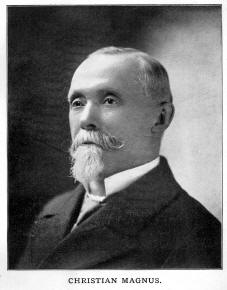
During his youth
Christian Magnus learned the brewing business with his father, and
then traveled through Germany, working in different cities and
thoroughly learning the business in all its branches. In connection
with it he also worked two years at the cooper’s trade in Frankfort
and thus qualified himself for his chosen occupation. He traveled and
worked in different cities of Germany for several years.
In 1857 Mr.
Magnus crossed the Atlantic, and took up his residence in Twin
springs, Winneshiek county, Iowa, where he started a brewery for a
Frenchman, remaining there one year. He subsequently spent a short
time in Chicago and Milwaukee, and in 1859, came to Cedar Rapids,
where he worked in the brewery of Jacob Wetzel as head brewer for two
years. He next started a brewery in Kankakee, Illinois, where he
remained two years, then returned to Cedar Rapids and formed a
partnership with Mr. Wetzel in the brewing business, that connection
continuing until 1868, when Mr. Magnus bought out his partner. He
began business here in a small way, but has enlarged his facilities
from time to time to meet the growing demands of his trade until the
capacity of his brewery is now twenty-five thousand barrels per year.
He was at the head of the business when it was organized as a stock
company with Mr. Magnus as a stockholder and director. He was one of
the promoters and an original stockholder in the Cedar Rapids National
Bank; a stockholder in the Cedar Rapids Savings Bank, the Electric
Light and Power Company, a stockholder and director of the Cedar
Rapids Water Company, and also extensively interested in real estate
and building, owning the Magnus block on South Second street, and
other valuable property. He was president of the Iowa State Brewers’
Association for four years, during which time was fought the
prohibition campaign, when the brewers made an active campaign to save
their property. Politically, Mr. Magnus has been a Democrat, and
served two terms as alderman from the First ward, during which time
the sewering was begun.
Mr. Magnus was
married in Cedar Rapids, in 1864, to Miss Mary A. Wetzel, a daughter
of Jacob Wetzel, one of the old settlers of the city. Mr. Magnus has
made a number of trips to Europe, and has visited all of its great
cities, spending some time at the Paris Exposition in 1900 and
returning home in February of the following year. Fraternally, he is a
prominent member of the Odd Fellows lodge of Cedar Rapids, in which he
has filled all the chairs and is now a past grand. As a
public-spirited and enterprising business man he has done much to
promote the welfare of his adopted city and advance her interests
along various lines. He has a large circle of friends and
acquaintances here who will peruse this sketch with interest.
Source:
The Biographical Record of Linn County Iowa, Illustrated,
Chicago: The S. J. Clarke Publishing Company, 1901, pages 220-223.
Submitted by: Terry Carlson
CHRISTIAN MAGNUS, proprietor
of the Eagle Brewery, located at Cedar Rapids, was born March 19, 1834,
in Giessen, a town of Germany, Grand Duchy of Hesse Darmstadt, capital
of Ober-IIessen, on the Lahn, noted for its University, founded in
1607, and famous for its School of Chemistry and also its Normal School
and School of Forest Economy, and other institutions of learning, and
possessing library of 150,000 volumes.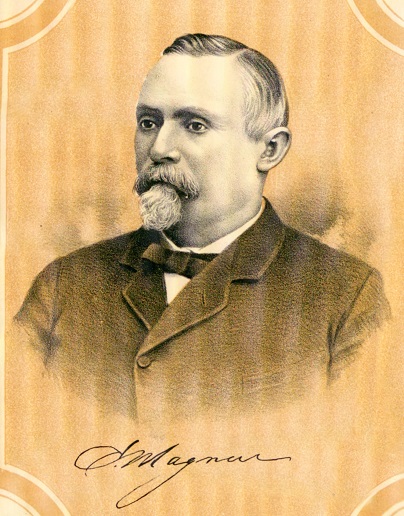 He is a son of Carl and Elizabeth (Selzer) Magnus, natives of Germany
and born in the same town as our subject. The father was a brewer, and
continued in that business through life. He was born Jan. 18,
1808, and died Feb. 6, 1871, in his native land. The mother was
born July 31, 1807, and died Aug. 7, 1850. They had a family of
seven children, five of whom are yet living: Carl, a resident of
Germany; Johannetta married C. Schaad, and they are living at Cedar
Rapids; Christine and Fritz live in the Faderland, and our subject, who
was first in order of birth. The father was a prominent citizen
of his native town, well-to-do in this world's goods, and gave to all
his children a good opportunity to secure a thorough education.
He was a gentleman universally loved and respected by those who knew
him.
Christian Magnus attended school in his native land until fourteen
years of age, when he took a preparatory course for the
University. He subsequently traveled through
Frankfort-on-the-Main, Leipsic, Aachen and Eisenach, and was engaged
for three years in thus traveling for the purpose of completing his
trade as a brewer. Returning home, he remained for awhile, and
then set sail for the United States, arriving in New York City in
1857. He remained in the metropolis until January of the
following year, 1858, when he came west and located at Dubuque, going
thence to Winneshiek County, this State. There he started a
brewery for a Frenchman, and of which he was foreman until 1859, when
he went to Chicago and became an employe as maltster for Lill &
Diversy, and also worked for Conrad Seipp. In September, 1859, he
came to Cedar Rapids and started a brewery for Jacob Wetzel, which was
located where Mr. Magnus' brewery now stands. Our subject was
foreman for Mr. Wetzel two years, when he went to Kankakee, Ill., and,
in partnership with George Diehl, started another brewery. They
continued in partnership for two years, when Mr. Magnus sold his
interest to his partner, and returning to Cedar Rapids, became a
partner of Jacob Wetzel, for whom he had previously erected the brewery.
The partnership of our subject with Mr. Wetzel continued until 1868,
when Mr. Magnus purchased Mr. Wetzel's interest, and has since
continued the business alone. In 1873 our subject was burned out,
sustaining a loss of between $8,000 and $10,000, but in 1875
rebuilt. When the brewery was first started its capacity was only
400 barrels per year, but its present capacity is 25,000 barrels, and
the malting capacity 60,000 bushels of barley per year. Mr.
Magnus employed, prior to the Prohibitory Law, from thirty to
thirty-five men, and was doing an exceedingly good business, his sales
having been constantly on the increase. His brewery is on Sixth
avenue and Eighth street, and his residence on Fifth street and A
avenue. He is a stockholder in the Savings Bank.
Mr. Magnus was married in 1864 to Miss Mary Wetzel, a native of
Cleveland, Ohio, and daughter of Jacob Wetzel, a native of
France. Socially Mr. Magnus is a member of the I. O. O. F., and
has held all the offices of that order. He was City Alderman of
the First Ward for two years, and is one of the leading tax-payers in
Cedar Rapids. In politics he is a Democrat. He has been
President of the Iowa Brewers' Association for four consecutive years,
and is one of the foremost business men of Cedar Rapids, and as such
the publishers of this work are pleased to present his portrait on an
accompanying page.Source
of portrait and biographical sketch (verbatim transcription):
“Portrait and Biographical Album of Linn County, Iowa”, 1887,
biographical sketch on pages 397 - 398, portrait on page 396
He is a son of Carl and Elizabeth (Selzer) Magnus, natives of Germany
and born in the same town as our subject. The father was a brewer, and
continued in that business through life. He was born Jan. 18,
1808, and died Feb. 6, 1871, in his native land. The mother was
born July 31, 1807, and died Aug. 7, 1850. They had a family of
seven children, five of whom are yet living: Carl, a resident of
Germany; Johannetta married C. Schaad, and they are living at Cedar
Rapids; Christine and Fritz live in the Faderland, and our subject, who
was first in order of birth. The father was a prominent citizen
of his native town, well-to-do in this world's goods, and gave to all
his children a good opportunity to secure a thorough education.
He was a gentleman universally loved and respected by those who knew
him.
Christian Magnus attended school in his native land until fourteen
years of age, when he took a preparatory course for the
University. He subsequently traveled through
Frankfort-on-the-Main, Leipsic, Aachen and Eisenach, and was engaged
for three years in thus traveling for the purpose of completing his
trade as a brewer. Returning home, he remained for awhile, and
then set sail for the United States, arriving in New York City in
1857. He remained in the metropolis until January of the
following year, 1858, when he came west and located at Dubuque, going
thence to Winneshiek County, this State. There he started a
brewery for a Frenchman, and of which he was foreman until 1859, when
he went to Chicago and became an employe as maltster for Lill &
Diversy, and also worked for Conrad Seipp. In September, 1859, he
came to Cedar Rapids and started a brewery for Jacob Wetzel, which was
located where Mr. Magnus' brewery now stands. Our subject was
foreman for Mr. Wetzel two years, when he went to Kankakee, Ill., and,
in partnership with George Diehl, started another brewery. They
continued in partnership for two years, when Mr. Magnus sold his
interest to his partner, and returning to Cedar Rapids, became a
partner of Jacob Wetzel, for whom he had previously erected the brewery.
The partnership of our subject with Mr. Wetzel continued until 1868,
when Mr. Magnus purchased Mr. Wetzel's interest, and has since
continued the business alone. In 1873 our subject was burned out,
sustaining a loss of between $8,000 and $10,000, but in 1875
rebuilt. When the brewery was first started its capacity was only
400 barrels per year, but its present capacity is 25,000 barrels, and
the malting capacity 60,000 bushels of barley per year. Mr.
Magnus employed, prior to the Prohibitory Law, from thirty to
thirty-five men, and was doing an exceedingly good business, his sales
having been constantly on the increase. His brewery is on Sixth
avenue and Eighth street, and his residence on Fifth street and A
avenue. He is a stockholder in the Savings Bank.
Mr. Magnus was married in 1864 to Miss Mary Wetzel, a native of
Cleveland, Ohio, and daughter of Jacob Wetzel, a native of
France. Socially Mr. Magnus is a member of the I. O. O. F., and
has held all the offices of that order. He was City Alderman of
the First Ward for two years, and is one of the leading tax-payers in
Cedar Rapids. In politics he is a Democrat. He has been
President of the Iowa Brewers' Association for four consecutive years,
and is one of the foremost business men of Cedar Rapids, and as such
the publishers of this work are pleased to present his portrait on an
accompanying page.Source
of portrait and biographical sketch (verbatim transcription):
“Portrait and Biographical Album of Linn County, Iowa”, 1887,
biographical sketch on pages 397 - 398, portrait on page 396
Submitted by: Eric & Marcia Driggs
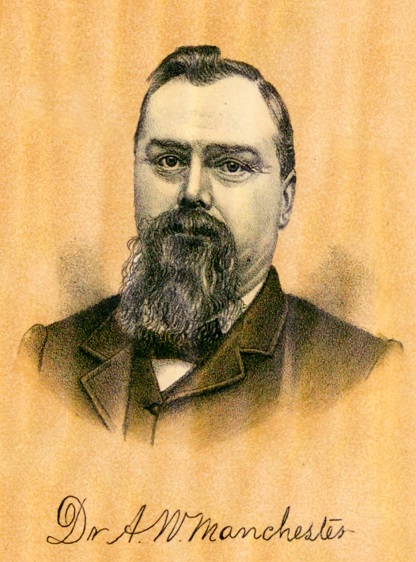
DR. A. W. MANCHESTER,
of Walker, is one of the most prominent and popular physicians of Linn
County. He is a native of Rhode Island, born Jan. 9, 1847, and
came to Illinois when but a lad. He only remained here but a
short time, however, returning to New England after two years, and
locating in Massachusetts, where he remained for eight years. He
then turned his face westward once more, and came into Iowa, where he
completed the education which he had begun in the East, by attendance
at Cornell College. He studied medicine with HI. W. Sigworth at
Wanbeck, Iowa, for about three years, and also attended a course of
lectures at Iowa City. He was a close student, and deeply
interested in the intricacies of his future calling. He began his
practice at Walker, which he has continued successfully for twelve
years, building up a large patronage and securing hosts of personal
friends.
Dr. Manchester and Miss Alice
Barnes were united in marriage, May 19, 1875. Mrs. M. was born in
Stephenson County, Ill., May 31, 1857, and has become the mother of two
children – George E. and Gifford W.; the latter is deceased.
Dr. Manchester built the first drug-store in this village twelve years
ago. He has accumulated considerable property, and has a
comfortable homestead in Walker. He is a practitioner of the
regular school, and is well-read and scientific in his practice.
Politically he votes uniformly with the Democratic party.
Dr. Manchester is known far and wide, and his many friends will lie
gratified upon seeing his portrait in this volume. He may justly
be classed among the representative professional gentlemen of this
county.
Source of portrait and biographical sketch (verbatim
transcription): “Portrait and Biographical Album of Linn County,
Iowa”, 1887, biographical sketch on page 297, portrait on page 296
Submitted by : Eric & Marcia Driggs
ALVA MANN
One of the most progressive and
successful agriculturists of Linn township, is Alva Mann, who is the
owner of a beautiful farm on sections 8, 16 and 17. His entire life
has been passed in this township, where he was born on the 11th of
November, 1843, his parents being Adam and Jennie (Whitlach) Mann, who
were honored pioneers of Linn county. His father was a native of
Greene county, Pennsylvania, and continued his residence in that state
during his boyhood and youth. When a young man he went to Ohio, where
he lived for four years, and then came to Iowa, crossing the
Mississippi eight miles from Muscatine, at Pine Creek, August 8, 1837.
On this trip he was accompanied by his parents, David and Nancy Mann,
who located on a farm in Greenfield township, Jones county, where they
made their home until death.
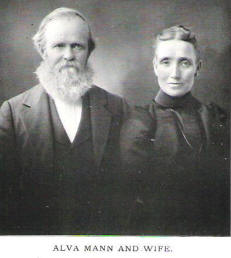
Adam Mann remained with his parents in
Jones county until 1840, when he came to Linn county, and took up his
residence on section 8, Linn township, where he entered one hundred
and sixty acres of land from the government. He at once commenced to
break and improve his land, and in his farming operations here he met
with marked success, owning at the time of his death nearly five
hundred acres of valuable land in Linn township, though he had already
given some of his children farms. In connection with general farming
he carried on stock raising to some extent. He voted the Democratic
ticket, and was an earnest and consistent member of the Baptist
church, as is also his wife. He died on the old home place, October 6,
1889, at the age of sixty-five years, but she is still living in Linn
township at the age of seventy-six, and enjoys good health. She is a
native of Ohio, and a daughter of John W. and Annie (Mann) Whitlach.
Her father was engaged in farming in Linn township for a great many
years, but shortly before his death removed to Nebraska, where he
passed away about twelve years ago. His wife has been dead
twenty-three years.
The subject of this sketch is the second
in order of birth in a family of seven children, the others being as
follows: Katherine married John A. Kearns, who died in June, 1900, and
she resides on a farm in Linn township; Hamilton died at the age of
two years; William B. is a farmer of southern Kansas; Stephen married
Lucy Coleman and died in Linn township, this county, January 22, 1892,
leaving a widow and three children, who reside on the homeplace on
section 10; Nirah is the wife of William Lacock, of Linn township; and
Addie is the wife of Abner Lacock, a farmer of the same township.
Alva Mann grew to manhood upon the home
farm and was educated in the district schools of Linn township. He
started out in life for himself upon his present farm, a part of which
was given him by his father, it being a valuable and well improved
tract of one hundred and ninety-five acres, which he has placed under
a high state of cultivation and improved with good buildings. He has
given considerable attention to the raising of stock, and being a man
of good business ability and sound judgment, as well as a systematic
and practical farmer, he has met with well-deserved success in his
undertakings.
On the 24th of June, 1874, in Franklin
township, Mr. Mann was united in marriage with Miss Alicia Coleman, a
daughter of Elisha and Rebecca (Carr) Coleman, both now deceased. Her
father followed farming in Franklin and Linn townships for a number of
years, and then moved to Nebraska, where he lived for some time, but
his last days were spent in Kansas, where he died at the age of
seventy-three years. Her mother departed this life in Nebraska at the
age of sixty-nine. In the family were nine children of whom seven are
still living. One of these is Lucy, widow of Stephen Mann, previously
mentioned.
Unto Mr. and Mrs. Man were born five
children, namely: Lena and Stella, both of whom are at home; Bertie,
wife of Otto Dunlap, a cooper of Springville, Brown township, Linn
county; Lillian, who died at the age of sixteen years; and Deverre, at
home.
During Mr. Man's boyhood Linn county was
but sparsely settled, and he well remembers when much of the land was
still in its primitive condition and wild game of all kinds was
plentiful. He has seen the wild land transformed into highly
cultivated farms, and in the work of development and upbuilding has
ever borne his part, being one of them who has materially aided in
making the county what it is to-day - one of the richest agricultural
districts in the state. In his political vies he is a Democrat, and in
religious faith is a Presbyterian, having long been an active and
prominent member of the church at Paralta, as well as one of its
trustees. His fellow citizens hold him in high esteem on account of
his honorable and upright life, and he commands the confidence and
respect of all who know him.
Source:
The Biographical Record of Linn County Iowa, Illustrated,
Chicago: The S. J. Clarke Publishing Company, 1901, pages 360-363.
Submitted by: Terry Carlson
E. L. MANSFIELD, M. D.
Prominent, not only in the medical
profession, but among the business men of Cedar Rapids, for many
years, was the well-known figure of Dr. E. L. Mansfield. He was a
native of Athens, Ohio, and a graduate of the Western Reserve College,
Cincinnati. Having practiced medicine in this native State about two
years, he came to Cedar Rapids in 1847 to make it his permanent home.
At one time he was in partnership
with Dr. S. D. Carpenter, and in later years with other physicians;
but for many years he practiced his profession alone. While some of
his partners early turned aside into other channels of business, he
continued the practice of medicine with unflagging devotion for
thirty-five years.
During the latter part of his life,
I believe, he gave less attention to the practice of medicine, and
devoted more time to business matters in other channels.
He operated to a considerable extent
in real estate, and erected some large buildings which are at this
time recognized as ornaments in the city. He was connected with the
banking and manufacturing interests of the city, and the ample fortune
which he secured, is proof sufficient of his business sagacity.
One characteristic of the doctor
was, that he was always very lenient with his patients who were unable
to pay for the services he had rendered them. This I can testify to
from my own personal knowledge of some cases.
And then I have this from his
daughter, Mrs. C. J. Deacon, which is a good illustration of this
trait in his character. When Mrs. Deacon was an infant only a few days
old, the doctor had a call to go to Boone to amputate a man’s leg. It
was before the days of railroads in that direction, and the doctor had
to drive his horse and buggy all the way there and back. Months and
years rolled away and the bill was never paid. Finally, after
twenty-one years, and the infant daughter had grown to womanhood and
was married, the bill was paid without interest, and the doctor
invested the amount in a silver pitcher, which he presented to his
daughter, to pay for leaving her so suddenly and on such a long
journey, when she had only looked out upon this strange world but
three or four days.
He died very suddenly, May 26, 1887.
One day he was riding out in the country north of town on business,
and when near the residence of Mr. Wm. Hunter, some three miles out,
Mrs. Hunter observed the horse and carriage go by and then suddenly
stop under a tree, and surmising that something was wrong, she went
out to see what was the matter, when to her dismay, the doctor was
found to be quite dead. The cause of his death was supposed to be
apoplexy.
Source: Carroll, George R.,
Pioneer Life In and Around Cedar Rapids, Iowa From 1839 to 1849.
Cedar Rapids, Times Printing and Binding House. 1895. Pages 133-135.
Submitted by: Terry Carlson
REV. DR.
JAMES MARSHALL
Rev. Dr. Marshall Passes Away This
Morning. His death the sudden result of an attack of pneumonia -
his work at Coe College prospered under his guidance - Active during
the war.
Cedar Rapids people were much surprised this morning when the
announcement was made that Rev. Dr. James Marshall, president of Coe
college, had died after only two days' serious illness at St. Luke's
hospital. Very few were even aware of his illness, as no mention of
the same had been made in any of the papers. Dr. Marshall attended
the Grand Army reunion at St. Paul last week and from there went to
White Bear Lake in order to meet several young people who were
contemplating attending the college this fall. While there he took a
severe cold and when he reached this city Tuesday evening he was
suffering intensely from the same. He went to his home for the night
and remained there alone until the next day when his illness became
so serious that he came down town for medical assistance. He was at
once taken to the hospital where he was given all possible care, but
pneumonia had developed in a most aggravated form. Last evening the
physicians practically gave up hope of his recovery and at 10
O'clock this morning he breathed his last.
Dr. Marshall came to this city nine
years ago from New York state in order to take the presidency of Coe
College. He has occupied that position ever since, and during his
brief stay in the state has become one of its best known educators.
He was enthusiastic in his educational work and much devoted to the
interests of Coe College. He was a man of broad, liberal education
who gave much attention to public matters. He served with
distinction in the army as an officer and was a member of the G. A.
R. and Loyal Legion. He has delivered several addresses before
veteran associations and at meetings of the Loyal Legion, his
favorite subject being General Grant. His lecture on that famous
military leader has been regarded as one of the best that has ever
been delivered.
Dr. Marshall spent a part of the summer
in the east and would have remained there until near the opening of
the fall term of the college, but was called back to attend to
important business connected with the institution. He was very
hopeful of the future of the college and had been daily visiting
since his return, various places in order to induce students to come
here to secure an education.
Dr. Marshall was much loved and always
respected by the students of the college. His influence led them to
hopeful anticipation of the highest ideals of life. He was not only
scholarly but his mental attainments were tempered by deep piety;
not that which makes men distrusted by the people, but that which
wins respect and admiration. He was not a theorist. He had the rare
faculty so often lacking in educators, of distinguishing between
realism and that which is capable of standing the test of every day
life. He separated the practical from the theoretical and directed
his students how to use their attainments in the great struggle of
actual life.
His influence in this city has been of
the best. He has won for Coe college not only the cordial support of
the Presbyterians of northern Iowa, but has placed Coe college in a
position that is seldom reached by an institution of its age and
surroundings. He made high scholarship and not numbers the end to be
attained, and the standing of the college in the state proves how
well he succeeded.
Only a few days ago he had a long talk
with a Gazette representative. He told of his difficulties; how they
had been overcome, and complimenting the board of trustees for their
ever ready support, expressed anticipation of still better things
for Coe. About four years ago Mrs. Marshall, his devoted wife was
called away. No children survive them.
James Marshall was born in Grove
township, Alleghany county, N.Y., Oct. 4, 1834, of Scotch-Irish
ancestry. His grandfather, a native of Pennsylvania, was a patriot
soldier in the revolutionary war, who, early in the nineteenth
century, settled in Livingston county, N.Y., near Conesus lake,
where he raised a large family of children. His father, the eldest
son, was born in Pennsylvania, but removed with the family to New
York state, and served as a soldier in the war of 1812. After this
he was married to a daughter of Samuel Stilwell, one of the early
settlers of the Genesee valley, who was a son of Daniel Stilwell, a
revolutionary patriot, who served with Washington at Monmouth and
Trenton. She was, on her mother's side, descended from the Tennents
of New Jersey, who founded the Log college at Neshaminy, Pa., the
foundation of Nassau hall, afterwards Princeton college. Upon their
marriage they located in Alleghany county where James was born, but
removed the next year to near the homestead at Conesus lake. Here
the son was debarred from the advantages of rapid progress at
school, as a widowed mother and a large family of brothers and
sisters were to be provided for. Health, purpose, economy and
self-reliance removed the obstacle, and the district school,
academy, seminary and teaching when seventeen years old, with hard
work out of school hours, placed him at the very door of college,
but with no surplus fund to carry him through the course. He
therefore went to Akron, Ohio, and served as clerk for an elder
brother and from there to Salem, Ohio, to take charge of a branch
store. While at Salem Louis Kossuth passed through the town on his
visit to America, and young Marshall was selected by the committee
of the town as the orator to welcome the Hungarian patriot. He took
up the study of law at Akron, and in September, 1853, was
matriculated at Yale college, and was graduated in the class of 1857
an A. B. His partial support during his college course was derived
from selling books during vacations, and this labor somewhat
interfered with consecutive study. At Yale he took two prizes, one
in debate, in a contest with the class of 1856, and one in oratory
in his own class.
In 1857 Mr. Marshall studied law in
Syracuse, N.Y. His life purpose was, however, changed while he was a
law student, and he entered into active educational and religious
work, refounding the Y. M. C. A. in Syracuse, establishing city
missions and organizing the first city mission Sunday school, called
the "Scatter-good," which was the foundation of the present Syracuse
Memorial Presbyterian church. He gave up the study of law and opened
a school for girls and young women which was eminently successful.
In 1861 he entered the theological seminary at Princeton, studying
the first year in the class of 1864. In the spring of 1862 he went
to Washington, D.C., under the auspices of the American Tract
Society, to teach refugees in that city and Alexandria, having been
ordained an evangelist by the presbytery of Onondaga in June, 1862.
He received a commission from President Lincoln as chaplain in the
United States army in July, 1862. He was on duty as a United States
army chaplain in the Chesapeake general hospital near Fortress
Monroe for four years, being mustered out of the United States
service in April, 1866. His services at this period were very
important and form an eventful chapter in hospital life during the
war. He secured the aid of Miss Dorothy L. Dix, Dr. S. L. Abbott and
other philanthropists, and was associated with Rev. E. P. Roe in
giving Christian burial to over 6,000 soldiers' bodies and gathering
them into graves which afterwards became a national cemetery, in
which, by his effort, was erected a monument seventy-five feet high,
costing $15,000. Dr. Marshall then spent three years abroad in study
and travel. He took a four years' course in theology in the New
College of Edinburgh, also studying in Heidelberg, Berlin, Paris and
London. He returned to the United States in 1869 and founded and
became pastor of the Westminster Presbyterian church at Troy, N.Y.
In 1872 he accepted the charge of the
First Presbyterian church, Hoboken, N.J. In 1876 he took up his
residence in New York city as pastor of the DeWitt Memorial church,
built through Mr. Marshall's efforts by Maurice K. Jesup, at an
expense of $80,000. He made in this church a new departure in city
evangelization, in the poorer districts of the city, among the great
middle class. As a traveler he studied Edward Dennison's work in
London, and this knowledge was of great value in his New York City
work among the middle and lower classes. He helped to organize and
was the first president of the Lebanon club for working men, the
first of its kind in New York City, and which afterwards became so
effective in rescue work. He planned it after the coffee house work
in England combining the coffee house music hall, amusement hall,
library, reading room and lecture course. His health failing in 1883
he had to relinquish his New York City work and seek rest in the
family home in Nunda, N.Y. While recuperating he declined the
presidency of Ingham University, LeRoy, N.Y., and of Blairstown
Presbyterian academy, New Jersey. In May, 1887, he accepted the
presidency of Coe college and under his direction it has enlarged
all its lines of educational work. It now has a fine corps of
instructors and 150 students, with a library of several thousand
volumes and a large museum. All departments are fully equipped for
the best college work. Mr. Marshall was married October 3, 1866, to
M. Jeanne, Daughter of Robert McNair, of Morris, N.Y. She was his
companion in his studies and travels abroad and his efficient
co-worker in his pastoral and college work at home up to the time of
her death. Lenox college conferred upon him the degree of D. D. in
1887. Among his published addresses and writings are "The Grounds of
National Confidence," "Workingmen's Clubs," various sermons on the
war, published while an army chaplain, Eulogies on Lincoln, Grant,
F. C. Hormel, Robert Thompson Soutter and others; baccalaureates
delivered to bodies of students from 1888 to 1894 and many magazine
articles on living subjects, which entered into his varied and wide
experience as a student, a traveler and army chaplain, a pastor, a
missionary to the poor in a great city, a teacher and a college
president; in all of which positions he was eminently successful,
and in none more so than in the high and responsible position of
college president.
Source: The Coe College Cosmos, Cedar
Rapids, IA October, 1896 p. 3-6. Vol. VII. NO. 1.
Submitted by: Terry Carlson
BURGESS MARTIN
Burgess Martin, who devotes his attention to the operation of a well
improved and valuable farm of eighty-six and a half acres in Marion
township, is a native of England, his birth having occurred in that
country on the 28th of February, 1848. His parents, William and Ann
Martin, spent their entire lives in England. Their children were nine
in number, six of whom are yet living.
Burgess Martin remained a resident
of his native land until he had attained his majority. In 1870, having
determined to establish his home in the new world, he crossed the
Atlantic to the United States and located in Michigan, where he
resided for two years. Since leaving the Wolverine state he has made
his home in Linn county, Iowa, the period of his residence here
therefore covering thirty-eight years. He secured employment as a farm
hand and at the end of four years had accumulated sufficient capital
to enable him to purchase land of his own, coming into possession of a
tract of eighty-six and a half acres adjoining the city limits of
Marion. As the years have gone by he has made many improvements on the
farm and its splendid appearance indicates his careful supervision,
progressive methods and practical ideas. Excellent crops are annually
harvested in return for the cultivation bestowed upon the fields.
On the 20th of December, 1872, Mr.
Martin was united in marriage to Miss Sarah Cory, likewise a native of
England and a daughter of William and Elizabeth Cory, who were also
born in that country. They emigrated to the United States at an early
day and spent the remainder of their lives in this county. Unto Mr.
and Mrs. Martin were born seven children, namely: Charles, living in
Linn county; May, the wife of Henry Vahl; Oscar, who is a resident of
South Dakota; Clarence, of this county; Florence, a graduate of the
Marion high school, who is still at home; and two who died in infancy.
The wife and mother was called to her final rest in April, 1902, her
remains being interred in the Oak Shade cemetery. Coming to this
country in early manhood, Mr. Martin found the opportunities he sought
and through their wise utilization has gained a place among the
prosperous and respected citizens of his community.
Source:
History of Linn County Iowa, From Its Earliest Settlement to the
Present Time, Vol. II, Chicago, The Pioneer Publishing Company,
1911, p. 185.
Submitted by: Terry Carlson
JAMES MARTIN
In 1849 Mr. James Martin, with his
wife and four children, Elmira, George, Lizzie and Nathaniel H. came
to this place from Calaise, Maine. They have always been numbered
among our best people. For many years, Mr. Martin was employed about
the flouring mills, and the family kept a boarding house where all the
comforts of a home were enjoyed by its patrons. Mr. Martin was quiet
and unobtrusive in his manners, but he was a man of intelligence and
of unimpeachable integrity of character.
MrS. Martin was one of those
motherly, kindhearted women that every body loved to meet. In times of
sickness and bereavement she was always present with loving words of
sympathy and willing hands to help. At such times here discreet
counsels and her wise and loving ministrations were invaluable to the
many anxious and suffering ones who sought and obtained her help in
those times of need.
Mrs. Martin, and I believe all of
the children were members of the Methodist church. She died April 24,
1884. Mr. Martin departed this life at LaCross, Wisconsin, at the home
of his daughter, Mrs. Elizabeth Gault, October 22, 1889.
Miss Elmira, one of our purest and
noblest Christian characters, died at the same place as that of her
father, January 21, 1894. The remaining two children, George and
Nathaniel H. are residents of this city, the former a well known
conductor on the B., C. R. & N. Ry. And the latter a commercial
traveler for one of our business houses.
Source: Carroll, George R.,
Pioneer Life In and Around Cedar Rapids, Iowa From 1839 to 1849.
Cedar Rapids, Times Printing and Binding House. 1895. Pages 176-7.
Submitted by: Terry Carlson
HENRY E. MASON
Henry E. Mason, who is an enterprising and successful farmer of
Bertram township, was born in Fairfield county, Ohio, on the 4th of
October, 1851, a son of Robert and Susannah (Brauneller) Mason. The
father was a native of Virginia, while the mother was born in the
Buckeye state. They spent their married life in Ohio and to them were
born ten children of whom four are deceased. With the exception of
Henry lit all the others live in Ohio. Both the parents are now
deceased, their death occurring in that state.
Henry E. Mason was reared in the
state of his nativity and assisted his father in his work until he had
reached the age of twenty-six years. He then rented land in Ohio,
which he operated for ten years, and subsequently sought the broader
opportunities of the middle west, coming to Linn county, Iowa. He has
made farming and stock-raising his work since coming to this state and
now rents a farm of two hundred and forty acres in Bertram township.
Mr. Mason was married to Miss Clara
Sawyer, a daughter of William and Isabel Sawyer, both of whom died in
Ohio. Mrs. Mason is one of six children born to her parents, of whom
four are now living, the other three making their home in Ohio. Unto
Mr. and Mrs. Mason have been born three children: Valid
F., who married Flora Munn and lives at home; Orval C., who married a
Miss Walters and lives in Bertram township; and Merrill M., still
under the parental roof.
In politics Mr. Mason is a
republican and his fellow townsmen have called upon him to fill a
number of local offices. He has served as alderman of Mount Vernon,
has been school director and at the present time is serving as trustee
of Bertram township. His fraternal relations connect him with Mount
Vernon Lodge, No. 551, I. 0. 0. F., in which he has filled the chair
of noble grand. Both he and his wife are members of the Presbyterian
church, in which he has served as trustee. Mr. Mason is a man of worth
in the community in which he makes his home. He takes a deep interest
in public affairs, lending his aid and influence in the cause of every
good movement and heartily promoting the progress and advancement of
his locality.
Source:
History of Linn County Iowa, From Its Earliest Settlement to the
Present Time, Vol. II, Chicago, The Pioneer Publishing Company,
1911, p. 737.
Submitted by: Terry Carlson
BENJAMIN MATHES
This well-known resident of Marion is one of the leading German-born
citizens of the place, and in his successful career he has shown the
characteristic thrift and enterprise of his race. Beginning with no
capital except that acquired by his own industry, he met with
excellent success in his farming operations for many years, and is now
living retired.
Mr.
Mathes was born near Frankfort-on-the-Main, Germany, February 11,
1831, and is a son of Nicholas and Barbara (Fischer) Mathes, natives
of the same place, where as farming people they spent their entire
lives, the father dying at the advanced age of ninety-six years, the
mother at the age of eighty-eight. Religiously they were members of
the Lutheran church. They were parents of six children, namely:
Margaret, Mary and Philip, all deceased; Nicholas, who came to Linn
county, Iowa in 1856, and died here in 1889; Dorde, wife of Lewis
Cager, of Johnson county, Iowa; and Benjamin.
The
subject of this sketch was reared and educated in his native land, and
prior to coming to America he worked for one firm four years in the
wholesale grocery business and the manufacture of soap and candles.
It was in 1851 that he crossed the broad Atlantic and took up his
residence in Lancaster county, Pennsylvania, where he was in the
employ of the Safe Harbor Iron Works until August, 1855. The
following two months were spent in Dubuque, Iowa, and at then end of
that time he came to Marion with his brother and others. He brought
with him three hundred dollars in gold, which he invested in city
lots. After working for other for five years Mr. Mathes purchased a
team and commenced breaking prairie. Subsequently he rented the Judge
Walch farm in Marion township for two years, and at then end of that
time purchased the place. As a farmer and stock raiser he met with
marked success, and at one time owned three hundred acres of valuable
and well-improved land in this county, which he sold on his removal to
Marion in the fall of 1888, and has since laid aside all business
cares, enjoying a well-earned rest. His present elegant home was
built by him in 1897 at a cost of three thousand dollars.
On
the 2d of July, 1859, in Marion, was celebrated the
marriage of Mr. Mathes and Miss Anna Schmidt, who was also born in
Germany, and came to this country when fourteen years of age. Unto
them were born the following children: Lizzie, wife of Sylvester
Walser, a farmer of Otter Creek township, this county; Charles, a
farmer of Johnson county, Iowa, whose wife, Minnie Grieshopper, died
in September, 1895; Benjamin F., who married Ada Strucker, and follows
farming in Otter Creek township, Linn county; John, who married Anna
Cannon, and is employed in a hardware store in Marion; Lewis E., who
married Flora Carpenter, and is clerking in a grocery store in Marion;
and Robert Wesley, at home.
In
his religious belief Mr. Mathes is a Lutheran, and in his political
affiliations is a Republican. He has served as a delegate to the
conventions of his party, and has most capable filled the office of
school director, giving his unqualified support to any enterprise
which he believes will advance the moral, educational or material
welfare of his adopted county. He has always been a very steady,
hard-working man, and well deserves the success that has come to him.
Source:
The Biographical Record of Linn County Iowa, Illustrated, Chicago:
The S. J. Clarke Publishing Company, 1901, pages 145-146.
Submitted by:
Carrie J. Robertson of Marion
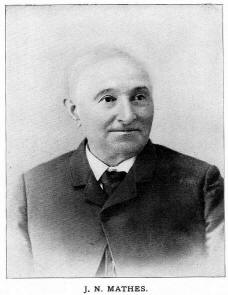
JOHN NICHOLAS MATHES
John
Nicholas Mathes, deceased, was for several years an honored and highly
respected citizen of Linn county, his last days being spent in the
city of Marion, where he died on the 24th of October,
1889. A native of Germany, he was born near Frankfort-on-the-Main
November 13, 1825, his parents being Nicholas and Barbara (Fischer)
Mathes, who were life-long residents of that place. The father, who
was a farmer by occupation, died at the advanced age of ninety-six
years, and the mother passed away at the age of eighty-eight.
Religiously they were members of the Lutheran church. Their children
were Margaret, Mary, Philip and John Nicholas, all deceased; Dorothy,
wife of Lewis Zanger, of Johnson county, Iowa; and Benjamin, who is
represented on another page of this volume.
The
subject of this sketch grew to manhood in Germany, and in 1849
emigrated to the new world, locating first in Columbia, Pennsylvania,
where he was engaged in mining for two years. He was next employed in
the iron works at Safe Harbor, that state, until 1855, when he and his
brother Benjamin came west. After spending the winter in Dubuque,
Iowa, they came to Linn county in the spring of 1856, and our subject
engaged in teaming in Marion until 1862, when he purchased a slightly
improved farm of one hundred and twenty acres in Otter Creek
township. To the further improvement and cultivation of that place he
devoted his time and attention for seven years. On selling that farm
in 1869, he bought two hundred and eighty acres of land in Long Grove
township, eighty acres of which had been placed under cultivation, and
he continued to engage in agricultural pursuits on that place until
his removal to Marion in 1874, making his home there until his death.
There he dealt in wood and also engaged in teaming to some extent. He
was very industrious and energetic, and developed one of the best
farms in Linn county.
On
the 4th of May, 1851, in Columbia, Pennsylvania, Mr. Mathes
married Miss Anna Mary Darmstetter, who was born March 20, 1826, near
his birthplace in Germany, and came with her mother to America in
1850. Her father, George Darmstetter, died in Germany. The other
children of his family were George, who died in Germany; Barbara Mary,
deceased; and Katie, wife of Mark Swain, of Chicago. Of the several
children born to Mr. and Mrs. Mathes all died young with the exception
of two, namely: Kate married William Corum, who died in 1885, and she
departed this life in 1873. They had two children: William, who died
at the age of three years; and Anna Frances, wife of John Mathes, by
whom she has one child Anna Bernice. Benjamin, son our subject, died
at the age of fourteen years.
Mr.
Mathes and his family held membership in the Evangelical Lutheran
church of Marion, and were among the most highly respected citizens of
the community. He led an honorable and useful life, and due success
was not denied him, so that at his death he was able to leave his
widow in comfortable circumstances. She is a most estimable lady, and
has a large circle of friends and acquaintances in Marion.
Source:
The Biographical Record of Linn County Iowa, Illustrated, Chicago:
The S. J. Clarke Publishing Company, 1901, pages 180-183.
Submitted by:
Carrie J. Robertson of Marion
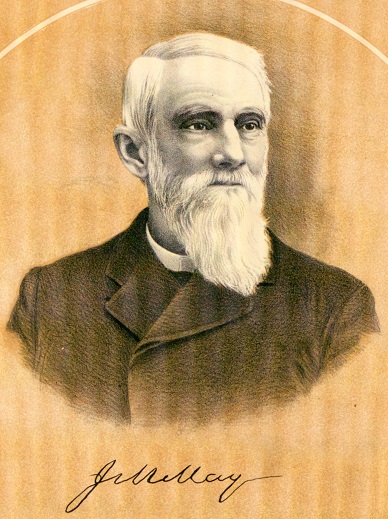
COL. JOHN M. MAY,
one of the leading citizens of Cedar Rapids, Iowa, and whose portrait
is given on the opposite page, is known throughout the country for his
enterprise, worth, integrity and liberality. He was born in
Washington County, N. Y., and is a son of Ellis and Mary (Wells) May,
natives of Dedham, Mass., and Cambridge, N. Y., respectively, and who
were married in 1797. The father of our subject was born in 1772,
aud his wife in 1778. They settled on a large farm adjoining
Union Milage, Washington Co., N. Y., where all their children were
born. A thorough and prosperous farmer, adding farm to farm, and
a Deacon in the Presbyterian Church, he was social, hospitable and
philanthropic in a marked degree, and lived a married life of more than
fifty-five years. He and his wife reared to manhood and womanhood
twelve children, only three of whom are now living: Philander F., of
Nashua, Iowa; John M.. of this county, and Lucius S., of Rochester, N.
Y. Few families had more careful culture and religious training
by pious parents than that of our subject. The eldest brother
became an able and highly-esteemed Presbyterian minister; two others
were judicious medical practitioners, and all were respected and useful
citizens.
Col. John M. May was educated for the legal profession, and practiced
chiefly in the Federal courts, making a specialty of patent cases, in
which department of jurisprudence lie achieved marked success.
His taste for this branch of the profession was awakened at an early
age by listening to the great Daniel Webster in appealed patent cases,
in the Supreme Court of the United States (full bench), in the city of
Washington, notably the celebrated Woodworth Planing Machine patent
cases, so long in litigation and involving large sums of money.
Thus fostered, with his skill and knowledge of the mechanical arts, he
possessed great advantages.
Col. May has done much in inventing and bringing into use many valuable
improvements of his own, besides securing patents for others.
There have been issued to him by the United States Patent Office over
twenty patents of his own inventions, including steel plows, pumps,
wind-mills, corn-planters, quartz-rock crushing machinery, oscillating
barbs for wire fence to prevent the laceration of animals coming in
contact, yet retaining their repelling qualities, railroad rails and
railroad wheels and axles. He is now engaged in perfecting his
automatic railroad trucks, for obviating the friction of wheels against
rails on curves on the allignment of railroads, and has built a few
hundred feet of railroad track for conducting his experiments.
When residing in Wisconsin Col. May was a successful manufacturer of
agricultural implements, especially his steel plow, that obtained great
popularity and was the leading plow as early as 1850, taking the first
premium in the city of Chicago, in sharp competition, at the third
annual fair of the Chicago Mechanics' Institute. He also
established a literary and family newspaper, the Northwestern Advance,
in the city of Janesville, Wis., removed it to Milwaukee, conducted it
successfully for three years, making it "metropolitan in every
respect," and sold it to parties in that city.
The subject of our sketch is a member of the Congregational Church, and
a liberal giver to all institutions of merit, and has never been known
to turn a deaf ear to true charity, a trait inherited from his revered
parents. When times are hard and work difficult to procure he
contrives some useful employment for willing hands, thus earning the
“richest of crowns – the blessings of the poor." With the
temperance movement he has ever been identified. He was initiated
into the Sons of Temperance order at Philadelphia. Pa., at its early
organization, and became the Grand Worthy Patriarch of the Grand
Division of Wisconsin, on his removal to that then Territory, and
personally organized twenty subordinate divisions. The order
flourished many years, and was succeeded by the Good Templars, the more
excellent ritual and efficiency of the latter meeting his hearty
approbation, and he was for many years one of its Worthy Chief
Templars. These organizations and their noble work are
reminiscences that he cherishes. With the Masonic and I. O. O. F.
institutions Col. May was also identified, and built for them their
first hall in his adopted city. Later his work in the Masonic
fraternity was chiefly in the Chapter and Commandery, ever deeming the
salutary influences of these several orders second only to that of the
Church and the Bible. With the Republican party he has been
identified since its organization, and has always taken a deep interest
in its success, cheerfully sharing its burdens.
One of his elder brothers, skilled in military tactics, taught classes
in the use of arms, particularly the sword exercise.
Our subject held commissions from two of the Governors of the State of
New York as a staff officer, with the rank of Major, before the
memorable “go West, young man” was promulgated; and in Wisconsin, in
its Territorial days, held a like commission, and after it became a
State, and its military organization completed, he was commissioned a
military engineer, on Maj.-Gen. Sutherland's Staff, with the rank of
Colonel. This was during the Southern Rebellion, at a time when
another call for troops was expected, but the Rebellion was approaching
its culmination and failure. In the early years of the war
Congress passed a law that those not liable to draft could send
representative recruits, if they chose, to fill the depleted ranks of
the armies at the front. Col. May and two of his fellow-citizens
sent each a recruit at a cost of $1,000 each, besides contributing
freely for the boys in blue.
Col. May has always been a bold and sagacious real-estate operator,
first at Belmont on the Genesee River, at a point where the N. Y. &
E. R. R. crosses that stream, where he laid out a town on the opposite
side of the river from Belmont, giving it his middle name, Milton,
which was afterward incorporated into the town of Belmont, and is now
one of the finest portions of the city. Here was his first and
successful experience as a railroad contractor, under the original N.
Y. & E. R. R. corporation; next at Janesville, Wis., by laying out
an addition to that city, and building extensively; next in Cedar
Rapids, Iowa, in 1853, when he came to this city and purchased land and
lots, remaining but a short time, returning' annually and making more
purchases,
and finally, in 1874, came to reside permanently, taking an active part
in its development. He has laid out one addition to the city of
Cedar Rapids, and eight or more additions to West Cedar Rapids, a name
that he secured for the West side by an act of the Legislature in 1855
at its last session in Iowa City. He also secured an act for the
first free bridge in the city, which was built and used to great
advantage, but was afterward destroyed by ice and flood. He also
laid out the town of May Island, on May's Island, of about six acres,
lying
between
Cedar Rapids and West Cedar Rapids, and connected with each by iron
bridges, also by a double track street railway. On this island he
has already expended about $25,000, largely in fortifying and
strengthening it. On the island now reside six families, and his
own office, fronting on Island avenue. About half its area is a
fine garden, and the balance is heavily timbered, which he preserves
with care. Many native song birds make it their summer home,
adding to its attractions as a summer resort, and to kill or even
frighten them is to incur the decided displeasure of the owner.
He has also laid out a town – Mayfield – on the B., C. R. & N. R.
R., adjoining the city of Cedar Rapids on the south. On this plat
there is an abundance of building stone, also exhaustless beds of
unexcelled clay, suitable for drain tile, pressed brick, sewer pipe and
pottery ware. The name Mayfield is given in honor of the
beautiful and wealthy English village of that name a few miles south of
London, to which his family ancestry is traced to the early date of
1640. We glean this from an elaborate volume, entitled “Genealogy
of the May Family,” a second and enlarged edition now in press.
He has projected a site for a manufacturing city, also, at the town of
Cedar Bluffs, on the Cellar River, in Cedar County. Iowa, about thirty
miles southeast from Cedar Rapids, having purchased farming and timber
land and extensive quarries of the Anamosa stone formation, and
organized a company for its improvement. The water-power here is
pronounced the best in the State for volume and safety. Situated
in one of the richest and best agricultural counties in Iowa, settled
by an intelligent, industrious and thrifty people, the Bluffs is
already quite a business center.
In Fairview Township, adjoining the city of Anamosa. in Jones County.
Iowa. Col. May has farming, timber and quarry lands, the latter
traversed three-fourths of a mile by the C. M. & St. P. R. R.
His benevolent disposition is indicated by his having already given ten
city lots as sites for manufacturing industries and for church and
Sunday-school purposes without denominational bias.
Substantially a self-made man. Col. May belongs to a class whose
characteristics in every-day life are patriotism, intelligence and
integrity.
Source
of portrait and biographical sketch (verbatim transcription):
“Portrait and Biographical Album of Linn County, Iowa”, 1887,
biographical sketch on pages 759 - 761, portrait on page 758
Submitted by: Eric & Marcia Driggs
DAVID McCLENAHAN, M.D.
Among Cedar Rapids'
honored and highly esteemed citizens is numbered the subject of this
sketch, who was for many years one of the leading physicians of the
city, but is now practically living a retired life, enjoying a rest
which he has truly earned. He came here in 1866 from Guernsey county,
Ohio, and at once became prominently identified with the interests of
the city.
The Doctor is a
native of Ohio, born in New Athens, Harrison county, January __, 1821,
and is a son of John and Mary (Urey) McClenahan, who were born in
Ireland of Scotch-Irish parentage. Throughout life the father followed
the occupation of farming and died in Fairview, Ohio, at the age of
seventy-four years. The mother was seventy-eight years of age at the
time of her death. In their family were eleven children, one of whom
died in early childhood, and all are now deceased with exception of
our subject. His brother Robert died in De Witt, Iowa, in 1900, aged
ninety-one years.
During his boyhood
Dr. McClenahan pursued his studies in the log schoolhouses then common
in Ohio, but his early educational advantages were rather limited. He
remained on the home farm, assisting in its work until twenty years of
age, when he entered Antrim College. Later he took a preparatory
course at New Concord, Ohio, and then studied medicine with Dr. James
Campbell, of Middletown, Ohio, for three years. He subsequently took a
course of lecturers at the Starling Medical College of Columbus, Ohio,
but during the rush to see the gold fields of California in 1849 he
made a trip overland with an ox-team, being enroute from May till
September, 1849, and spent about a year in the mines. On his return to
Ohio he completed his medical course and was graduated in the spring
of 1853 with the degree of M. D. from Starling. He was then engaged in
practice at Fairview, Ohio, until coming to Cedar Rapids in 1866.
Dr. McClenahan was
married, in Fairview, Ohio, in 1855, to Miss Parmelia Grier, who died
in Cedar Rapids July 20, 1894. They became the parents of four
children: Mary, Thomas, Martha and Rob - Mary died in June, 1900, at
the age of forty-one. William married Ella Cooper, and they have one
child, Margaret; and Robert married Edith Shakaker, and they have four
children; Mary, Thomas, Martha and Robert. Both are business men of
Cedar Rapids. [transcription
note: This paragraph appears to have been mistyped in the original]
The Doctor first came
to Iowa, in 1854 and entered land in Benton county, but did not locate
here until his removal to Cedar Rapids in 1866. This city was then a
small town of about five thousand inhabitants. Finding that there were
good schools for his children to attend, he decided to make this his
permanent home, and purchased property here. He was not long in
building up a large and lucrative practice, which in early days
extended to many surrounding towns and other counties, and he
continued to successfully engage in general practice until 1898, since
which time he has lived retired, though he still visits some of his
old patients who will have no other physician. For many years he was a
member of the Linn County Medical Society. He is one of the early
stockholders in the Water Company.
In early life Dr.
McClenahan was a Whig in politics and cast his first presidential vote
for Henry Clay, and since the dissolution of that party has been an
ardent Republican. He is an active and faithful member of the United
Presbyterian church, and has always been a liberal contributor to the
charitable institutions of the city, in Manner he is quiet and
unassuming, yet very popular, makes friends wherever he goes, and is
held in high regard by old and young, rich and poor.
Source:
The Biographical Record of Linn County Iowa, Illustrated, Chicago:
The S. J. Clarke Publishing Company, 1901, pages 60-61.
Submitted by: Terry
Carlson
WILLIS A.
McCONKIE, M. D.
The name of iM7cConkie has figured prominently in connection with the
medical profession of Cedar Rapids for twenty-two years and for much
of this time Dr. Willis A. McConkie has been a practitioner. Joining
his father, an eminent physician, his reputation rivals that of the
senior physician and his ability has gained him marked distinction as
one of the best informed and most capable practitioners of the city.
His birth occurred at Canal Winchester, Franklin county, Ohio, January
16, 1865. When two years of age he was taken by his parents to
Allegan, Michigan, where he lived for twelve years, acquiring his
early education in the schools of that place. He afterward was a
student for one year in the high school at Traverse City in Grand
Traverse county and subsequently entered the University of Michigan at
Ann Arbor, where he completed the classical course. Entering upon the
study of medicine in the same institution, he was graduated with the
class of 1889 and then came to Cedar Rapids to join his father who had
opened an office here the previous year. The partnership that was then
formed has since been maintained, although Dr. James J. McConkie has
practically retired from the profession, leaving the burden of the
practice upon the young man whose ever-increasing ability well
qualifies him for the onerous and responsible duties that devolve upon
the capable and conscientious physician. He has further qualified for
his chosen life work by a post-graduate course in Chicago in 1899 and
private reading and research keep him in touch with the most advanced
thought of the profession.
In 1892 Dr. McConkie was united in
marriage to Miss Mary Elsie McDaniel of Cedar Rapids and they have
become the parents of seven children, one of whom died in infancy,
while six are yet living. Dr. McConkie takes an active and helpful
interest in the welfare and growth of the city. He became a member of
the Presbyterian church in early life and is still identified
therewith as an active worker in the church and Sunday school.
His political affiliation for a few
years was with the prohibition party but of late years his support has
been mainly given to the republican party. Close attention has
precluded his active participation in political affairs, yet he is
never remiss in the duties of citizenship and aids in many progressive
public movements. Notwithstanding all this his attention is chiefly
fixed upon his chosen life work and he is deeply interested in
anything which tends to bring to man the key to the complex mystery
which we call life. In a profession where advancement must depend
entirely upon individual merit, he has made continuous progress and
held to high ideals and his course will undoubtedly be marked by
further advancement and higher professional attainments and success.
Source:
History of Linn County Iowa, From Its Earliest Settlement to the
Present Time, Vol. II, Chicago, The Pioneer Publishing Company,
1911, p. 50-1.
Submitted by: Terry Carlson
Godfrey
McDowell
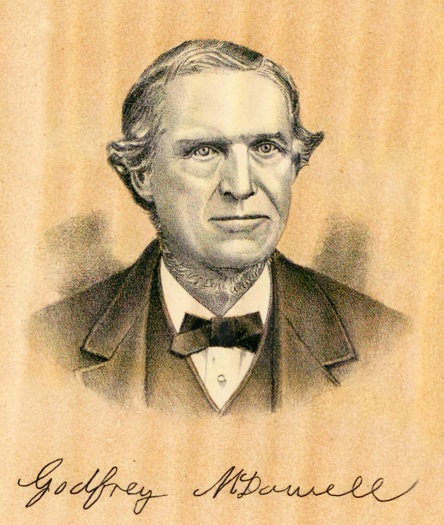 Among the names, of the sturdy pioneers who came to Iowa when
in its infancy and aided the young territory in establishing itself as
one of the future States of the Union, that of our subject is entitled
to a place in the front rank. He came here in the strength of his
young manhood, when his heart and hands were well calculated to begin
the battle of life with prospects of attaining success. The
country was very thinly settled upon his arrival here, and its solitude
was seldom broken except by the tread of the Indian and the wild
animals that sought shelter among the primitive forests.
The homestead farm of Mr. McDowell is finely located on section 1,
Fairfax Township, and consists of 240 acres. He is also the owner
of the undivided half of thirty-five acres on section 10, and twenty
acres within the corporate limits of Cedar Rapids. He is a
practical and enterprising farmer, and with his agricultural pursuits
has combined the raising of line stock, at which he has become very
successful, and produces some of the best grades of cattle to be found
in the county. The homestead is noted for its fine buildings, its
comfortable dwelling, and excellent barns, and everything about it is
of that substantial character which indicates ample means and a wise
judgment in its disbursement. Godfrey
McDowell is a native of Westmoreland County, Pa., and was born March
24, 1829. The name of his father was John A. McDowell. He
was a farmer by occupation and of German-Scotch ancestry. The
marriage of the parents occurred in Westmoreland County, Pa., and the
maiden name of the mother was Mary A. Keltz. She was also a
native of Pennsylvania, and it is supposed of similar ancestry to her
husband. They carried on agricultural pursuits successfully in
Westmoreland County, accumulating a good deal of property, and
terminated their lives there, having well earned the respect and esteem
of their neighbors and fellow-citizens. They were prominent
members of the Presbyterian Church, and in polities the father was an
old-line Whig. The subject of our sketch
remained at home with his parents until he arrived at man's estate,
when he became an apprentice to learn the carpenter and joiner's trade,
under Isaac Barron, of Westmoreland County. Pa. He served
faithfully for the space of two and a half years and became quite an
expert at his calling. He determined to seek his fortune in the
West, and arrived within the boundaries of the Hawkeye State in 1852,
locating for a time in Cedar Rapids City, soon after proceeding to
Fairfax Township, where he purchased a tract of land of eighty acres of
a brother who had preceded him to this vicinity. It was partly
improved, and Mr. McDowell immediately sel to work to further prepare
it for the raising of farm produce. At the same time he did not
abandon his trade, but pursued it whenever the duties of the farm
permitted. He has had a hand in the erection of many of the
important buildings in his township, and especially in his immediate
neighborhood. He has met with success in all of his important
enterprises, and has greatly aided in building up the community of
which he was one of the earliest members.
Godfrey McDowell and Miss Keziah Burkholder were united in marriage in
Westmoreland County, Pa., Feb. 1, 1855. Mrs. McDowell is a
Pennsylvania lady, and a native of Westmoreland County, where she was
born March 26, 1830. She remained in the home of her parents
until her marriage, receiving a fair education in the public
schools. Her father, Joseph Burkholder, was a native of
Pennsylvania, of pure German descent, and with the exception of ten
years passed in Iowa, spent most of his life there. He died in
the fall of 1880. The maiden name of his wife was Cloranna M.
Gelvin. She was a native of Franklin County. Pa., and died at the
home of her eldest daughter, Mrs. Campbcll, in Westmoreland
County, about the year 1876. Mrs. McDowell
was one of the elder children of her father's family, and by her union
with our subject four children have been born, viz.: Clara M., wife of
Frank Beebe, now living in Fairfax Township and operating a part of the
McDowell homestead; Martha A. is the wife of G. W. Ryder, a successful
farmer in Greene County, Iowa; Anna M. remains under the parental roof
and administers to the comfort of her parents; Joseph A. died when a
child of thirteen months. Mr. and Mrs. McDowell are members of the Presbyterian Church, and he has held some of the minor
offices of his township. He is a stanch Republican, and with his
amiable and accomplished lady occupies a high position in the
community. Source: Portrait & Biographical Record of Linn County Iowa, 1887, pages 457 & 458.
Submitted by: Eric & Marca Driggs
JOHN McHUGH
John McHugh,
deceased, was for many years one of the leading farmers and highly
respected citizens of Franklin township. He was born in Sligo,
Ireland, in June, 1825, and was educated in the national schools of
that country, but his school privileges were very limited. At the age
of nineteen years he emigrated to America, the voyage being made on a
sailing vessel and lasting over two months. He landed in New York and
soon obtained work on a fruit farm in New Jersey, though not far from
the eastern metropolis, which was the market place for the farmers in
the neighborhood. He remained there seven years, receiving four
dollars per month for his services.
In 1855 Mr. McHugh
came to Linn county, Iowa, and first located at Mr. Vernon, where he
worked by the day, often being paid in chickens, pigs, etc., for his
labor. At that time wild hogs, turkeys, prairie chickens and other
game was plentiful, and much of the land in this locality was still in
its primitive condition. He did his first farm work with a team of
oxen. As soon as he was able Mr. McHugh purchased eighty acres of
land in Franklin township, to which he subsequently added a tract of
twenty acres, and after residing thereon until 1884, when he sold that
place, and removed to the farm which his family still occupy. This
consists of two hundred and one acres on sections 23 and 26, Franklin
township, and to its cultivation and improvement he devoted his
energies until called to his final rest June 29, 1892. He was a
devout member of the Catholic church, and was buried in the Catholic
cemetery at Lisbon. In politics he was a Democrat, and he filled the
office of school director for a number of years.
About 1850 Mr.
McHugh married Miss Ann Kilkinney, a native of county Galway, Ireland,
who died in 1867 and was also buried in Lisbon. By that union he had
three children, namely: (I) Margaret, born August 20, 1857, is the
wife of John Butler, of White Oak, Greenfield township, Jones county,
Iowa, and they have three children, Edward, Mary and Alice. (2) Mary,
born November 15, 1851, died at the age of thirty years. (3)
Catherine, born January 3, 1862, is the wife of Fred Emerson, who
lives south of Tipton, Iowa, and they have six children, Ross, Clara,
Eva, Emily, Hiram and Stonerook.
Mr. McHugh was
again married, at Tipton, Iowa, April 27, 1879, his second union being
with Miss Annie J. Drury, who was born in Boyle, Roscommon, Ireland,
June 24, 1844, a daughter of Edward and Bridget (Murray) Drury, also
natives of Roscommon. The father died when Mrs. McHugh was only three
years old, and the mother subsequently married Patrick McCauly, of
Boyle, county Roscommon, where her death occurred in March, 1877. Mr.
McCauly died in 1890. Of the four children born of the first union
Mrs. McHugh is the only one now living. Those by the second marriage
were Winnefred, who died in Los Angeles, California, in April, 1893,
at the age of forty years; James died in St. Louis, Missouri, in the
fall of 1887, at the age of thirty-eight years; Mary is the wife of
Michael H. Duggan, of Los Angeles; Bessie is a resident of San
Francisco, California; Patrick married Margaret Brown and lives at
Delmar, Clinton county, Iowa; and Ann is the wife of Thomas Boyton, of
Boyle, county Roscommon, Ireland.
By his second
marriage Mr. McHugh had two children, but the older died in infancy.
John Edward, born March 2, 1881, was educated in the district schools
near his home and the Mt. Vernon high school. He is now managing the
home farm, and is one of the most energetic and successful young
farmers of Linn county. He raises a high grade of horses, cattle,
sheep and hogs for market, but notwithstanding his numerous farm
duties he still finds time to devote to literary pursuits, and is a
well-informed young man. He is a member of the Catholic church of
Lisbon, and a supporter of the Democratic party.
Source:
The Biographical Record of Linn County Iowa, Illustrated, Chicago:
The S. J. Clarke Publishing Company, 1901, pages 72-3.
Submitted by:
Carrie J. Robertson of Marion
ANDREW J. McKEAN
Andrew J. McKean was born in Bradford County, Pennsylvania, October
3, 1816. His ancestors were from Scotland, and settled in Maryland
about four generations ago, and are now scattered over several
states of the Union. His grandfather resided a long time in
Pennsylvania, where he died many yhears ag, leaving a family. His
father, Robert McKean, married Martha Wilson, and had eight
children. He died about 1826, and his wife in 1862. Young McKean
resided with his parents until he was twelve years of age, and then
went to live with his grandfather, Noah Wilson, of Alba,
Pennsylvania, and remained till 1834. He was educated in the common
schools, and taught several winters, thus aiding in the support of
his mother and younger brothers and sisters. In June 1838, in
company with H. W. Gran and Alonzo Pratt, he started for the West,
traveling over Illinois and Iowa, and finally settled in Linn
County, near Mt. Vernon. In removing there has since made it his
home. In 1854 he was elected Clerk of the District court, which
position he held till January, 1973 – a period of eighteen years, in
the meantime dealing to advantage in real estate.
In December,
1972, he purchased an interest in the only bookstore in Marion, the
firm being McKean & Gibson, and has since assisted in its
management.
Mr. McKean married Abiah Day November, 1842, and by her has had nine
children, four of whom are living. She died in 1861, and he was
again married in 1863 to Phoebe L. Hickok, of Pennsylvania.
Mr. McKean is a
Republican, and has been identified with that party since its
organization.
Source:
A. T.
Andreas' Illustrated Historical Atlas of the State of Iowa. 1875.
Chicago, p. 385.
Submitted by: Terry Carlson
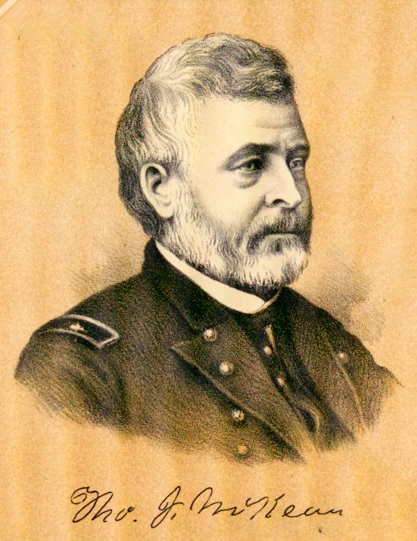 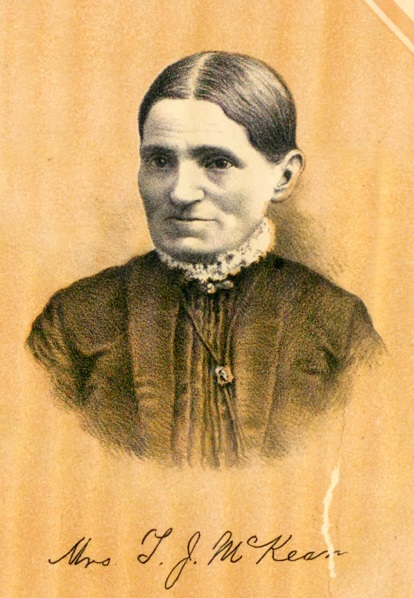
BRIG.
GEN. THOMAS J. McKEAN, deceased, a veteran of three wars, and a
distinguished pioneer of Linn County of 1840, was born Aug. 3, 1810, in
Bradford County, Pa. His parents were Robert and Martha (Wilson)
McKean, the former born in Maryland, of Scotch ancestry, and the latter
in Vermont, a descendant of an old New England family. Thomas J.
was the second in order of birth in a family of eight children, two of
whom are still living – Andrew J., of Marion, and N. W. McKean, of Mt.
Vernon, Iowa. Thomas J. passed his boyhood on his father's farm,
receiving his primary education in the public schools. At the age
of seventeen, through the influence of his uncle, Samuel McKean, then a
member of Congress, and later a United States Senator from
Pennsylvania, he was appointed a cadet at West Point. He entered
the Military Academy on the 4th of July, 1828, where he took a three
years' course, and from which he graduated in 1831. He was
commissioned Second Lieutenant of the 4th United States Infantry, and
entered the service in July following, 1831. He continued in the
United States service from March, 1831, until 1834, when he resigned,
and engaged in civil engineering, accepting the position of Chief
Engineer of the New Orleans Railway & Canal Co. His health
becoming impaired by exposure to the malaria of the Southern swamps, he
was forced to resign, and returned to his Northern home.
On the breaking out of the Florida Indian War in 1837, our subject was
commissioned Lieutenant in a Pennsylvanian regiment of volunteers; was
promoted to Adjutant of the regiment, and served with distinction till
the close of the war, in April, 1838. He was elected Major on the
field to fill a vacancy, but the time of enlistment of the regiment
having expired, it was mustered out before his commission was
received. On his return from the war, he resumed his profession
and was employed in civil engineering in Southern Illinois from the
summer of 1838 until 1840, when he came to Marion, this State. He
served two terms as County Surveyor of Linn County, and was also
employed on Government surveys and in civil engineering throughout the
State. In 1844 he was chosen a member of the convention called to
frame the first Constitution of Iowa, and served as a member of that
body. On the occurrence of the war with Mexico, he began, in the
winter of 1846 - 47, to raise and drill a regiment for that service,
with a fair expectation of being one of the field officers of the
regiment, but the ten United States Regiments being substituted for
State volunteers, the volunteer organizations were disbanded and the
appointment of officers thrown nominally into the hands of the
President, but really into the hands of Congressional delegations,
instead of being left to an election by the men. Being a Whig in
politics he was on the wrong side to expect any favors from the party
in power, in the then high state of party feeling prevailing in
Iowa. But being determined to have a hand in the war, he
enlisted, in April, 1847, as a private of Co. K, 15th Vol. Inf., one of
the regiments of which Col. George W. Morgan was in command. On
the 15th of May following, our subject was appointed Sergeant Major of
the regiment, and in this capacity served in the battles of Contreras,
Cherubusco, Molino del Rey and Chapultepec. He distinguished
himself in the main assaulting column on the castle of Chapultepec, and
in the battle around the city of Mexico. For his meritorious
conduct he received an appointment as Second Lieutenant in the 2d
Regiment U. S. Dragoons, which was promptly declined. He
continued in service until after peace was declared and the regiment
was disbanded, Aug. 7, 1848.
After the close of the Mexican War, our subject returned to Marion and
was united in marriage with Miss Sarah P. Gray, the ceremony which made
them man and wife being performed Sept. 4, 1848. Mrs. McKean was
born in Tioga County, Pa., April 8, 1820. She is the daughter of
John and Sarah (Doud) Gray. Her grandfather Gray was a soldier of
the Revolutionary War, and held a Captain's command in the army of
Washington. He was descended from James Gray, one of three
brothers, Englishmen, who emigrated from England to the United States
at an early colonial day, and who married a Scotch lady, Sarah
Bissel. Their son, grandfather of Mrs. McKean, offered himself as
a soldier in the war of independence when sixteen years of age; he was
rejected, but seized a musket and joined the ranks, rising to the
position of Captain, and did good work for his country, serving all
through the war. The grandfather married Miss D. White, and they
had three daughters and four sons, of whom John, Mrs. McKean's father,
was the eldest. He was a soldier of the War of 1812, and,
marrying Sarah
Doud,
became the father of five children, two sons and three daughters, of
whom Mrs. McKean is one. She was educated at Wellsboro Academy,
Pa., and graduated therefrom when seventeen years of age. She
followed teaching for four years, coming to Iowa in 1845. Five
children were born to the union of Gen. McKean and wife, of whom two
died in infancy. Two sons and a daughter lived to the age of
maturity: Louis L., the eldest, is now living in Montana Territory;
Helen became the wife of Dr. M. L. Shuck, of Clarence, Iowa, and died
Oct. 24, 1885; the younger son is the present efficient Deputy Recorder
of Linn County.
After his return from the Mexican War, Maj. McKean again engaged in
civil engineering, through 1848-51, being chief engineer of the Dubuque
& Keokuk Railway. Through 1851-53 he was United States Deputy
Surveyor General of Iowa and Wisconsin, he was elected Sheriff of Linn
County, for the term of 1861, but resigned June 1, 1861, to enter the
service of the late Civil War. He was appointed additional
Paymaster of the United States Army, and entered upon the duties of the
office at Washington, D. C. He received notice of his appointment
as Brigadier General, United States Volunteers, on the 27th of
November, 1862, and, in accordance with instructions, reported to Maj.
Gen. Halleck, Commander of the Department of Missouri. On the 8th
of April he reported to Maj. Gen. Grant at Pittsburg Landing, and was
assigned to the 6th division of the Army of the Tennessee, which had
formerly been Gen. Prentiss', who was captured at Shiloh. July
16, 1862, he look command at Benton Barracks, and on the llth of
September was transferred to the Army of the Tennessee, and on the 27th
of that month he took command of the 6th division, which he directed
during the battle of Corinth. Nov. 17, 1862, he was placed in
command of the 4th division, and participated in the Grenada
expedition, commanding the districts of Nebraska and South
Kansas. In 1864 he reported to Gen. Banks at New Orleans, and
September 18 became Chief of Cavalry of the Department of the
Gulf. He served as President of the Military Court, and was given
command of the district of West Florida and subsequently of Southwest
Missouri. Gen. McKean continued in the service till the close of
the war, doing duty most of the time as Major General, and was
honorably discharged Aug. 24, 1865, as Brevet Major General; 114 other
general officers were discharged by the same general order, No. 135,
from the War Department. The entire period of our subject's
service, including regular army and volunteer, was about thirteen years.
In June, 1868, Gen. McKean received a paralytic stroke, which seriously
impaired both mind and body. A second stroke in July, 1869,
confined him to his house and bed much of the time, and on the 18th of
April, 1870, the last and fatal stroke came, resulting in his death
about 6 P. M. of the 19th. Thus closed the earthly career of a
brave and gallant soldier and a skillful General, who had served his
country with zeal and ability through three wars. As a neighbor
and friend he was held in high esteem. Unassuming and retiring in
his disposition, he seldom alluded to the trying scenes of his military
career. He was a kind father, an affectionate husband, and leaves
his wife and children a rich legacy in the history of an honorable,
upright life, distinguished by a brilliant, useful and patriotic career.
Source: Portrait & Biographical Record of Linn County Iowa, 1887, pages 197 & 198.
Submitted by: Eric & Marca Driggs
David McKinnon 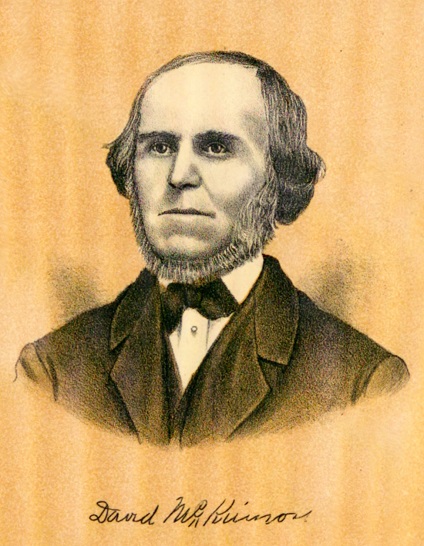 DAVID
McKINNON, deceased, was a highly respected pioneer of Linn County, and
a prominent stock-grower, and occupied his comfortable homestead
enjoying, in a large measure, the friendship and esteem of those who
had known him for a long term of years. He was a native of
Scotland, of good old Scottish ancestry, born in Sterlingshire, Sept.
9, 1812, and was reared, as were many of the Scottish farmers, on a
small tract of land, the agriculturist of that country possessing only
a limited idea of farming as it is carried on in the New World.
He had, however, read the glowing accounts of what might be
accomplished by men of energy in the United States, and he resolved to
come hither with the hopes of bettering his financial condition.
His first location was made in Linn County, and after a few years he
sent for the balance of his family, who left their native land and
joined him here. He took up tract of unbroken land in Fairfax
Township, being the first settler in that locality, and his nearest
neighbor three miles away. In this solitude he lived by himself
for a time, enjoying only occasionally the company of some roving
Indian who strayed that way, and of whom he was seldom afraid. In
the absence of the redskins, he consoled himself in the companionship
of a hen and chickens, which he valued very highly, as their cackle and
crow reminded him of the happy days in his Scottish home. DAVID
McKINNON, deceased, was a highly respected pioneer of Linn County, and
a prominent stock-grower, and occupied his comfortable homestead
enjoying, in a large measure, the friendship and esteem of those who
had known him for a long term of years. He was a native of
Scotland, of good old Scottish ancestry, born in Sterlingshire, Sept.
9, 1812, and was reared, as were many of the Scottish farmers, on a
small tract of land, the agriculturist of that country possessing only
a limited idea of farming as it is carried on in the New World.
He had, however, read the glowing accounts of what might be
accomplished by men of energy in the United States, and he resolved to
come hither with the hopes of bettering his financial condition.
His first location was made in Linn County, and after a few years he
sent for the balance of his family, who left their native land and
joined him here. He took up tract of unbroken land in Fairfax
Township, being the first settler in that locality, and his nearest
neighbor three miles away. In this solitude he lived by himself
for a time, enjoying only occasionally the company of some roving
Indian who strayed that way, and of whom he was seldom afraid. In
the absence of the redskins, he consoled himself in the companionship
of a hen and chickens, which he valued very highly, as their cackle and
crow reminded him of the happy days in his Scottish home.
In due time, when he felt that his means would justify the step, Mr.
McKinnon took unto himself a life partner in the person of Miss
Elizabeth Risk, who had come to America in company with her sister when
they were both young ladies. Their marriage occurred April 13,
1858. She was also a native of the same shire as her husband, and
was born May 4, 1825. They located in Canada West upon their
arrival here, and afterward proceeded to Linn County. It is
possible that the plans of herself and her future husband were laid
before his emigration to the United States. Her parents hail
departed this life in Scotland some years before she left her native
land. The union of Mr. McKinnon and wife was blest by the birth
of five children, all living and at home. Their names are
Jeannetta, George, Mary, Alex and David. Mr. McKinnon departed
this life Dec. 5, 1882. Mrs. McKinnon and family are members of
the First Presbyterian Church, our subject being one of the founders of
the society in this place. In politics he was a solid Republican,
believing that the principles of that party are the principles best
calculated to promote the interests of his adopted country.
Mr.
McKinnon was fully worthy to receive the title of an honest man and a
good citizen. From his early youth he was imbued with high moral
principles, and has transmitted these to the sons who have risen up to
do him honor, lie will long be remembered in his township as one whose
place it will be difficult to fill. His portrait, which will be
found on another page of this work, will be highly appreciated by all
who knew him.
Source of portrait and biographical sketch
(verbatim transcription): “Portrait and Biographical Album of
Linn County, Iowa”, 1887, biographical sketch on pages 257 - 258,
portrait on page 256 Submitted by Eric & Marcia Driggs
JAMES H. McLAUGHLIN
James H.
McLaughlin, a prosperous farmer and highly esteemed citizen of
Franklin township, whose farm is pleasantly located on section 17, was
born in that township on the 23d of August, 1843, and has
there spent his entire life. His father, John McLaughlin, was born in
Ireland November 15, 1799, and on his emigration to America located
first in the east, where he was married, August 26, 1826, to Miss Arsa
Kimball, who was born in Vermont January 20, 1805. Soon after their
marriage they removed to Illinois, and during the ‘30s came to Linn
county, Iowa, being among the pioneer settlers of this locality.
Locating in Franklin township, the father entered the land on which
our subject now resides, and made his home there until his death. He
started overland for California, but became ill before reaching thee
and died in Oregon in 1849, his remains being interred in that state.
His wife died September 30, 1873, and was buried at Mt. Vernon. They
had nine children, namely: George, who married Cassie Morford and
resided in La Fayette, Iowa; he died in the service of his country
during the Civil war. Nancy is the wife of William Hunt, of Redland,
California. Lucy married Bert Sargent, of Franklin township, this
county, and both are now deceased. Hiram, deceased, first married Jane
Carnahan, and after her death wedded Elizabeth Horn, and resided in
Lincoln, Nebraska. Sarah married Joseph Carnahan, who died in the
service during the Civil war, and she is now the wife of John Denaway,
of Jasper county, Iowa. John died at the age of eight years. Elvira
married Demott Rose, who died in Franklin township, this county, and
later wedded a Mr. Schwatzel, of Kansas, where her death occurred,
though her remains were brought back to Mt. Vernon for interment.
Caroline is the wife of Scott Thomas, of Garnet, Kansas. James H., our
subject, is the youngest of the family.
Mr. McLaughlin
of this review pursued his studies in the public school until eighteen
years of age, and since then devoted his entire time and attention to
general farming and stock raising. After his marriage he purchased the
interests of the other heirs in the old homestead, consisting of one
hundred and eighty acres of land on section 17, Franklin township, and
has since added to it, making a good farm of two hundred and twenty
acres, which he has brought to a high state of cultivation. He has
built a good house, two large barns and numerous cattle sheds, and now
has a well-improved and attractive farm. He makes a specialty of stock
raising, and being an excellent judge of cattle, horses and hogs he
keeps only the best grades of stock upon the farm. The Republican
party finds in him a stanch supporter of its principles, but he has
always refused to hold public office, preferring to devote his
undivided attention to his business interests.
On the 4th
of July, 1864, in Marion, Iowa, Mr. McLaughlin married Miss Margaret
Ann Waln, and they have become the parents of ten children, namely:
(1) George William, born July 17, 1865, follows farming in Franklin
township. He was married, August 27, 1884, to Isabel McIntosh, and
they had four children, Darlie, Ina, Clara and Anna, of whom the last
two are now deceased. (2) Francis H., born January 25, 1867, was
married August 27, 1884, to Chet Litts and resides near Toddville,
Iowa. They have two children, Mabel and Edith. (3) Peter, born in
1869, died at the age of two years. (4) Polly born in 1870, died at
the age of eight months. (5) Thomas H., born March 4, 1872, (6) Nettie
M. born January 22, 1874, (7) Fred Harvey, born April 23, 1876, (8)
Cora A., born October 25, 1878, (9) Rosie J. born February 25, 1880,
and (10) Nellie E. born February 18, 1884, are all at home.
Mrs. McLaughlin
was born in Linn county October 20, 1848, and is a daughter of William
H. and Fannie (Burge) Waln, the former a native of Ohio the latter of
Greene county, Pennsylvania. Her great-grandfather on the maternal
side was a Mr. Barnett, who was drafted and served forty years in the
Swiss army before coming to America, and in this country took part in
the war. He had two daughters, both of whom married Walns. Mrs.
McLaughlin’s parents were married in this county and made their home
on what was known as the William Waln farm until the father’s death,
he being killed in a tornado in 1860. The following four years he
conducted the farm alone, and in 1864 she married Silas Bailey, and
continued to make their home on the farm one year, when they sold
their property and moved to Creston, Iowa, where they lived till 1874,
when the property there was sold and she returned to Linn county and
remained one year. At the end of that period she rejoined her husband
and removed to Nebraska, where they purchased a farm. There she died
December 13, 1892. Mrs. McLaughlin is the oldest in a family of eight
children, the others being as follows: Samuel J., born April 8, 1850,
married Ida Patmore and lives west of Mt. Vernon; Martha Jane, born
June 11, 1851, died in childhood; Eliza J., born December 5, 1852, is
the wife of Emanuel Welty, of Winteset, Iowa; William Henry, born June
4, 1854, married Cynthia Hill and resides in Raven, Arkansas; John E.,
born February 24, 1857, married Hattie Russell and makes his home
north of Mt. Vernon; Lemuel J., born May 26, 1858, is represented on
another page of this volume; and Milton B., born February 8, 1860,
married Emma Maybower and lives in Mt. Vernon.
Source:
The Biographical Record of Linn County Iowa, Illustrated, Chicago:
The S. J. Clarke Publishing Company, 1901, pages
217-218.
Submitted by: Terry
Carlson
JOHN G. McLEOD
The name of John G. McLeod is
remembered by the early settlers, as one of our most prominent men,
and a very useful citizen. His claim included the big spring which has
always borne his name, and which is located two and a half miles north
of this city. It is one of the finest springs I have ever seen, and I
am not aware of anything in Iowa that surpasses or even equals it, in
the amount and clearness of the waters it discharges. There may be
others just as fine, but although I have traveled over the state quite
extensively, I have not yet seen them. The water power of one of the
first saw-mills in this county was furnished by that spring. I am not
sure but that this mill was the first in the county. Certain it is
that no one antedated it very many months.
To Mr. McLeod belongs the honor of
erecting that mill. It was an event of the greatest importance to the
pioneers of this section of the country. Few can understand at this
distance of time the absorbing interest with which the people watched
the progress of this new enterprise.
It was in 1841, two years after our
arrival, that this mill was built. I remember well when Mr. McLeod
came to invite our family to the raising. After extending the
invitation to father and the older boys, he turned to mother and said:
“You must come, too, and bring all your dishes with you.” The thought
never seemed to enter his mind to ask if it would be convenient for
her to go; but he used the imperative mood with an emphasis that
seemed to admit of no excuse or failure. Of course, mother was only
too happy to go with her dishes and cooking utensils, together with
what provisions she could supply, and do all she could towards
providing a good dinner for the busy workmen who were assisting in
this new and welcome enterprise. She had a hearty laugh, however,
afterwards over the earnest and summary way in which Mr. McLeod
commanded her presence on that important occasion.
Sometime after the saw-mill had been
put in operation, Mr. McLeod decided to put in a small run of stone,
which he did. The stones were only eighteen or twenty inches in
diameter perhaps, but they served a very good purpose for “cracking
corn” as they called it. This mill afforded us our first corn meal
manufactured in this region, and it was a matter of no small interest
to the surrounding inhabitants, when it was set in operation. The meal
was probably not of the finest grade, but it was fresh and sweet, and
the people were too glad to get it to be critical in regard to its
coarseness. A few years later, Mr. McLeod erected a larger and better
mill that was capable of manufacturing both meal and flour of very
good grades. This mill did a very large business and proved a great
blessing to the people all through this region, and for many miles
around. This property in after years passed into the hands of Mr. N.
B. Brown, who converted it into a distillery, to afford drink to those
who were not satisfied with the cool, limpid waters of the spring. A
few years later this famous mill afforded food for the flames, and so
passing out of existence, many more hearts rejoiced than when it was
first erected.
Mr. McLeod in after years moved into
the northern part of the state, where he continued in the milling
business up to the time of his death, which occurred many years ago.
Source: Carroll, George R.,
Pioneer Life In and Around Cedar Rapids, Iowa From 1839 to 1849.
Cedar Rapids, Times Printing and Binding House. 1895. Pages 138-140.
Submitted by: Terry Carlson
HORACE G. McMILLAN
Whatever else may be
said of the legal fraternity, it cannot be denied that members of the
bar have more important actors in public affairs than any other class
of American people. This is but the natural result of causes which are
manifest and require no explanation. The ability and training which
qualify one to practice law also qualify him in many respects for
duties which lie outside the strict path of his profession and which
touch the general interests of society. The subject of this record is
a man who has brought his keen discrimination and thorough wisdom to
bear not alone on professional paths but also for the benefit of the
community in which he resides. He is now attorney for the northern
district of Iowa, and makes his home in Cedar rapids.
A native of Ohio, Mr.
McMillan was born in Wayne county, May 29, 1854, and is a son of P. R.
and Elizabeth (Cully) McMillan, the former a native of New York state,
the latter of Wayne county, Ohio. His paternal great grandfather came
to this country from Scotland in the latter part of the eighteenth
century and settled in Washington county. New York, where the father
of our subject was born. He was only six years old, however, when he
removed with his parents to Seneca county, Ohio, and there in the
midst of the forest he grew to manhood with little opportunity to
attend school. He took an academic course after reaching his majority,
and by thoroughly applying himself to his studies at home he succeeded
in acquiring a splendid education, becoming a fine Latin, Greek and
German scholar, and mastering all the branches of higher mathematics.
While a resident of Wayne county, Ohio, he taught school, and in 1846
he came to Iowa as the first principal of Washington Academy under Dr.
George Vincent, the founder of that school and a very noted divine of
the Presbyterian church. After teaching there for some years Mr.
McMillan returned to Wayne county, Ohio, where he was married and
engaged in farming four years. At the end of that time he again went
to Washington county, Iowa, where he was engaged in mercantile
business at Crawfordsville with two brothers four years, and then
removed to a farm near Washington, the county seat, and turned his
attention to agricultural pursuits. Throughout the remainder of his
life he engaged in farming and raising fine stock. He died March 19,
1882, and his widow now resides with a daughter in Aberdeen, South
Dakota. They were the parents of three children, namely: Alice is the
wife of T. C. Rogers, who for some years has been engaged in the grain
and milling business in Beloit, Kansas, and has served in the
legislature of that state. Horace G., of this review, is the next in
order of birth. Frances is the wife of A. W. Glenn, of Aberdeen, South
Dakota, who is a conductor on the Chicago & Milwaukee Railroad between
Aberdeen and Sioux City, and although he has been with that company
for twenty-seven years has never been laid off a day. He has farming
interests in South Dakota.
Horace G. McMillan
received his primary education in the district schools, and later
attended the Grandview Academy in Louisa county, Iowa, two terms, and
the Washington Academy about one year. He was then engaged in raising
fine stock as a partner of his father, handling horses, cattle, sheep
and hogs of a high grade, and he continued in this business for five
years after reaching his majority. In the meantime he commenced the
study of law, and later entered the office of J. F. McJunkin, then
attorney-general of Iowa, with whom he remained for a year, walking
from the farm to the city each morning and returning home at night.
After two years and a half devoted to study he was admitted to the bar
in 1880, and was engaged in practice in Washington, Iowa, about two
years. He then removed to Rock Rapids, Lyon county, where he
successfully followed his chosen profession until coming to Cedar
Rapids in July, 1898, having been appointed district attorney in
February of that year.
During the first
seven years spent at Rock Rapids, Mr. McMillan was in partnership with
A. Van Wagenen, under the firm name of Van Wagenen & McMillan, at the
end of which time his partner was appointed district judge by Governor
Boies. Our subject then became connected with Mr. Van Wagenen's
brother, who had studied with the firm, and this partnership lasted a
year and a half. Mr. McMillan was then alone for two years, and at the
end of that time formed a partnership with J. W. Dunlap under the firm
style of McMillan & Dunlap, which connection was continued until our
subject's removal to Cedar Rapids. In the spring of 1898, in
partnership with Cyrenus Cole, he bought out the Republican Printing
Company, of which he is now president and business manager. He is also
still interested in farming and stock raising. He first purchased a
small farm in Lyon county, which he stocked, but has since bought a
large place, consisting of seven hundred acres, known as the Lakewood
Stock Farm, to which he gives his personal supervision. Here he raises
thorough-bred stock, his specialty being Percheron horses, Jersey
cattle, of which he has one of the finest herds in the west, and he
holds annual sales, disposing of his surplus stock. Besides this
valuable place, which is one of the finest stock farms in the state,
he now owns over five thousand acres of highly cultivated land,
which he has purchased from time to time. Since 1895, he has been
largely interested in raising both imported and home-bred registered
Percheron horses, having now one hundred head, and in the future he
proposes to make this his principal farm business.
On the 28th of
August, 1877, Mr. McMillan was united in marriage with Miss Alice Van
Doren, a native of Washington county, Iowa, and the third in order of
birth in a family of five children. Her father, W. A. Van Doren, was
for many years a prominent attorney and real-estate dealer of
Washington, Iowa, and was one of the early settlers and pioneer
lawyers of that section of the state. Unto Mr. and Mrs. McMillan were
born six children, namely: Glenn V.; Viva; Stella, who died in
infancy; Florence; James B.; and Horace G., Jr., all at home. The wife
and mother is a member of the Presbyterian church; has always taken a
deep interest in educational affairs; and was largely instrumental in
founding the public library at Rock Rapids.
Before entering upon
the duties of his present office Mr. McMillan had probably the largest
private practice of any lawyer in this section of the state, and was
retained as counsel either on one side or the other of all the
important cases that came up. He has had large experience in trying
personal injury cases, both for and against railroad companies, and
obtained one of the largest verdicts probably ever secured in this
state. He was prominently connected with the bond litigation of Lyon
county, when the county had been fraudulently bonded for one hundred
and seventy thousand dollars, and various school districts had been
bonded for from twenty to two hundred and fifty thousand dollars. Mr.
McMillan tried these cases in both the state and United State courts
and the supreme court at Washington, D.C., decided in his favor. As a
jury advocate he is very successful, and to-day ranks among the
foremost attorneys of Iowa. Prominence at the bar comes through merit
alone, and the high position which he has attained attests his
superiority.
Since reaching
manhood Mr. McMillan has taken an active and prominent part in
political affairs; was three times elected a member of the Republican
state central committee from the eleventh congressional district; and
three times elected chairman of the same. He was alternate delegate at
large to the national convention in 1896, and had charge of the
campaign when Francis M. Drake was elected governor by an almost
unprecedented majority. He also had charge of the McKinley and Hobart
campaign in Iowa, which he conducted in such a manner as to win the
praise of the Republicans and gold Democrats alike, and he managed the
campaign when Leslie M. Shaw run for governor. As a campaign leader
Mr. McMillan has tenacity of purpose, persistence of effort and a wise
spirit of conciliation, and under him the party has developed no
factions nor has it wavered. The first office he was called upon to
fill was that of assessor of his township, which he held when a young
man. He served two terms as city attorney of Rock Rapids; three terms
as county attorney of Lyon county; and ten years as a member of the
board of insane commissioners of that county. As a citizen he ever
stands ready to discharge any duty devolving upon him; his public
service has been most commendable; and he stands deservedly high in
professional, political and social circles. Fraternally he is a member
of the Knights of Pythias and the Modern Woodmen of America.
Source:
The Biographical Record of Linn County Iowa, Illustrated, Chicago:
The S. J. Clarke Publishing Company, 1901, pages 30-33.
Submitted by: Terry
Carlson
FRANK P. McNAMARA
Frank P. McNamara, a well known farmer and prominent citizen of Buffalo
township, has spent his entire life in Linn county, his birth occurring
here on the 18th of February, 1866. His parents, John and Ann (Slattery)
McNamara, were natives of Ireland and on their emigration to America in
1849, located in Buffalo, New York, where they spent two years. At the end
of that time, however, they came to Iowa and for five years made their home
in Jones county. The father then purchased forty acres of land in Buffalo
township, Linn county, whereon the family took up their abode.
As
an agriculturist he steadily prospered and bought more land from time
to time as his financial resources increased until he had accumulated
five hundred acres in this county, one hundred acres in Jones county,
and six hundred and forty acres in South Dakota. His Linn county
property he placed under a high state of cultivation and improved by
the erection of good, substantial buildings. He continued the operation
of his farm for many years but finally deeded eighty acres to each of
his children as they became of age. After a useful and well spent life
he passed away May 10, 1900, and his wife, who had been a faithful
helpmate to him throughout her, life, died February 25, 1903.
They
were communicants of the Catholic church and were laid to rest in
Castle Grove Catholic cemetery. Frank P. McNamara was feared in much
the usual manner of farm lads, acquiring his literary education in the
schools near his boyhood home. He was twenty-five years of age when he
left the parental roof and settled on the eighty acres of land given to
him by his father and to its improvement and cultivation he has since
devoted his energies. He has extended the boundaries of his farm from
time to time, however, and now has two hundred and forty acres of very
valuable and productive land which has been improved by himself and is
now one of the best farms of the county.
He has always devoted considerable attention to the raising of fine stock but has
never made a specialty of any particular breed except the Hereford
cattle. Mr. McNamara was married January 24, 1894, to Miss Katy Drummy who, like
her husband, acquired a good common school education in her youth, Her
parents are W. F. and Lizzie (Kehoe) Drummy, the former a native of New
York and the latter of Delaware county, Iowa. They were married on the 25th
of October, 1875, and located upon a farm in Delaware county. Both are
still living. Eleven of the fifteen children born to them also survive.
To
Mr, and Mrs. McNamara have been born ten children, as follows: Francis
P., who was born October 26, 1894, and died August 2, 1896; Thomas E.,
born February 26, 1896; John W., born August 8, 1897; Elizabeth B.,
born December 21, 1898; William Joseph, born July 4, 1900; Emlin A,,
born May 16, 1902; Bernard A., born May 15, 1903; Anna M., born May 30,
1905; Frances D., born June 4, 1907; Bernice M,, born June 30, 1909,
The parents are faithful members of the Catholic church and in his
political views Mr. McNamara is liberal, supporting the men and
measures he believes best calculated to promote the public welfare. He
is a progressive and public spirited citizen and gives his earnest
support to those measures which he believes will advance the general
welfare of the community in which he resides.
Submitted by Becky Teubner
Duncan McTavish
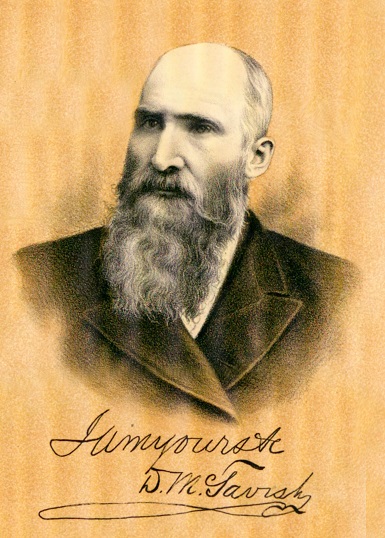 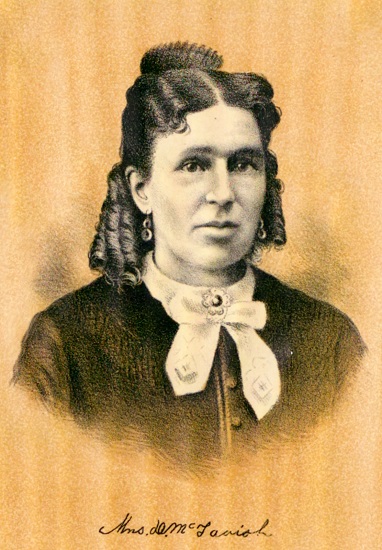
DUNCAN
McTAVISH, M. D., is a recent and valued addition to the medical
fraternity of Linn County, and is located in Central City. He is
a native of Canada, born in Halton County, Jan. 17, 1840. His
father, Dugald McTavish, was born in Argylshire, Scotland, and grew to
manhood in Glasgow, where he graduated at the University. He was
a mechanical engineer, and emigrated to America about 1829, following
his profession for several years afterward, and in the meantime
purchased land in Halton County, and while working at his profession,
employed laborers to clear the land, upon which lie subsequently
settled, and remained engaged in agricultural pursuits the remainder of
his life. He died there in 1882. The maiden name of his
wife was Catherine Buchanan, also a native of Argylshire, and of their
union there were born six children. The wife and mother survived
her husband two years, and departed this life in 1884.
The
subject of our sketch is the eldest child of his parents. He
obtained a good education by attending the public schools, and pursued
the study of English classics and mathematics until the age of nineteen
years, when he commenced teaching. In the meantime he took up the
study of medicine, and by his duties as a teacher earned sufficient
money to pay his way through college. In 1863 he pursued his
studies and afterward attended medical lectures at Philadelphia,
graduating from Pennsylvania Eclectic College. About eighteen
months later he abandoned the Eclectic and attached himself to the
Regular School of Medicine, to which he has since adhered.
After
receiving his diploma, Dr. McTavish recommenced his labors of teacher,
at which he continued at Guelph, Canada, being employed as classical
and mathematical teacher in the High School there. At the
termination of this engagement he commenced the practice of medicine at
Waldemar, Canada. He was not satisfied with his situation and
prospects, however, and resolved to seek a home beyond the
Mississippi. Accordingly, in 1872, he crossed the Father of
Waters and came into Iowa, and located at Colo, Story County, opening
an office, and began practicing his profession there. Four years
later he opened a drugstore in connection with his practice, and was
very successful up to July 4, 1879, when he met with a disaster, his
drug-store being destroyed by fire. By this calamity he also lost
a large stock of goods and a valuable library. He then removed
from Colo and located in Wright County. This locality, however,
proved unfavorable to his health. He was attacked with pernicious
malaria, and obliged to abandon his practice for the time.
In
the winter of 1883-84 Dr. McTavish went to DesMoines, Iowa, and
attended a course of medical lectures in the College of Physicians and
Surgeons. He pursued his studies through the following summer,
and the next winter took another course at this college, from which he
received his diploma in the spring of 1885. He then again opened
an office in Eagle Grove in Wright County, but in October he was again
attacked with pernicious malaria, and was forced to seek another
location. He then came to Linn County and stopped in Paris until
February, 1886, and thence came to Central City, where he is building
up a good practice.
In
September, 1866, the marriage of Dr. McTavish and Miss Elizabeth
Beattie took place. Mrs. McTavish was a native of Ireland, and of
Scottish ancestry. Of this union four children were born, only
two of whom are living – William and Cassie. The second child,
Effie, died in infancy, and the fourth child, Dugald, at the age of two
years. Mrs. McTavish died Oct, 21, 1886.
Dr.
McTavish is a member of the Northwestern District Medical Association
and the Iowa Union Medical Society. He is also a member of Bower
Lodge, Eagle Grove, A. F. & A. M. He is highly esteemed for
his genial and affable disposition, and a popular member of his
profession in this vicinity. The prospect is that he will very
soon become a leader in his profession, in this city. He is well
read, and takes a worthy pride in striving to become a master of the
art by which disease is made to yield to the ingenuity and the
intelligence of man.
The
portraits of Dr. McTavish and wife, which are shown on another page of
this ALBUM, will be welcomed by a large number of friends.
Source
of portrait and biographical sketch (verbatim transcription):
“Portrait and Biographical Album of Linn County, Iowa”, 1887,
biographical sketch on pages 337 - 338, Duncan and Elizabeth (BEATTIE)
McTAVISH’s portraits on page 336
Contributed by: Eric & Marcia Driggs
The
subject of this sketch is well known throughout the state as one of the
largest and most successful breeders of fine hogs in Iowa. He makes his
home on section 9, Jackson township, Linn county, where he owns a
valuable and well-improved farm of two hundred acres, known as the
Chapel Hill Farm, and although he is engaged in general farming, he
gives the greater part of his time to his stock raising interests.
Mr.
McTavish was born in New London, Canada, September 21, 1867, a son of
Dr. Duncan and Elizabeth (Beatty) McTavish, who were natives of Canada,
of Scotch descent. The father was reared near Acton, Ontario, and after
acquiring a good common-school education, supplemented by a course in
the University of Toronto, took up the study of medicine. Going east,
he attended a medical college in Philadelphia, Pennsylvania, where he
was graduated. He then returned to Acton, Canada, where he followed his
chosen profession for several years, and later was engaged in practice
at New London until 1865, when he removed to Kankakee, Illinois, but
remained there only a short time. We next find him a resident of Colo,
Story county, Iowa, where he engaged in practice for several years. He
subsequently spent a short time in Eagle Grove and on the Wapsie, at
Paris and Central City, Linn county, where he continued in active
practice up to the time of his death, which occurred June 5, 1889.
While at Eagle Grove, owing to failing health, which made it impossible
for him to practice, he improved his time by attending a course of
lectures at the College of Physicians and Surgeons of Des Moines, Iowa,
from which institution he was graduated. The mother of our subject also
died in Central City, October 24, 1886. They were the parents of four
children: William D., of this review; Effie, who died young; Cassie, a
resident of Central City; and Dugald, who died in infancy.
The
boyhood and youth of William D. McTavish were mainly passed in this
state, and he attended the high school at Nevada, Story county. In
early life he learned the printer's trade at Sheldahl, Iowa, and later
was employed as train master's clerk in the office of the Chicago &
Northwestern Railroad Company at Eagle Grove, Iowa. Succeeding this he
entered Coe College at Cedar Rapids, where he was pursuing his studies
when his father died. Being thrown upon his own resources, he worked
for a time as a farm hand in this county. Being industrious and
economical, he had, when in the employ of the railroad company, saved a
small sum of money, which, in addition to an amount inherited from his
father, enabled him to purchase a small farm near Waubeek, where he
lived for a short time, and then bought eighty acres of his present
farm on section 9, Jackson township. To this has been added by purchase
and inheritance one hundred and twenty acres until he now has a
valuable tract of two hundred acres, as previously stated, and also
owns some timber land elsewhere in the same township.
During
his entire business career Mr. McTavish has made stock raising his
principal occupation, being a breeder of Red Polled cattle and
Berkshire swine. He won more prizes in 1900 at the Iowa State Fair than
any other breeder of Berkshire swine in the state. At the great
International Stock Show at Chicago in December of the same year, the
boar winning first prize in his class and also the sow winning first in
the class for sows and championship over all ages were the "get" of one
of Mr. McTavish's brood sows, thus placing his herd as one of the best
breeding herds in America. He is a member of both the American
Berkshire Association and the Red Polled Cattle Club of America.
Mr.
McTavish was married in 1891 to Miss Mary Henderson, of Jackson
township, who was born January 12, 1876, a daughter of P. G. and
Arabella (Mills) Henderson, whose sketch appears elsewhere in this
work. Three children bless this union, namely: Hugh, Ruby and Harold G.
Mr. McTavish and his wife are both members of the Jackson
Congregational church, which is located on his farm, and he also
belongs to the Masonic Lodge of Coggon, and Coggon Camp, No. 4591, M.
W. A. He take[s] a deep and commendable interest in public affairs.
Source: The Biographical Record of Linn County Iowa, Illustrated, Chicago:
The S. J. Clarke Publishing Company, 1901, pp. 934-935.
Transcribed by Cheryl Siebrass, September, 2015.
John Mentzer
JOHN
MENTZER, deceased. The honored name of the subject of this
history will be remembered long after those who were personally
acquainted with him have passed away. He was one of the early
residents of the State of Iowa, a man of great energy and force of
character, and left his decided impress upon the community in which he
lived and upon all with whom he came in contact. He was a native
of Franklin County, Pa., born March 9, 1809. His death occurred
at his home in Marion, Nov. 3, 1882, after a long season of great
suffering, his death being caused by cancer.
John
Mentzer was the son of Samuel and Eva (Hinkel) Mentzer, also natives of
Pennsylvania. Their ancestors were natives of Germany, who
emigrated to America in colonial days. Our subject served a
regular apprenticeship as a mason, becoming thoroughly familiar with
the business in all its branches, and attained to the position of a
master workman, contractor and builder. He helped to build the
college at Fannettsburg, Pa.; contracted for and assisted in the
building of the college at Mercersburg, Pa., and was the superintendent
of many other public and private buildings then in course of erection
in his native State. In early life he exhibited that system and
thoroughness in all his undertakings which characterized him until the
close of his business career.
The
marriage of John Mentzer and Miss Nancy Foreman took place in Franklin
County, Pa., Aug. 22, 1833. She was the daughter of Frederick and
Sarah (Burger) Foreman, and was born near Mt. Hope, Franklin County,
July 12, 1814. Nine children were the result of this union, seven
sons and two daughters, all of whom are living except two sons.
The record is as follows: George A. was born March 15, 1835, and died
April 6 of the same year; Thomas J., born May 8, 1836, was married, and
is now engaged in the grocery business at Shenandoah, Page Co., Iowa;
Frederick, born June 21. 1839, only lived a few hours; Sarah, born Aug.
18, 1840, is the wife of Peter C. Garrett, of the firm of Mentzer &
Garrett, furniture dealers at Marion (see sketches); Patrick Henry,
born Sept. 3, 1843, is married, and engaged in the grocery business at
Shenandoah, Iowa, with his brothers; Benjamin F., born Aug. 1, 1847,
married Miss Carrie Daniels, and is engaged in the grocery and
furniture business at Marion; John, born Feb. 10, 1851, married Miss
Emma Myers and is in business with his brothers at Shenandoah; Charles
C, born Sept. 9, 1854, married Miss Alice Walser, and resides at
Marion; he is also interested in the canning business at Shenandoah;
Mary C. born Sept. 10, 1858, is the wife of G. W. Gunnison, of Sidney,
Fremont Co., Iowa. The two last named were born in Marion, and
the others in Franklin County, Pa.
Mr.
Mentzer emigrated with his family from Pennsylvania to Marion, Iowa, in
1854, arriving here on the 6th of April. He at once engaged in
the prosecution of his former business, which he had carried on
extensively for many years. His skill as a workman, his
thoroughness and his superior taste as an architect, soon came to he
recognized, and he was employed to superintend the erection of many of
the principal business blocks and finest residences of Marion.
Among these are the Park Place Hotel, Marion High School, Methodist
Episcopal Church, the old stone mills, since burned, the fine
residences of D. T. McAfee, Joseph Mentzer, the late Col. Srnythe, and
Thomas S. Ovington.
Mr. Mentzer was
well educated, and prior to coming to Iowa had been employed several
terms as a teacher in the schools of his native county. He was
well informed on general subjects, fond of argument, and was a keen
debater. He was well versed in sacred history, had been reared in
the Lutheran denomination, and was more than a match for the average
minister in the discussion of Biblical topics. In the matter of
education he was largely self-taught, for his duties as an apprenticed
mason involved hard labor, leaving him fatigued when night came, yet at
night he devoted hours to his studies when his fellow-workmen were
sleeping. He applied himself with the same indomitable zeal to
everything he undertook. In his vocation he was a master workman,
rapid and perfect in execution. He possessed an energy and force
of character that eminently fitted him for a leader. Often in the
large number of men in the employ of Mr. Mentzer there would be drones;
with such he had no patience, and they were either forced to do their
duty or were weeded out. His success as a builder was the result
of a thorough knowledge of his business, combined with an untiring
industry and a conscientious determination to do honest work.
John
Mentzer was the father of a large family and always provided liberally
for them. He was stern and exacting in family discipline,
believing such a course necessary for the welfare of his children, but
nevertheless, he was kind, and took great pride in his family. He
was quick tempered and a man of strong passions, but no one could
truthfully charge him with being unjust or unmanly. His integrity
was beyond question, and his wind was as good as his bond.
Politically he was an uncompromising Democrat, and always advocated
with zeal the principles and policy of that party.
Mrs.
Nancy Mentzer still survives, and is residing at Marion. This
aged and revered lady has been a devoted wife and mother; no labor was
too great, no self-sacrifice regretted, in the interest of those she
loved. She was always patient, industrious and zealous in the
discharge of her home duties. She reared a large family
successfully, giving them by example, as well as precept, lessons in
truth, honesty, frugality and industry, and has been rewarded by living
to see them become worthy and respected members of society. It is
a satisfaction to behold lives like these rounded up ripe in years, and
fruitful in good deeds. Verily, they have not lived in vain.
The portraits of Mr. Mentzer and wife, which are presented on another page of this work, will be highly appreciated.
Source of portrait and biographical sketch (verbatim transcription): “Portrait
and Biographical Album of Linn County, Iowa”, 1887, biographical sketch
on pages 217 - 218, John and Nancy (FOREMAN) MENTZER’s portraits on
page 216Contributed by: Eric & Marcia Driggs
MARSHALL F.
MEREDITH
Marshall F. Meredith, a well known and successful farmer and
stock-raiser of Buffalo township, is the owner of a valuable tract of
land comprising two hundred and eight and two-thirds acres. His birth
occurred in Indiana in 1852, his parents being Daniel and Sarah (Ball)
Meredith, who were likewise natives of the Hoosier state. There the
father spent his entire life, passing away in 1881. The mother came to
Linn county, Iowa, in 1892 and made her home with our subject until
called to her final rest on the 9th of May, 1909, her remains being
interred in the Boulder cemetery in Buffalo township: She was a
devoted amid consistent member of the United Brethren church. Her
children were ten in number, namely: Elizabeth A.; Mary J., who is
deceased; Priscilla K.; Marshall F., of this review; William B.; John
D., who has likewise passed away; Henry N.; Sarah E.; Miranda,
deceased; and Frances.
Marshall F. Meredith remained under the
parental roof until seventeen years of age and then began working as a
farm hand by the month, being thus employed for three years. During
the following twenty years he devoted his attention to the operation
of rented land and in 1893 purchased one hundred and forty acres of
the farm on which he now resides. Subsequently he extended the
boundaries of the place by an additional purchase of sixty-eight and
two-thirds acres, so that it now embraces two hundred and eight and
two-thirds acres of land in Buffalo township, all of which is under a
high state of cultivation and improvement. During the past twenty
years he has also devoted
considerable attention to the feeding of stock, handling both cattle
and hogs. He derives a gratifying annual income from both his farming
and stock-raising interests and has long been numbered among the
substantial and representative citizens of the community.
On the 22d of February, 1873, Mr.
Meredith was united in marriage to Miss Lucinda M. Grayson, a daughter
of Wren and Lucinda (Williamson) Grayson, who spent their entire lives
in Indiana. They were both faithful members of the Methodist Episcopal
church. Unto them were born thirteen children, as follows: Nancy and
Byrel P., both of whom are deceased; John T.; Hiram T.; Catherine A.;
Rebecca J., who is likewise deceased; William H.; Samuel B.; Eliza E.;
Mary E.; Mrs. Meredith; Anna D.; and one who died in infancy. Mr. and
Mrs. Meredith became the parents of three children, namely: Eva Viola,
who was born July 7, 1875, and died on the 15th of August, 1881;
Daniel W., who is married and lives on a portion of the homestead
farm; and Raymond G., at home.
In his political views Mr. Meredith is a
republican, believing firmly in the principles of that party. He
served as township trustee for four terms and for several terms has
acted as justice of the peace, his fair and impartial decisions
winning him ‘‘golden opinions from all sorts of people.” His religious
faith is indicated by his membership in the Methodist Episcopal
church. He is always the same honorable and upright gentleman in
whatever relation of life he is found and his salient characteristics
are such as have gained him the respect, confidence and good will of
all with whom he has come in contact.
Source:
History of Linn County Iowa, From Its Earliest Settlement to the
Present Time, Vol. II, Chicago, The Pioneer Publishing Company,
1911, p. 12-13.
Submitted by: Terry Carlson
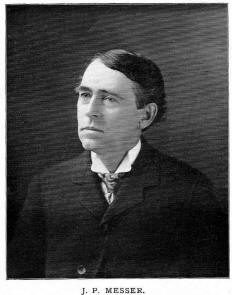 JOHN
PERLEY MESSER JOHN
PERLEY MESSER
Prominent among the
business men of Cedar Rapids is numbered John Perley Messer, who has
been engaged in real estate and loan business for some years, with
offices located at present in the Granby block. Mr. Messer was born
at Bow Center, in the town of Bow, New Hampshire, on the 9th
of December, 1843, and is the second son of Silas and Nancy (Hadley)
Messer, who are also natives of the old Granite state. His father was
a farmer in early life, and later was a railroad man, but is now
living retired in St. Paul, Minnesota. The mother died in that city
in 1894, and was buried in Oak Hill cemetery, Cedar Rapids.
John P. Messer was
reared on the home farm, and received his education in the public
schools. At the age of sixteen he left the farm and went to work as a
locomotive fireman on the Concord Railroad. At eighteen he was
promoted to the position of locomotive engineer, and at that time was
the youngest man who had ever been entrusted with an engine on that
road. He continued in that employment until 1862, when he resigned to
enter the service of his country as assistant engineer in the navy,
and was ordered to the United States steam frigate Colorado, on which
he served for nearly three years. He participated in both
bombardments and in the capture of Fort Fisher. At the first battle
Mr. Messer had charge of the fire department (a department of sixteen
men to extinguish fires), and at the second battle he served under B.
F. Garvin, chief engineer and Lieutenant George Dewey, executive
officer as one of Commodore Henry K. Thatcher’s staff officers. In
these engagements the Colorado suffered severely and was ordered to
the New York navy yards for repairs. Mr. Messer was then transferred
to the U. S. S. Trefoil. He was on that vessel when she
“accidentally” collided with and sunk the Confederate privateer
Florida. Also at the capture of Spanish Fort and Fort Blakely in
Mobile bay, and continued to serve on her until the close of the war,
when he resigned and received an honorable discharge from the United
States navy.
At Bow, New
Hampshire, September 1, 1866, Mr. Messer married Miss Carrie E. Evans,
who was also a native of that state and a daughter of Stephen W. and
Emma (Veazy) Evans. Shortly after their marriage Mr. and Mrs. Messer
removed to the then new state of Minnesota, the journey occupying a
full week and requiring twelve changes of cars and boats. They are
the parents of three children, namely: Walter S., who died April 5,
1881, at the age of eleven years; Emma Evans, now Mrs. James W. Clark;
and Florence V., who is at home. They also have one grandchild,
Charles A. Clark, Jr.
On his removal to
Minnesota Mr. Messer at once entered the employ of the Minnesota
Valley Railroad as a locomotive engineer. He was with that road about
two years and ran the first freight and passenger trains into the
towns of St. Peter and Mancato, Minnesota. From that state he came to
Cedar Rapids in 1869, and has made his home here ever since. He was
the first regular engineer and master mechanic at Cedar Rapids in the
service of the Burlington, Cedar Rapids & Minnesota (now Northern)
Railroad, and he remained with that road for about ten years as
engineer, master mechanic and passenger conductor. As engineer he was
in charge of the first regular trains into each of the towns along the
line from Cedar Rapids to Rockford, Iowa, as the road was completed to
those points.
Mr. Messer resigned
his position with the Burlington, Cedar Rapids & Northern Railroad in
1879 to take the superintendency of the Memphis, Kansas & Colorado
Railroad, then in course of construction and built some twenty miles
of this road besides opening about forty-five miles from Parsons to
Messer. This road was an enterprise of the late Judge Green and the
late C. S. Bennett, both of Cedar Rapids, and was sold by them to the
Kansas City, Fort Scott & Gulf Railroad, at which time Mr. Messer
resigned. As superintendent of the old City Street Railway Company,
of Cedar Rapids, he built the largest part of their road, building the
first line across the river.
After about twenty
years in the railway service, Mr. Messer entered the real-estate
business in Cedar Rapids in 1881, and is still actively engaged
therein. He has met with well-deserved success in this business, as
he had formerly done in the railroad business, and has acquired a
comfortable competence. In his political affiliations Mr. Messer is a
Republican, but has never sought office. As a public-spirited
citizen, however, he takes an active interest in public affairs and
gives his support to all enterprises which he believes calculated to
advance the social, moral or material welfare of Cedar Rapids.
Source:
The Biographical Record of Linn County Iowa, Illustrated, Chicago:
The S. J. Clarke Publishing Company, 1901, pages 102-6.
Submitted by: Carrie J. Robertson of Marion
J. W. MILHOLIN
The agricultural
interests of Franklin township are well represented by this gentleman,
who was born in Linn township, this county, on the 31st of
December, 1860. The Milholin family originated in Ireland, but many
bearing the name now live in Scotland and America. James Milholin,
our subject’s father, was born on the Emerald Isle, but when a boy
went to Scotland, and in 1853 came to the United States. After
spending two years in Pennsylvania, he removed to Iowa, and was
married in Marion, to Miss Elizabeth McLaughlin, a native of Glasgow,
Scotland, who came to the new world in 1856, and located in Marion,
Iowa. After living in that place for a time, they removed to a farm
in Linn Grove, Linn township, and later spent two years on the farm of
Colonel Robert Smyth in Franklin township. Their next home was on the
Robert Rose farm, where they continued to reside until their deaths.
The mother departed this life February 15, 1878, and the father died
February 2, 1897, the remains of both being interred in the Mt. Vernon
cemetery. Unto them were born five children, as follows: Isabella
Agnes is now the wife of Andrew Dill and lives south of Cedar Rapids;
John C. is a railroad conductor and makes his home in Livingston,
Montana; J. W., our subject, is next in order of birth; Thomas H.
lives on a farm adjoining our subject in Franklin township; and Robert
A. resides with his brother Thomas H.
The district
schools of Franklin township afforded our subject his educational
advantages, and on leaving school at the age of nineteen years he gave
his entire time to the work of the home farm, continuing to manage the
place for one year after his marriage. The following year he operated
rented land, though in 1887 he had purchased fifty-five acres of
land. In 1898, he bought the James Bryney farm of one hundred and
five and one-half acres on section 18, Franklin township, and in the
operation of this place he has since met with marked success. Like
most of the farmers of this region he devotes considerable attention
to the raising of stock. He is progressive in his methods and his
success in life has been worthily achieved, it being due entirely to
his own well-directed and energetic efforts. Politically he is
identified with the Republican party, and socially is connected with
the Camp of Modern Woodmen, No. 216, at Mt. Vernon.
On the 19th
of October, 1892, at Mt. Vernon, was celebrated the marriage of Mr.
Milholin and Miss Elsie Adella Bair, who was born at Elvira, Clinton
county, Iowa, February 14, 1870, and is a daughter of Joseph Bair,
whose sketch appears on another page of this volume. Four children
bless this union, their names and dates of birth being as follows:
Harry B., October 14, 1894; J. Clifford, May 10, 1896; Florence E.,
July 3, 1898; and Glen Leroy, March 10, 1900, died April 1, 1901.
Florence was born the day Cervera’s fleet was captured by the
Americans during the Spanish-American war.
Source:
The Biographical Record of Linn County Iowa, Illustrated, Chicago:
The S. J. Clarke Publishing Company, 1901, pages 209-210.
Submitted by:
Carrie J. Robertson of Marion
MILO MILLER
This gentleman dates his residence in
Linn county from January, 1853, and as a progressive agriculturist he
was prominently identified with the growth and development of the
county for over a quarter of a century, but he has now laid aside all
business cares, and is living retired in Cedar Point. A native of New
York, he was born near Syracuse, September 8, 1821. His father,
William Miller, was born and reared in England, and when a young man -
came to the United States. He was married in New York to Miss Loraine
Fountaine, who was born in that state of French and German parentage,
and there they continued to make their home throughout life.
Milo Miller remained a resident of the
Empire State until nineteen years of age, and then went to Warren
county, Pennsylvania, where he worked in the lumber camps for about
six years. The following year was spent near Milan, Ohio, and at the
end of that time he removed to McHenry county, Illinois, where he
rented land and engaged in farming for a time. He next made his home
near Valparaiso, Indian, for about five years, and from there removed
to Jackson county, Iowa, here he bought a farm of two hundred acres,
of which sixty acres had been placed under the plow. After residing
there for two years he sold that place and came to Linn county, in
1853, purchasing a partially improved farm of two hundred and twenty
acres in Grant township. He planted the first crop raised upon that
place, and to the cultivation and improvement of that farm he
continued to devote his time and energies until his removal to Center
Point in 1876. He added to his property and erected thereon good and
substantial buildings. For some time after locating in Center point he
was engaged in the real estate business and has handled considerable
property. He has made several farms by buying raw land which he has
broke and improved by the erection of a good set of farm buildings,
and he has also improved considerable village property, which he
either sells or rents. He is still the owner of about a dozen
residences in Center Point and two business blocks, besides five farms
aggregating six hundred acres of valuable land. He has been a man of
industrious habits, progressive and enterprising, and to his excellent
business and executive ability he owes his success in life, for he
started out in the world for himself empty-handed.
Mr. Miller has been twice married. In
1843, in Pennsylvania, he wedded Miss Patience Meeker, who died in
Indiana. By that union he had two children, of whom one died in
infancy. The other, Elmira married George Fee, of this county, and
died in 1899. Mr. Miller was again married in Indiana, in 1848, his
second union being with Miss Cyuthia Sprague, who was born in Allen
county, Ohio, and removed to Porter county, Indiana, with her father,
Solomon Sprague, locating near Valparaiso. Unto them were born four
children, namely: Delia, now the wife of Theodore Lampman, a farmer in
Linn county, Iowa; Samuel, a resident of Center Point; Paulina, wife
of Edward Sarchet, also a farmer of this county; and Anna, wife of
Oliver Hines of Center Point.
Mr. Miller takes no active part in
politics or has never cared for office. During his long residence in
this county, covering almost half of a century, he has materially
aided in the growth and building of his town and county, and has
become widely and favorably known as an upright, reliable business man
of strict integrity and sterling worth.
Source:
The Biographical Record of Linn County Iowa, Illustrated,
Chicago: The S. J. Clarke Publishing Company, 1901, pages 364-5.
Submitted by: Terry Carlson
MASON P. MILLS
Mason P. Mills (deceased) was born at
East Windsor, Connecticut, January 15, 1843, died at Cedar Rapids,
Iowa, July 31, 1896. The life of this soldier, lawyer and citizen was
a noble example of the best there is in American citizenship; his
death a public calamity. As the public is apt to place a correct
estimate upon the character of a man whose career has been a highly
prominent one the biographer can do no better than to record in part
an editorial which appeared in the Cedar Rapids Republican at the time
of the death of Mr. Mills:
"As a citizen he was, from the first
active in all things that make for a city. He was public spirited and
energetic to a degree attained by few men. He was an alderman for many
years, and in this capacity did a great deal to shape legislation. He
was a born leader. If there was an enterprise on foot, Mr. Mills was
either for or against it with all his might. He had the courage, the
strong intelligence, the rare, subtle magnetism, which, as public men
are analyzed, compose the requisites of the real genius of leadership.
As a lawyer he attained a very high rank. He was a worker a master of
the art of accumulation of testimony - a tactician, skillful in
cross-examination, a perfect judge of men, and therefore, one who
selected a jury with method and keen analysis of those who presented
themselves for acceptance. Many of our foremost business men relied
upon him absolutely, and to them the loss will be as a personal
bereavement. As a friend, perhaps the word loyal is the best and most
expressive adjective descriptive of this phase of his character. It is
the fortune of strong characters like Mason P. Mills to be strong in
friendship and intense in resentment, to have friends bound to them
with hooks of steel, and at the same time have those who swear,
Hamilcar-like, to love them not at all. And now, what of him? * * * It
does not seem possible that a soul of a man like Mason P. Mills - the
force that was in that brain can have gone out forever. Meeting by the
side of his grave this great question which is the dark cloud on the
horizon of all of us, we are glad to know that he here found reason
for hope."
The father of the deceased died when he
was a mere boy and the other, within a few years, married P. T.
Crowell, of Springfield, Massachusetts, a trusted employee of the
United States armory at that city. The mother, whose maiden name was
Elizabeth Strong, was a lineal descendant of the Grant family of East
Windsor. The early education of Mr. Mills was acquired in the common
schools. He was a student in the Upper Iowa University at the breaking
out of the war, and at the first call for troops went to Washington
and enlisted in a squadron of cavalry known as McClellan's Dragoons.
This was George B. McClellan's bodyguard. He served in that capacity
under the commanders of the Army of the Potomac until the
winter of 1863-4, when the squadron of cavalry was ordered to Chicago
and made a part of the Twelfth Illinois Cavalry. There he was
made sergeant of the regiment, and afterward promoted to regimental
quartermaster and first lieutenant by Governor Yates. He served
gallantly at Yorktown, Antietam, Fredericksburg,
Chancellorsville, Gettysburg, and in the seven days'
fight before Richmond, as well as in the smaller affairs in which
the Army of the Potomac was engaged up to the year of 1864. He was
then sent on the Red river expedition under General Banks.
He was mustered out of the service
February 17, 1865, but until July of that year he was in the
government employ, having charge of Camp Fry, in Chicago. He was not
mustered out as an officer until 1887, when he took advantage of the
act of congress permitting volunteer officers to be mustered according
to their rank, if they had failed to be so mustered, owing to active
operations in the field. He did this in order to become eligible to
membership in the Loyal Legion, which he at once joined.
When his country no longer needed his
services he commenced the study of law in the office of Ira P. Buell,
of Chicago, and was admitted to the bar there in 1866. In 1867 he
located in Cedar Rapids and engaged in practice, where he remained
until his death. Although not a college-bread man, he was recognized
as a thorough scholar. An omnivorous reader, his whole life was a
process of self-education. He was a Republican in politics, and was
colonel on the staff of Governor Gear during his last administration.
He was a prominent member of the Loyal Legion, and served as
department commander of the G. A. R. in 1890.
Mr. Mills was married, October 14, 1869,
to miss Flora B. Coulter, a native of Wooster, Ohio. Her father,
Colonel John P. Coulter, was born in Butler county, Pennsylvania, and
was engaged in the practice of medicine in Ohio for many ears. In 1857
he came to Cedar Rapids, Iowa and followed his profession at this
place until the breaking out of the Civil war. He assisted in
organizing a regiment, which was mustered into the United States
service as the Twelfth Iowa Volunteer Infantry, and was commissioned
lieutenant-colonel. Later he was made lieutenant-colonel of the Union
Brigade. He was wounded during an engagement and never afterward
regained his health. On his return to Cedar Rapids at the close of the
war he lived retired from active practice, and died in that city in
1876. His wife passed away in 1884, and both were laid to rest in Oak
Hill cemetery. They had four children, namely: Lewis, a resident of
Chicago; Edward, an express messenger on the Burlington, Cedar Rapids
& Northern Railroad, and a resident of Cedar Rapids; Eleanora, wife of
J. M. Jolley, of Florida; and Mrs. Mills. Unto our subject and his
wife were born three children: John P., of Cedar Rapids; Flora, wife
of Edward R. Kaupke, of the firm of Frick & Kaupke, wholesale grocers;
and Mary M., a student in the high school at Cedar Rapids, Iowa.
Source:
The Biographical Record of Linn County Iowa, Illustrated,
Chicago: The S. J. Clarke Publishing Company, 1901, pages 365-7.
Submitted by: Terry Carlson
EDWIN E. MITCHELL
Edwin E. Mitchell,
proprietor of one of the leading livery stables of Mt. Vernon, was
born in Rock county, Wisconsin, on the banks of the Rock river, a few
miles below Janesville, July 31, 1848, and in 1856 came to Iowa with
his parents, John T. and Elizabeth (Miles) Mitchell, both of whom were
natives of Indiana, from which state they removed to Wisconsin in
territorial days. During his entire residence there the father
followed the occupation of farming, and on coming to Iowa continued to
engage in agricultural pursuits, his first being near Lisbon, just
over the line in Cedar county. As a farmer and stock raiser he was
fairly successfully, and on his retirement from active labor in 1890
he removed to Lisbon, where he and his wife are now living, enjoying
the fruits of their early industry. In religious belief they are
Seventh Day Adventists, and are earnest, consistent Christian people.
Unto them were born seven children and five of the number are still
living, our subject being the oldest; Thomas A. is a farmer of Cedar
county; Mary J. is the wife of Daniel Andre, a farmer of the same
county; Emma, wife of Julius Hall, of Battle Creek, Michigan; and
Charles H. is a farmer of Cedar county, Iowa. The others died when
quite young.
On arriving at
man’s estate Edwin E. Mitchell engaged in general farming and stock
raising in Cedar county until 1894, when he removed to Mt. Vernon and
was engaged in the wood business for two years. Since then he has had
charge of the livery and feed stable with which he is still connected,
being associated in business with his son Thomas I. They have a
well-equipped barn on First street and enjoy an excellent trade.
Mr. Mitchell was
married, on the 29th of September, 1869, to Miss Catherine
Dorcas, of Cedar county, who is a native of Richland county, Ohio, and
a daughter of Jesse and Mahala (Boulas) Dorcas. The father was a
farmer of Richland county. He died some years ago at the age of
sixty-three and the mother died in 1897. Unto Mr. and Mrs. Mitchell
were born four children, namely: Thomas I., born in Nemaha county,
Kansas, October 22, 1872, was educated at the Agricultural College in
Ames, Iowa, where he took a course in veterinary surgery, and is now
successfully engaged in the practice of his profession, having his
office in his father’s livery stable at Mt. Vernon. Louis E., born in
Cedar county, Iowa, December 8, 1880, is now in the employ of the
Electric Light & Power Company of Mt. Vernon. Earl G., born in Cedar
county August 5, 1883, was educated in the common schools of Mt.
Vernon, and now assists his father at the stable. John Robert, born
in Kansas December 8, 1874, died in Cedar county, Iowa, at the age of
two years.
Mr. Mitchell is a
member of the United Brethren church, and also belongs to the Knights
of Pythias, Foresters and Modern Brotherhood fraternities. In
politics he has always supported the Republican party.
Source:
The Biographical Record of Linn County Iowa, Illustrated, Chicago:
The S. J. Clarke Publishing Company, 1901, pages 166-7.
Submitted by:
Carrie J. Robertson of Marion
CHARLES W. MONN
Charles W. Monn is president of the Cedar Rapids Bottling Works, one
of the important industrial enterprises of Linn county, and he was
here born May 14, 1873. His father, Samuel Monn, a native of
Pennsylvania and a Union soldier during the Civil war, formerly
engaged in farming and teaming. He wedded Mary Garlinger and they are
still residents of Cedar Rapids.
After attending the public schools
to the age of eleven years, Charles W. Monn worked upon a farm for
three or four years and was afterward in the employ of a veterinary
surgeon for two years. He then entered the employ of the Hamilton &
Brown Bottling Works with which he was connected until about three
years ago as an employee. He then purchased an interest in the
business and is now president of the company.
On the 26th of October, 1896, in
Cedar Rapids, Mr. Mann was united in marriage to Miss May Hardin of
Cedar Rapids. They have one child, Ferol Francis, seven years of age,
who is with them in their home at No. 330 South Seventh Street West,
which property Mr. Monn owns. Mr. Mann belongs to several fraternal
organizations, being an Odd Fellow, Woodman and Eagle. His attention,
however, is chiefly given to his business interests, his energy and
determination enabling him to overcome the obstacles and difficulties
in his path and win success when sometimes failure is threatened.
His partner, Arthur Hurtt, who is
secretary and treasurer of the Cedar Rapids Bottling Works, was born
in Kankakee, Illinois, March 3, 1867, a son of Allen S. and Esther
(Porter) Hurtt. The father was a contractor and also a soldier of the
Civil war. He died in 1906 after long surviving his wife who passed
away in 1882.
Arthur Hurtt attended the public
schools and at fourteen years began earning his own living in the
employ of the Shaver & Dows Cracker Company with whom he remained for
six years. He then worked for J. B. Morin in a cold storage plant,
continuing with that concern for eight years when he entered the
service of the Brown Bottling Works. Two years were passed after which
he purchased an interest in the business and is now secretary and
treasurer of the Cedar Rapids Bottling Works.
In 1893 Mr. Hurtt wedded Miss Mary
L. Dupuy of Cedar Rapids and they have two children, Eunice, fourteen
years of age, and Lois L., ten years of age. Mr. Hurtt is a Mason, a
Woodman, a Workman and a Forester.
It will be interesting in this
connection to note something more of the Cedar Rapids Bottling Works
of which Charles W. Mann and Arthur Hurtt are the partners. They are
the first to make a success of this business in Cedar Rapids. The
enterprise was originally started by the firm of Rank & Adams who
failed.
They sold out to John Hamilton who admitted Mr. Brown as a partner and
the latter finally purchased Mr. Hamilton’s interest and attempted to
conduct the enterprise alone but he also failed. It was then that the
present owners, who were in the employ of Mr. Brown, joined forces and
purchased the business. In a short time they have made of it a
splendid success. When they came into possession about three years ago
the business was conducted in a small shanty and today they have a
splendid plant thoroughly equipped with modern machinery and
accessories. They attribute their success to hard work, to their
mutual faith, and to their personal supervision of all departments of
the business. Mr. Monn attends to all the outside work and the sales
while Mr. Hurtt looks after the inside part, including bookkeeping and
a general superintendence of the manufacture. The methods employed in
manufacturing are of the most modern and the output is of such
excellence as to secure a ready sale on the market.
Source:
History of Linn County Iowa, From Its Earliest Settlement to the
Present Time, Vol. II, Chicago, The Pioneer Publishing Company,
1911, p. 187-188.
Submitted by: Terry Carlson
WILLIAM J. MONROE
William J. Monroe, the well-known and efficient foreman of the round
house of the Burlington, Cedar Rapids & Northern Railroad at Cedar
Rapids, was born in Cattaraugus county, New York, November 5, 1867,
and is the only child of Henry and Annetta Grace (Thomas) Monroe, also
natives of the Empire state. The father, who was a farmer by
occupation, died in New York, after which the mother married again,
becoming the wife of George Brown, a retired farmer now living in
Cedar Rapids. By the second union there is one daughter, Gertrude
Brown. Our subject's paternal grandfather was a native of Scotland,
while his maternal ancestors were of English origin.
When quite small, Mr. Monroe was taken to Chicago by his mother, the
family making their home there until after the Chicago fire. In 1872
they came to Cedar Rapids, where he attended the common schools. At
the age of thirteen years he entered the employ of the Burlington,
Cedar Rapids & Northern Railroad, as an apprentice in the machine
shop, where he has worked continuously since. After mastering the
trade, he worked as a journeyman until promoted to night foreman, in
which capacity he served until 1899, when he was made day foreman of
the round house. He has thirty-five men working under his supervision
and has entire charge of the round house and repairs of the engines in
service. He fills the position most creditably, and he has the
confidence and respect of his employers, as well as those working
under him.
In
1888 Mr. Monroe married Miss Agnes Burke, who was born in Elkhorn,
Wisconsin, November 5, 1867. Her father is now a resident of
Watertown, South Dakota. Our subject and his wife have six children:
Grace, Gladys and Lester, who are now attending school; Wilma; Maria
and Margaret, twins. The family residence is on the east side at the
corner of B avenue and Seventh street. In religious faith Mrs. Monroe
is a Catholic, while our subject holds membership in the Episcopal
Church. Fraternally he is a member of Lodge No. 278, A. O. U. W., and
politically he is a supporter of the Republican party, though he takes
no active part in public affairs. Although still comparatively a young
man, he has met with good success in his chosen vocation, and has
advanced rapidly until he now occupies an important and responsible
position, the duties of which he has most ably discharged.
Source:
The Biographical Record of Linn County Iowa, Illustrated, Chicago:
The S. J. Clarke Publishing Company, 1901, pages 363-4.
Submitted by:
Terry Carlson
J.
E. MOORE
J.
E. Moore, an enterprising agriculturist of Franklin township, is the
owner of a fine farm on section 25, and his management of the place is
marked by the scientific knowledge and skill which characterize the
modern farmer. He was born in Jones county, Iowa, May 13, 1866, and
is the only child of Daniel and Mary (Wagner) Moore, both natives of
Pennsylvania, their marriage being celebrated in Lycoming county, that
state. The father was born, however, in Bucks county. In 1860 they
emigrated to Iowa and took up their residence in Jones county, where
he engaged in farming until 1867. The following year was spent at
Lisbon, and at the end of that time they removed to Cedar county,
where he also carried on farming for seventeen years. He then
returned to Linn county and purchased two hundred and thirty acres of
land on sections 25 and 36. When our subject took this place the
father bought forty acres on which was a good set of farm buildings,
making his home there until the spring of 1898, when he removed to
Lisbon, where he owns a pleasant home, and surrounded by all the
comforts of life he is now living retired from active labor. He still
owns one hundred and eighty acres of fine farming land in this county,
having disposed of the remainder of his property. By his ballot he
supports the men and measures of the Republican party and he has been
called upon to fill the offices of township trustee, road supervisor
and school director, the duties of which positions he most
satisfactorily discharged. Both he and his wife are members of the
United Brethren church, and he was formerly a trustee of the same.
The
subject of this sketch was principally reared in Cedar county, where
he attended the district schools, and later took a course at the
business college of Cedar Rapids. Being the only child, he remained
at home, and at the age of twenty-two took charge of the farm, which
he successfully managed until 1899, when he bought that portion of the
place, consisting of fifty acres on section 25, Franklin township, on
which stands all the buildings. He is a most progressive and
up-to-date farmer, who has made a scientific study of his chosen
occupation, and is meeting with excellent success. He gives
considerable attention to the breeding of cattle, making his specialty
of thoroughbred Jerseys.
In
Linn county, February 15, 1893, Mr. Moore was united in marriage with
Miss Lora A. Fisher, and to them were born twins, Howard and Homer,
who were born June 2, 1899, but Homer died two days later. Mrs. Moore
was born in Lisbon March 2, 1868, and is a daughter of Perry Jackson
and Cornelia E. (Ringer) Fisher, the former a native of Ohio, and the
latter of Crawfordsville, Indiana. Her parents were married in Jones
county, Iowa, and for some time made their home in Lisbon, where the
father taught school for a number of terms. He also engaged in
farming for a while, and when thus employed studied law. After his
admission to the bar he engaged in practice for many years at Lisbon,
Linn county, but in 1886 removed to a fruit farm which he had
previously purchased, making it his home until his death, which
occurred December 7, 1895. His remains were interred in the Lisbon
cemetery. His widow now makes her home in Linn county with her
children. Their family consisted of the following named: William P.
wedded Mary Russell and lived for a time in Oklahoma, but now resides
in this county; Fannie F., born June 23, 1862, died October 9,1895;
Nellie B. is the wife of George G. Miller, a farmer of Linn township;
Lora A. is the wife of our subject; Mary E. is the wife of William
Reigor, a farmer of this county; and Howard R. is engaged in
mercantile business in Oklahoma.
Religiously Mr. Moore is a member of the United Brethren church, and
politically is identified with the Republican party. He has served as
treasurer of the school board for a number of years, and never
withholds his support from an enterprise which he believes calculated
to advance the moral, intellectual or material welfare of this
township or county, and is justly numbered among the valued citizens
of the community in which he lives.
Source:
The Biographical Record of Linn County Iowa, Illustrated, Chicago:
The S. J. Clarke Publishing Company, 1901, pages 188-189.
Submitted by:
Carrie J. Robertson of Marion
JOHN
MURPHY
This well-known and
honored resident of Mt. Vernon, Iowa, is a native of Ireland, and was
a lad of fifteen years when he crossed the broad Atlantic with the
intention of making his home in the new world. He landed at New York
city, and proceeded at once to Erie, Pennsylvania, where he resided
for eight years, being engaged in teaming. In 1856 he came to Iowa,
arriving in Cedar Rapids on the 3rd. of November, but he remained in
that city only a short time, and then went to Marion, where he spent a
year. He next removed to Franklin township, this county, where he was
engaged in general farming and stock raising for many years. On his
retirement from active labor in 1893 he removed to Mt. Vernon, where
he has since made his home, enjoying a well-earned rest. In his
farming operations he met with well-deserved success, and still owns a
small farm near the city. Our subject's mother died in Ireland and his
father came to this country at the same time that he did, but remained
in Germantown, near Philadelphia, where he died.
Mr. Murphy was
married, in Cedar Rapids, to Miss Mary Coleburt, also a native of
Ireland, and to them were born four children, but two died when small.
Those living are Alice, wife of Thomas Glancey, a farmer of Franklin
county, Iowa; and Mary, wife of Thomas Phillips, who is now engaged in
farming on Mr. Murphy's place in Cedar township, Johnson county.
While residing in the
county Mr. Murphy efficiently served as school director for some
years, and he has always taken an active and commendable interest in
public affairs. By the improvement of his farm he has materially
advanced the welfare of the community. In religious faith he and his
family are Roman Catholics. In politics he has always supported the
Democratic ticket.
Source:
The Biographical Record of Linn County Iowa, Illustrated, Chicago:
The S. J. Clarke Publishing Company, 1901, pages 43-44.
Submitted by: Terry
Carlson
Home
|