JOSEPH J. CALDWELL
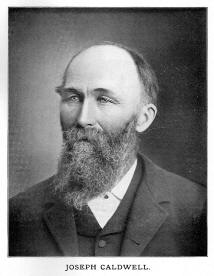 Joseph
J. Caldwell, a prominent citizen and prosperous agriculturist of
Bertram township, was born in Fountain county, Indiana June 20, 1836,
and is of Scotch ancestry, his paternal great-grandfather having
emigrated from Scotland in the early part of the eighteenth century.
The vessel on which he sailed was wrecked in a terrible storm, and he
was the only one on board that was saved. He finally reached land and
later went to New York. He located in the south and there reared his
family, in which were four sons who fought for the freedom of the
Colonies in the Revolutionary war. One of these was wounded in the hand
during his service and another died of camp fever. The third
subsequently removed to Butler county, Ohio, and engaged in farming. By
trade one of the number was a weaver. Joseph
J. Caldwell, a prominent citizen and prosperous agriculturist of
Bertram township, was born in Fountain county, Indiana June 20, 1836,
and is of Scotch ancestry, his paternal great-grandfather having
emigrated from Scotland in the early part of the eighteenth century.
The vessel on which he sailed was wrecked in a terrible storm, and he
was the only one on board that was saved. He finally reached land and
later went to New York. He located in the south and there reared his
family, in which were four sons who fought for the freedom of the
Colonies in the Revolutionary war. One of these was wounded in the hand
during his service and another died of camp fever. The third
subsequently removed to Butler county, Ohio, and engaged in farming. By
trade one of the number was a weaver.
Robert Caldwell, the grandfather of our subject, was the
youngest of these patriotic brothers, and was only fifteen years of age
when he enlisted in General Washington's army. After the war he
continued to make his home in Maryland for some time and was there
married. When the father of our subject was about two years old the
grandfather removed with his family to Butler county, Ohio, becoming
one of its early settlers. He was one of the ten prospectors who first
settled on the present site of Cincinnati. At that time the Indians
were very troublesome, and the pioneers needed stout hearts and ready
hands to protect themselves against the red men and the wild beasts
that roamed through the forest. Mr. Caldwell was a carpenter by trade
and found a knowledge of this craft most useful in his pioneer life. He
was in every sense of the word a representative frontiersman -
courageous, energetic and enterprising. For some time he engaged in
agricultural pursuits in Butler county, Ohio, and then removed to
Fountain county, Indiana, where he died at a good old age.
Joseph J. Caldwell, Sr., our subject's father, was a native of
Maryland, and was reared to agricultural pursuits upon the frontier.
The greater part of his life was passed in Indiana, but in 1852 he
removed to Johnson county, Iowa, purchasing four hundred and eighty
acres of raw prairie land in Cedar township, which he proceeded to
break with six yoke of oxen and a breaking plow. He soon had his land
under cultivation, and erected thereon a good house and barn. There he
died in October, 1855, at the age of sixty-two years. His wife, who
bore the maiden name of Nancy Runnolds, was a native of Virginia and a
daughter of Nehemiah Runnolds.
She passed away in January 1855, and her death was widely and
deeply mourned. In their family were seven children, namely: Mary, who
married Jacob Spitler and both died near Solon, Iowa; Eleaza, who died
in California in 1850; Robert, who wedded Mary Spurgeon and both died
in Holt county, Missouri; Frank, who first married Mary Williams and
second Christina Bock, and died at his home eleven miles south of
Independence, Iowa; Simon, who died at the age of two years; Joseph I.,
the subject of this sketch; and Amzi, deceased, who married Eliza
Williams, now residing near Solon, Iowa.
Our subject's early school privileges were very limited, being
able to attend the subscription schools for a brief time only. His
elder brother, however, had received a fair education, and taught him
at home, and by the time he was five years of age he was able to
correctly repeat the multiplication tables. At the age of six he
commenced work in the fields, and has since labored on an average of
sixteen hours per day. He grew up to a self-reliant and self-respecting
manhood in his birth place, and came with the family to Iowa in 1852.
Immediately succeeding the death of his parents he took complete charge
of the homestead farm. His father gave him eighty acres of land, and to
this he subsequently added until he had three hundred and thirty acres
of rich and arable land in Johnson county, where he made his home until
1897, when he sold his property there and removed to Linn county. He
bought one hundred and thirty acres of land on sections 26 and 35, and
has since made many improvements upon the place.
Mrs. Caldwell, who was a most estimable lady, a devoted wife,
a sincere friend and kind neighbor, died in September, 1892. Our
subject was again married at Solon, Iowa, June 7, 1894, his second
union being with Miss Elizabeth Blain, who was born in Linn county,
April 2, 1874, and is a daughter of Jesse and Erma (Hunter) Blain,
natives of Johnson and Linn counties, respectively. She is the second
in order of birth in a family of ten children, the others being May,
who died in childhood; Ella, wife of Frank Knapp, a merchant of
Bertram; Charles, a farmer of Bertram township; Julia; James, Raymond,
John and Vesta, all living at home. One died in infancy. Mr. and Mrs.
Caldwell have two children: Sherwin, born April 4, 1895; and Ilza, born
July 20, 1897.
For almost a quarter of a century Mr. Caldwell has engaged in
buying, feeding and shipping cattle and is considered an excellent
judge of stock, as well as a man of good financial ability. He is a
scientific farmer, and has acquired a comfortable competence, to which
he is continually adding. For many years he has been a member of the
Methodist Episcopal church, and has always been found on the side of
right and justice. He takes an active interest in all things pertaining
to the good of the community in which he lives, and was a prominent
factor in building the Burlington, Cedar Rapids & Great Northern
Railroad through Linn and Johnson counties. In his political
affiliations he is a Republican. His wife is a bright, intelligent
lady, most pleasant in her social relations, and takes a very active
interest in church work.
Source: Biographical Record of Linn County, Iowa. Chicago: The S. J. Clarke Publishing Company, 1901, p. 370-373.
MAJOR JACOB H. CAMBURN, M. D.
More than forty-seven years have passed since this gentleman arrived in
Cedar Rapids, and he is justly numbered among her honored pioneers and
leading citizens. As a physician and surgeon he was actively identified
with her professional interests in early life, but is now living
retired. His is an honorable record of a conscientious man, who by his
upright life has won the confidence of all with whom he has come in
contact.
The Doctor was born at Macedon Centre, Wayne county, New York,
December 8, 1823, and comes of good old Revolutionary stock, his
paternal great-grandfather, the father of Levi Camburn, having fought
for the independence of the colonies as a soldier of the Continental
army. The great-grand father was from Glasgow, Scotland, and was a
child of seven years when brought to this country by his father, who
was one of the pioneers of New Jersey. There Levi Camburn made his home
until the father of our subject, J. K. Camburn, was seven years old,
and then removed to the Genesee country, New York, finally locating in
Macedon, Wayne county, remaining in that county until 1835, clearing
and improving a farm on the Holland purchase. In later years he removed
with his son, J. K., to Michigan, the family becoming pioneer settlers
of Lenawee county, that state, where they engaged in agricultural
pursuits, buying two hundred acres of land. In 1842 they moved to
Moscow Plains, Hillsdale county, Michigan, where the death of both
occurred. The Doctor’s father was married in Wayne county, New York, to
Miss Rebecca Champion, a native of New Jersey, who died in Franklin,
Lenawee county, Michigan in 1840. He spent his last years in Hillsdale
county, Michigan, where he died in 1895, at the advanced age of
ninety-one years.
Dr. Camburn was reared in Michigan and there acquired his
primary education in an old log schoolhouse, such as was common on the
frontier at that time. Later he attended one of the four branches of
the State University at Tecumseh, all of which have since been
consolidated, forming the university at Ann Arbor. After reading
medicine with Prof. A. B. Palmer, M. D., who was practicing at
Tecumseh, he attended lectures at the medical department of the Western
Reserve College, Cleveland, Ohio, and entered upon the practice of his
chosen profession at Tecumseh, Michigan, in partnership with Professor
A. B. Palmer, of the medical department of the university at Ann Arbor,
remaining there some years. At an early day the University of Michigan
was controlled by regents, appointed from each church denomination, and
ministers, who were not practical, usually being the ones appointed.
Witnessing the bad effects from such a course, the Doctor, with others,
got a bill through the legislature to have the regents elected by the
people of the state, and from that time on the school has been
broadening all the time. In 1845 Dr. Camburn came to Cedar Rapids,
Iowa, and was engaged in practice here for some years. He is one of the
two pioneer physicians of this place who are still living here. During
the Civil war he received the appointment as regimental surgeon of the
Sixteenth Iowa Infantry, and went to the front with his regiment in
February, 1862, but soon afterward was taken ill and was forced to
resign in June of that year. Subsequently he again entered the service
as surgeon of the Sixth Iowa Calvary, with the rank of major, and went
to Dakota, where he served as medical director on the staff of General
Sully, a son of the noted painter, who was sent to that section to
quell the Indian outbreaks. When the war was over the Doctor was
honorably discharged in November, 1865, and returned to Cedar Rapids.
He has practiced very little since then except among old friends.
At Moscow, Hillsdale county, Michigan, Dr. Camburn was
married, December 27, 1848, to Miss Eleanor Blackmar, who was born near
Buffalo, New York, a daughter of Judge Lyman Blackmar, who was one of
the early settlers of Hillsdale county, and a prominent probate judge
for many years. Four children blessed this union, namely: Thomas A.;
James F. and Myron O., both residents of Cedar Rapids, and Eleanor C.,
wife of Charles L. Martin, of St. Louis, Missouri. The wife and mother
departed this life July 21, 1891. Originally, Dr. Camburn was an old
Jacksonian Democrat, but voted for Abraham Lincoln in 1860, and has
since been a stanch supporter of the Republican party, but never a
politician in the sense of office seeking. He served as justice of the
peace for about fifteen years, but never would accept other political
positions. He assisted in organizing the Grand Army Post, of Cedar
Rapids, of which he was the first commander. Prior to the Civil war he
also affiliated with the Masonic fraternity, having joined that order
in Michigan, being a member of the blue lodge, chapter and council. At
Iowa City, Iowa, he became a Knight Templar, and with one exception, he
is the oldest Knight Templar now living in Cedar Rapids. For some
years, however, he has not actively affiliated with the order. In
manner he is courteous, kindly and affable, and those who know him
personally have for him warm regard. As a pioneer he has witnessed
almost the entire growth and development of Cedar Rapids, and has
always taken an active interest in its welfare.
Source: The Biographical Record of Linn County Iowa,
Illustrated, Chicago: The S. J. Clarke Publishing Company, 1901, pages
116-118.
Submitted by: Carrie J. Robertson of Marion
GEORGE P. CARPENTER, M. D.
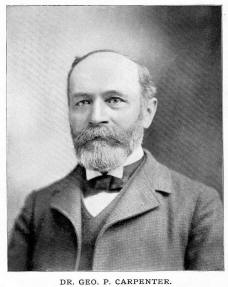 Dr.
Carpenter, who is the oldest medical practitioner in Cedar Rapids, has
that love for and devotion to his profession which has brought to him
success and secured him a place among the ablest representatives of the
medical fraternity in this section of the state. He was born in
Lancaster, Ohio, September 21, 1846, and is a son of Dr. Paul and Mary
(Fetters) Carpenter. On the paternal side his ancestors came from
Holland in colonial days, and representatives of the family bore a
prominent part in the Revolutionary war and the war of 1812. The
Fetters family is of German origin and was founded in Ohio at an early
day. Dr.
Carpenter, who is the oldest medical practitioner in Cedar Rapids, has
that love for and devotion to his profession which has brought to him
success and secured him a place among the ablest representatives of the
medical fraternity in this section of the state. He was born in
Lancaster, Ohio, September 21, 1846, and is a son of Dr. Paul and Mary
(Fetters) Carpenter. On the paternal side his ancestors came from
Holland in colonial days, and representatives of the family bore a
prominent part in the Revolutionary war and the war of 1812. The
Fetters family is of German origin and was founded in Ohio at an early
day.
Dr. Paul Carpenter, our subject’s father, was born in
Lancaster, Pennsylvania, and when a young man began the study of law
with James Buchanan, afterward president of the United States, but not
liking that profession he ran away from home and located in Lancaster,
Ohio, where he took up the study of medicine, later becoming one of the
foremost physicians and surgeons in that part of the state. For
forty-five years he was successfully engaged in practice in Lancaster,
and there died in 1880, at the age of seventy. He was a prominent Mason
and served as eminent grand commander of the state for twenty years. As
a Republican he took an active interest in political affairs, but could
never be prevailed upon to accept office. Religiously both he and the
mother of our subject were members of the Methodist Episcopal church.
The latter died in Lancaster, Ohio, at the age of thirty-five years. Of
their five children our subject is the second in order of birth and the
only survivor. The father was twice married, his first wife being Mary
Cannon, by whom he had two children, both living, namely: Henry W., a
physician of Lancaster, Ohio; and Mary Ellen, wife of W. J. Carty, of
Columbus, Ohio.
Dr. George P. Carpenter obtained his early education in the
schools of his native place, and was graduated from the high school of
that city at the age of fifteen years. He then entered the Ohio
Wesleyan University at Delaware, Ohio, where he pursued a literary
course and was graduated in 1865. He commenced the study of medicine
under the able direction of his father, and later attended lectures at
the Ohio Medical College, of Cincinnati, where he was graduated in
March, 1868, at the age of twenty-two years. While yet a student he
spent one year in an army hospital with his brother, Dr. H. W.
Carpenter, who was a surgeon in the army. There were from twelve
hundred to eighteen hundred patients in the hospital the entire time,
and there he gained a good practical knowledge of medicine and surgery,
which was of great benefit to him in his subsequent career.
Immediately after graduation Dr. Carpenter came to Cedar
Rapids, arriving here on the 4th of April, 1868, and at once opened an
office. The city at that time contained a population of only three
thousand, and he has therefore witnessed almost its entire growth and
development. Two years after locating here he entered into partnership
with Dr. E. L. Mansfield, and together they engaged in practice for
five years, but with that exception Dr. Carpenter has always been
alone. He has always engaged in general practice, but of late years has
given special attention to surgery and has performed many notable
operations.
On the 1st of July, 1869, in Delaware, Ohio, Dr. Carpenter was
united in marriage with Miss Delia Fant, a native of that state and a
daughter of Rev. S. Fant, who was a minister of the Methodist Episcopal
church, and one of the pioneer clergymen of that section. By this union
were born four children, namely: Laura, wife of A. S. Smith, of
Chicago; Alice, at home; Paul F., a resident of Los Angeles,
California; and George B., a student in the high school of Cedar
Rapids. The wife and mother died March 31, 1897, and was laid to rest
in the Oak Hill cemetery of Cedar Rapids.
In his political affiliations Dr. Carpenter is a Republican.
Religiously he is one of the leading and active members of the
Methodist Episcopal church, in which he has served as steward and
trustee for thirty years. Fraternally he is a member of Mt. Herman
Lodge, No. 263, F. & . M., and Trowel Chapter, No. 49, R. A. M.,
and also orders. He is medical examiner of the Northwestern Life
Insurance Company, of Milwaukee, and treasurer of the Iowa Union
Medical Society, of which he is a member. He is also a member of the
American Medical Society, the Tri-State Medical Society, the Iowa State
Medical Society, and the Cedar Rapids Medical Society, and has been a
member of the staff of St. Luke’s hospital since it was founded fifteen
years ago. He stands high in his profession and enjoys the personal
friendship of a number of the most noted physician of the United
States. The Doctor is widely and favorably known, and it is safe to say
that no man in Linn county has more friends or is held in higher regard
than he. He has a very fine collection of relics and curios gathered
from all parts of the world.
Source: The Biographical Record of Linn County Iowa,
Illustrated, Chicago: The S. J. Clarke Publishing Company, 1901, pages
190-4.
Submitted by: Carrie J. Robertson of Marion
DR. S. D. CARPENTER, M.D.
Dr. S. D. Carpenter came to Cedar Rapids in 1849. He practiced
medicine for some time in company, first with Dr. Mansfield, and then
with Dr. S. C. Koontz. During our late war he served his country as
surgeon in the army, continuing in the service from the beginning of
the struggle till the close.
In later years, however, he gave up the practice of his profession and
devoted his energies to the building of railroads. For many years after
leaving here he resided in Ottumwa, of this state, but finally moved to
Louisiana and engaged in the lumber business.
On July 6, 1850 he was married to Miss Sarah Weare, who came to Cedar
Rapids in the autumn of 1846. This lady had enjoyed the advantages of a
good education and was one of our earliest and best school teachers. In
society she always held a very high place. Refined and genteel in
manners, and intelligent and lively in conversation, she was always a
bright light in the social circles in which she moved. She died after a
protracted and painful illness, in St. Louis, March 8, 1889. She had
always been an active member of the Protestant Episcopal church, and
took a lively interest in its prosperity.
Dr. and Mrs. Carpenter were the parents of four children: Catharine G.,
wife of the late J. Asbury Taylor; Mary L., wife of A. G. Harrow; Sarah
A., wife of William D. Elliot, and Ralph Weare, who died August 22,
1891. The daughters are all residents of Ottumwa, Iowa.
Source: Carroll, Rev. George R., Pioneer Life In and Around
Cedar Rapids, Iowa from 1839 to 1849, pages 135-136, Times Printing and
Binding House, Cedar Rapids, Iowa, 1895.
Submitted by: Terry Carlson
WASHINGTON B. CARPENTER (from the 1901 History)
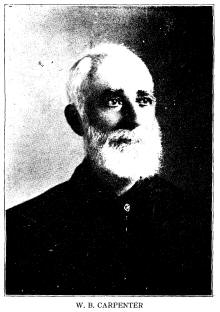 The
subject of this personal narration is one of the most successful and
progressive farmers of Marion township, though his home is in the city
of Marion on Seventh avenue west. He was born in Delaware county, New
York, on the 27th of October, 1829, and is a son of David P. and Rachel
(Brownell) Carpenter, the former also a native of the Empire state and
the latter of Rutland, Vermont. The father was a farmer by occupation
and was an officer in the war of 1812, receiving a land warrant for his
services. He had two brothers, William and Charles, who fought for
American independence as soldiers of the Revolutionary war. Both he and
his wife were active and consistent members of the Methodist Episcopal
church, in which he served as class leader for many years. He died in
New York at the age of sixty-four years, and she passed away at the age
of fifty-four. Of their thirteen children our subject is probably the
only survivor, though his brother Caleb, who has not been heard of for
years, may be still living in Pennsylvania. The
subject of this personal narration is one of the most successful and
progressive farmers of Marion township, though his home is in the city
of Marion on Seventh avenue west. He was born in Delaware county, New
York, on the 27th of October, 1829, and is a son of David P. and Rachel
(Brownell) Carpenter, the former also a native of the Empire state and
the latter of Rutland, Vermont. The father was a farmer by occupation
and was an officer in the war of 1812, receiving a land warrant for his
services. He had two brothers, William and Charles, who fought for
American independence as soldiers of the Revolutionary war. Both he and
his wife were active and consistent members of the Methodist Episcopal
church, in which he served as class leader for many years. He died in
New York at the age of sixty-four years, and she passed away at the age
of fifty-four. Of their thirteen children our subject is probably the
only survivor, though his brother Caleb, who has not been heard of for
years, may be still living in Pennsylvania.
During his boyhood Washington B. Carpenter attended the
district schools of his native state, but his educational advantages
were meager. His training at farm labor, however, was not so limited
and he early acquired an excellent knowledge of agricultural pursuits.
Before coming west he was employed in a wholesale store in New York
city for eight or nine years. In March, 1864, he arrived in Mt. Vernon,
Linn county, Iowa, and was first engaged in farming in Franklin
township, where he purchased land. In his farming operation he has met
with most excellent success, and is now the owner of a fine farm of
four hundred and seventy-five acres of land in Marion township, all of
which is under a high state of cultivation with the exception of a
small tract of timber land. He has an orchard upon his place, but most
of the land is planted in corn and oats. He raises a high grade of
thoroughbred cattle, and raised the finest steer ever produced in the
state, it weighing thirty-six hundred pounds in Chicago when four years
old. He owns two farms, one of which he rents, while the other is
operated by hired help.
On the 21st of March, 1852, Mr. Carpenter was united in
marriage with Miss Frances A. Mason, also a native of New York, and a
daughter of R. W. and S. M. Mason, who came to Mt. Vernon, Iowa, about
1850. By occupation her father was a farmer. Of his twelve children
three sons were among the boys in blue of the Civil war. L. H., who had
previously served as sheriff of this county, was a quartermaster in the
service and died about twelve hours after his return home. E. R., now a
resident of Marion, was a lieutenant, and was held a prisoner at
Andersonville for six months. John C. entered the service as a
corporal, and was severely wounded in the battle of Shiloh, after which
he returned home. He has been sergeant at arms at the capitol in Des
Moines, and is now serving as justice of the peace in Greenfield, Iowa.
Unto Mr. and Mrs. Carpenter were born three children: (1)
Alfred M., a farmer of Marion township, Linn county, married, first,
Alice D. Simpson, and they had seven children, Blanche, Florence,
Frances, Pearl, Emily, Cora and Earl. In 1897 she died, and in April,
1899, he married Mrs. Marjorie Goodlove, and they have one child,
Dorothy. (2) Claud C., an extensive farmer and cattle dealer living a
mile east of Marion, married, first, Libbie Belle, and they had five
children: Daisy, who died young; Belle; Benjamin; Clinton and Ralph. In
1893 she passed away, and for his second wife he married Stella
Stinson, in 1899, and they have one child, Frances Beulah. (3) Cora A.
married Charles Heer and died in 1887, at the age of twenty-four years.
With her was buried her daughter, Louise, who died at the same time,
aged two years. Our subject and his wife have three
great-grandchildren: Lewis Matthews, Earl Lary and Alice Thompson.
Since her girlhood days Mrs. Carpenter has been an earnest
member of the Methodist Episcopal church, and she is also a member of
the Chautauqua Society. Mr. Carpenter is a Knight Templar Mason, and is
one of the most prominent and highly esteemed citizens of Marion. In
business affairs he is upright and honorable and his life has ever been
such as to commend him to the confidence of all with whom he has come
in contact either in business or social affairs.
Source: The Biographical Record of Linn County Iowa,
Illustrated, Chicago: The S. J. Clarke Publishing Company, 1901, pages
116-118.
Submitted by: Carrie J. Robertson of Marion
WASHINGTON BENJAMIN CARPENTER
Was for many years identified with farming interests and
although now living retired, making his home in Marion, is still the
owner of a valuable and productive farm of four hundred and eighty-five
acres, situated about five miles north of the. city in which he lives.
lie was born in Delaware county, New York, and is a son of David P. and
Rachel (Brownell) Carpenter. The father always resided in his native
state. He was a soldier of the war of 1812, serving with the rank of
captain, while two of his brothers, George and Thomas Carpenter, were
soldiers in the Revolutionary war.
Washington B. Carpenter is one of a family of thirteen
children but only he and his brother Caleb, a resident of Pennsylvania,
now survive. He attended the common schools and worked on the home farm
with his father in his youthful days but thinking that his
opportunities were limited by the confines of the farm, he afterward
went to New York city, where he remained for eleven years, which
brought him up to the time that he was thirty-five years of age. He
then left the east and, making his way to Iowa, settled at Mount
Vernon, where he purchased two hundred and seventy-five acres and began
the development of a new farm. Later he located on the place which he
now owns in the vicinity of Marion, in 1870. Year after year he
carefully tilled the fields, bringing the place under a high state of
cultivation and became, through judicious investment, the owner of four
hundred and eighty-five acres of valuable land, which he continued to
cultivate with gratifying success until about fifteen years ago, when
he turned the active work of the farm over to others and took up his
abode in Marion. He has the proud record of raising the finest steer
ever produced in the state, it weighing thirty-six hundred pounds in
Chicago when four years old.
Mr. Carpenter was married on the 21st of March, 1852, to Miss
Frances Mason, and unto them were born three children. Alfred M., the
eldest, is a farmer of this county, who married Alice Simpson, and unto
them were born eight children: Blanch, the wife of Robert Larry;
Florence, the wife of Lou Mattis, by whom she has one child, Louie;
Frances, the wife of Andrew Falcon, and the mother of two children,
Gladys and Norman; Emily, the wife of Alfred Busenbark; one child, a
boy, who died in infancy; Pearl, the wife of Marion Owen, by whom she
has a daughter, Alice; Cora, the wife of Sumner Jordan and the mother
of a daughter, Isabel; and Donald. After the death of his first wife,
Alfred M. Carpenter wedded Marjorie Goodbye, and their children are
Dorothy arid Charlotte. Claud C. Carpenter, the second son of W. B.
Carpenter, married Miss Elizabeth Beall, and their children are: W. B.,
at home; Belle, the wife of Joseph Napier; Clinton C., attending
college in Ames, Iowa; and Ralph, at home. For his second wife Claud C.
Carpenter chose Stella Stinson and they have four children, Frances,
Mary, Howard and Irene. Cora, the third child of W. B. Carpenter, is
the wife of Charles Herr. They had a daughter, Louise, now deceased.
After losing his first wife Mr. Carpenter of this review wedded
Elizabeth Cooper, a native of County Down, Ireland.
In his fraternal relations Mr. Carpenter is a Mason and has
attained the Knight Templar degree. He has always been interested in
the welfare of the community and has aided in promoting its moral
progress as a member of the Methodist church. He was one of the
organizers of the Farmers & Merchants State Bank at Marion and is
still one of its directors. He belongs to the Old Settlers Association
and takes an active interest in its meetings and in recalling the early
days when this was a pioneer district in which the work of improvement
and development had scarcely begun. Through his business life he took
an active part in promoting the agricultural progress of the county and
he has been an interested witness of its growth along many lines since
coming to the county more than four decades ago.
Source: History of Linn County Iowa, From Its Earliest
Settlement to the Present Time, Vol. II, Chicago, The Pioneer
Publishing Company, 1911, p. 332-5.
Contributed by Terry Carlson
COLONEL CHARLES A. CLARK
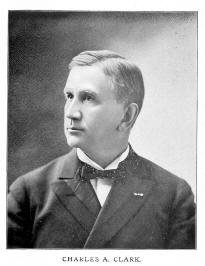 Among
the prominent attorneys and influential citizens of Cedar Rapids is
Colonel Charles A. Clark, who devoted the opening years of his manhood
to the defense of our country from the internal foes who sought its
dismemberment, and his gallant service on field of battle won for him
distinctive preferment in military circles. He was born in Sangerville,
Maine, on the 26th of January, 1841, and belongs to a family which was
founded in this country by Hugh Clark, who came from England in 1640
and located in Massachusetts. William G. Clark, the Colonel's father
was a life-long resident of the old Pine Tree state, and a prominent
lawyer, who was noted for his great oratorical ability. As a speaker he
took a very active and influential part in the national campaigns, and
was one of the leading politicians of the Whig party in his state. Among
the prominent attorneys and influential citizens of Cedar Rapids is
Colonel Charles A. Clark, who devoted the opening years of his manhood
to the defense of our country from the internal foes who sought its
dismemberment, and his gallant service on field of battle won for him
distinctive preferment in military circles. He was born in Sangerville,
Maine, on the 26th of January, 1841, and belongs to a family which was
founded in this country by Hugh Clark, who came from England in 1640
and located in Massachusetts. William G. Clark, the Colonel's father
was a life-long resident of the old Pine Tree state, and a prominent
lawyer, who was noted for his great oratorical ability. As a speaker he
took a very active and influential part in the national campaigns, and
was one of the leading politicians of the Whig party in his state.
In 1855 he was secretary of the state senate of Maine, when Hon. James
G. Blaine and Chief Justice Fuller were members of that body, the
latter being at that time editor of the Augusta Argus, the leading
Democratic paper of the state. Throughout his active business career
Mr. Clark continued to follow the legal profession and died in
Sangerville of typhoid fever at the age of forty-two years, honored and
respected by all who knew him. In early life he married Miss Elizabeth
White Stevens, a daughter of Dr. Whiting Stevens, who for over half a
century successfully engaged in the practice of medicine in Limerick,
York county, Maine. The Stevens family was of English origin and among
the early Puritans who came to this country.
Unto Mr. and Mrs. Clark were born eleven children, of whom the Colonel
is third in order of birth. The four oldest sons were soldiers of the
Civil war and all were wounded, while one was killed in battle, and
another died from the effects of his wounds several years after the
close of the war. Of the four our subject and his brother Frank A. are
still living. He has four other brothers namely: George E. and Eugene
H., both prominent lawyers of Algona, Iowa; William G., who is now
engaged in practice with our subject; and Frank A., who has served in
the second auditor's office in the United States treasury for many
years. The mother of these children died in Algona, Iowa, at the age of
sixty-eight years.
During his boyhood and youth, Colonel Clark attended the
Sangerville public schools and the Foxcroft Academy of Maine, where he
pursued a literary course fitting himself for Harvard University, but
when the Civil war broke out he laid aside his books and entered the
service of his country, enlisting in April, 1861, as a private in
Company A, Sixth Maine Volunteer Infantry. For his meritorious service
and bravery on field of battle he won promotion rapidly, and was soon
made adjutant of the regiment. Later he was successively commissioned
captain and assistant adjutant-general, brevet-major and lieutenant
colonel.
While serving as adjutant he received a congressional medal of honor by
saving his regiment from capture through his personal gallantry and
skill at Banks Ford, Virginia, just outside of Fredericksburg, May 4,
1863. He was severely wounded in a successful charge on the Confederate
works at Rappahannock, November 7, 1863, when from his regiment sixteen
out of the twenty-one officers that entered the charge were either
killed or wounded, and in the official report it was recorded that
Adjutant Clark fell "after he had driven his sword into an enemy" in
the hand to hand contest which resulted in holding the works and
capturing two thousand prisoners, seven pieces of artillery and five
Confederate battle flags.
He was also with his regiment in its successful charge upon the heights
of Fredericksburg, May 3, 1863, a portion of Sedgwick's operation,
while Hooker was engaged in the battle of Chancellorsville. Colonel
Clark was in the successful charge upon the Confederate works at
Petersburg, July 15, 1864, and upon Fort Harrison in front of Richmond,
in September of the same year. He was with General Burnham, who led the
victorious column, and received that commander in his arms when he fell
mortally wounded within the assaulted fort. Thus Colonel Clark bore a
conspicuous part in four out of the eleven successful charges made by
the Union forces on earth works during the entire Civil war as recorded
in Fox's work, "Regimental Losses."
With exception of the first battle of Bull Run he participated in all
of the important engagements in which the Army of the Potomac took
part, including the battle of Yorktown, the "seven days' battles" in
front of Richmond, under McClellan, the battle of Williamsburg, the
second battle of Bull Run, and the battles of Antietam, Fredericksburg,
Brandy Station, Gettysburg and Rappahannock Station. He was in the
command of General Butler during his operations around Petersburg and
Richmond, and was with General Grant at the battle of Cold Harbor,
where ten thousand men were lost before breakfast.
He was with Baldy Smith in his successful charge on the works of
Petersburg and the engagements around that stronghold and Richmond.
Being broken down in health and suffering from the wounds he had
received, Colonel Clark resigned in the fall of 1864 and returned to
his old home in Maine, with a war record of which he may be justly
proud.
The Colonel then took up the study of law with A. W. Paine, of
Bangor, one of the foremost lawyers of the state. Taking Horace
Greeley's advice, he came west in May, 1866, and located in Webster
City, Hamilton county, Iowa, where he made his home for about ten
years, enjoying a large and lucrative practice, which extended all over
northwestern Iowa, taking in fifteen or twenty counties. As there were
no railroads in that locality at that time he traveled over the
territory either on horseback or with livery teams and in stage
coaches. He was instrumental in getting the first railroad through,
acting as attorney for John I. Blair, when he built what is now the
Illinois Central from Iowa Falls to Sioux City.
In 1876 Colonel Clark came to Cedar Rapids and formed a
partnership with Judge N. M. Hubbard, which connection lasted for ten
years. He was then alone in practice until 1898, when he admitted his
son James W., to partnership under the firm name of Charles A. Clark
& Son, and now his youngest brother William G. Clark is also with
them. During his residence here the Colonel has been interested in much
of the important litigation of the state, either on one side or the
other, and has practiced in the United States courts of half a dozen
other states; in the United States supreme court at Washington, D. C.,
since 1880; and in the United States circuit court of appeals since its
establishment. He has argued in person a large number of important
cases in the United States supreme court. He is a man who thoroughly
loves his profession, and is eminently gifted with the capabilities of
mind which are indispensable at the bar. He is also a man of deep
research and careful investigation, and his skill and ability have won
for him an extensive practice. He has a very valuable and complete law
library.
On the 19th of December, 1863, in Sangerville, Maine, Colonel
Clark was united in marriage with Miss Helen E. Brockway, a native of
that town and a schoolmate of our subject. Her father, Cyrus Brockway,
was a prominent and prosperous manufacturer, proprietor of Brockway's
Mills at Sangerville, and a representative of an old pioneer family of
that locality. He had four children of whom Mrs. Clark is the youngest.
Of the seven children born to the Colonel and his wife one son died in
infancy. Those living are Mary A., at home; Laura A., wife of Robert I.
Safely, of Cedar Rapids, whose sketch appears on another page of this
volume; Helen and Florence, both at home; James W., who married Miss
Messer and is now engaged in the practice of law with his father; and
Atherton B., who is attending the public schools of Cedar Rapids.
Fraternally Colonel Clark is a prominent member of the Loyal
Legion and was commander of the order in this state in 1899 and 1900.
He is also a member of the Medal of Honor Legion of Washington, D. C.,
and the Grand Army Post of Cedar Rapids. He now belongs to the blue
lodge, chapter and commandery of the Masonic fraternity, and was master
of the lodge at Webster City during his residence there. Formerly he
was a Democrat in politics, but in 1896 and 1900 he supported William
McKinley for the presidency.
He has always taken a very active and prominent part in political
affairs, and has made many addresses in every important campaign in
Iowa during his residence here. The bar of Linn county made him their
candidate for supreme judge in 1900, and he received a good support
from lawyers all over the state but was not nominated, very much to his
own satisfaction, as he prefers to give his entire time and attention
to his extensive private practice.
He served one term as mayor of Cedar Rapids, during which time he made
many improvements in the city, especially as to its cleanliness,
driving the horses and cows from the streets, and the pig pens from the
back yards. It is but just and merited praise to say that as a lawyer
Colonel Clark ranks among the ablest in the state, and as a citizen is
honorable, prompt and true to every engagement. It is not alone because
of special prominence at the bar that he has, and is justly entitled
to, the respect and confidence of his fellow men, for his personal
qualities are such as to make him loved and honored. He is a worthy
representative of that class to whom more than to any other is due the
continued growth and prosperity of many thriving cities of the west.
Source: Biographical Record of Linn County, Iowa. Chicago: The S. J. Clarke Publishing Company, 1901, p. 76-81.
FRANCIS J. CLEVELAND
Francis J. Cleveland, who since January, 1907, has capably
discharged the duties devolving upon him in the capacity of county
auditor of Linn county, is numbered among the worthy native sons of
this county, his birth having occurred in Marion on the 14th day of
January, 1868. His parents were David and Sarah (Carver) Cleveland. The
father, who was engaged in business as a carpenter contractor, came to
this state from Washington county, New York, in early manhood. When the
Civil war broke out he enlisted in defense of the Union, becoming a
member of Company K, Twenty-second Iowa Volunteer Infantry, with which
he served throughout the entire period of hostilities. After being
honorably discharged from the army he went to Johnson county, Iowa, but
soon afterward took up his abode in this county. Here he resumed work
at his trade and thus remained an active factor in industrial circles
of Marion until the time of this death, which occurred in November,
1872. His widow is living at the age of sixty-seven years in Marion and
still enjoys good health. Unto them were born two children, namely:
Mrs. Caroline Kerr, residing in Ramona, California; and Francis J., of
this review.
Francis J. Cleveland attended the public schools in the
acquirement of an education and after putting aside his text-books
secured a position in the First National Bank of Marion, while later he
entered the Cedar Rapids Savings Bank and next became employed in the
Mount Vernon Bank. He afterward re-entered the First National Bank at
Marion, remaining in the service of that institution until 1903, when
he was appointed deputy auditor of Linn county. After acting in that
capacity for four years he was elected county auditor, in which office
he has remained the efficient incumbent since January , 1907.
In July 1895, Mr. Cleveland was united in marriage to Miss
Nellie Walter, a daughter of B. F. and Abbey (Schenck) Walter, of Mount
Vernon. They are now the parents of four children: Lester Francis,
Walter Newell, Elizabeth Grace, and Grover, born February 9, 1910.
Mr. Cleveland is a worthy examplar of the Masonic fraternity,
belonging to the blue lodge, the chapter, the commandery and the
shrine. He is likewise identified with the Knights of Pythias and also
belongs to the Presbyterian church, in the work of which the members of
his family take an active and helpful part. As a citizen he is public
spirited and whatever tends to promote the best interests of the
community receives his endorsement and hearty support. He has spent his
entire life in this county and is therefore widely and favorably known,
commanding the high regard of all with whom he has been associated.
Source: History of Linn County Iowa, From Its Earliest
Settlement to the Present Time, Vol. II, Chicago, The Pioneer
Publishing Company, 1911, p.57-58
Submitted by: Terry J. Carlson
GEORGE A. COBBAN
George A. Cobban has been one of the important factors in the
business circles of Marion, Iowa, for many years, and his life is an
exemplification of the term “the dignity of labor.” The possibilities
that the United States offers to her citizens he has utilized, and
though he came to this country a poor boy he has steadily and
perseveringly worked his way upward, leaving the ranks of the many to
stand among the successful few.
Mr. Cobban was born on the 8th of May, 8134, in Iverness,
Canada East, a son of Robert and Mary (Anderson) Cobban, both of whom
were natives of Scotland, and the latter a daughter of Captain
Anderson, of Aberdeen. In early life the father of our subject was
connected with a publishing house of that city, and for a number of
years was editor of the Aberdeen Chronicle. In 1830 he emigrated to
Canada, where he followed farming throughout the remainder of his life.
Both he and his wife died there, our subject being only eight years old
when the mother passed away. In the family were eleven children,
namely: John A., Robert, William F., Mary Ann, Julia, Jessie, George
A., Charles, Joseph, Simon and Joanna. Only four of the number are now
living.
Being an ambitious lad George A. Cobban asked his father’s
permission to come to the United States when fifteen years of age, but
was told that he was too young to start out in life for himself. Being
given a small piece of land to work, he made fifty cents from the
products he raised thereon, and with this capital he decided to come to
the United States. Accordingly one night in June, 1851, he left home to
seek his fortune, having first told his sister Jessie, who prepared him
a lunch. The following day he walked thirty miles before sunset, and
spent the night in a tavern. The second day he traveled forty miles,
and after sleeping all night on the floor of an inn he walked thirty
miles on the third day, arriving at Derby, on the Vermont line, at
sundown. After buying five cents worth of crackers he found that he had
only ten cents of his half-dollar remaining. He started out to look for
work, but found none and slept that night on the floor of the Derby
House. He was told by the clerk that there was a farmer living ten
miles from town who was in need of a boy, and without a bite to eat he
started for the place, only to find that the place had already been
taken. He inquired for work at different places along the way, but
found none. At length becoming discourages, as well as tired and
hungry, he entered a field where a man was plowing, and again asked for
employment. On being told that the man had no work for him he broke
down, and large tears rolled down his cheeks. The kind-hearted farmer
then questioned him, and on learning his story took him to the house
and gave him something to eat. Mr. Cobban offered his last ten cents
for the meal. On reaching town the hotel clerk told him that Colonel
Kilbourne, across the line in Canada, might give him work, although he
disliked to return to Canada he saw that this was his only chance and
again started out. He was hired for one month at six dollars, and at
the end of that time was persuaded to stay a few months longer at seven
dollars per month.
Having saved twenty dollars from his wages, Mr. Cobban started
for Boston on the 1st of October, 1850. He walked the first day to
McEndos Falls, a distance of thirty miles, then the terminus of the
Vermont Central Railroad. He met some boys who told him that there was
a lumber train going that night to Wells River, fifteen miles below,
and if he waited he could ride on the lumber. He had never seen a
railroad or a car previous to this time. He rode to Wells River, and
was not discovered by the conductor until arriving at that place. The
following morning he decided to proceed to Boston, but arrived at the
depot just in time to see the train pull out. He ran after it a short
distance, calling for it to stop, but as it failed to heed him he had
to wait until the next morning. On reaching Boston he purchased some,
new clothes, and then took a train for West Newbury, Massachusetts,
where his brother William was living. He remained with him a short time
and attended school. The following spring he joined his brother John,
in Holliston, that state, and there worked one year pegging brogands at
five dollars per month for the first six months, and ten dollars per
month for the remaining time. Mr. Cobban next found employment cutting
sole leather in a shoe factory, and from that time on he has steadily
prospered, until he is to-day one of the most substantial and prominent
business men of his community. He served for some time as foreman of a
large boot and shoe factory in the east.
At the age of twenty Mr. Cobban visited his old home in
Canada, and spent one evening with his father’s family without being
known, so much had he changed in the years of his absence. In 1860 he
went to Scotland to see his relatives there, but not meeting with a
kindly reception he soon returned a wiser and happier man. His
relatives there belonged to the aristocratic classes, and did not take
very kindly to American ideas. While calling on his mother’s sister, he
was asked what profession he followed, and on his replying that he was
only a mechanic, he was told that he need not take the trouble to call
again. He was glad to return to a country where any honest occupation
was respected and where there was no such false ideas of
respectability.
The shoe firm for whom Mr. Cobban worked failed in 1861 and he
was compelled to take notes for the amount due him at that time. He had
previously saved three hundred dollars, and with that and what was due
him he had intended to embark in business for himself. He was greatly
disappointed therefore on being unable to obtain the latter amount, but
not discouraged. He decided to come to Iowa and select some growing
town where he believed he could succeed in business. Believing that
Marion would prove a good location, he bought about fifteen hundred
dollars worth of boots and shoes on time and shipped the same to Cedar
Rapids. The freight charges on the goods amounted to fifty-two dollars,
and as he had only seventeen dollars, he proposed to leave a part of
the stock as security in Mr. Bever’s warehouse, but that gentleman
being a good judge of human nature told Mr. Cobban he could take all
his goods and give him a due bill for the amount, which our subject
paid two days later. By extensive advertising and close attention to
business he met all his obligations in this way before the bills were
due, and built up a large and prosperous business. He removed his store
to Cedar Rapids in 1880, but has always made his home in Marion, and
continued in active business until 1889, being one of the largest
wholesale boot and shoe dealers in Iowa. He also employed several
shoemakers and in this way placed a large amount of custom-made shoes
on the market. Since 1889 he has been interested in Butte, Montana,
real estate, loans and mining, and in this undertaking has been also
successful. He also deals largely in Cedar Rapids property, and is one
of the leading business men of Linn county.
On the 16th of November, 1865, Mr. Cobban was united in
marriage with Miss Marcia B. Todd, of St. Stephens, New Brunswick. Her
father was Hon. William Todd, a highly respected and prominent citizen
of that place, and a life-long member of the provincial parliament. He
was appointed by the Queen as member of the executive council of the
Confederation of Provinces, but owing to ill health never accepted. He
was largely interested in railroads and other business enterprises, and
was president of the St. Stephens Bank and of the New Brunswick &
Canada Railroad. He died August 5, 1873, at the age of seventy years.
Mr. and Mrs. Cobban are the parents of five children, namely: Harry,
born October 29, 1869, died at the age of seven and a half years;
Mabel, born July 6, 1871, died at the age of one and a half; Neva L.,
born July 2, 1873, is the wife of H. S. Scampton, who lives with our
subject and is an engineer on the Chicago, Milwaukee & St. Paul
Railroad; Alice M., born May 5, 1879 is at home; and George T., born
May 8, 1880, is now at home.
Mr. Cobban built his present home in Marion in 1866, and has
since made a number of additions and improvements to the place. He also
erected a brick business block in that city in 1872, and has been
prominently identified with the growth and development of the place. In
his religious views he is liberal and in politics is an ardent
Republican. Coming to the United States without capital he deserves
great credit for his success in life. He has always made the most of
his opportunities, and by straightforward, honorable dealing has
secured the public confidence and the public patronage. He has
accumulated a handsome property, and his life illustrates what can be
accomplished through industry, perseverance, good management and a
determination to succeed.
Source: The Biographical Record of Linn County Iowa,
Illustrated, Chicago: The S. J. Clarke Publishing Company, 1901, pages
84-6.
Submitted by: Carrie J. Robertson of Marion
GEORGE A. COBBAN
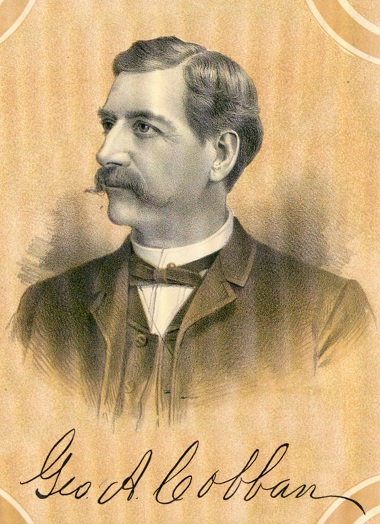 GEORGE
A. COBBAN, whose portrait is given on the opposite page, is a wholesale
and retail dealer in boots and shoes at Cedar Rapids. He located
in Marion in April, 1861, where he carried on a successful business for
about twenty years, moving to Cedar Rapids in the spring of 1880.
The demands of an increased business caused him to largely augment his
facilities, which was done in his name. Mr. Cobban was born at
Inverness, Canada East, May 8, 1834. His father, Robert Cobban,
emigrated to Canada from Scotland, in 1830, and engaged in
farming. There he reared a family of eleven children, seven boys
and four girls, viz.: John A., Robert, William F., Mary Ann, Julia,
Jessie, George A., Charles, Joseph, Simon and Joanna, all of whom are
living but Robert, Mary Ann, Julia and Charles. Our subject's
father died in Canada. He married a daughter of Capt. Anderson,
also of Aberdeen, Scotland. Before coming to Canada, he owned and
carried on a printing and publishing house in Aberdeen, and was for
many years editor of the Aberdeen Chronicle. GEORGE
A. COBBAN, whose portrait is given on the opposite page, is a wholesale
and retail dealer in boots and shoes at Cedar Rapids. He located
in Marion in April, 1861, where he carried on a successful business for
about twenty years, moving to Cedar Rapids in the spring of 1880.
The demands of an increased business caused him to largely augment his
facilities, which was done in his name. Mr. Cobban was born at
Inverness, Canada East, May 8, 1834. His father, Robert Cobban,
emigrated to Canada from Scotland, in 1830, and engaged in
farming. There he reared a family of eleven children, seven boys
and four girls, viz.: John A., Robert, William F., Mary Ann, Julia,
Jessie, George A., Charles, Joseph, Simon and Joanna, all of whom are
living but Robert, Mary Ann, Julia and Charles. Our subject's
father died in Canada. He married a daughter of Capt. Anderson,
also of Aberdeen, Scotland. Before coming to Canada, he owned and
carried on a printing and publishing house in Aberdeen, and was for
many years editor of the Aberdeen Chronicle.
One
of the sad events which occurred in the boyhood of our subject was that
of the death of his mother, which took place when he was but eight
years of age. He was a very ambitious youth, and during his
younger years often asked his father for permission to go to the States
to seek his fortune. To this his father would always demur,
saying he was too young. When our subject was fifteen his father
gave him a small tract of land to cultivate. From the products of
his labors he realized fifty cents, and with this small amount he
determined to start out in the world to seek a larger field for
operations. Accordingly, one dark night in June, 1850, having
made a confident of his sister Jessie, who was two years his senior and
who furnished him with a cold lunch, he bade farewell to home and
kindred and started out into the cold, strange world to seek his
fortune. Space will not allow us to dwell on the hopes, doubts
and aspirations, as well as resolutions, that filled young George's
heart on that eventful night. Brave, honest and full of de-
termination to succeed, he traveled on, making ten miles the first
night. Starting out early the following day, he traveled thirty
miles by sunset, when he came to a tavern. Here, he met a man who
had worked for his father, and to whom he became indebted for a night's
lodging and breakfast. The second day, although footsore and
somewhat dejected in spirit, he traveled forty miles, resting himself
for a while at night in a farmhouse, where he satisfied his hunger with
a bowl of bread and milk, and for which he paid ten cents. A
little further on he came to an inn, upon the floor of which he lay for
the night. On the third day George walked thirty miles, arriving
about sundown at Derby Line, Yt. This day's journey was through a
dense forest, inhabited with bears and wolves. After purchasing
five cents' worth of crackers for his supper, he had ten cents left out
of the fifty with which he started from home. After eating his
lunch of crackers, he looked about for work, but without success, and
that night slept on the floor of the Derby House. He was rudely
awakened in the morning by a kick and told to get out of the way.
This was a little too much for George's spirits, but he got up and
washed his face and again looked about for work. He was told by
the clerk of the hotel that a farmer about ten miles from town was
inquiring the day before for a boy. Without a bite to eat the
determined lad started for the farmer's house, and arrived only to find
that the place was filled. He retraced his steps, applying for
work on the way, but without success. At last, discouraged,
tired, footsore and hungry, he started out into a field where he saw a
man plowing and applied to him for work. On being refused he
broke down, large tears coursing down his young cheeks. At this the
farmer questioned the boy, who told his story. The kindhearted
farmer took him to the house, and gave him a large bowl of bread and
milk and a piece of apple pie. George offered him his last ten
cents, which was refused. On going back to town he was informed
by the hotel clerk that Col. Kilbourne, across the line in Canada,
might give him work. George did not like to return to Canada, but
it seemed to him the only chance, so he started for Kilbourne's place,
where he obtained work on a month's trial at $6. At the end of
the month he was persuaded to stay a few months longer at $7 a month.
About
the 1st of October, 1850, the subject of our notice, with $20 in his
pocket, concluded to make his way to Boston. He walked the first
day to McEndos Falls, a distance of thirty miles, which was then the
terminus of the Vermont Central Railroad. There he met some boys
who told him that there was a lumber train going that night to Wells
River, fifteen miles below, and if he would wait, he could get on the
lumber and get a ride. This he concluded to do. He had
never seen a railroad or a car before. The railroad tracks at
that time were not as smooth as they are at present. When he
arrived at Wells River it was very dark. The conductor came along
with his lantern, and seeing a boy on the car of lumber, asked him when
he got on. George told him, and the
conductor ordered him down, and told him if he ever caught him there
again it would not be healthy for him. George, even without this
admonition, had not the slightest notion of trying a ride like that
again. The following morning he started for the depot to take the
train for Boston, but got there just in time to see the train pulling
out. George ran after it, calling for it to stop, which of course
it did not do. The next morning he was on hand in time, and
taking the train soon arrived in Boston. After buying himself
some clothes, he took the train for West Newbury, where his brother
William lived, and from whom he received a hearty welcome. He
remained with his brother for a time, who sent him to school, but in
the spring he went to Holliston, the home of his brother John. In
that place he worked one year, pegging brogans at $5 per month for the
first six months and $10 for the second six months. He then
secured a job at cutting sole leather in a shoe factory.
From
the last mentioned time on the subject of this sketch seemed to
prosper, and gradually rising to positions of trust and responsibility,
he finally became foreman of a large boot and shoe factory. In
1860, he made a visit to Europe to see his friends in Scotland, but he
did not stay long, and returned a wiser and a happier man. His
relations in Scotland belonged to the aristocratic classes and did not
take to the American idea very kindly. When he called upon his
mother's sister, they inquired what profession he belonged to and, upon
his replying that he belonged to no profession but was a mechanic, they
told him that he need not take the trouble to call again, which
injunction he faithfully adhered to. He was glad to return to a
country where every honest occupation was respected and where there
were no such false ideas of respectability.
Previous
to our subject's going to Scotland, and at the age of twenty, he
visited his old home in Canada and spent an evening with his father's
family without being recognized. In 1861 the company for whom he
was working failed, and our subject was compelled
to take notes for the amount due him. He had saved besides the
notes he took, some $300, and with this and what was due him he had
intended to start in business for himself. He purchased about
$1,500 worth of goods on time, had some cards printed, and started for
the West. His goods were shipped to Cedar Rapids, he having
selected Marion as the place for opening up. When the goods
arrived at Cedar Rapids there was $52 freight charges on them, while
the .young merchant only had $17 to pay with. He proposed to
leave part of the goods as security in Mr. Bever's warehouse, but the
latter gentleman, being a good judge of human character, told our
subject to take all his goods and him his due bill for the amount, and
when he took in the money to send it down. In about two days the
bill was paid. By liberal use of printer's ink and close
attention to business he met all of his obligations before they were
due. In this way he built up a large and prosperous business,
which would reflect honor upon one enjoying every advantage in starting
life, not one of which outside of his own inherent ability did our
subject enjoy.
Mr. Cobban was united in marriage in 1865 with
Miss Marcia B., the estimable daughter of the late Hon. William Todd,
of St. Stephens, N. B. He died Aug. 5, 1873, aged seventy
years. He was a highly respected and prominent citizen. He
was a life member of the Provincial Parliament and was largely
interested in railroads and other business enterprises of that
Province. He was also President of St. Stephens Bank, and of the
New Brunswick & Canadian
Railroad. Mr. and Mrs. C. became
the parents of five children, namely: Harry, born Oct. 29, 1869; Mabel,
July 6, 1871; Neva Louise, July 2, 1873; Alice M., May 5, 1879; and
George A., Jr., born May 8, 1880. The first daughter died Dec.
15, 1872, and Henry died April 13, 1877.
In
1866 Mr. Cobban erected a fine brick dwelling in Marion, where he still
resides. In 1872, he put up a brick store, which he occupied for
many years. Eight years later, however, desiring a larger field
for his business operations, he removed his store to Cedar Rapids,
where he has now one of the leading boot and shoe establishments in the
State. He has invested quite largely in real estate in that city,
and is one of its leading business men. He is a Republican in
politics, and liberal in his religious views.
Mr.
Cobban's success in life shows what courage, perseverance and an honest
purpose will accomplish under Republican institutions where labor is
honorable and success open to all who may seek it.
Source: portrait
and biographical sketch (verbatim transcription): “Portrait and
Biographical Album of Linn County, Iowa”, 1887, biographical sketch on
pages 357 - 359, portrait on page 356
Submitted by: Eric & Marcia Driggs
JOHN CONE
John Cone, ex-sheriff of Linn county and an honored veteran of the
Civil war, is now living a retired life at his pleasant home, No. 998
Eleventh street, Marion. He was born in this county, November 2, 1841,
his parents being Norris and Ann (Blakslee) Cone, natives of
Connecticut and pioneers of Iowa. In the east the father worked as a
farmer and mechanic, being employed in a wooden comb factory a part of
the time. He lived for a time in Hendersonville, Illinois, and in the
winter of 1838-9 came to Linn county, Iowa, locating first on a farm
four miles southeast of Marion. On selling that place he bought another
farmer on the Mt. Vernon road, where he made his home until his removal
to Marion on the 1st of march, 1854. He assisted his sons in the
painting business for fifteen years thereafter and then lived retired
until his death. For many years he was a deacon in the Baptist church,
of which both he and his wife were life-long members, and they were
people of the highest respectability. He was born in 1808, and died in
1885, while she was born in 1810 and passed away in 1883.
Of their seven children the two oldest were born in
Connecticut, the others in this county. (1) Byron, a lather by trade,
and a resident of Marion, enlisted in 1862 in Company F., Twentieth
Iowa Volunteer Infantry, and after serving two years was discharged for
disability. (2) Oliver B., like our subject, enlisted in 1861 in
Company K, Ninth Iowa Regiment, and was shot in the battle of Pea Ridge
after serving six months. At the end of a year he was discharged for
disability and never regained his health, though he worked at the
tinner's trade for a time and engaged in other pursuits, but lived
retired mostly. He died in May, 1899, at the age of sixty-five years.
(3) George W., a resident of Marion, was the first white child born in
this county, his natal day being April 12, 1839. (4) John is next in
order of birth. (5) Laura A. is the wife of Joseph Starbuck, who has a
paint and paper store on Fifth avenue, Marion. (6) Lucius L. was taken
ill while in the employ of the private bank of Judge Green, at Cedar
Rapids, and returned to his home in Marion, where he died January 10,
1871, at the age of twenty-three years. (7) Norris R., born in
February, 1850, died in 1880.
While living on the home farm during his boyhood John Cone had
to walk two and one-half miles to the nearest school. His education,
however, was completed in the schools of Marion. At the age of sixteen
years he learned the trade of painting and paper hanging, which he
continued to follow until six months before he entered the army. It was
on the 14th of September, 1861, that he enlisted as a private in
Company K, Ninth Iowa Volunteer Infantry, under Captain D. Carskaddon
and Colonel William Vandever to serve three years or during the war. He
was promoted to corporal and later to sergeant and participated in the
following engagements: Sugar Creek, February 17, 1862; Pea Ridge, March
5 to 8, where he was wounded in the head by a minie ball; Chickasaw
Bayou, Mississippi, December 28 and 29, where he was again wounded,
this time in the left foot by a piece of shell; Arkansas Post, January
11, 1863; Jackson, Mississippi, May 14; siege of Vicksburg, from May 18
to July 4; Lookout Mountain, November 24; Missionary Ridge, November
25; and Ringgold, Georgia, December 27. He was discharged December 31,
1863, by reason of his reenlistment as a veteran January 1, 1864, in
the same company and regiment. Later he was in the battles of Resaca,
May 13-15, 1864; Dallas, May 27-30; Kenesaw Mountain, June 9;
Chattahoochie River, July 6-10; Decatur, July 24; Atlanta, July 22-28;
Jonesboro, August 30; Savannah; Columbia; and Bentonville. During the
Atlanta campaign he was under fire almost constantly for one hundred
days and nights. After the siege of Vicksburg, his regiment was a part
of General Logan's corps, in General Sherman's army. Mr. Cone
participated in the grand review at Washington, D. C., in May, 1865,
and was honorably discharged at Louisville, Kentucky, July 24, 1865,
after almost four years of active service on southern battle-fields.
Returning to his home in Marion, Mr. Cone resumed work at his
trade, which he continued to follow until appointed deputy sheriff
January 1, 1890. He held that position until the fall of 1896, when he
was elected sheriff of the county by a majority of two thousand four
hundred and sixteen votes. So acceptably did he fill the office that he
was re-elected by a handsome majority and continued to serve until
January 1, 1900. During that time he never had to administer capital
punishment, although he felt that several who were sent to the
penitentiary deserved hanging. Since his retirement from office he has
lived a retired life. He has also served as a member of the city
council and on the school board for many years, and his official duties
have always been most capably and satisfactorily performed.
While home on a thirty days' veteran furlough during the war
Mr. Cone was married in Marion, March 2, 1864, to Miss Caroline
Mitchell, also a native of Linn county, and a representative of one of
its prominent old families. Her parents were Matthew and Mary Mitchell,
natives of Ireland and Pennsylvania, respectively. His people were the
first of the family to come to America, but later many of their
relatives came to this country. During his residence in Linn county
Matthew Mitchell followed teaming and various other occupations as were
needed in earlier pioneer days. He and his two oldest sons entered the
army together, enlisting in July, 1861, in Company A. Sixth Iowa
Volunteer Infantry. At the battle of Shiloh he was wounded in the foot,
and lay on the battle-field for three days and two nights, but was
finally picked up and taken on a hospital boat to Cincinnati, Ohio,
where he died in 1862, at the age of forty-five years, being laid to
rest in the national cemetery there. His wife died of cancer in 1882 at
the age of fifty-six. Both were members of the Methodist Episcopal
church and most estimable people. In their family were the following
children: (1) Robert E. born in 1841, enlisted as a private in Company
A, Sixth Iowa Volunteer Infantry, under Hosea W. Gray. Later was
promoted to sergeant, and was killed while leading the third charge at
Missionary Ridge in 1863. For bravery on the battle-field at Jackson,
Mississippi, he was brevetted a lieutenant and soon after his death the
papers were received by his family. He was a young man of fine physical
appearance and wonderful promise. Robert Mitchell Post, G. A. R., of
Marion, is named in his honor. (2) John K. served three years in the
Union army, but did not re-enlist, as his father and brother had
answered to the roll call in the great beyond, and he went home to care
for his mother and sisters. He was only seventeen years of age when he
participated in the battle of Shiloh. He married Susie Sayers and lives
in Waseca, Minnesota. For thirty-six years he has been in the service
of the Chicago & Northwestern Railroad, and is now a passenger
engineer. (3) Caroline, wife of our subject, is next in order of birth.
(4) Margaret died at the age of ten months. (5) Elizabeth is the wife
of Elias Cope, of Philadelphia; Josephine is the wife of Andrew Grant,
a grain and stock dealer of Iowa; and Elisha is a painter of Iowa.
Mr. and Mrs. Cone are the parents of four children, namely:
Maud L. is the wife of A. E. Chislett, of Denver, Colorado; Lucia May
is the wife of F. A. Shumack, proprietor of the principal store of
Marion, and they have one child, Caroline, the joy and pride of the
home; Jessie Plummer is attending St. Joseph's Academy in Cedar Rapids;
and John Jr., is attending the high school of Marion.
In his social relations Mr. Cone is a member of the Masonic
Lodge, No. 6, of Marion; the Modern Woodmen of America; and the Modern
Brotherhood. He is also a charter member of the Grand Army Post and the
Independent Order of Odd Fellows of Marion, and has filled all the
chairs in the latter lodge. Politically he has been an ardent
Republican since the organization of that party, having been a member
of the "Wide Awakes" and carried a torch in the parades when John C.
Fremont ran for president in 1856. His first vote was cast for Abraham
Lincoln. His duties of citizenship have always been most faithfully and
conscientiously performed, and his patriotism has been manifest in the
days of peace as well as in time of war.
Source: The Biographical Record of Linn County Iowa,
Illustrated, Chicago: The S. J. Clarke Publishing Company, 1901, pages
20-23.
Submitted by: Terry Carlson
CHARLES C. COOK
Captain Charles C. Cook, being one of the earliest settlers of
the country, deserves honorable mention in these reminiscences of
primitive times in Linn county. He was a half brother of the writer,
and came to the country at the same time.
Personally, Mr. Cook was a man of fine physique, six feet and one inch
in height, and in his earlier years, of a ruddy countenance, his hair
of such as made him remarkable for his strength and power of endurance.
In his later years, however, his health gave way under the pressure of
the extreme hardships through which he had passed, and for years before
his death he suffered a great deal from his bodily infirmities.
He was a man of unbounded ambition and unconquerable energy. He never
favored himself in the least, and he never shrank from any undertaking,
no matter how arduous, if he saw that the interests of the town and the
general public good could be advanced by it. He performed an immense
amount of hard work for which he received no remuneration, except the
consciousness that he had acted honestly and earnestly for the best
good of the community in which his lot was cast.
His education was limited, but he had a bright intellect, and
he had learned many valuable lessons in the school of experience, of
which he made good use in his busy, restless life. He was naturally
very diffident, but his intense interest in his public affairs overcame
this natural bent of his character to some extent, and not infrequently
his voice was heard in public assemblies advocating those measures and
principles which he deemed were for the interests of the people.
The railroads, the public highways, the manufacturing interests, the
schools and the churches always found in him a warm advocate and a
ready helper. In the opening up of the boulevard from Cedar Rapids to
Marion, he took a very active part, laboring incessantly from the time
of its inception, till it became an accomplished fact.
In the time of the war he raised a company and entered with enthusiasm
into the service of his country. Here, as he was wont to do, he forgot
himself in his anxiety for the welfare of his men, and in a few months
after he entered the service he was stricken down with a disease that
came very near terminating his life. His wife, however, going to his
relief was able finally to get him home, but with a constitution
shattered beyond recovery. But his unconquerable will kept him moving
about until a few days before his death. His busy life and his well
fought battle, came to an end March 5, 1880.
His wife Emily, daughter of Hon. L. M. Strong, Marion’s first settler,
survived her husband only a few years longer. She died August 8, 1889,
honored and loved by all who knew her. She and her husband were members
of the First Presbyterian church. Mr. Cook was a native of Niagara
county, New York, his birth occurring May 2, 1822, and his wife was
born in Ohio.
They were the parents of four children, George F. and Henry A., who
were twins; Kittie and Charles. George having enlisted in the regular
army, died a number of years ago in Dakota, and Kittie died several
years later in this place. The whereabouts of Charles is unknown, but
he is supposed to have died on his way to California several years
since. Henry A. is the editor and publisher of the Denison Bulletin.
Source: Carroll, Rev. George R., Pioneer Life In and Around
Cedar Rapids, Iowa from 1839 to 1849, pages 140-142, Times Printing and
Binding House, Cedar Rapids, Iowa, 1895.
Submitted by: Terry Carlson
HON. ISAAC COOK
The first lawyer to locate permanently in this place was Mr.
Isaac Cook. He was a native of Chester Co., Pa. His first move to the
West was to Palmyra, Mo., in 1844, where he completed his legal studies
and was admitted to the bar. In 1846 he went to Dubuque, and from that
place came to Cedar Rapids in 1848.
His ability as a lawyer was of the first order, and in 1857 he
was elected judge of the district court, over which he presided with
characteristic dignity and fidelity. Finding the salary inadequate and
caring but little for its honors he resigned after about one year’s
service. He was remarkably modest and retiring in his disposition, and
he had no taste for the complications and conflicts into which his
profession naturally let him. He was a man of the purest motives and
the highest aspirations and conscientious and strictly honest in all
his business transactions. He could be trusted in any position and to
any extent without the slightest concern that he would in any way
betray the trust committed to his care.
In the singular integrity and unswerving uprightness of his character,
he had but few equals and no superiors. He was a member and office
bearer in the First Presbyterian church of this place for some years,
but subsequently removed his church relationship to Marion, that being
more convenient to his farm home, where he spent the latter part of
this life. His death occurred August 8, 1878.
In 1851 he was married to Miss Luceba Brooks, several children being
the issue of that union. Mrs. Cook who is a woman of most amiable
character still survives and resides with her children in Dakota.
The old homestead of Judge Cook is now owned by his brother, Mr.
William Cook, who came to the place in 1853, and who is one of our best
known and highly respected citizens of Linn County.
Source: Carroll, Rev. George R., Pioneer Life In and Around
Cedar Rapids, Iowa from 1839 to 1849, pages 160-161, Times Printing and
Binding House, Cedar Rapids, Iowa, 1895.
Submitted by: Terry Carlson
H. N. CRAEMER
H. N. Craemer, who for years figured prominently in connection
with the dry-goods trade in Cedar Rapids, in which connection he built
up a business of large and gratifying proportions, was born in
Heidelberg, Germany, on the 11th of February, 1865. The father died in
Germany and the mother afterward came to America when her son was only
seven years of age. She first settled in St. Louis but subsequently H.
N. Craemer went to Texas where he resided until 1893, when he returned
to the north and located in Cedar Rapids, where he gave his attention
to the dry-goods business as a member of the firm of Reps, Craemer
& Company. He was thus engaged for five years, at the end of which
time he disposed of his interest in the business and established an
independent enterprise under his own name. In that connection he built
up a large and gratifying trade, for he always carried a well selected
line of goods and the methods pursued in the conduct of the store were
such as commended him to the confidence and support of the general
public. Ever fair and reliable in his dealings, his house became a
synonym for commercial integrity and for progressiveness.
In April, 1892, Mr. Craemer was united in marriage to
Josephine M. Martin, a native of Missouri and a daughter of Frank and
Minnie (West) Smith, who were likewise natives of that state but both
are now deceased. In their family were seven children. Unto Mr. and
Mrs. Craemer were born two children, Gertrude J., who is now attending
school in St. Louis; and Nicholas Z., at home. Mrs. Craemer is still
conducting the dry-goods business which was established by her husband,
who on the 25th of August, 1908, was called from the activities of this
life to the home beyond. He left the record of an honorable name as
well as a substantial business, and during the fifteen years of his
residence in Cedar Rapids won many friends who greatly esteemed him
because of his genuine personal worth and his many substantial traits
of character.
Source: History of Linn County Iowa, From Its Earliest
Settlement to the Present Time, Vol. II, Chicago, The Pioneer
Publishing Company, 1911, p. 50.
Contributed by Terry Carlson
EDWARD M. CROW
Wherever there is pioneer work to be done, men of energy and
ability are required, and success or failure depends upon the degree of
those qualities that is possessed. In wresting the land of Linn county
from its native wilderness; in fitting it for the habitation of men; in
developing the natural resources of the community in which they lived,
few if any contributed more than Edward M. Crow, who was the first
white man to locate permanently in this county.
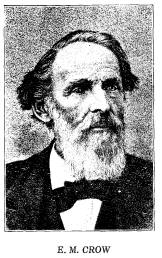 He
was born in Paoli, Orange county, Indiana, June 4, 1816, a son of John
and Mary (Millis) Crow, natives of North Carolina, who removed to
Orange county, Indiana, in early life and were there married June 20,
1815. They continued their residence there until the spring of 1834,
when they removed to Chicago, but as Joliet, Illinois, was then the
most promising town they went to that place after spending one season
in Chicago. Six months later, however, they removed to Kane county, the
same state, locating near Geneva, where the mother died January 9,
1836. He
was born in Paoli, Orange county, Indiana, June 4, 1816, a son of John
and Mary (Millis) Crow, natives of North Carolina, who removed to
Orange county, Indiana, in early life and were there married June 20,
1815. They continued their residence there until the spring of 1834,
when they removed to Chicago, but as Joliet, Illinois, was then the
most promising town they went to that place after spending one season
in Chicago. Six months later, however, they removed to Kane county, the
same state, locating near Geneva, where the mother died January 9,
1836.
Later the father married Miss Docia Hill, of Naperville, Illinois, and
in the spring of 1838, they came to Linn county, Iowa, locating east of
the present town of Viola. There the father died March 3, 1841. His
children were all by the first marriage and in order of birth were as
follows: Edward M., our subject; Garrison C., who died in California,
December 13, 1875; Wesley, who died in Grant county, Wisconsin, October
8, 1883; Nelson A., a banker and capitalist of St. Charles, Minnesota;
Esther, who married Julius A. Peet and died in Jones county, Iowa,
February 22, 1883; Nancy, who married Truman J. Peet and died in
Buffalo township, Linn county, November 1, 1854; John, who died in
Jones county, this state, November ?? 1873; and Mary, who wedded
Charles C. White and died in California June 10, 1864.
Mr. Crow of this review was eighteen years of age when the
family went to Chicago, and he accompanied his parents on their various
removals until the autumn of 1835, when he returned to his native
county and there attended school for one winter. Desiring to try his
fortune farther west, he purchased a horse and on horseback went to
Kane county, Illinois, where he remained until June 4, 1837, when he
crossed the Mississippi and came to Linn county, Iowa. On the 4th of
July he laid claim to a large tract of land on what is now sections 13
and 14, Brown township, east of where Viola now stands.
He then returned to Fox River, Illinois, and shortly afterward, in
company with James Dawson and his brother, Garrison Crow, purchased six
yoke of cattle and made preparations to again come to Linn county. The
little wagon train left Fox River in the latter part of August and
arrived at their destination September 5, 1837. They built a shanty on
Crow creek in Brown township, which stream was named by the United
States surveyors in honor of Mr. Crow, who was living on its banks when
they arrived. The little company immediately began cutting hay and
making general preparations for the winter season.
Subsequently Edward Crow, in company with John Joslin,
returned to Illinois after provisions to carry them through the winter.
Being overtaken by a snowstorm, they left their teams at a Mr. Nye's on
this side of the Mississippi. They crossed the river and traveled
eastward about fifteen or twenty miles, where they bought corn, meat
and other provisions, which were hauled to the river by hired teams.
After having their corn ground at Mr. Nye's mill they started for the
big woods on the Wapsie, but were overtaken by a heavy snowstorm at
Cherry Grove and in order to reach their cabin had to wade through very
deep snow. The following winter was intensely cold, long and dreary,
and the privations endured by the little band of pioneers was
exceedingly great. Snow lay about two feet deep on the level.
On the 22nd of February Mr. Crow was obliged to return to
Illinois to meet his father and family, and the third day after
starting they reached Black Dick's point, which was a small grove of
timber. The trail was so bad that they could only travel about eight
miles a day. The ice on the river was weakened by the January thaw, but
had been somewhat strengthened by subsequent cold, but as it was then
the latter part of February, the little band of travelers were fearful
that it was not strong enough to bear the full weight of their ox
teams, so they unhitched them and drew the wagon across the river with
one ox, the other being led at a safe distance in the rear. Upon the
island in the river they met a band of wood choppers who were cutting
wood for steamboats. During their trip from Linn county to the
Mississippi, however, they had only met one white man, a trapper by the
name of Wheat.
They proceeded on their journey to Prophetstown, Illinois, where they
crossed the Rock river on the ice, meeting between two rivers only
three white settlers. Near Pawpaw Grove, about twelve miles from the
Rock river, they met a little cavalcade on sleds, which proved to be
that of their parents. As the snow melted the following day the sledges
were abandoned and the remainder of the journey was made by wagon. They
followed the Rock river down to within four miles of its mouth, and
crossed the Mississippi at Davenport, reaching home April 10, 1838. The
father brought with him fifty head of cattle and about the same number
of hogs, which were the first swine brought to the big woods.
Mr. Crow could relate many interesting incidents of pioneer
life, when he was compelled to go to the lead mines at Galena,
Illinois, for his mail, a distance of sixty miles, and had to pay
twenty-five cents for each letter received. The trip was frequently
made on foot. At one time he went to Davenport, fifty miles away, to
get his plow sharpened and his coulter mended, so that he might
continue his work of breaking prairie. The first grain he raised was
sod corn and buckwheat, which he took to Thompson's mill on the Little
Iowa river, five miles from Dubuque, but the mill was so imperfect that
when ground the buckwheat could not be bolted. The trip was made with
ox teams and required ten days. Mr. Crow being compelled to camp out on
the way and carry food for himself and cattle. In crossing streams he
frequently had to cut the ice or scatter old hag along and pour water
over it and later freeze it to keep the cattle from slipping. On the
other hand when there was no ice he had to built rafts to cross the
stream.
In the spring of 1838, Mr. Crow commenced to improve his
claim, but the following October he sold it and returned to Orange
county, Indiana, where he attended school during the winter of 1838-9.
He had previously made a claim in Buffalo township, this county, and
erected thereon a shanty, which he found had been destroyed by fire on
his return here in April, 1839. He at once rebuilt and continued to
make his home in Buffalo township throughout his life. In later years
he erected a good brick residence upon his place, and made many other
valuable and useful improvements. He prospered in his farming
operations and kept adding to his landed possessions until he had at
one time thirteen hundred acres of land in Linn and Jones counties, but
later disposed of a portion of it, retaining four hundred acres in
Buffalo township, this county; fifty-eight acres in Jones county, Iowa;
one hundred and fifty-seven acres in Crawford county, this state; and a
large stone quarry with eighty acres in Kansas. He was quite
extensively engaged in stock raising, feeding about sixty head of
cattle, 6 horses and fifty hogs annually.
On the 14th of November, 1839, in Linn township, Mr. Crow was
united in marriage with Miss Elizabeth Bennett, who taught the first
school in this county. Her father, Ezra Bennett, was lost at sea. She
was born in Syracuse, New York, but was reared in Canada, and died at
her home in Buffalo township, this county, February 1844. By this union
were born two children: Mary E., born November 11, 1840, married John
Wall and died in Redwood, Minnesota, April 18, 1868; and John Wesley,
born May 4, 1842, married Rachel Boltenhouse, and is now living on a
ranch near Houston, Texas. He served over three years in the Civil War
as a member of the Thirty-first Iowa Infantry.
Mr. Crow was again married in Brown township November 14,
1848, his second union being with Mrs. Narcissa E. Bowman, the widow of
Isaac Bowman. By their union three children were born, namely; Willard
D., born November 7, 1849, married Louisa Burke, and is a large land
owner and wealthy citizen of Houston, Texas; Edward Linas, born
November 13, 1852, married Adelia Gillen, and is now a stock and grain
dealer of Mapleton, Iowa; and Nancy E., born May 3, 1856, died December
13, 1891. She was the wife of George S. Elwood, who was an extensive
land owner and stock dealer of Washington county, Kansas. The mother of
these children departed this life in Buffalo township July 17, 1857.
At Anamosa, Iowa, December 8, 1860, Mr. Crow married Mrs.
Sarah A. Green, widow of Addison Green, and to them were born seven
children, as follows: Jefferson D., born December 25, 1861, married
Elsie Leaf and is engaged in farming near Mapleton, Iowa; Nelson M.,
born March 19, 1863, married Addie Dial and died in State Center, Iowa;
Sarah E., born September 18, 1864, is the wife of Owen Carl, of Perry,
Iowa; Charles F., born August 5, 1866, married Mertie Boyles and is a
farmer of Jones county, Iowa; Garrison M., born April 28, 1868 and
Louis N., born August 17, 1870, are both deceased; and Orpha B. born
September 30, 1871, is the wife of J. Harold Leaf, who is represented
on another page of this volume. Mrs. Crow died November 3, 1872.
In his political views Mr. Crow was a Jacksonian Democrat and
a stanch supporter of his party and its principles. As one of the
leading and influential citizens of his community he was called upon to
fill a number of local offices, and served as supervisor for nine years
and justice of the peace in early life. In religious belief he was a
Universalist, broad and liberal in his ideas. He passed away July 26,
1894, honored and respected by all who knew him. His remains were
interred in Wilcox cemetery, Brown township, near the village of Viola,
where his wives were also buried.
He always took an active and commendable interest in the welfare of his
adopted county, and was prominently identified with its growth and
development. He was not only genial and hospitable in disposition, but
was exceedingly charitable, and no one coming to him for aid was ever
turned from his door empty-handed. He often gave shelter to those less
fortunate than himself, both children and grown people making their
home with him at various times. Mr. Crow was not only Linn county's
earliest settler, but was also one of its best known and most highly
esteemed citizens.
Source: Biographical Record of Linn County, Iowa. Chicago: The S. J. Clarke Publishing Company, 1901, p. 694-699.
VINCENT CUHEL
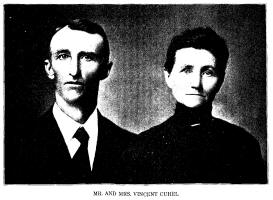 The
agricultural interests of Linn county are largely represented by men of
foreign birth and among this class none are more worthy of mention in
this volume than Vincent Cuhel, who has persevered in his undertakings
until he is now the owner of two hundred and forty acres of valuable
land located on section 36, Fairfax township. Born in Moravia, Austria,
October 20, 1856, he is a son of Vincent and Frances (Mach) Cuhel, the
latter a daughter of John and Mary Mach, prosperous farming people of
that country. The year 1861 witnessed the arrival of the Cuhel family
in America. They at once made their way to Iowa and settled on forty
acres of raw and unbroken land in Johnson county. It was an arduous
task that confronted the father but he at once set to work to develop
and improve his land and as soon as he had acquired a sufficient sum of
money, he purchased one hundred acres, which he also improved, and thus
lie became a prosperous farmer of this state. He died in Johnson county
in 1896 when he had reached the ripe old age of eighty-six years, while
his wife passed away in 1905 at the age of seventy-five. The
agricultural interests of Linn county are largely represented by men of
foreign birth and among this class none are more worthy of mention in
this volume than Vincent Cuhel, who has persevered in his undertakings
until he is now the owner of two hundred and forty acres of valuable
land located on section 36, Fairfax township. Born in Moravia, Austria,
October 20, 1856, he is a son of Vincent and Frances (Mach) Cuhel, the
latter a daughter of John and Mary Mach, prosperous farming people of
that country. The year 1861 witnessed the arrival of the Cuhel family
in America. They at once made their way to Iowa and settled on forty
acres of raw and unbroken land in Johnson county. It was an arduous
task that confronted the father but he at once set to work to develop
and improve his land and as soon as he had acquired a sufficient sum of
money, he purchased one hundred acres, which he also improved, and thus
lie became a prosperous farmer of this state. He died in Johnson county
in 1896 when he had reached the ripe old age of eighty-six years, while
his wife passed away in 1905 at the age of seventy-five.
Vincent Cuhel was a little lad of five years when with his
parents lie took passage on the steamer at Hamburg bound for the United
States. He still has vivid recollection of the trip across the Atlantic
and of the establishment of a home in a new country. At the usual age
he was sent to school but he was permitted to pursue his studies only
to the age of fifteen years, for it was then necessary that he give his
entire time to work on the home farm, as at that time his father was in
limited circumstances and was trying to acquire a competence. He
remained under the parental roof until the age of twenty-six and then
started out in life for himself, purchasing eighty acres of land on
section 36, Fairfax township. He developed and improved this tract and
in due time added one hundred and sixty acres to his original holdings,
so that his possessions now embrace two hundred and forty acres. He has
made all of the improvements on the place, including a good country
residence and a substantial barn and outbuildings for the shelter of
his grain and stock. He has made a close study of the soil, knows the
crops to which it is best adapted and therefore meets with good results
in his labors In his pastures are also found good grades of stock, for
he gives much of his time to this branch of his business.
On the 13th of September, 1882, occurred the marriage of Mr.
Cuhel and Miss Mary Mekota, a daughter of Frank and Dorothea Mekota.
Mrs. Cuhel was born December 8, 1863, in Bohemia, and accompanied her
parents on their emigration to the new world, the family home being
established on a farm near Solon, Iowa For many years the father
followed general agricultural pursuits but spent the last years of his
life in honorable retirement and passed away in Solon in 1907. Mrs.
Cuhel has a sister, Mrs. John F. Janko, who lives on a farm in College
township, while another sister, Mrs. Jausa, resides in Los Angeles,
California. One brother, John, is living retired in Cedar Rapids, while
her brother Joseph is a well known attorney of that city. Her brother
Wencil follows farming near Solon and Charles C. and Frank M. are
farmers of Johnson county, this state.
The marriage of Mr. and Mrs. Cuhel has been blessed with ten
children, as follows: Charles E., who was born September 26, 1883, and
follows farming in Johnson county; Anna, who was born February 14,
1885, and is now the wife of Ed Holets of Cedar Rapids; Mary, who was
born December 23, 1886, and is a resident of Los Angeles; Joseph, who
was born June 27, 1889, is a graduate of Coe College in Cedar Rapids
and is now in California; Frank, whose birth occurred September 4,
1891; Jerry, born December 14, 1893; Bessie, born March 23, 1895
Stephen, born March 29, 1897; Lillian, who was born November 21, 1900;
and Dorothea Olga, whose birth occurred on the 31st of December, 1903.
In polities Mr. Cuhel is independent and for two terms served
as school director, the cause of education ever ending in him a warm
friend. His religious faith is indicated by his membership in the
Reformed Evangelical church. Success has crowned his efforts and he is
ever found loyal to the best interests of his adopted state.
Source: History of Linn County Iowa, From Its Earliest
Settlement to the Present Time, Vol. II, Chicago, The Pioneer
Publishing Company, 1911, p. 218-221.
Contributed by Terry Carlson
|
|