FREDERICK BOKORNY
This well-known contractor on public works, residing at 422 C Avenue,
dates his residence in Cedar Rapids from 1868. He was born in the city
of Chicago on the 15th of December, 1862, and is a son of Frederick
Bokorny, Sr., who came to the new world in early life and settled in
Chicago, where he worked at his trade of stone cutter for some years.
On leaving that city he made a permanent location in Cedar Rapids in
1868. At this place he was first in the employ of others and
subsequently as a contractor and builder he followed his chosen
occupation for some years, though his last days were spent in
retirement from active labor. He died here in 1885. His wife still
survives him, and is now seventy-eight years of age.
Our subject accompanied his parents on their removal to Cedar
Rapids, and is indebted to the city schools for his educational
advantages. He partially learned his trade with his father, and later
commenced contracting on public works in his own interest, and has
since been actively engaged in business in connection with the laying
of sewers, the building of bridges and with other public enterprises in
Cedar Rapids and Linn county for fifteen years. He is a practical and
skilled mechanic, who thoroughly understands the business, and is
meeting with well-deserved success. He has bought lots and erected
several houses in the city, and also owns some valuable farm property
near Cedar Rapids.
Mr. Bokorny was married in Cedar Rapids in 1884 to Miss Katie
Guinn, who was born, reared and educated in Germany, and was a young
lady when she came to America and took up her residence in Cedar
Rapids. They have two children living, namely, Katie, a graduate of
Cedar Rapids high school; and Trophy, still a student in the city
schools. Their son Frederick died at the age of six months.
In his social relations Mr. Bokorny is a member of the
Independent Order of Odd Fellows and the Benevolent Protective Order of
Elks. As a business man he stands high in the esteem of his fellow
citizens who recognize his ability, and the success that has crowned
his efforts has been worthily achieved, as it has come to him through
his own industry and persistent effort. On national issues he votes
with the Democracy, but at local elections he votes independent of
party lines, supporting the men whom he believes best qualified to fill
the offices. He has never cared for political honors for himself.
Source: Biographical Record of Linn County, Iowa. Chicago: The S. J. Clarke Publishing Company, 1901. p.862.
MALCOM V. BOLTON
Among the enterprising and wide-awake business men of Cedar Rapids is
this well-known real estate and loan agent. He was born in Stockholm,
St. Lawrence county, New York, on the 30th day of June, 1869, a son of
Thomas Harrison and Rosina Caroline (Schellenger) Bolton, also natives
of that county. His paternal grandfather, James Bolton, was an
Englishman by birth, and emigrated to America about 1835, locating in
St. Lawrence county, New York. As his father was a landed proprietor of
England he was reared amid wealthy surroundings, had no practical
business experience, and lost his property. After coming to this
country he followed farming in St. Lawrence county, New York, until his
death.
Thomas H. Bolton, father of our subject, was the fifth in
order of birth in a family of six children. For many years he has
followed the insurance business, making his home in Stockholm, New
York, though for about half the time in the past twenty years he has
made Springfield, Illinois, his headquarters. He owns considerable farm
property in St. Lawrence county, which is operated by tenants. Of his
four children two sons died in infancy, while those living are Malcom
V., our subject; and Thomas Harrison, Jr., who is attending the Cedar
Rapids high school.
Malcolm V. Bolton received his literary education in the
schools of Stockholm and the Lawrenceville Academy, and in 1888, at the
age of nineteen years, he removed to Cedar Rapids, took a course in the
Cedar Rapids Business College, and then entered the employ of McGee
& Kauppe, later Frick and Kauppe, wholesale dealers in coffees,
teas and spices. He remained with them in the capacity of bookkeeper
and salesman for three years. At the end of that time he accepted the
position of bookkeeper of the Order of Railway Conductors, whose
national headquarters are located at Cedar Rapids, and was in their
employ for two years. He then engaged in the real estate and loan
business. He deals in city and farm property and makes a specialty of
city and farm loans.
Mr. Bolton is secretary of the De La Hunt Flush Tank Company
of Cedar Rapids, and is also secretary of the Occidental Club, a social
organization composed of the Cedar Rapids business men. Fraternally he
affiliates with Mt. Herman Lodge, F. & A. M., and the Benevolent
Protective Order of Elks. In politics he is independent.
Source: The Biographical Record of Linn County Iowa,
Illustrated, Chicago: The S. J. Clarke Publishing Company, 1901, pages
169-170.
Submitted by: Carrie J. Robertson of Marion
HIRAM I. BOOTH
With the farming interests of Fayette township the Booth family
has long been prominently identified and he whose name introduces this
sketch now owns and operates a good farm within its borders. A native
of Ohio, he was born in Licking county, on the 1st of February, 1847.
His father, Isaiah Booth, was a native of New York state and was
educated for the ministry. While attending Granville College, now
Denison University, from which he was graduated in 1844, he became
acquainted with Phoebe H. Jones who was pursuing her studies it the
academy at the same time and she afterward became his wife. She, too,
was born in New York but during her girlhood had removed with her
parents to the Buckeye state. Instead of devoting his time to
ministerial work the father commenced teaching at Lancaster, Ohio,
where he conducted a select school for eight years. At the end of that
time his health failed and he came to Linn county. Iowa. He located on
a farm in College township, four miles southeast of Cedar Rapids. and
for ten years was engaged in agricultural pursuits. In The meantime, in
1851, he erected the first frame house built in that township. In 1862
he went to Kansas, but three years later returned to Iowa and settled
on his farm in College township. In 1870, however, he crossed the
plains to California on account of his health, but after the family had
received three letters from him they heard nothing more and it is
supposed that he died suddenly among strangers or was murdered for the
money which he had with him. The mother of our subject passed away on
the old home place in 1879.
Hiram I. Booth passed his boyhood and youth in much the usual
manner of farm lads and the knowledge which he acquired in the district
schools was supplemented by one year’s attendance at Western College.
For three terms he engaged in teaching school but since that time has
devoted his entire time to agricultural pursuits, owning sixty-one and
one-half acres of his present farm. In 1872 he went to Colfax county,
Nebraska, where he homesteaded eighty acres, living thereon for five
years, during which time the grasshoppers ate his crops every year.
Becoming discouraged there, he then returned to his farm in Fayette
township, this county, and has since engaged in its cultivation with
marked success. He has added to the property from time to time until he
now owns one hundred and twenty-six and one-half acres that he has
placed under a high state of cultivation and improved with good and
substantial buildings.
On the 14th of November, 1869, was celebrated the marriage of
Mr. Booth to Miss Rhoda D. Nelson of College township and they have
become the parents of eleven children, ten of whom are still living,
namely: Carrie R.; Abbie A.; Phoebe D.; Julia B.; Mary D.; Berith L.;
Esther C.; Isaiah J.; Harvey W. and Vera 0. Since attaining his
majority Mr. Booth has affiliated with the democratic party but at
local elections where no issue is involved he votes for the men whom he
believes best qualified for office regardless of party lines. He has
been called upon to serve as a member of the board of township trustees
and was assessor of his township for several years and for more than a
quarter of a century has been a member of the school board. He has
always been found prompt and faithful in the discharge of any duties
imposed upon him and he is justly regarded as one of the leading
citizens of his community. Both he and his wife are consistent members
of the Seventh Day Adventist church and their lives have ever been such
as to gain for them the esteem and friendship of a large circle of
acquaintances.
Source: History of Linn County Iowa, From Its Earliest
Settlement to the Present Time, Vol. II, Chicago, The Pioneer
Publishing Company, 1911, p. 733-4.
Contributed by: Terry Carlson
JACKSON W. BOWDISH
Member of the finance committee of the Iowa State Board of
Education, was born in Merwinsville, Litchfield county, Connecticut, on
the border line between new York and Connecticut. His parents and all
the other members of the family except himself were natives of New York
state. When he was a child his parents moved from Dutchess county, New
York, to Linn county, Iowa, and located on a farm in Maine township. He
resided on the farm until after he was of age, having completed his
education at Cornell college, Mount Vernon, Iowa. He left the farm to
enter the banking business, which he pursued the greater part of his
life. In 1880 he was engaged in the banking business in Canisteo, New
York, where he married Charlotte Allison. On his return to Iowa in
1886, he was elected clerk of the district court of Linn county, after
which he followed the grocery business for a short time. In 1892 he
assisted in the organization of the Bohemian American State Bank, and
the Iowa Savings Bank of Cedar Rapids, Iowa, which, by merger became
the present American Trust and Savings Bank. In politics he is a
democrat.
Source: Iowa Official Register, 1927-1928; Biographies of State Officials.
OTHO S. BOWLING
 OTHO
S. BOWLING, now deceased, and whose portrait we give in connection with
this sketch, was greatly lamented by all who had the honor and pleasure
of his acquaintance. He was a good man in every sense that the word
implies, and his loss was greatly felt in the community of which he
became a member early in the settlement of what was then the Territory
of Iowa. It will perhaps be remembered that he came to this vicinity
in company with Robert Ellis, a sketch of whom is given in another part
of this work. The two men whose friendship was thus formed early in
life, continued to regard each other with the affection of brothers
during their lifetime. OTHO
S. BOWLING, now deceased, and whose portrait we give in connection with
this sketch, was greatly lamented by all who had the honor and pleasure
of his acquaintance. He was a good man in every sense that the word
implies, and his loss was greatly felt in the community of which he
became a member early in the settlement of what was then the Territory
of Iowa. It will perhaps be remembered that he came to this vicinity
in company with Robert Ellis, a sketch of whom is given in another part
of this work. The two men whose friendship was thus formed early in
life, continued to regard each other with the affection of brothers
during their lifetime.
Mr. Bowling came to Linn County in
the year 1838. The wild country was dotted here and there by a lonely
cabin, and Indians and wild beasts were often the only moving things
that greeted the eyes of the settler as he stood in his cabin door,
and, perhaps, for a moment, east a longing eye toward his Eastern
home. It is evident, however, that the early pioneer seldom allowed
himself to give way to home-sickness, for if such had been the case, we
would not now behold such results as they have accomplished in the
cultivation of land and the building up of settlements. When Mr.
Bowling and his companion came into the Territory there was not even a
Government land-office established in their vicinity, and it was some
time before they could obtain an undisputed title to their
possessions. They finally succeeded, however, in establishing them-
selves firmly upon their claims, and set to work with undaunted
resolution to build for themselves a home, having high hopes of the
future of the country, very many personal anticipations of what the
near future might bring them, and the home ties that they no doubt
expected would in time be formed around them. In the course of time
Mr. Bowling became possessed of several hundred acres; a part of his
original purchase now constitutes the southern portion of the city of
Cedar Rapids. Previous to coming into Iowa Mr. Bowling had spent some
time in Michigan.
Otho S. Bowling was born in Westmoreland
County, Pa., Nov. 26, 1812. The name of his father was Adam Bowling,
who was a farmer by occupation and a gentleman of Welsh ancestry. The
father of Adam Bowling emigrated to this country from Wales when a
child, and with his parents settled in Westmoreland County, they having
been among the first settlers of the Keystone State. After their
emigration the history of the family was similar to that of the other
pioneers who passed over the bounds of civilization and became
identified with the struggles, hardships and privations incident to the
life of a pioneer. Adam Bowling was reared and married in Westmoreland
County, and there his life terminated. His wife, the mother of our
subject, was a Pennsylvania lady, and died in her early years, when her
son Otho was a child of three years.
In early youth Mr.
Bowling left his native State for Michigan, where he had friends
residing. He was a man of strong affections, and the ties of home and
friendship were not easily broken. His natural inclinations led him to
do good, as he had opportunity, all his life. His home was his castle,
and he contentedly remained there each evening after the labors of the
day, improving his mind with such reading as he could lay his hands
upon, and strengthening the ties which he gradually formed as the
country grew up around him. He was united in marriage with Miss
Adeline Frazee, in November, 1849, at the residence of the bride's
parents near Cedar Rapids, by Rev. Swayenger. This lady was the
daughter of Aaron and Nancy (Clapsaddle) Frazee, natives of Herkimer
County, N. Y. Her parents were of French and German extraction,
respectively, with just enough Scottish admixture to make the
combination complete. They were excellent citizens, of high moral
principles, and their honored names are remembered by large
communities, and over an extensive tract of country. The grandparents
were married in their native country, and the father acquired the trade
of a carpenter and joiner, at which he became an expert workman, and in
his latter years, was extensively engaged as a contractor for many
important buildings.
In the year 1848, Aaron Frazee with
his family, consisting of ten children, of which the wife of Mr.
Bowling of this notice was the eldest, came into Iowa and located just
outside the city limits of Cedar Rapids. He continued his former
occupation for some time, when, on account of failing eyesight, he was
forced to abandon this and purchased a small farm, the labors of which
he was enabled to direct, and there remained until his death, which
occurred in 1803, at the age of sixty-three years. The mother survived
her husband many years, her decease taking place April 10, 1886, when
she was seventy-four years old. Mrs. Rowling remained under the
parental roof until she was twenty-two years of age, at which time she
became the wife of the subject of our sketch. She is the mother of
live children, as follows: Mary E., the wife of W. O. Barber, resides
on Sixth avenue, Cedar Rapids City; Mr. Barber is an extensive dealer
in wagons and carriages. Dillie is the wife of W. G. Mallory; they are
also prominent and esteemed citizens of Cedar Rapids. Silas W. remains
on the homestead, and is engaged in carrying on the duties of the farm;
he is a promising young man, and bids fair to follow in the footsteps
of his honored sire. Ira L. is united in wedlock with Miss Carrie E.
Crabill; Mr. B. is a dealer in real estate, and they are residents of
Cedar Rapids; the remaining son, D. D., is the youngest, and remains
with his mother, assisting in the labors of the farm; he also is a
promising lad, a dutiful son and a comfort to his mother.
A
part of the original homestead has been laid out in city lots, which
are becoming quite valuable. As might be inferred, from his character
and his worth, upon Mr. Bowling were conferred many of the offices
within the gift of his community, and the duties of each were fulfilled
in a painstaking and conscientious manner, lie was a man of more than
ordinary intelligence, who kept himself well informed on the leading
questions of the day, and was deeply interested in all matters
pertaining, not only to the welfare of his community, but to the State
and nation at large. He was a solid Republican, honestly believing in
the principles advocated by that party, and did everything in his power
to promote the interests of the party which he believed to be for the
interests of his country. This excellent man passed away on Christmas
Day, 1883. He died surrounded by mourning kindred and friends, and
left in his home and in his community a void which can never be filled.
Source: “Portrait and Biographical Album of Linn County, Iowa”, 1887,
biographical sketch on pages 374 and 377, portrait on page 376
Submitted by: Eric & Marcia Driggs
Benjamin Bowman
The subject of this sketch is one of the most successful and
progressive farmers within the borders of Marion township, where he
owns four hundred and seventy-five acres of valuable and well improved
land. He has made his special field of industry a success, and is
highly esteemed and respected by all who know him.
Mr. Bowman was born near Lancaster City, Lancaster county,
Pennsylvania, February 26, 1830, and is a son of Daniel and Mary
(Smith) Bowman, also natives of that county, and both now deceased. The
father made farming his life occupation. In the family were eight
children, namely: Benjamin, of this review; David, a farmer of
Cumberland county, Pennsylvania; Captain A., who is engaged in farming
on section 35, Marion township, this county; Anna, wife of David
Weaver, of Cumberland county, Pennsylvania; Mary, wife of David Mohler,
of the same county; Daniel, a merchant of Shiremanstown, Pennsylvania;
Lydia, wife of Scott Smith, a miller of the same place; and Reuben,
foreman of one of the departments of the gas pipe works at Middletown,
Pennsylvania.
Benjamin Bowman received only a limited education in the
common schools of his native state, and on laying aside his text books
he learned the miller's trade in Cumberland county, Pennsylvania. In
1850 he removed to Licking county, Ohio, where he continued to follow
that occupation until coming to Linn county, Iowa, in January, 1856.
After working for four years in a flouring mill in Marion, he purchased
one hundred and sixty acres of land on section 36, Marion township,
known as the Brody farm, and turned his attention to agricultural
pursuits. Prospering in this venture he bought the Joseph Cooper place
of one hundred and twenty acres, and in 1870 purchased one hundred and
fifteen acres on section 26, Marion township; the McCurdy place of
eighty acres on section 36, in 1880, and later forty acres south of his
present home, making four hundred and seventy five acres of land, all
in Marion township. He is a thorough and systematic farmer, whose
success is due entirely to his own energetic and well-directed efforts.
On the 13th of May, 1856, Mr. Bowman was married in Utica,
Ohio, to Miss Eliza Wilson, of Licking county, a daughter of Abel and
Mary (Forry) Wilson, the former a native of Lancaster county,
Pennsylvania, the latter of Licking county, Ohio. By occupation her
father was a farmer. To Mr. and Mrs. Bowman have been born the
following children: May, born August 25, 1857, and died on September
28, 1858; Arthur Wilson, who married Dora Leonard, of Cedar Rapids,
Iowa, and is now engaged in the retail shoe business in Omaha,
Nebraska; James Wilbur, who married Ida May Gibson, and is now serving
as clerk of the courts of Linn county; May E., at home; Nettie L., wife
of George Strong, who is engaged in farming on our subject's old
homestead, in Marion township; and Myrtle Estella, at home.
In connection with general farming Mr. Bowman has always
carried on stock raising quite extensively, and has dealt in stock of
all kinds. In 1891 he erected his present elegant home at a cost of
four thousand dollars, and has made many other useful and valuable
improvements upon his place which add greatly to its attractive
appearance. The Republican party has always found in him a stanch
supporter of its principles, and in religious belief he is a
Presbyterian. He and his family are prominent in the social circles of
their community, and have a host of warm friends throughout Linn
county.
Source: The Biographical Record of Linn County Iowa,
Illustrated, Chicago: The S. J. Clarke Publishing Company, 1901, pages
41-42.
Submitted by: Terry Carlson
MOSES BOXWELL
Prominent among the early settlers and honored veterans of the
Civil war now residing in Linn township is the gentleman whose name
introduces this review. He was born on the 25th of May, 1837, in
Fayette county, Pennsylvania, of which state his parents, Robert and
Rhoda (Young) Boxwell, were also natives. In 1845 they removed with
their family to Iowa, and settled in Linn township, Linn county, where
the father took up eighty acres of government land, to the improvement
and cultivation of which he gave his time and attention throughout the
remainder of his life, farming being the occupation which he always
followed. He died at the age of seventy-four years, and his wife, who
survived him about five years, passed away at the age of seventy-six,
the remains of both being interred in Linn township. They had eight
children of whom four died when quite young. The others are William and
Robert, both farmers of Linn township; Mary Ann, who is the widow of
David Clark, and resides on the home farm in Linn township with her
children; and Moses, the subject of this sketch.
Moses Boxwell was educated in the district schools of Linn
township and early acquired an excellent knowledge of agricultural
pursuits on the home farm. After his marriage he purchased one hundred
and twenty acres of land on section 24, Linn township, which at that
time was only partially improved, and upon that place he has since made
his home. As a farmer and stock raiser he has met with well-deserved
success, and now has one of the most desirable farms of its size in the
township. On the 2d of July 1868 Mr. Boxwell was united in marriage
with Miss Irene Corbly, who was born in this county, a daughter of
William and Elizabeth (Inghram) Corbly. Her father was a native of
Virginia, and in pioneer days located in Linn county, Iowa. He engaged
in farming in Linn township, where he died at the age of sixty-two
years. Mrs. Boxwell lost her mother when a small child. She has two
brothers and two sisters living, besides a half sister.
Unto Mr. and Mrs. Boxwell have been born eight children,
namely: Robert, a farmer of Marion township, married Sophia Frazer, and
they have two children, Ralph and Merl; Frances is the wife of Charles
Parker, a farmer of the same township, and they have four daughters,
Edith, Nellie, Hazel and Ruth; Jennie is the wife of Harry Lacock, a
farmer of Linn township; Earl, born September 13, 1879, assists his
father in the operation of the home farm; Maude and Ray are also at
home; Hazel died at the age of four months; one died in infancy
unnamed. Mr. Boxwell was among the boys in blue during the war of the
Rebellion, having enlisted in Company F, Twenty-fourth Iowa Volunteer
Infantry, for three years.
He took part in all of the important engagements in which his regiment
participated, including the battle of Champion Hills, and was taken
prisoner near New Orleans, being held a captive for nine weeks before
being exchanged. When his term of enlistment expired he was honorably
discharged at Savannah, Georgia. He is a stanch supporter of the
Republican party, and has filled the office of school director in a
most creditable manner. Fraternally he is a member of John Buck Post.
G.A.R. Religiously he is a member of the Methodist Church, and is a man
of the highest respectability.
Source: Biographical Record of Linn County, Iowa. Chicago: The S. J. Clarke Publishing Company, 1901. p.359-360.
D. L. BOYD
For about one-third of a century this well-known banker and
lumber dealer has been a resident of Mt. Vernon, and by his industry,
keen discrimination and good executive ability he has placed himself
among the foremost business men of Linn county. He is a native of
Ireland, born in County Antrim, December 5, 1841, and is the son of
James and Jennie Boyd, who spent their entire lives in that county, and
who were the parents of eight children, of whom our subject is the
youngest.
During his boyhood our subject attended a model school in his
native land, and was later a student in the training school at Dublin.
On leaving that institution he successfully engaged in teaching in
Ireland for seven years. But the new world had attractions for him, and
he determined to come to that country where every man was equal in the
eyes of the law, and where all had an equal chance for advancement. In
1868 he bade good-bye to home and friends and went from Belfast to
Liverpool, England from which port he sailed for the United States.
Landing in New York, he proceeded at once to Marengo, Iowa, where he
remained three weeks and then came to Mt. Vernon, which has since been
his home. He began life here as a farm hand in the employ of James
Smyth, with whom he remained three months, and for three weeks he was
similarly employed by Colonel Smyth. At the end of that time he
accepted a position in the lumber yard of Colonel R. Smyth & Co.,
at Mr. Vernon, and a year later purchased an interest in the business.
This partnership continued for some time, and he then purchased his
partner's interests, and has since continued to be identified with the
lumber business of his adopted city.
In May, 1900, he took into partnership with him his son, Jay C., and
under the firm name of D. L. Boyd & Son the business is continued
with remarkable success. On the advent of his son into the firm, he
became connected with the banking business as cashier of the Mt. Vernon
Bank, and is now holding that position. His intimate knowledge and
extensive acquaintance with the people who do business in Mt. Vernon
make him a valuable acquisition to the bank.
On the 8th of December, 1870, Mr. Boyd was united in marriage
with Miss Margaret Craig, who was born three miles west of Mt. Vernon,
and who was the daughter of Thomas Craig, a native of County Antrim,
Ireland, and who came to this country about 1830, first locating in
Ohio. In 1839, soon after Linn county was first settled, he removed
here and took up government land, about three miles west of Mt. Vernon,
where he engaged in farming until his death, in 1860.
He was twice married, his first wife being Margaret Shaver. After her
death he married Martha Smyth, and to them were born three children, of
whom Mrs. Boyd is the only survivor. Three children were also born to
Mr. and Mrs. Boyd. Jay Craig, born December 23, 1872, is now the junior
member of the firm of D. L. Boyd & Son. He married Miss Mabel
Shire, and they have one child, Donald L. William Walter, born May 26,
1876, resides at home. Florence B., born April 22, 1882, is attending
Cornell College.
Mr. Boyd is a faithful and consistent member of the
Presbyterian church, and in politics is an ardent Republican. For two
years he efficiently served as mayor of Mt. Vernon, and has been a
member of the school board for many years, while he is now serving as
one of the trustees of Cornell College. He is a very pleasant and
courteous gentleman, who takes a deep interest in every enterprise
which he believes will be of public benefit, and he stands deservedly
high in both business and social circles.
Source: Biographical Record of Linn County, Iowa. Chicago: The S. J. Clarke Publishing Company, 1901. p.502-503.
WILLIAM R. BOYD
Chairman of the finance committee of the Board of Education, is a
native of Iowa, having been born in Lisbon, Linn county, May 19, 1864.
His boyhood was spent in Tipton, Iowa, where he attended the public
schools. He was graduated from the college of liberal arts of the state
university in June, 1889, having earned his way by teaching school and
clerking in a store. He was principal of the school at Mechanicsville,
Iowa, two years. He was editor of the Tipton Advertiser two years,
editor and associate editor of the Cedar Rapids Republican sixteen
years. Mr. Boyd served as postmaster of Cedar Rapids from 1899 to 1909,
resigning this office to accept his present position. He has long been
interested in educational matters, and was for several years a member
of the board of trustees of Coe college, and for a time lecturer on
political economy in that institution. Mr. Boyd is a director of the
American Trust and Savings bank, and president of the Perpetual Savings
and Loan association, both located in Cedar Rapids. A republican in
politics.
-source: Iowa Official Register, 1927-1928; Biographies of State Officials.
CHARLES BRACKETT
The subject of this sketch was for some years one of the most energetic
and progressive business men of Mt. Vernon, Iowa, but is now
practically living a retired life at that place. He was born in
Saratoga county, New York, October 17, 1855, and is descended from a
good old colonial family of Scotch origin, from whose coat of arms it
is supposed they belonged to the agricultural class. The first to come
to America was Captain Richard Brackett, a native of Scotland, who was
one of the fifteen hundred people composing the Massachusetts Bay
colony, who came to the new world with Governor Winthrop about 1629,
and settled near Boston. The family has always been a patriotic and
loyal one, and among its representatives have been soldiers of the
Revolutionary war, the war of 1812, and the war of the Rebellion.
James S. Brackett, father of our subject, was born near
Pittstown, Rensselaer county, New York, January 29, 1823, and is a son
of John Adams and Eliza (Chase) Brackett, who were natives of New York
and Rhode Island, respectively, and were married in Rensselaer county
of the former state. There Eliza Brackett died and for his second wife
John A. Brackett married Elizabeth Sturgis. Later he removed to
Saratoga county, New York, where his death occurred in 1871. He had
eight children, three by the first marriage and five by the second,
namely: James S., father of our subject; William, who married Elizabeth
Sherman and died in Mt. Vernon, Iowa, in 1896; Henry, who married Mary
Ott and resides in Saratoga county, New York; Hattie who married John
Fryer, and is dead; George, who married Elizabeth Perry and died in
Glens Falls, New York, in February, 1901; and John, who was wounded at
Gettysburg, and died in the army during the Civil war.
At the age of five years James S. Brackett began his education
in the district schools near his boyhood home, and at the age of twelve
accompanied his father on his removal to Saratoga county, New York. He
assisted his father in the operation of the farm and sawmill and made
his home there until coming to Mt. Vernon, Iowa, in January, 1873. Here
he was engaged in the meat business with our subject for some time, and
since disposing of their market he has lived retired. He and his son
erected the building now owned by the Wolf Brothers, and took a very
active and prominent part in the business affairs of the city.
On the 15th of September, 1844, in Saratoga county, New York,
was celebrated the marriage of James S. Brackett and Nancy Sherman, who
was born in that county, January 4, 1823, and died there April 5, 1865,
her remains being interred at Wilton, New York. The only child born of
that union was our subject. His maternal grandparents were Sylvanus and
Clara (Slatter) Sherman, who were married in Rensselaer county, New
York, and were the parents of the following children: Caroline, who
married Smith Carr and both died in Saratoga county, New York; Nancy,
mother of our subject; Elizabeth Ann, who married William Brackett and
both are now deceased; Elisha, deceased, who married Polly Brackett and
lived in Washington county, New York; and James, who died in that
county.
Reared in his native county, Charles Brackett attended first
the district schools and later the high school at Saratoga Springs. In
the spring of 1874 he came to Mt. Vernon, Iowa, and for one year was a
student at Cornell College. He embarked in the meat business with his
father in the fall of 1876, and successfully conducted a market here
until 1892, when they sold out. In December of that year he purchased a
two-story brick block, and in January following opened a clothing
store, which he carried on until his retirement from the business in
1898, when he sold out to the firm of Bair & Kyle. In 1899 he built
one of the best residences in Mt. Vernon, it being supplied with all
modern improvements and furnished in a most tasteful manner. He also
owns other city property and is quite well-to-do, having accumulated a
comfortable competence through his good business ability, sound
judgement and untiring perseverance.
Mr. Brackett was married at Saratoga Springs, New York,
September 6, 1876, to Miss Jane E. Springsted, who was born at that
place January 31, 1857, a daughter of John and Martha F. (Owen)
Springsted. The Springsted family was founded in America by her
great-grandfather, who came from England in 1790, and settled in
Coeymans, Albany county, New York. Her grandfather, Stephen Springsted,
was born at that place January 16, 1799, and married Abigail Terry, who
was born March 1, 1801. They had nine children, all born in Coeymans,
namely: Jeremiah, born February 19, 1820, died September 22, 1879;
Lydia, born November 25, 1821, still resides in Coeymans; Oliver, born
November 14, 1823, died in December, 1896; Henry, born January 18,
1826, resides in Coeymans; John, father of Mrs. Brackett, is next in
order of birth; Jane E., born July 20, 1830, died May 16, 1851; Sally
Ann, born February 2, 1833, died December 14, 1834; Mary, born May 14,
1835, resides in New Bethlehem, New York; and Stephen, born October 31,
1837, died April 30, 1891. Mrs. Brackett’s maternal grandfather was
William C. Owen, who was born in East Line, Saratoga county, New York,
June 14, 1807, and died in Saratoga Springs, April 28, 1893. His wife
bore the maiden name of Hannah Bliss, was born in Greenfield, the same
county, July 22, 1809, and died in Saratoga Springs January 2, 1883.
She was a cousin of Senator P. P. Bliss. In the Owen family were the
following children: Mary M., born March 20, 1831, died July 22, 1859;
Martha F., mother of Mrs. Brackett, was the second of the family; Phebe
E., born October 18, 1834, died February 19, 1858; Henry W., born
February 22, 1836, resides in Mt. Vernon, Iowa; William J., born
February 27, 1837, died October 28, 1866; James B., born December 1,
1838, died February 26, 1839; Eliza J. born February 11, 1840, died
September 17, 1885; Charles, born November 15, 1841, died August 1,
1842; Harriet Emma, born October 30, 1844, resides in Saratoga Springs,
New York; and Charles A., born July 1, 1850, died November 19, 1872.
John Springsted, Mrs. Brackett’s father, was born in Coeymans, New
York, February 29, 1828, and was married at Martha F. Owen, who was
born in Greenfield, that state, January 8, 1833. In 1857 they came west
and located near Peru, Illinois, where the father followed farming
until his death, which occurred September 9, 1861. By trade, however,
he was a tinner. After her husband’s death Mrs. Springsted returned to
Saratoga Springs, New York, where she was married, September 3, 1869,
to Samuel Ainsworth, a native of Vermont, by whom she had one son,
Samuel W., who was born in Saratoga Springs April 23, 1871, and still
resides at that place. He was married in Mt. Vernon, Iowa, September
15, 1894, to Sally Courtney. Mrs. Brackett is the older of the two
children born of the first marriage, the other being Mary J. Etta, who
was born in Illinois January 8, 1862, and is now the wife of Daniel
Barbey, a journalist of Saratoga Springs, New York. The mother died at
that place May 21, 1899. Mr. and Mrs. Brackett have two children: Frank
J., born September 15, 1883; and Florence Etta, born January 15, 1897.
The former is now attending Cornell College.
Politically Mr. Brackett is a Republican with prohibition
tendencies, and religiously is a member of the Methodist church.
Socially he belongs to Mt. Vernon Lodge, No. 112, F. & A. M., and
Ashlar Chapter, R. A. Saratoga Springs, November 11, 1855, to M., and
is also connected with Star of Bethlehem Lodge, K. P. Social,
educational and moral interests have been promoted by him, and anything
that tends to uplift and benefit humanity secures his hearty
co-operation. Both he and his father enjoy a wide acquaintance and
marked popularity in the city where they have made their home for over
a quarter of a century.
Source: The Biographical Record of Linn County Iowa,
Illustrated, Chicago: The S. J. Clarke Publishing Company, 1901, pages
133-6.
Submitted by: Carrie J. Robertson of Marion
ALLEN P. BRESSLER
Among Cedar Rapids' most active and enterprising business men
is numbered Allen P. Bressler, who was born here on the 4th of October
1850, and has always made this city his home, his present residence
being at No. 308 Sixth avenue. His father, Jacob C. Bressler, was a
native of Pennsylvania, born March 23, 1821, and was a son of George
Bressler, who was born in the same state of Germany ancestry. There the
father grew to manhood and was married October 18, 1842 to Miss Barbara
Erford, whose birth also occurred in the Keystone state, in 1824. In
1847 they came to Iowa and took up their residence in Cedar Rapids,
which was then a mere village. Jacob C. Bressler had charge of the
cooper shops here for eight years, and later engaged in house moving,
which business he established in Cedar Rapids about 1858, and which he
continued to carry on throughout the remainder of his active life. He
died in 1892, at the age of seventy-one years, but his wife still
survives him, a hale and hearty old lady of seventy-seven years.
During his boyhood and youth Allen P. Bressler pursued his
studies in the schools of his native city, and at an early age
commenced work with his father. He was with him in business for some
years, and then took up the same line of work for himself, having
devoted about thirty-five years to house moving. He has bought, moved
and fitted up a number of places, which he later sold, and has built
whole blocks in a very short space of time. He is one of the successful
business men of the city, and now owns considerable residence and
business property. For a short time he was also engaged in building
railroad and wagon bridges for the Canton (Ohio) Iron Bridge Company,
but has made house moving his principal occupation. He is the inventor
of a house-moving truck of considerable value in the business, and a
portable capstan.
On the 27th of October, 1885, in Cedar Rapids, was celebrated
the marriage of Mr. Bressler and Miss Ella Harrier, who was born in
Muscatine, Iowa, but was principally reared in Cedar Rapids. Her
father, Nathaniel Harrier, was one of the pioneers of this state. Our
subject and his wife have three children, namely: Leona, Carl and
Allen, all attending the home schools In his political views Mr.
Bressler has been a life-long Republican, and has been a delegate to
both city and county conventions of his party. For a number of years he
was a member of the police force, and also served as street
commissioner for a few years, proving a very capable and faithful
officer. Fraternally he is a member of the Ancient Order of United
Workmen. He is widely known throughout the city, and justly merits the
confidence and respect so freely accorded him by his fellow citizens.
Source: Biographical Record of Linn County, Iowa. Chicago: The S. J. Clarke Publishing Company, 1901. p.964-965.
HARRISON BRISTOL
And then there was Harrison Bristol, who had an eye for
business and early purchased a lot and erected a house thereon, and
whose hospitable roof sheltered my mother and her family prior to the
erection of her own house near the corner of Second street and Third
avenue [Cedar Rapids].
He was a genial, clever young man whom everybody liked, and in later
years became one of the most prominent businessmen of Vinton, being in
partnership with his father-in-law, Mr. Russell Jones, a former trusted
and highly esteemed clerk in Greene’s store in our city.
In later years financial reverses overtook Mr. Bristol from which he
has never been able to fully recover. After these reverses, true to his
old instincts as a lover of stock, he studied veterinary surgery and
has for a number of years practiced that profession.
Both he and his estimable wife still reside in Vinton and are members of the Presbyterian church of that place.
Source: Carroll, Rev. George R., Pioneer Life In and Around Cedar
Rapids, Iowa from 1839 to 1849, page 192, Times Printing and Binding
House, Cedar Rapids, Iowa, 1895.
Contributed by: Terry Carlson
JOHN CORNELIS BROEKSMIT
 The
best justification of our republican government lies in the fact that
young men of other lands seeking homes in America have opportunity to
demonstrate the power they possess, and, equally with the native-born
sons of the country, work their way upward by diligence, earnest effort
and perseverance, unhampered by the caste system which prevails in the
old countries and which is certainly detrimental to the development of
talent. Coming to this country, Mr. Broeksmit won recognition by his
merit and has worked his way upward until he holds to-day the
responsible position of auditor of the Burlington, Cedar Rapids &
Northern Railroad. His life has been an eventful and interesting one,
and integrity, activity and energy have been the crowning points of his
success. Such a career is well worthy of perpetuation on the pages of
Iowa's history, and with pleasure we present this sketch to our
readers. The
best justification of our republican government lies in the fact that
young men of other lands seeking homes in America have opportunity to
demonstrate the power they possess, and, equally with the native-born
sons of the country, work their way upward by diligence, earnest effort
and perseverance, unhampered by the caste system which prevails in the
old countries and which is certainly detrimental to the development of
talent. Coming to this country, Mr. Broeksmit won recognition by his
merit and has worked his way upward until he holds to-day the
responsible position of auditor of the Burlington, Cedar Rapids &
Northern Railroad. His life has been an eventful and interesting one,
and integrity, activity and energy have been the crowning points of his
success. Such a career is well worthy of perpetuation on the pages of
Iowa's history, and with pleasure we present this sketch to our
readers.
Mr. Broeksmit was born in the city of Zierikzee, Holland, on
the 25th of January, 1825, and is the son of Adrian F. and Gertrude (De
Zwitzer) Broeksmit, also natives of Holland. His ancestors have for
many generations resided in that country. His father was a merchant,
dealing in grain and madder, the latter a commodity which has now
fallen into disuse owing to the introduction of chemical dye stuffs,
but which fifty years ago was in great demand all over the world.
Under the parental roof Mr. Broeksmit spent his boyhood days,
and the public schools of the neighborhood afforded him his early
educational privileges. Subsequently he entered the French Institute,
where he studied engineering, algebra, the higher mathematics and the
French language. His business training was received in his father's
counting room, where he remained between the ages of eighteen and
twenty-one years. During this time he became attracted by the reports
which he heard of the United States and the advantages here afforded,
and resolved to try his fortune in the new world. In 1847 he sailed for
New York, arriving in the eastern metropolis after a voyage of several
weeks, for it was not yet the era of steam navigation. In his native
land he had demonstrated his ability as a young man of excellent
capacity for business, possessing energy and sound judgment, and was
given several letters of recommendation; but he was unfamiliar with the
English language and it was therefore difficult to obtain a situation
where his services would prove of any material value.
Failing to obtain employment in New York, he went to Boston
and secured a situation in the office of Thomas H. Dixon & Son,
importers and ship-owners, located at No. 41 India Wharf. The senior
member of this firm was Consul General of the Netherlands for the state
of Massachusetts, New Hampshire, Rhode Island and Maine. He took a
personal interest in our subject, having received a letter from the
mayor of Zierikzee, urging him to assist the young man and assuring him
that Mr. Broeksmit was worthy of any trust. During the two years that
he remained with that firm our subject gained the mastery of mercantile
methods in America, and also learned to speak, read and write the
English language. His next position made him assistant bookkeeper for
the firm of George W. Warren & Company, extensive dealers in dry
goods, doing both a wholesale and retail business. From 1851 until 1855
he was bookkeeper in the Nahant Hotel near Boston, and then traveled
southward, his object being a desire to see the country.
Making his way to New Orleans Mr. Broeksmit became chief clerk
for Samuel Van Loon, master mechanic of the New Orleans, Jackson &
Great Northern Railroad, in Louisiana. He occupied that position until
the breaking out of the Civil war in 1861. It happened that at that
time a vessel of his own country lay in port at the Crescent City, the
only ship flying the colors of that nation that had entered the harbor
of New Orleans for twenty-three years. It was ready to start on the
return trip to Holland, and Mr. Broeksmit, feeling a strong desire to
visit his native land, became one of its passengers, and thirty-two
days later reached his old home.
In that country, Mr. Broeksmit continued railroad work, being
employed in various capacities and stationed at various places,
including Breda and Zutphen. After a time he secured a clerkship for
the railroad commission having in charge the construction and operation
of the railroads in the Dutch East Indies, for which he sailed and saw
service on the Island of Java, at Batavia and Samarang. There he
witnessed the ceremonials attending the building of the first railroad,
and saw the first spade stuck into the ground for the railroads on that
island by Baron Sloet Van de Beele, Governor General of the Netherlands
Indies. Subsequently our subject returned to his native land, where he
spent a part of the year 1867.
America, however, had won his love and he determined to again
identify his interests with this country. Accordingly, in 1868, he once
more crossed the Atlantic and made his way to Chicago, where, through
the instrumentality of George P. Lee, treasurer of the Chicago &
Northwestern Railroad Company, he obtained the appointment of station
agent at Cleveland, Illinois, where large coal mines of the company
were located. Subsequently he was transferred to Coal Valley, Illinois,
and later became agent of the Davenport & St. Paul Railroad under
Hon. Hiram Price at Maquoketa, Iowa. In 1871 he was promoted to the
position of assistant auditor of the Burlington, Cedar Rapids &
Minnesota Railroad and removed to Cedar Rapids, where he has since made
his home. Two years later he was appointed auditor of the same road,
and on its reorganization in 1876, when it became known as the
Burlington, Cedar Rapids & Northern Railroad, his services were
retained in the same capacity. He yet holds that position, but his
duties are far more extensive and important, owing to the growth of the
road. His position is indeed a responsible one, but he is fully capable
of handling and managing its interests. That he has won and merited in
the fullest extent the confidence of the railroad officials is
demonstrated by his long continuance in this office, and his uniform
courtesy and fairness to the employees under him has also gained their
genuine respect.
Turning from the public to the private lie of Mr. Broeksmit,
we chronicle the event of his marriage, which was celebrated in 1873,
the lady of his choice being Miss Laura Shaw, daughter of John Shaw, of
Maquoketa, Iowa. She is a member by descent of an old New England
family, members of which participated with distinction in the
Revolutionary war. Four children have been born in their family -
Gertrude, Eugene, Helen and John. By a former marriage he had one son,
W. F. Broeksmit [see bio below], the present freight auditor of the
Burlington, Cedar Rapids & Northern Railroad.
Mr. Broeksmit is pre-eminently a pubic spirited citizen,
devoted to the welfare of his adopted country and to the upbuilding of
his community. He has been an important factor in advancing several
business enterprises of importance in Cedar Rapids, and has been a
director of the Merchants' National Bank, and secretary of the Cedar
Rapids Water Company. The cause of education finds him a stalwart
champion, and he is treasurer of Coe College, which institution owes
not a little of its advancement and success to his well directed
efforts in its behalf. He is a consistent member and active worker in
the Presbyterian church and was president of the board of trustees of
the Young Men's Christian Association. He votes with the Republican
party, and though he has never sought or desired office he takes an
interest in political affairs, as every true American citizen should
do. His career has been one of honorable methods, and while it has won
him prominence and success he has gained the respect and esteem of a
large circle of warm friends, while he is a man of very genial and
social nature.
Source: Biographical Record of Linn County, Iowa. Chicago: The S. J. Clarke Publishing Company, 1901. p.9-11.
WILLIAM FREDERICK BROEKSMIT
For almost fifteen years the subject of this sketch has served
as freight auditor for the Burlington, Cedar Rapids & Northern
Railroad, with headquarters at Cedar Rapids, and is one of the popular
railroad men of the city. He was born in Madisonville, St. Tammany
parish, Louisiana, September 24, 1858, and is the only child of John C.
and Jane (Burns) Broeksmit. During his boyhood he pursued his studies
in the common schools of his native parish, and at the age of thirteen
years joined his father at Cedar Rapids, his father being connected
with the old Burlington, Cedar Rapids & Minnesota Railroad. Here
our subject attended school for several years, and in 1879 found
employment in the carpenter shops of the same road. Two years later he
was transferred to the stationery supply department as clerk, and
remained there about a year. He next accepted a clerkship in the
auditor's office under his father, being employed in that capacity from
1882 until August, 1885, when he was made chief clerk in the freight
auditor's office. He held that latter position until October 1, 1886,
when he received the appointment of freight auditor for the Burlington,
Cedar Rapids & Northern Railroad, and has filled the office ever
since with credit to himself and to the entire satisfaction of the
company. His duties have always been performed in a most conscientious
and capable manner, and he well merits the confidence imposed in him.
On the 28th of September, 1886, Mr. Broeksmit was united in
marriage with Miss Fanny A. Tisdale, of Cedar Rapids, the wedding
ceremony being performed by Revs. Casebeer and Fowler. She was born in
Herkimer county, New York, the third in order of birth in a family of
nine children, all still living, and in 1869 accompanied her parents,
Daniel and Harriet L. Tisdale, on their removal to Cedar Rapids, where
they now reside. Mrs. Broeksmit was educated in the schools of Cedar
Rapids. Both she and her husband are members of the Second Presbyterian
church of the city, and have a large circle of friends and
acquaintances throughout the community. In his political views, Mr.
Broeksmit is a Republican, and he takes a deep interest in public
affairs, as every true American citizen should.
Source: Biographical Record of Linn County, Iowa. Chicago: The S. J. Clarke Publishing Company, 1901. p.973-974.
ARTHUR G. BROWN
Arthur G. Brown is the proprietor of one of the leading
confectionery establishments of Cedar Rapids, known as the Palace of
Sweets, and during the period of his residence here he has built up a
substantial business in the manufacture and sale of candies and ice
cream and also as a caterer. A native of Illinois, he is the youngest
son of Dr. Benjamin Franklin Brown, who served through the Civil war as
a surgeon in the Union ranks. After the cessation of hostilities he
settled in Oneida, Illinois, where he continued in the practice of
medicine until his death. He reared a family of six children of whom
Mark and Eli are now deceased. The others are Edward, Charles, Arthur
and Carrie. Of these Charles is a prosperous farmer living near Oneida,
Illinois. Edward is a very prominent stock-raiser of Mitchell,
Nebraska, handling pedigreed hogs and cattle, and at one time was the
owner of a famous boar which was the prize winner at the World's
Columbian Exposition in Chicago in 1893. The daughter, Carrie, is now
the wife of Jesse Jagger and resides at Denver, Colorado.
Arthur G. Brown was only two years of age when left an orphan
by the death of his father. His mother had previously passed away and
he was reared by a stepmother, acquiring his education in the public
schools of Oneida, Illinois, which he attended to the age of eighteen
years. He then began learning the trade of a master baker at Knoxville,
Illinois, and after two years he established business in that line on
his own account at Stevens Point, Wisconsin, where he remained for
three years. On the 15th of February, 1901, he arrived in Cedar Rapids
and with the capital which he had previously acquired he established
himself in business here, beginning the manufacture of candies and ice
cream. His establishment, known as the Palace of Sweets, has become one
of the popular resorts of this character in this city and its trade is
constantly growing. Its manufactured products are of the highest grade,
tempting the most capricious palate, and as a caterer Mr. Brown is also
doing a successful business, his services being constantly in demand by
the people of Cedar Rapids and vicinity. His business, too, is
carefully and systematically managed and his store is thoroughly
equipped with all accessories needed in making the goods which he
handles. He has recently erected a splendid brick business block on one
of the prominent streets and entertains optimistic views concerning the
future of Cedar Rapids.
In 1904 occurred the marriage of Arthur G. Brown and Miss
Elizabeth Parrott, of Waverly, Iowa. Fraternally he is connected with
the Knights of the Maccabees, the Knights of Pythias and the Red Men.
His political views are in accord with republican principles where
national issues are involved, but at local elections when the only
question for consideration is the capability of the candidate he casts
an independent ballot. Dependent upon his own resources from the age of
eighteen years, he has made continuous advancement in business and as
the architect of his own fortune has builded wisely and well,
recognizing the fact that there is no excellence without labor and that
close application and energy constitute the most substantial foundation
for success.
Source: History of Linn County Iowa, From Its Earliest
Settlement to the Present Time, Vol. II, Chicago, The Pioneer
Publishing Company, 1911, p. 132-3.
Contributed by: Terry Carlson
NICHOLAS B. BROWN (from Carroll's book)
The first and most prominent figure that stands out before us
in the matter of improving the water power of our city, is that of Mr.
Nicholas B. Brown. He came to this place in 1840, and purchased the
land which contained the original plat of Cedar Rapids. It was not
until sometime during the summer of 1841 that he began active
operations towards the improvement of the water power. The first dam
was a very weak and temporary affair, made of brush or small trees with
stone piled upon them. The brush and trees were brought down the river
on flat boats from the neighboring islands, and the stone was quarried
from the river bottom on the rapids. It was a long and tedious job to
build it, and when completed, it was a poor make shift, and always
caused trouble whenever there was a rise in the river. However, it
answered for a beginning, and when the saw-mill was completed in 1842,
and the waters of the Cedar began to make its machinery hum, it was the
beginning of a new period for our town and the harbinger of better days
to come.
Mr. Brown’s means were limited, and it was with much
difficulty that he could procure the money with which to pay the
faithful toilers who had helped him in this new enterprise. A grist
mill was added in due time, and later, in 1846-7, I believe, the woolen
factory was built.
The one dominant characteristic of Mr. Brown was his great tenacity of
purpose. He was not an aggressive man, but rather the reverse. But he
had the gift of hanging on, and this, doubtless, was what brought him
his fortune at last. His loose business habits involved him in endless
litigation and caused him an immense amount of needless trouble.
There can be but little doubt that many a shrewd business man, standing
in his place, and possessing his rare advantages, would have made
vastly more out of the splendid property which he controlled. However,
it must be admitted by all, that Mr. Brown did some excellent work as a
pioneer settler, in making a beginning in a new country, and under many
adverse circumstances.
In my personal relations with Mr. Brown, I always found him courteous
and gentlemanly. In the later years of his life, I seldom met him, not
being a resident of this city during that period. But I am told that a
decided change came over his life a number of years previous to his
death, and that he became a member of the Methodist church, and a
regular and interested attendant upon its stated meetings, and a
liberal contributor towards its support.
He was born in New Jersey in 1814. A few years before coming
to this state, he had resided in Kentucky. His death occurred Sept. 16,
1880. His first wife was Miss Catherine Craig, who died many years ago.
His second wife’s maiden name was Miss Susan Emery. Her home is still
in the city, although, much of the time she is absent. She is a woman
of irreproachable character, and is, and always has been, conspicuous
in works of benevolence and charity. Few can show a better record. She
is a member of the Methodist church, and for many years has been one of
its most faithful workers.
Source: Carroll, Rev. George R., Pioneer Life In and Around
Cedar Rapids, Iowa from 1839 to 1849, pages 87-90, Times Printing and
Binding House, Cedar Rapids, Iowa, 1895.
Submitted by: Terry Carlson
HON. NICHOLAS B. BROWN (from 1901 history)
Nicholas B. Brown, deceased, was one of the honored pioneers
and representative citizens of Cedar Rapids, where he made his home for
forty years. He was born in Sussex county, New Jersey, July 10, 1814,
and was a self-educated as well as a self-made man, having none of the
school privileges and other advantages usually afforded the boys of the
present day. His father was a miller and as a young man our subject
followed the millwright's trade, which he acquired in Pennsylvania.
About 1840 Mr. Brown came to Cedar Rapids, becoming one of the
founders of the town, as well as one of its most enterprising and
public-spirited citizens. He built the dam across Cedar river, and as a
millwright he put in operation of several of the first mills in this
locality. He also had a woolen factory, which gave employment to many
people, and was also engaged in the mercantile business in an early
day. Meeting with success in his business ventures, he became the owner
here of considerable city property and had landed interests elsewhere,
which enabled him to spend his last years in retirement from active
labor.
Mr. Brown was unite in marriage, May 8, 1852, with Miss Susan
Emery, who was born at Demons Ferry, Pike county Pennsylvania, August
19, 1824, a daughter of Nathan and Cornelia (Broadhead) Emery. Her
ancestors came from England at an early day and settled in
Pennsylvania, where her parents always made their home. The father died
there at the age of ninety, the mother at the age of eighty years. Of
their eleven children, four are still living, namely: Oliver and Mrs.
Brown, both residents of Cedar Rapids; and Mrs. H. E. Higley and Miss
M. E. Emery, both of Florida.
When Mr. Brown brought his bride to Cedar Rapids it was but a
small village, and she has watched with interest its growth and
advancement. Five children were born to them, but three died in early
childhood. Those living are Nathan E., who is married and resides in
Cedar Rapids, and Harry T., who lives with his mother.
Mr. Brown died at his home on the corner of Sixth street and A
avenue September 15, 1880, leaving many friends as well as his
immediate family to mourn his loss. He was a very active and generous
man and a liberal supporter of the Methodist Episcopal church, in which
he was an official member. He was also an active member of the Masonic
fraternity. Politically he was a Democrat, but he never aspired to
official position, though he served for a time as mayor of Cedar
Rapids. In his life span of sixty-six years he accomplished much, and
left behind an honorable record well worthy of perpetuation.
Mrs. Brown received a good academic education and prior to her
marriage successfully engaged in teaching school in Pennsylvania for a
number of years. As a stranger she accompanied her husband to their new
home in Cedar Rapids, but at once adapted herself to the place, and
became interested in the welfare of the community. Since his death she
has erected a very large modern brick residence on the site of their
old home, and has ably managed her business affairs. He left
considerable property, all of which lies within the city limits.
Although quite advanced in years Mrs. Brown is still well preserved.
She, too, is a member of the Methodist Episcopal church, to which she
is a liberal contributor, and formerly took an active part in church
and charitable work. She is beloved by a large circle of friends and
acquaintances, and is held in high regard by all who know her.
Source: The Biographical Record of Linn County Iowa,
Illustrated, Chicago: The S. J. Clarke Publishing Company, 1901, pages
241-242.
Submitted by: Terry Carlson
NICHOLAS B BROWN
 The
late Nicholas B. Brown was a highly respected and representative
pioneer and extensive business man of Linn County, and deserves a
prominent place among the best class of people who ever graced the
records of the county. He was born in Sussex County, N. J., July
10, 1814, and was the son of John Brown. The
late Nicholas B. Brown was a highly respected and representative
pioneer and extensive business man of Linn County, and deserves a
prominent place among the best class of people who ever graced the
records of the county. He was born in Sussex County, N. J., July
10, 1814, and was the son of John Brown.
He was one of the
earliest pioneers of Iowa, coming into the Territory as early as 1840,
and made permanent settlement in this county in October of that
year. Thus, by his early advent into this district, while the
country presented to the eye of the enchanted beholder the beauty of
Nature's handiwork unmarred by the hand of man, he is justly a
pioneer. He was an enterprising man, and a most valuable
acquisition to a new settlement. He immediately set about the
building of a sawmill at Bertram, which occupied his time during the
year 1840 and a portion of the year following. During this period
he did not let pass the golden opportunity of procuring some of the
cheap lands for sale in the county, but being sagacious and far-seeing,
purchased a large tract where the flourishing city of Cedar Rapids now
stands. In 1841 he commenced building the first dam across the
Cedar River, at a point where Cedar Rapids was since built. This
work was completed in 1842, and from that time he was ever a prominent
figure in the development of one of the most thrifty cities in the
Northwest.
From 1842 until 1877 Mr. Brown was extensively
engaged in milling, manufacturing, merchandising and real estate,
together with the erection of a sawmill, woolen-mill, etc. He
built several brick blocks in Cedar Rapids, also residences, and also
the Brown Hotel in that city, now known as the Southern. He was
an extensive business operator, and one of the largest real-estate
owners in the city. For many years he was engaged in the
mercantile business, and was a gentleman possessed of that energy and
determination, combined with good judgment, which never fails to bring
success. We quote from a Cedar Rapids paper in regard to him; “He
was the first man on the ground, and, although others did much toward
directing hither the stream of emigration, Mr. Brown was a faithful and
indefatigable laborer in developing the natural advantages of the
place. He had unbounded faith in the future of the city, and
always manifested his faith by putting every dollar he made into
improvements for the general advantage of all who were striving to
build up the city.”
Mr. Brown was, in addition to being a
first-class business man, a strictly moral and upright one. He
was a firm believer in the tenets promulgated by the Methodist
Episcopal Church, and if he knew nothing good of a man he was never
known to speak meanly about him. Socially he was a member
of the Masonic fraternity. He was one of the first Mayors of
Cedar Rapids.
Mr. Brown was united in marriage with Miss Susan
Emery, May 8, 1852. She was a daughter of Nathan and Cornelia
(Broadhead) Emery, natives of New Jersey, and the parents of ten
children, eight of whom are yet living. To Mr. and Mrs. Brown
were born five children, three of whom are deceased. Those living
are Nathan E. and Harry T.
Mr. Brown
departed life Sept. 16, 1880, mourned as a kind father, a loving
husband, and a generous, warm-hearted neighbor, as well as one of the
foremost citizens of Linn County. His widow yet survives, and is
residing on the corner of A avenue and Sixth street, in a fine brick
residence which she built in 1884. She is a consistent Christian
woman.
The portrait of Mr. Brown, which we give in connection
with this sketch, will be welcomed by all his pioneer co-laborers who
are yet living, and will be regarded with great interest by the young
and future generations as the face of one of the most worthy and
indefatigable laborers in laying the foundation upon which the present
prosperity, not only of the city of Cedar Rapids, but of the State,
rests.
Source of portrait and biographical sketch (verbatim transcription): “Portrait and Biographical Album of Linn County, Iowa”, 1887, pages 177 - 178, portrait on page 176
Contributed by: Eric & Marcia Driggs
NICHOLAS BRODHEAD BROWN (from 1911 history)
 Nicholas
Brodhead Brown, son of John and Johannah (Brodhead) Brown, was born in
the village of Sandiston, Sussex county, New Jersey, July 10, 3814. his
father, John Brown, was a native of Connecticut, while his mother was
horn in Wallpack, Warren county, New Jersey, a few miles above the
Delaware water gap, and was the daughter of Garret Brodhead, Jr., and
his wife, Affe Decker. Through his mother he was a descendant of Daniel
Brodhead, a Yorkshire Englishman, who came to America in 1664 with
Colonel Richard Nichols as a captain in the Nichols expedition, which
was ordered to America by Charles II of England to capture New
Amsterdam and the New Netherlands from Peter Stuyvesant and the colony
of Dutch over which he was governor. Daniel Brodhead was for a time
military governor of a part of New Netherlands under Colonel Nichols,
and was located at what is now known as the town of Kingston, New York,
dying there in 1670. His grandson; also named Daniel Brodhead, removed
in 1733 to the Delaware water gap in what is now Monroe county,
Pennsylvania. He acquired some six or seven hundred acres of land and
some of his descendants are still living upon the original tract. He
had four sons, Daniel, Garret, Charles and Luke, who with their father
during the Indian wars in Pennsylvania refused to. leave their home,
protected themselves, with others, by a stockade and maintained their
stand until peace was restored. Of these sons three became officers in
the Revolutionary army, Daniel serving as a general, Luke as captain,
while Garret was also an officer. His son, Garret Brodhead, Jr., was a
sergeant and was for a time in that part of the army commanded by
General Washington. Garret Brodhead, Jr., was the grandfather of
Nicholas B. Brown. Nicholas
Brodhead Brown, son of John and Johannah (Brodhead) Brown, was born in
the village of Sandiston, Sussex county, New Jersey, July 10, 3814. his
father, John Brown, was a native of Connecticut, while his mother was
horn in Wallpack, Warren county, New Jersey, a few miles above the
Delaware water gap, and was the daughter of Garret Brodhead, Jr., and
his wife, Affe Decker. Through his mother he was a descendant of Daniel
Brodhead, a Yorkshire Englishman, who came to America in 1664 with
Colonel Richard Nichols as a captain in the Nichols expedition, which
was ordered to America by Charles II of England to capture New
Amsterdam and the New Netherlands from Peter Stuyvesant and the colony
of Dutch over which he was governor. Daniel Brodhead was for a time
military governor of a part of New Netherlands under Colonel Nichols,
and was located at what is now known as the town of Kingston, New York,
dying there in 1670. His grandson; also named Daniel Brodhead, removed
in 1733 to the Delaware water gap in what is now Monroe county,
Pennsylvania. He acquired some six or seven hundred acres of land and
some of his descendants are still living upon the original tract. He
had four sons, Daniel, Garret, Charles and Luke, who with their father
during the Indian wars in Pennsylvania refused to. leave their home,
protected themselves, with others, by a stockade and maintained their
stand until peace was restored. Of these sons three became officers in
the Revolutionary army, Daniel serving as a general, Luke as captain,
while Garret was also an officer. His son, Garret Brodhead, Jr., was a
sergeant and was for a time in that part of the army commanded by
General Washington. Garret Brodhead, Jr., was the grandfather of
Nicholas B. Brown.
With the example of these ancestors before him it is not
surprising that Nicholas B. Brown was ambitious to make his mark and be
of some consequence in the world. His father, who was a millwright and
the owner of a mill, became a man of some considerable property, but
his business affairs were somewhat involved at the time of his death,
which occurred when he was comparatively Young. The educational
facilities in those days being limited, it was decided that N. B. Brown
should follow the occupation of his father and he accordingly became a
millwright’s apprentice. On the expiration of his apprenticeship he
immediately began contracting on his own account, building a mill in
Pike county, Pennsylvania, which was still in existence a few years
ago. He afterward went to Henderson. Kentucky, where he built a mill
for E. and W. King. After completing that contract he returned to his
home, but soon decided that the opportunities of the new and
comparatively unknown west promised success and he resolved to try his
fortune in that section of the country. Taking passage upon a boat on
the York and Erie canal he traveled as far as he could in that manner
and then purchased a horse, saddle and bridle and upon horseback
continued the journey. In 1839 he passed over the ground upon which the
city of Cedar Rapids now stands, but either in a spirit of adventure or
in quest of further knowledge of the country he traveled as far north
as Cedar Falls, returning in 1840, to what became his new and permanent
home. Cedar Rapids represented to him the ambition of his life: the
building of a new city in a new country as his ancestors had done
before him, and he was one of the incorporators of the town. In 1840 he
erected for Elias and Daniel James Doty, brothers, the first
manufacturing plant to be propelled by motor power in Linn County. He
next purchased from Osgood Shepard an interest in the riparian rights
along the Cedar river in the city and in 1841 began improving the water
fall located here by the erection of a temporary dam and the building
of the second sawmill to be erected in Linn county. He built the
sawmill for himself, the date of its erection being 1842. He then in
1843 began the building of what became the first flour mill in Linn
county to be placed in operation. In 1847 or 1848 he erected a woolen
mill which was the first of its kind to be built in this part of Iowa.
he also improved the waterfall to be found in McLeod ‘s run some two
miles northeast of this city and erected upon it what in all
probability was the first starch mill to be built in the city or
territory of Iowa. This enterprise, however, proved to be a failure
through improper management and the building was converted into a
distillery, being the first and only one ever operated in Linn county.
Besides these enterprises, which in their day were of the utmost
importance to the new and growing country and considering the lack of
financial facilities were really affairs of magnitude, Mr. Brown was
also engaged largely in erecting buildings and buying and selling real
estate and to some extent he also followed farming.
Not only were Mr. Brown’s labors of direct benefit to himself,
but he was a cooperant factor in many movements relative to the public
good. He aided in the building of and was first senior warden of Grace
Episcopal church and later became one of the most ardent supporters and
upbuilders of St. Paul’s Methodist Episcopal church, contributing most
generously toward the erection of the present house of worship. He was
one of the few who built and aided in maintaining the first schoolhouse
in Cedar Rapids. He was a strong believer in education and morality,
and his influence could always be counted upon to further any movement
or project for the benefit of city and county along the lines of
material, intellectual and moral progress.
From the foregoing statement it will he seen that Nicholas
Brodhead Brown was by nature and birth a man of energy and enterprising
ability, of that class of men who were of the utmost importance to a
new and unpopulated country, who by reason of their faith in themselves
and their faith in the district in which they located not only put
forth untiring effort for its upbuilding but also induced others to
locate here and aid in the improvement and development of the region
about them. He possessed a genial, kindly disposition, was devoted and
loyal to his friends, was a lover of good cheer but thoroughly
temperate in all things throughout his life, and was an indulgent
father and husband. His life was such a one as to honor the community
which honored him. Notwithstanding all of his good qualities, his
social and genial disposition, his last days were days of sickness and
adversity but he bore up under these with an unusual degree of
fortitude.
On the 8th of February, 1844, Mr. Brown was married to Miss
Catharine Craig, a daughter of Thomas Craig, who settled at Mount
Vernon in 1839. She did not long survive her marriage, for her death
occurred on the 6th of July. 1846. Their only child died in infancy. On
the 8th of May, 1852. Mr. Brown was again married, his second union
being with Miss Susan Emery, a daughter of Nathan and Cornelia
(Brodhead) Emery. She was his cousin and in the same line of descent as
himself.
Mr. Brown was never a church member, but was a strong believer
in Christian work and the good influence of churches in a community. In
politics he was a Douglas democrat and, notwithstanding adverse
criticism during the Civil war was a firm believer in the maintenance
of the union of states and was a contributor to the Union defense fund.
He cast his ballot for Abraham Lincoln when he was for a second time a
presidential candidate, believing that it was the duty of all northern
men to stand by the government at that critical period in the history
of the country. He belonged to the Masonic fraternity and was a firm
believer in its teachings and tenets, saying that if its teachings were
strictly followed there would be little need for the churches.
John J. Daniels, in writing reminiscences of pioneer days for
the local press of Cedar Rapids, said: “Before closing this article I
feel it my duty to speak more at length of Nicholas B. Brown, almost
one of the earliest settlers, and who is justly deserving of a lasting
remembrance, being a leader among men, with a master mind, in hewing
the way and laying the foundation stones from which arose some valuable
manufacturing establishments and many of the modern structures of Cedar
Rapids. It certainly will be conceded by unbiased and impartial minds
that Mr. Brown did some valuable initial work, as a pioneer, in making
a beginning in a new country under so many adverse circumstances as he
had to contend with — especially in building a dam with very limited
facilities and the scarcity of laborers. The life that N. B. Brown
lived is past, his labors are done, but the works he wrought still live
and the blessings he bestowed are in their first fruition. The
sufferings he has relieved and the help he gave is only fully recorded
in the great book of remembrance. My opinion is that hereafter when
Cedar Rapids has another park to name or dedicate, in grateful
remembrance to a man who was the largest factor in the early settlement
of Cedar Rapids and vicinity and a worthy pioneer, that N. B. Brown
should not be so intentionally sidetracked, forgotten or omitted and
the name given to some other man less deserving. Can the present
generation afford to be guilty of robbing a man so justly deserving of
a lasting remembrance and do such an apparent and personal injustice to
Brown ‘s memory — to his widow and his posterity — I for one cannot,
for I have not overlooked or closed my eyes to the valuable
achievements accomplished by him from 1840, the year of his coming to
Linn county, until his death, September 16, 1880. Whether the writer is
or is not in point of time, considered a contemporary with Mr. Brown,
yet I will say that the larger part of my remarks in his behalf is from
actual knowledge gained from personal observation and my intimate
acquaintance with him for thirty-six years.”
Source: History of Linn County Iowa, From Its Earliest
Settlement to the Present Time, Vol. II, Chicago, The Pioneer
Publishing Company, 1911, p. 30-34.
Contributed by: Terry Carlson
HUGH LEGARE BRYAN
Mr. H. L. Bryan came to this place in 1849 from Charleston,
South Carolina. I presume that he was born in that city and state,
although I am unable to state this with certainty. I only know that he
was a genuine southerner in all his tastes and habits of life. He was a
Presbyterian of the old school, and a thoroughly conscientious good
man. He had the charge of the extensive business of his aunt, Miss Mary
S. Legare [read her bio].
Mr. Bryan had two brothers Michael, and “Doc,” as they called him,
although that was not his true name. Besides these came his
brother-in-law Mr. E. G. Stoney, and four sisters, Mrs. Rutledge, Mrs.
Stoney, Hartley, and Joanna, the latter two quite young girls. They all
came, I think, about the same time, and being quite wealthy they made a
decided impression upon our community.
For a time they monopolized the larger part of the business of the
town, having leased Mr. Brown’s mills and the Woolen Factory, and
engaging in the dry goods trade and controlling many of the blacksmith
and carpenter shops and I know not what other branches of industry.
Miss Legare invested largely in real estate, and her large fortune
seemed to be the main capital employed to carry on all these various
branches of business.
Mr. Bryan was the chief manager of all these great interests. For a
year or two it made lively times for our town and the country around.
Mr. Bryan managed the best he knew how. He was a kind, generous hearted
man and perfectly honest in his business transactions. Of this I can
testify from actual experience in dealing with him to a considerable
extent.
But he undertook too much, and financial disaster was the unavoidable
result. It was a cause of sincere regret that they did not succeed
better, but their ways of doing business and their habits of life were
such as to render success an impossibility in a new and undeveloped
country like this. The failure, however, was an honest one, and Mr.
Bryan’s fortune went down with the rest. Of his honesty in all these
trying times I have never had any doubt. He never regained his
financial standing, but seemed content to gain a livelihood by honest
toil. For many years he pursued the calling of a drayman, and finally
devoted himself mainly to gardening.
His death occurred April 19, 1877. Where I to write his epitaph it
would be in these words: “Here lies a good man, who in the face of
great adversity tried to do his duty.”
His wife was a lady of rare accomplishments and of the highest
Christian character. She is living, I believe, with some of her
children in the far west.
Source: Carroll, Rev. George R., Pioneer Life In and Around
Cedar Rapids, Iowa from 1839 to 1849, pages 186-190, Times Printing and
Binding House, Cedar Rapids, Iowa, 1895.
Submitted by: Terry Carlson
JACOB D. BUNGER
Among the leading business men of Cedar Rapids and the honored
veterans of the Civil war is this well-known contractor and builder,
who came to this city in 1873 and has since been an important factor in
its business affairs. A native of Monroe county, Indiana, he was born
near Bloomington on the 5th of May, 1834. His father, David Bunger, was
a native of Virginia, and when a young man went to Indiana, locating in
Monroe county, where was celebrated his marriage with Miss Juritha
Berry, a native of Kentucky. Throughout life he engaged in farming and
stock raising, and died in Monroe county, in 1845, at the early age of
thirty-three years. His wife survived him many years and reared their
family. In 1851 she removed to Illinois, and settled on a farm in
Henderson county. Her last days were spent with her only daughter, Mary
P., wife of Samuel Brightwell, residing near Chariton, Iowa, and there
she died at the age of seventy-eight years. She had four sons, of whom
Jacob D. is the oldest; William, who died in Burlington, Iowa, in 1884,
was a soldier of the Civil war and lost a leg in the siege of
Vicksburg; Green is a farmer of this county; and Joseph is a farmer of
Nebraska.
Jacob D. Bunger grew to manhood upon the home farm in
Henderson county, Illinois, and in early life learned the trade of a
carpenter and joiner, at which he worked in Indiana and Illinois until
the Civil war broke out. On the 14th of August, 1862, he joined the
boys in blue of Company G, One Hundred and Eighteenth Illinois
Volunteer Infantry, as corporal, and was sent down the Mississippi to
Memphis. He participated in the battles of Chickasaw Bayou, Arkansas
Post, Port Gibson and the siege of Vicksburg, and assisting in taking
that stronghold. He had two fingers of his right hand shot off, and was
thus permanently disabled. He was ill in the hospital at Keokuk, Iowa,
until the close of the war, and was then sent to Davenport, where he
was mustered out and honorably discharged on the 18th of May, 1865,
after which he returned to his home in Illinois.
In the fall of the same year, however, Mr. Bunger came to
Iowa, and settled in Blairstown, where he engaged in contracting and
building for five years. At the end of that time he removed to Marion,
where he was similarly employed for three years, and then came to Cedar
Rapids, where he has since successfully carried on operations as a
contractor and builder. He has erected a number of business buildings
but has mostly engaged in building private residences, and on all sides
are seen evidences of his handiwork. He has bought lots and built two
houses for himself.
At Galesburg, Illinois, in June, 1856, Mr. Bunger married Miss
Eliza H. Woodbridge, who was born and reared in McDonough county, that
state, and was educated at Galesburg. Unto them were born five
children, namely: Clara married George Shaffer, of Cedar Rapids, and
died here leaving one child, Nina, who now resides with her
grandparents and is attending the Cedar Rapids high school; Edward is
married and engaged in farming in Linn county; David is an energetic
man of good business ability residing at home; Nora is the wife of
George Holland, of Cedar Rapids; and Harry is in the upholstering
business in Denver.
Politically, Mr. Bunger has been a life-long Republican,
having never wavered in his allegiance to that party since casting his
first presidential vote for John C. Fremont in 1856. His duties of
citizenship are always faithfully and conscientiously performed, but he
has never sought political honors. He was made a Mason in Blairstown in
1867, and is now a prominent and honored member of Crescent Lodge, No.
25, F. & A. M. He and his wife are connected with the Christian
Science church, and are people of the highest respectability.
Source: The Biographical Record of Linn County Iowa,
Illustrated, Chicago: The S. J. Clarke Publishing Company, 1901, pages
199-200.
Submitted by: Carrie J. Robertson of Marion
MORDECAI EDWARDS BUNTING
Mordecai Edwards Bunting, filling the position of city
weighmaster at Marion and proving his loyalty to public interests in
his faithful performance of duty, resides at No. 436 South Eleventh
street. He was born in Zanesville, Ohio, and is a son of John and Mary
(Edwards) Bunting and the grandson of John and Hannah Bunting. The
grandfather was a native of Virginia and with his family removed to the
Buckeye state, where both he and his wife spent their remaining days.
Their son, John Bunting, Jr., was born in Culpeper county, Virginia,
and was a representative of one of the old and prominent families
there, the Buntings being identified with plantation interests in the
south. In his boyhood days he left the Old Dominion and became a
resident of Mansfield; Ohio, while later he made his home in
Zanesville, where he was married. Thinking to find still better
business opportunities in a region further west, where advantages were
easier obtained because competition was not so strenuous, he came to
Iowa in October, 1856, making his way to Marion. Soon afterward he
purchased land five miles northwest of the county seat and the farm
which he there improved and developed became known as the old Bunting
homestead. Under his management it was transformed into productive
fields and many modern improvements and accessories were added. He died
in Marion in August, 1880, and his wife died at the same place on the
20th of February, 1893.
Mordecai Edwards Bunting, who was the sixth in order of birth
in a family of ten children, began his education in the district
schools of Muskingum county, Ohio, but following the arrival of the
family in Iowa he continued his studies in the public schools of Linn
county for five years. He then taught school for some time and in 1862
was employed as teacher of the school which he, had attended, some of
his pupils being his old classmates. He taught for twelve consecutive
winter terms in Marion township, receiving at first only twenty dollars
per month, but of which salary he had to pay his board. During the
vacation periods he was employed at farm work, being early instructed
in the best methods of tilling the soil and caring for the crops. He
continued to assist his father in farming for some time but was
ambitious to establish a home of his own and in the fall of 1867
purchased one hundred and sixty acres of unimproved land near Marion,
on which not a furrow had been turned. He at once commenced its
development and today has one of the most valuable farms of Linn
county.
It was on the 30th of November, 1865, that Mr. Bunting wedded
Miss Lucy A. Ives, a daughter of Norman and Hannah (Gray) Ives, who
were early settlers in this part of the state. He took his wife to the
farm and there they reared their family of five children, namely: Effie
M., who is now the wife of Dr. F. E. Miller, of Cedar Rapids and has
one child, Isabella; Hallie I., a retired farmer now connected with the
Iowa Motor Company of Cedar Rapids, and who married Lydia Eidamiller;
B. Laura, who is prominent in the musical circles of Sioux City, being
a fine vocalist and pianist; William E., who is employed by the
Milwaukee & St. Paul Railroad Company and is located at Miles City,
Montana; and Norman E., an expert draftsman at Chicago with the
International Harvester Company. He wedded Mary June and their children
are Norma and Howard Jennings.
As the years passed by Mr. Bunting continued to cultivate his
fields and harvest his crops and met with fair success in his
undertakings, but at length retired from the farm and established his
home in Marion, where in April, 1909, he was appointed city
weighmaster, which position he is still filling. His fraternal
relations are with the Knights of Pythias and politically he is a
democrat. He has served as a member of the board of supervisors and in
various township offices, the duties of which he discharged with
promptness and fidelity. He is a very prominent and helpful member of
the Methodist Episcopal church, in which he is serving as a class
leader, and his life work in every relation has been in harmony with
his profession as a member of the church.
Source: History of Linn County Iowa From Its Earliest
Settlement to the Present Time, Vol. II, Chicago, The pioneer
Publishing Company, 1911, page 338-9.
JAMES M. BURGE
 Prominent
among the honored pioneers and representative citizens of Linn county
was James M. Burge, who was actively identified with the development of
this region for many years. He was born in Greene county, Pennsylvania,
July 5, 1821, and belonged to a family which originated in Hull,
Yorkshire, England, and coming to America with Lord Baltimore in early
colonial days, settled in Maryland. Some of its members took part in
both the Revolutionary war and the war of 1812. Prominent
among the honored pioneers and representative citizens of Linn county
was James M. Burge, who was actively identified with the development of
this region for many years. He was born in Greene county, Pennsylvania,
July 5, 1821, and belonged to a family which originated in Hull,
Yorkshire, England, and coming to America with Lord Baltimore in early
colonial days, settled in Maryland. Some of its members took part in
both the Revolutionary war and the war of 1812.
Jeremiah Burge, the father of our subject, was born in
Pennsylvania in 1800, and was a son of William and Priscilla (Long)
Burge, also natives of that state. He married Hester Morford, and to
them were born seven children, namely: James M., of this review;
Fannie, wife of William Waln, of this county; Jeremiah, deceased, who
married Sarah Archer; William, who married the widow of his brother
Jeremiah and lived in Franklin township, this county; John, who married
Harriet Harlis, deceased, and resides near Cedar Rapids; Jane, who
married Robert Maxwell, of Cedar county, Iowa, and both are now
deceased; and Martha, who married, first, Washington Turner, who was
killed in the Civil war, and she is now the widow of Elijah Rundell and
resides in Clyde, Nebraska.
During his boyhood James M. Burge was able to attend the
country schools only a short time, and his education was mostly
acquired by reading and observation in later years. In 1837, at the age
of sixteen, he came with his father's family to Muscatine, Iowa, the
journey being made by boat down the Ohio and up the Mississippi rivers.
After spending two years on a farm at that place, they came to Linn
county and took up their residence in Franklin township. Our subject
remained under the parental roof until about 1846, when he entered
eighty acres of land on section 21, Franklin township, and purchased
the same when it came into market. He walked to the land office in
Dubuque, starting on Monday morning and reaching home Wednesday
afternoon in time to do a portion of a day's work, though he had
traveled one hundred and forty miles in that time. His home was midway
between Dubuque and Iowa City, on the old military road, and was the
favorite stopping place for all passing that way. No one was ever
turned away hungry from his door, and he would charge nothing for the
meals and accommodations furnished. Mr. Burge was a very generous, open
hearted man, who was always willing to lend a helping hand to friend or
stranger, it mattered not. Even his youngest son remembers seeing as
many as forty-six persons entertained at one meal.
On starting out in life for himself, Mr. Burge became
interested in the stock buying business in connection with farming, and
bought cattle in three states. He would start out on horse back, going
first to Illinois, and working his way into Missouri and Iowa. He
marketed much of his stock at Davenport and Muscatine, and was one of
the first to ship cattle to the Chicago market after the opening of
shipping facilities to that place. He was one of the most prominent
cattle men of Iowa in early days, and as he prospered in business he
became an extensive land owner, having at one time over fourteen
hundred acres of land. He presented each of his children with a farm.
Mr. Burge was a man of splendid physique and unusual strength, and when
a boy was able to cradle grain with any of the men in the field. In
early days he used to raft his wheat down the Cedar and Mississippi
rivers to St. Louis and then return home on foot.
In 1844 Mr. Burge was married in this county to Miss Elizabeth
McRoberts, a native of Kentucky and a daughter of Michael and Mary
(Smith) McRoberts, who were born in Virginia. The McRoberts family came
from Scotland to America in the early part of the eighteenth century
and it has been well represented in the wars of this country. William
Smith, the maternal grandfather of Mrs. Burge, was in the secret
service under General Arnold in the war of 1812, was present at the
surrender of Detroit, and was massacred at the battle of River Raisin.
Mrs. Burge was the fifth in order of birth in a family of eleven
children, the others being William, who is married and is now living in
Watsonville, California; Russell, who wedded Mary Fitz and resides in
Greene county, Iowa; Mary Jane, who married John Prather, and after
residing for a time in Linn county, Iowa, moved to Kansas and later to
Oregon, where both died; George, who married Sarah Black and makes his
home in Mound City, Missouri; Frank and James, twins both of whom
entered the Union army during the civil war, and died at Maitland,
Missouri, from the effects of their army life; Lucinda who married
Henry Rogers, and both died in Greene county, Iowa; Elsina, who died in
infancy; Duncan, a physician, who was killed in the Civil war; and
Margaret E., who died at the age of twenty years.
Unto Mr. and Mrs. Burge were born twelve children, as follows:
Frances married Jeremiah Thomas, a farmer of Franklin township, and
died in 1878. Jerry was killed in a tornado on the home farm in
Franklin township June 3, 1860. Hester M. married Joseph Moore, who
died in this county in 1877, while her death occurred in Greene county,
Iowa, in 1885. Their sons are now engaged in the cattle business in
Tillamook, Oregon. John W. married Hannah Clark and is engaged in
farming in Bertram township, this county. Ellen married Andrew Dill, a
farmer of Franklin township, and died August 21, 1879. Elizabeth is the
wife of John Hoffman, a farmer of Franklin township. James R. married
Alvina Minick and is engaged in the ice business in Mt. Vernon. Lavina
is the wife of James Waln, a farmer of Franklin township. Elmer married
Kate Heller and resides on his grandfather's old homestead in the same
township. Ethelda makes her home with her brother George H. She is a
graduate of Cornell College and has for a number of years been a
teacher in the high schools. Anson S. married Luella Davis and resides
in Spokane, Washington. George H. is mentioned more fully below.
Politically Mr. Burge was a Republican but he never cared for
the honors or emoluments of public office, although he always took a
deep interest in those enterprises which he believed calculated to
prove of public benefit. He died upon his farm in Franklin township May
5, 1891, and in his death the community realized that it had lost one
of its most valued citizens. He was always a friend to the poor and
needy and was held in the highest respect and esteem by all who knew
him. His estimable wife passed away April 21, 1886, and both were laid
to rest in the Mt. Vernon cemetery.
George H. Burge, our subject's youngest son, was born on the
21st of August, 1872, on the old homestead in Franklin township where
he still continues to reside. The district schools afforded him his
early educational advantages, but he later attended the high school at
Mt. Vernon, where he was graduated with the class of 1888, and for
several terms during the winter he was a student at Cornell College,
while the summer months were devoted to farm work. In 1889 he took
charge of the home farm of one hundred and thirty acres, a half of
which he purchased, while his father gave him the remainder. This
includes the original tract entered by his father from the government.
As the son has prospered in his farming operations he has added to his
property until he now has two hundred and fifty acres of very valuable
and productive land, which he has placed under a high state of
cultivation, and on which he has made many useful and substantial
improvements. He has a good modern residence, has built new fences,
erected numerous cattle sheds, and has planted an orchard, so that he
now has one of the best places in the county, it being known as the
"Wayside Farm."
Mr. Burge is one of the most successful breeders of fine
cattle in America, making a specialty of the short-horn breed, and has
carried off many premiums at county fairs, and also at several state
fairs in different states. His cattle have not only won prizes at these
fairs, but also at national exhibits. He has made a constant study of
his chosen occupation and has met with success. Mr. Burge attributes
his success to the teachings of his father, who was a most excellent
judge of stock. His evenings are mainly devoted to study, and he has an
excellent library, his office at home reminding one more of a literary
man than a farmer. He is one of the most intelligent, progressive and
successful agriculturists of the county, while as a stock raiser he has
but few equals among the young men of this county. He is a scientific
as well as a practical farmer, and to this may be attributed his
success. In politics he is a Republican.
Source: Biographical Record of Linn County, Iowa. Chicago: The S. J. Clarke Publishing Company, 1901. p.735-738.
WILLIAM BURNS
William Burns, a highly esteemed citizen of Franklin township residing
on section 14, was born in Trumbull county, Pennsylvania, May 23, 1840,
and is of Scotch-Irish descent. His ancestors, however, came to America
at an early day and his great-grandfather took part in the
Revolutionary war. His parents were Solomon and Margaret (Faulk) Burns,
also natives of Pennsylvania, whence they came to Iowa in 1857, and
after spending three years in Appanoose county, located in Marion,
where they continued to make their home throughout the remainder of
their lives. The father died May 26, 1899, at the age of eighty-one
years, nine months and twenty-three days, and the mother passed away
May 19, 1887, at the age of sixty-six years, five months and two days.
In their family were twelve children, namely: Marcus married, first,
Dora Hayhusk, and second Ellen Minnea, and resides in Marion; William,
our subject, is next in order of birth; Sylvester married Anna
Fanlings, and lives north of Marion; Wallace married Annie Thompkins,
and lives in Marion; Emeline is the widow of Ephraim Andrews, and
resides on a farm near Springville; Sarah is the wife of Peter Kessler,
of Marion; Anna is the wife of Passmore Knight, of Center Point, Iowa;
Jane is the wife of George Knight, a brother of Passmore, and resident
of Marion; Hester is the wife of Aaron Taylor, of Mt. Auburn, Iowa;
Ella is the wife of Philip Bunton, of Marion; George married Barbara
Kohnkie, and lives north of Marion; and Effie, wife of William
Alexander, of the same place.
The first seventeen years of his life our subject passed in
his native state, and he received his education in its public schools.
He then accompanied his parents on their removal to Appanoose county,
Iowa, where he worked on a farm until the family came to Marion, Linn
county. On the 28th of May, 1864, he enlisted in Company G, Forty-sixth
Iowa Volunteer Infantry, and after being mustered into the United
States service at Davenport went south to Memphis, Tennessee, where he
remained until discharged on the 23rd of the following September. On
his return from the war he lived in Marion for two years, and then
removed to Mt. Vernon.
At the latter place he was married, December 20, 1866, to Miss
Nancy Painter, who was born February 28, 1850, in Armstrong county,
Pennsylvania, of which her parents, Lawrence and Mary (Orner) Painter,
were also natives and of German descent. Her father followed the
shoemaker’s trade until his death, which occurred in December, 1858.
The following year the family removed to Marion county, Missouri. The
mother afterward became the wife of Sylvester Hodges, and died in 1895.
She was born in 1809, and died October 5, 1900, being laid to rest in
Mt. Vernon cemetery.
Mrs. Burns is the tenth in order of birth in a family of
eleven children, the others being Michael, who married Maggie Hopkins
and lives in Hannibal, Missouri; Lewis, who married Jane Briney and
makes his home in Sciota, Illinois; Martha, wife of John Carnet, of Mt.
Vernon, Iowa; Mary, who died at the age of eight years; Catherine, wife
of Herman Otten, of Hannibal, Missouri; Johnnie, who died at the age of
three years; Joseph, who died at the age of one year; one who died in
infancy; Leonard, who married Matilda Wyant and lives in Schuyler
county, Illinois; and David, who wedded Mary Bryant, now deceased, and
resides in Oklahoma.
Unto Mr. and Mrs. Burns were born seven children: Lewis, born
December 13, 1867, it at home; Lydia, born December 14, 1870, was
married, in November, 1896, to Orley Walmer, a farmer of Cedar county,
Iowa; Addie, born July 25, 1875, died February 13, 1878; Nellie, born
January 30, 1878; William J., born July 4, 1881; Grace born May 21,
1884, and Earl, born February 16, 1890, are all four at home with their
parents.
For six years after his marriage Mr. Burns engaged in farming
on rented land near Mt. Vernon, and then lived on the Chauncey Dill
farm for a year. For a year and eight months he made his home on the
Smith farm, and when that place was sold he removed to the Gamble farm,
remaining there one year. The following five years were passed on the
Riddle farm, and the next three years were spent in Cedar county, Iowa.
At the end of that time he bought twenty acres of land on section 14,
Franklin township, Linn county, near Lisbon, where he has since
continued to reside. His wife has been to him a true helpmate and has
always contributed her share to the support of the family. She is an
expert carpet weaver, weaving all kinds of fancy rugs and carpet, and
has often turned out over one thousand yards of carpet in a year. Both
Mr. and Mrs. Burns are members of the Evangelical church, and are held
in high regard by all who know them. Fraternally he affiliates with W.
C. Dimmit Post, No. 126, G. A. R., of Mt. Vernon, and politically is a
gold Democrat. For a number of years he served as school director in
his district.
Source: The Biographical Record of Linn County Iowa,
Illustrated, Chicago: The S. J. Clarke Publishing Company, 1901, pages
138-140.
Submitted by: Carrie J. Robertson of Marion
GEORGE W. BURNSIDE
George W. Burnside, ex-sheriff of Linn county and a prominent
citizen of Coggon, now living retired, was born on the 13th of October,
1832, in Otsego, New York, of which state his parents, George and
Elizabeth (Walley) Burnside, were also natives. There the father
engaged in farming during the greater part of his life, but spent his
last years with our subject in Linn county, Iowa, where he died May 24,
1879. The mother had passed away many years previous, dying on the 3d
of August, 1844. They had a family of five children, of whom Marion and
Sarah A. are now deceased. Those living are Thomas, a farmer of
Delaware county, New York; George W., our subject; and William, a
retired farmer of Oconto, Wisconsin. All were educated in the common
schools of New York state.
After completing his education George W. Burnside left his
native county, and in 1857 came west, first locating in McHenry county,
Illinois, where he engaged in farming for about five years. In 1861 he
removed to Linn county, Iowa, and was one of the first to settle in
Bowlder township where he continued to follow agricultural pursuits for
five years. Later he started a creamery, which he conducted for a few
years, and then purchased a general store at Prairieburg, Bowlder
township, being engaged in merchandising there until 1890, and at the
same time serving as postmaster of the village.
In 1890 Mr. Burnside was nominated by the Republican party for
sheriff of Linn county, and was elected by a large majority. Disposing
of his business in Prairieburg, he removed to Marion, the county seat,
and entered upon the duties of his office. After filling the position
in a most creditable and satisfactory manner for four years he retired
from office and removed to Coggon where he has since made his home.
There he erected a new store building and again embarked in general
merchandising, but in 1895 his store and stock were destroyed by fire,
and since then he has not been actively engaged in any business. At one
time he was interested in the Coggon Savings Bank which he assisted in
establishing, and is now one of the stockholders of the Bank of Harris,
at Harris, Osceola county, Iowa. He has always been a lover of fast
horses and fine stock, and has owned one or two valuable horses during
his entire residence in this county.
Mr. Burnside married Miss Sarah A. McArthur, of Delaware
county, New York, a daughter of William McArthur, who was an extensive
farmer of that state where his death occurred. Our subject owns a nice
residence in Coggon, where he and his wife now make their home. They
are both members of the Presbyterian church and are people of
prominence in their community. Politically Mr. Burnside is a stanch
Republican, and socially is a thirty-second degree Mason, a member of
the blue lodge of Coggon, the chapter and commandery of Cedar Rapids,
He is a man of recognized ability, and is one of the most valuable and
useful citizens of the community in which he resides.
Source: Biographical Record of Linn County, Iowa. Chicago: The S. J. Clarke Publishing Company, 1901. p.738-739.
HENRY R. BUSER
In the thirty-five years of his residence in Cedar Rapids Henry R.
Buser so lived as to command the unqualified regard and esteem of his
fellowmen. He was, during that period, engaged much of the time in the
conduct of a photographic studio and the excellence of his work won him
liberal public support. It was his sterling traits of character, aside
from his business connection, however, that gained him the firmest hold
on the affections of his friends. He was a man who stood foursquare to
every wind that blows. There were never any equivocal phases in his
life but rather an open record which all might read. Born on a farm
near Williamsport, Pennsylvania, on the 3rd of April, 1840, he there
remained until 1858, when the family decided to seek a location in the
west, and with two brothers he made the journey across Ohio and Indiana
by wagon. They first took up their abode upon a farm near Warren,
Illinois, where Henry R. Buser made his home until after the outbreak
of the Civil war. He was twenty-two years of age when, in response to
the country’s call for troops, he offered his services to the
government and joined the boys in blue of Company K, Ninety-sixth
Illinois Infantry. With that command he took part in the battles of
Chickamauga, Lookout Mountain, Missionary Ridge, the siege of Atlanta
and other important engagements which led up to the final victories
that crowned the Union armies. His was a most creditable military
record, characterized by loyalty and by bravery upon every battle
field.
At the close of hostilities Mr. Baser was mustered out and
returned to Warren, where he entered the employ of a sash and door
manufacturing concern. In 1868, however, he took up the study of
photography and removed to Cedar Rapids to become a permanent resident
of this city. Here he opened the first studio and for a long period
conducted a prosperous business, keeping in touch with the advancement
made in the methods of photography. lie devoted nearly a quarter of a
century to the profession and about 1898 retired from the business,
after which he devoted his attention to his real estate interests,
having in the meantime made extensive and judicious investments in
property.
Just before coming to Cedar Rapids Mr. Buser was married on
the 6th of February, 1868, to Miss Mary Elizabeth Gann and unto them
were born two sons, who are yet living: Edward, now connected with the
shoe trade of the city; and Frank, a real-estate dealer. The elder son
married Nellie Compton and has one daughter, while Frank married Verna
Brock, of Chicago. Two other children died in infancy. The death of the
husband and father occurred April 12, 1903, after a residence of more
than a third of a century in Cedar Rapids. When he arrived here the
city contained a population of about five thousand but he was pleased
with its conditions and its prospects and took great pride in promoting
its interests and upbuilding. He was always active in support of any
project or movement to promote its welfare and his labors were
efficient and far-reaching. His home life was largely ideal and his
best traits of character were ever reserved for his own fireside. his
family found him a devoted husband and father who did everything in his
power to promote the welfare and happiness of his wife and children. In
fact, he possessed many traits of character which made him a valued
member of the community and enshrined his memory in the hearts of those
who knew him.
Source: History of Linn County Iowa, From Its Earliest
Settlement to the Present Time, Vol. II, Chicago, The Pioneer
Publishing Company, 1911, p. 28-9.
Submitted by: Terry Carlson
ALVAH P. BUTCHER
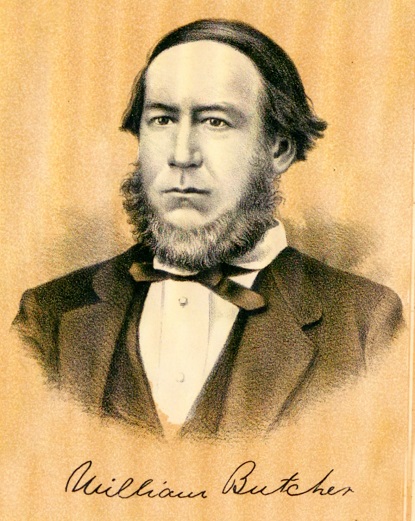
William Butcher
(Father of Alvah Butcher)
ALVAH P. BUTCHER has been a resident of
this State ever since he was three years of age, and, having been
reared to manhood within her boundaries and brought up to the noble
calling of a farmer, he has done his part toward the agricultural
development of the county. The father of our subject, William
Butcher, and his wife, Adeline (Paul) Butcher, were natives of Licking
and Knox Counties, Ohio, respectively. After their marriage they
settled in Licking County, that State, thence emigrated to Van Buren
County, Iowa, in 1849. Continuing residents of the latter county
for about six years, they, in 1855, removed to this county, and settled
in Linn Township. There the father followed farming, in which he
was successful, and there his demise occurred, July 31, 1881. The
parental family consisted of three children, who lived to attain the
age of man and womanhood – Alvah P., Amanda and Jane. Amanda is
the wife of Charles Coleman, who is a resident of Kansas; Jane married
Isaac Johnston, and they are living in Marion Township, this county.
Alvah
P. Butcher is a native of Licking County, Ohio, and was born Dec. 14,
1846. His education was received in the schools of this county,
and he lived at home until twenty-four years of age, assisting in the
labors on the farm, and during that time he was married. He then
rented his father's farm for six years, and was occupied in improving
and cultivating the same, after which he purchased a home in Marion
Township. He lived on the latter place until 1882, when he sold
it and bought 124 acres in Linn Township, this county, to which he has
added by a subsequent purchase of forty acres, making his landed
possessions in the county 164 acres. His farm is under a high
state of cultivation, and he is meeting with more than ordinary success
in the prosecution of his vocation.
Mr.
Butcher was married in Mt. Vernon, Iowa, Dec. 24, 1869, to Elminah E.,
daughter of John ami Elizabeth (Scott) Brokaw. Mrs. Butcher was
born in Ohio, May 25, 1845, and of her union with our subject four
children have been born – Eliza A., Hattie M., Harry C. and Nelly
A. Eliza A. died when about seven years of age. Mr. Butcher
has held the office of Township Trustee, and has also been elected to
other offices of minor import, but failed to qualify. In politics
he is a Democrat.
The elder Butcher was
a prominent person in his community during the early history of this
county. He was one of that noble band of hard-working pioneers
who converted the wilderness into a garden of plenty. The
memories of these founders of the present greatness and prosperity of
Iowa should be preserved until remotest generations, and as a means of
doing this a portrait of Mr. William Butcher is presented in this
connection.
Source: “Portrait and Biographical Album of
Linn County, Iowa”, 1887, Alvah BUTCHER’s biographical sketch on page
517, his father’s portrait on page 516
Submitted by: Eric & Marcia Driggs
CHARLES F. BUTLER
 Charles
F. Butler, president of the Springville Exchange Bank and a most
capable financier and successful business man, is a native of this
county, born on the old homestead in Brown township, December 8, 1857,
and is the son of Joseph S. Butler, a sketch of whom appears elsewhere
in this work. His boyhood and youth were spent upon the farm, and his
primary education, acquired in the schools of Springville, was
supplemented by two years' attendance at Cornell College, in Mt.
Vernon. Charles
F. Butler, president of the Springville Exchange Bank and a most
capable financier and successful business man, is a native of this
county, born on the old homestead in Brown township, December 8, 1857,
and is the son of Joseph S. Butler, a sketch of whom appears elsewhere
in this work. His boyhood and youth were spent upon the farm, and his
primary education, acquired in the schools of Springville, was
supplemented by two years' attendance at Cornell College, in Mt.
Vernon.
After completing his education Mr. Butler returned home and
engaged in farming and raising, feeding and dealing in stock. A few
years after his father established the Springville Exchange Bank he
became connected with the same and was in partnership with his father
until the latter's death, when he succeeded to the business and estate.
The capital stock has been increased from twenty five to seventy five
thousand dollars, having the largest capital of any bank in the county
outside of Cedar Rapids. Besides his banking business Mr. Butler owns
and operates several fine farms, and fattens for market several
carloads of cattle annually. He is one of the most public spirited men
of the town, and is ever ready to use his influence and means to
advance the interests of the community. He was one of the principal
promoters of the water works system of Springville, and owns a large
share of the stock.
On the old homestead in Brown township, where he was born, Mr.
Butler was married on Christmas Day, 1882, to Miss Clara Burger, a
native of Franklin county, Pennsylvania, and a daughter of Abraham
Burger, who was one of the early settlers of Linn county. Here Mrs.
Butler grew to womanhood, her education being acquired at Mt. Vernon.
They began their married life on the old home farm, and their only
child, Margaret Josephine, was born. After residing there for a few
years they removed to Springville, and the daughter will graduate at
the high school in that place in June, 1901.
Mr. Butler is a prominent member of the Knights of Pythias
Lodge, of Springville, of which he is past chancellor, having filled
all the chairs in the same and represented the lodge in the grand lodge
of the state. His wife is an earnest and active member of the
Presbyterian Church, and, although he is not a member of any religious
organization, he attends church with her and gives liberally to its
support. Politically he is a stanch Democrat, but, being in favor of a
gold standard, he voted for President McKinley in 1896 and again in
1900. Public office has no attraction for him, as he desires rather to
devote his entire time and attention to his extensive business
interests. A man of keen perception and unbounded enterprise, he has
met with marked success in his undertakings and is deserving of
prominent mention among the leading and representative business men of
the county.
Source: Biographical Record of Linn County, Iowa. Chicago: The S. J. Clarke Publishing Company, 1901. p.554-557.
JOSEPH S. BUTLER
One of the most prominent business men of Springville for many
years was Joseph S. Butler, who spent the greater part of his life in
this county and was a worthy representative of one of its honored
pioneer families. He was born in Gallipolis, Ohio, September 28, 1821,
and was a son of Colonel Isaac Butler, who was born in Kentucky of
Irish parentage and won his title as commander of a regiment of militia
that was stationed at Fort Dearborn (now Chicago, Illinois) in 1836. In
1828 the father removed with his family to Louisville, Kentucky; three
years later went to Cass county, Michigan, and in 1835 to Racine,
Wisconsin. In 1840 he came to the territory of Iowa and made a
permanent location in Linn county on land a part of which is now within
the corporate limits of Springville.
 Joseph
S. Butler was a young man of nineteen years when he came with the
family to this county, and he assisted his father in breaking, fencing
and improving the land, remaining on the home farm for several years.
In 1850 he started out in life for himself with no capital. Going to
Anamosa, Iowa, he formed a partnership with a gentleman and engaged in
the manufacture of cultivators and fanning mills for cleaning wheat for
four years. On his return to this county in 1854, he settled in Brown
township and engaged in farming and stock raising and also dealt in
real estate. Joseph
S. Butler was a young man of nineteen years when he came with the
family to this county, and he assisted his father in breaking, fencing
and improving the land, remaining on the home farm for several years.
In 1850 he started out in life for himself with no capital. Going to
Anamosa, Iowa, he formed a partnership with a gentleman and engaged in
the manufacture of cultivators and fanning mills for cleaning wheat for
four years. On his return to this county in 1854, he settled in Brown
township and engaged in farming and stock raising and also dealt in
real estate.
From 1862 until 1876 he was quite extensively engaged in dealing in
grain and stock and in dressing hogs for market. In 1878 he established
the Springville Exchange Bank with a capital stock of twenty-five
thousand dollars, and carried on the banking business by himself for
eight years, at the same time attending to his farming and stock
raising interests. His bank was in the old town on the south side of
Big Creek until 1881, when it was removed to its present location in
the new town.
His son, C. F., subsequently became a member of the firm, and together
they conducted the bank until the father's death, which occurred
December 31, 1898. He was laid to rest with Masonic honors, the
Springville lodge officiating, a great number of his fraternal brethren
from Marion, Cedar Rapids and other places being present. The Old
Settlers Association also attended the funeral in a body.
On the 4th of July, 1854, Mr. Butler was united in marriage
with Miss Maria L. Reneau, a native of Indianapolis, Indiana. Her
father, Jesse Reneau, was born in Tennessee of French ancestry and was
married in that state. Later he spent some years in Indiana, and from
there came to Linn county, Iowa, being one of its early settlers. Unto
Mr. and Mrs. Butler were born three children. The oldest, A. J. Butler,
was born September 28, 1856, on his father's birth day, and died
January 1, 1876, while had the father lived one day longer he would
have died on the anniversary of his son's death. Lurman died in
infancy. The other son is Charles F. Butler, whose sketch appears on
another page of this volume.
For several years Mr. Butler was obliged to use crutches as
the result of accidents. When a young man he had his foot crushed by
the fall of a horse, and in September, 1877, he was forced to have one
leg amputated below the knee as the result of an accident in crossing a
railroad track at Cleveland, Ohio. Notwithstanding these misfortunes,
he was actively engaged in business throughout life, and was one of the
most successful men of Linn county, accumulating a large estate. As the
public-spirited and progressive citizen he gave his time and means to
advance the interests of the community in which he lived, and never
withheld his support from any enterprise which he believed would
promote the general prosperity.
In 1862 Mr. Butler was commissioned by the Governor to raise a
company for the war of the Rebellion, and he raised and organized what
became Company H, of the Twenty-fourth Iowa Volunteer Infantry. He was
a Jeffersonian Democrat and took quite an active part in politics. In
1864 he was nominated and ran for representative to the state
legislature on the Democratic ticket, but was defeated by a small
majority. For some years he served as justice of the peace and also as
a member of the school board, always taking an active part in
establishing good schools and promoting educational interests.
He was an active member of the Presbyterian church, of Springville, and
gave liberally toward the erection of the house of worship and
parsonage belonging to the same, as well as toward the building of the
Methodist Episcopal church. Fraternally he was a Knight Templar Mason,
and an honored member of Springville Lodge, Marion Chapter, and Patmos
Commandery. He was a man of recognized ability who stood high in public
esteem, and had the confidence and respect of all with whom he came in
contact either in business or social life.
In 1881 Mr. Butler established the Springville New Era, an
eight-page sheet which he edited for a time, and was sole owner until
he sold the same to Alfred L. Flude. The paper was non-partisan in
politics and had a large circulation in Springville and vicinity. Mr.
Butler was also one of the principal promoters of the water works
system of Springville, in which he owns a large share of the stock.
In August, 1896, Mr. Butler read the following paper before the Old Settlers Association at Marion:
"The pioneers who came to Linn county and stood the brunt of
the hardships, the exposures and privations of a frontier life, found
this country to be a wilderness, a vast unbroken pasture field, with
frequent groves and streams, an abundance of wild fruit and game.
Highways and bridges there were none. It was a wilderness inhabited by
roving bands of Indians, wild animals, and the dreaded Mossagger rattle
snake. Occasionally a pioneer cabin was to be found in the edge of the
timber for the better protection from storms in winter. Their cabins
were built of round logs, the outside cracks daubed up with clay to
keep out the cold. The roof was covered with shakes and weight-poles,
while a puncheon floor, an old fashioned fire place, and a log cut out
for a window, completed the interior arrangements.
Many times greased paper served in place of glass for windows. Some of
these cabins when completed did not have a nail, spike or bolt, or a
piece of glass in their entire construction, the work being done with
an ax, saw, draw knife and augur. Often times it was many miles to the
nearest neighbor. The early pioneers usually brought all their worldly
possessions with them, which usually consisted of an ox team, a wagon,
cow or two, and many times without a dollar in money, but with a good
rifle, a faithful dog, and added to that he possessed a brave heart, a
determined will to defend himself and family and his property against
all intruders, whether they were white men, Indians or wild animals.
These pioneers were brave people, generous to a fault and when
a stranger visited their cabins, he always found the latch string out
and was always welcome to the best they had. They were generally an
industrious people, honest in their dealings, and usually paid their
debts promptly when due. They were very conservative in their mode of
living and of doing business, seldom buying anything on time unless it
was a necessity. Their credit was their only capital with which they
could do business, and they were generally very careful not to abuse
it.
It was very seldom they had a lawsuit, as their disputes were
usually settled by arbitration, each party picking a man, and if they
failed to agree, these two chose a third man, and their decision was
final and ended the matter.
At the same time there was quite a sprinkling of bad men in
the country, such as horse thieves and robbers, but they were mostly
transient, unwelcome night prowlers, ever to be dreaded, and
occasionally Judge Lynch was called upon to administer the law with a
rope and a gad, and sometimes in such a way that it was a terror to
other evil doers. The result was such that thieves and rogues found it
convenient to make haste to find a more congenial clinic to perpetrate
their dastardly deeds and make room for a better class of men to come
in and locate and help improve, built up and make Linn county what it
is today, with its thousands of beautiful farms under a high state of
cultivation, with good houses and barns, many of them with beautiful
residences finished off in the latest styles, with beautiful lawns,
flower gardens and orchards, artificial groves and splendid
outbuildings.
The thousands of herds and flocks of the finest live stock, including
horses, cattle, hogs and sheep, the great source of wealth of this
country, with the splendid cheese factories and creameries scattered
over the country with the finest machinery and fixtures, the products
of which are great sources of revenue to our people; with good public
roads leading in every direction; the county all checkered over with
railroads, with their many depots and ware houses for the convenience
of commerce and travel, all prove that these early pioneers built well
for the future prosperity of their country.
The numerous telegraph and telephone offices with easy communication by
wire with all parts of the country, the streams spanned by the most
substantial of iron bridges; the many weekly and daily papers with
their immense circulations among an intelligent people; the country all
dotted over with school houses, churches and colleges, with their
spires pointing heavenward; the thriving towns and cities, with
capital, energy and enterprise establishing jobbing houses doing
immense businesses; the numerous manufacturing institutions of various
kinds, the products of which are being shipped to all parts of the
state; the many solid monetary institutions which compare favorably
with any in this or any other state; the many systems of water works
and organized fire departments for the protection of property; the
magnificent county building on the county farm, a home for the
unfortunate poor and helpless, all these speak eloquently of the
foundation laid in poverty and privations by these early pioneers."
Source: Biographical Record of Linn County, Iowa. Chicago: The S. J. Clarke Publishing Company, 1901. p.624-629.
EBER C. BYAM
Eber C. Byam was born in Canada in 1826. He came to Iowa, locating in
Linn County. He was for many years a minister of the Methodist church
and at one time presiding elder. In the organization of the
Twenty-fourth Iowa Infanty, he was appointed by Governor Kirkwood its
colonel. He did not prove adapted to military command and resigned his
commission on the 30th of June, 1863. In 1871 he was appointed Register
of the United States Land Office at Fort Dodge and remained in that
city several years in the real estate business. He finally moved to
Rochester, New York, where he died many years ago.
Source: History of Iowa from the Earliest Times to the
Beginning of the Twentieth century. By Benjamin F. Gue. Volume IV. The
Century History Co., New York, NY. 1903. p. 35.
WILLIAM C. BYERS
Among the gallant defenders of the Union during the war of the
Rebellion was this well-known engineer on the Burlington, Cedar Rapids
& Northern Railroad, now residing in Cedar Rapids. He was born in
Greencastle, Franklin county, Pennsylvania, March 9, 1844, a son of
Martin and Margaret (Cline) Byers, who were natives of the same state
and came west in 1865, locating on a farm in Linn county, Iowa, about
eight miles east of Marion. The mother was accidentally killed by being
thrown from a wagon and breaking her neck, in September 1865. The
father survived nineteen years.
William C. Byers attended the common schools of his native
state until fourteen years of age and then learned the boot and
shoemaker's trade. He next entered the machine shop of Crowl &
Davidson, at Greencastle, where he worked about three years as an
apprentice. Hardly had the echoes from Fort Sumter's guns died away
when he joined the boys in blue, enlisting on the 20th of April, 1861,
at Harrisburg, Pennsylvania, in Company C, Second Pennsylvania
Volunteer Infantry.
On the expiration of his term of enlistment he returned home, but later
re-enlisted for nine months in Company K, One Hundred and Twenty-sixth
Pennsylvania Regiment. He participated in the battles of Falling Water,
Martinsburg, Harpers Ferry, the second battle of Bull Run, Antietam,
White Plains, Snuckers Gap, Fredericksburg, Chancellorsville and
Gettysburg. He was taken prisoner during the last named engagement and
recaptured by Colonel Dalgreen. He was discharged at Harrisburg. His
two brothers, Charles and George, were also soldiers, the latter being
a member of the same company as our subject. He was killed at the
battle of Fredericksburg, and Charles lost his life at the battle of
the Wilderness.
Before leaving Pennsylvania, Mr. Byers was married October 8,
1863, to Miss Lucretia C. Conrad, also a native of Shady Grove,
Franklin county, that state, and a daughter of Jacob and Mary (Keysey)
Conrad. She is one of a family of ten children, but only three of the
number are now living. Six children were born to our subject and his
wife, namely: (1) Sherman W., died in infancy; (2) Shannon M., an
engineer on the Burlington, Cedar Rapids & Northern Railroad,
married Loretta Myers, and they have three children, William, Harry and
Ruth; (3) Earle is now assistant bookkeeper for Rea & Company at
Pittsburg, Pennsylvania, and also plays the pipe organ in the Christian
church in that city. He was selected as a delegate from that place to
the musical convention held in 1900. (4) Edward is employed in a drug
store in Cedar Rapids. (5) Carl is connected with a wholesale harness
and saddlery establishment in Omaha, Nebraska. One died in infancy.
In the spring of 1864 Mr. Byers came to Linn county, Iowa, and
for a time engaged in farming. Later he carried on the boot and shoe
business at Springville for about six years, and then accepted a
position as locomotive fireman on the Dubuque and Southwestern
Railroad, with which he was connected for two years. On the 16th of
September, 1872, he entered the service of the Burlington, Cedar Rapids
& Northern Railroad, and after firing for three years was promoted
to engineer on a freight train, which position he filled for three
years and for the past nineteen years has been on the best passenger
runs on the road and is now about the ninth oldest man pulling a train
on the road.
Religiously Mr. and Mrs. Byers are members of the Trinity
Methodist Episcopal church, and they have made their home at 124 G
Avenue, West Cedar Rapids, for eighteen years. He is also a member of
the Ancient Order of United Workmen, the Brotherhood of Locomotive
Firemen and Engineers, and the Masonic fraternity, Crescent Lodge. No.
25 and Trowel Chapter, No. 49, and is a stockholder of the Masonic
Temple at Cedar Rapids. The Republican party has always found in him a
stanch supporter of its principles, and he has taken a very active and
influential part in public affairs, serving as a delegate to five
international conventions of the Brotherhood of Locomotive Fireman and
at numerous political conventions.
While a resident of Springville he served as school director one year
and constable 2 years and since coming to Cedar Rapids has represented
the 8th ward in the city council, twice being elected on the Republican
ticket, although it is the strongest Democratic ward in the city, being
chairman of the sidewalk and street committee for three years. His
election plainly indicates his personal popularity and the confidence
and trust reposed in him by his fellow citizens.
Source: Biographical Record of Linn County, Iowa. Chicago: The S. J. Clarke Publishing Company, 1901. p.619-621.
|
|