IA Orphan
Train banner

USGenWeb Project


IAGenWeb
Project

About the Young Girl in our Logo

What's New on our pages!

Addresses

Beginning Research

Biographies

County Specific

Interactive

Lookup Resources

Neighbors

Newspaper Resources

Orphanages & Societies

Photographs

Riders

Surname Researchers

Join the Team!

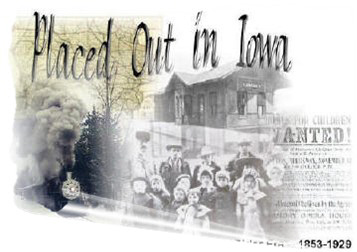
From 1853-1929 a mass migration of approximately 300,000 orphan children was in progress all across America. It is estimated that 8-10,000 babies, young children and young adults were brought to Iowa from many orphanages in Boston, New York and other northeastern coastal cities.

This event is referred to as the 'placing out' system. It was not a new concept as it had been used in Europe for many years prior to its use in America. This method of providing homes for orphans /children was the forerunner of foster care as we know it today.

Our developing history of America deals with the rapid influx of immigrants to our country that over-whelmed our ports. We were not prepared with homes, schools, food, medical care and the needs of people who were arriving by boatloads.

Eventually children of all ages were left to roam the streets, turning to any source for food, shelter and clothing. They obtained the basic needs of life by any means they could find such as singing on street corners or in bars, shinning shoes selling newspapers or flowers. While some ventured into the life of crime and were taken to jail.

Not all children were full orphans. Some had one or both parents living but they could not supply the needs of the child. Therefore, the parent turned them over to the various orphanages that were being supplied by the city.

Numerous orphanages, both public and private, were established. While most of them were 'Christian' by nature, some were opened for specific ethnic or religious groups. And many are still in business today.

There are too many to acknowledge so those listed here are the five major facilities that brought babies, small children and young adults to Iowa:

Home For Wayward Children opened in Boston, MA. In 1849.

The Baldwin Home for Little Wanderers opened in Boston, MA. In 1850.

Opened in 1851, The New York Juvenile Asylum merged with the Children's Village in Dobbs Ferry, N.Y.

Charles Loring BraceRev Charles Loring Brace began the New York Children's Aid Society and the society is still in business today. Rev. Brace initiated the "Placing out" system because he felt that to confine a child would undermine their development. And so, he established trade schools to provide working skills to be useful in a chosen occupation or at their new home.

Sisters of Charity of St. Vincent de Paul opened the New York Foundling Hospital (Home) with $5.00 and an empty building in 1869. Their main concern was the infant, the mother, and a Catholic up bringing. However, they also welcomed children of every race, color and creed and still take care of numerous children every year. Children from this facility were pre-arranged for through the local Catholic priest in the city where they were taken and they were most likely to be the ones that were adopted.

Police and ministers did their best to attend to the needs of the most sick, hungry or abused child they found and they did their best to find the parent(s). When this was not successful they took them to shelters, alms-houses or orphanages.

Upon arrival at the orphanages they were fed, bathed, checked for medical needs and, if known, information was recorded in ledgers such as age, date of birth, parents names, place of birth, etc. Some records were well kept while others are scant or missing. They were assigned places to sleep and chairs in the dining room. Those with apparent diseases were placed in an infirmary or away from the others until they were well.

Life went on from there with Agents and assistants caring for the well being of the residents. The personality, intelligence and other factors were closely monitored because eventually the child would become a member of a new family where these attributes would have a great bearing on stability in their new home.

Railroads to Iowa began in the early 1850's to and through Dubuque and Davenport, Iowa. The trips were planned for groups of 10-50 children along with their Agent(s) to arrive on Friday from New York. The Boston groups left on Sunday noon and the New York group left at noon on Tuesdays.

Children of all ages were chosen for the trip with the older ones helping the Agents take care of the younger ones. They came first in boxcars and later in Pullman cars. They were usually loaded first due to the large amount of luggage and food supplies needed for the long journey. When they were safely loaded on the train with their coats and lunches stored away, the Agents set aside dress clothes to be worn upon arrival at their destination.

A change of trains and perhaps depots was done in Chicago, ILL. Once loaded and settled the clatter of wheels on the tracks, along with the rocking motion of the train soon lulled the children to sleep and for the most part they all arrived in good condition.

Present records show that there were 8 Agents who brought groups to Iowa. There is currently no list of Catholic nuns but they did accompany their groups as well.

  • Mr. H. D. Clarke
  • Miss Clara B. Comstock
  • Mr. Robert Curran
  • Mr. Charles Frye
  • Miss Annie Laura Hill
  • Mr. E. E. Trott
  • Mr. J. W. Shields
  • Mr. E. Wright.

In 1910 Mr. Wright had recorded 119 trips West and this same number, more or less, occurred in the lives of the others as well.

In the early years when they arrived at the depot they were escorted by livery wagons or in good weather they all walked to the hotel or church to get washed up and changed clothes. Then they were ready to be seen by the folks who had gathered to view them and perhaps take one home with them. Sometimes the children sang songs, recited poems or simply visited with the crowd.

When a child was chosen by a family then the Agent and the head of the household signed an agreement that they were willing to take full responsibility for the care of the child until it reached adulthood. It included attending church, school, food, clothing and any needs of the child. There was no cost to the family nor were they paid for the care of the child. This could be reversed at any time should a grievance occur between the child and family occur. Siblings were usually separated at this time as couples wanted only one child or perhaps two. They were sometimes located in the same city or a city nearby.

Catholic orphanages traveled to pre-planned destinations because local citizens had already applied for a specific age and appearance of a child. This was accomplished through the local priest and the local priest sent the applications to orphanage after approval of the home. These requests were followed as closely as possible. A number was assigned to the request and the same number was sewn onto the hem of the dress of a girl and the inside of the jacket of a boy. A notice was sent to the couple about when and where the child would arrive. These children were most usually adopted by the couple because they were so young. Older children were also placed out by Catholic orphanages.

At a later time an Agent went to the home to see a child and the family and determine if everything was going well. If not, then the child was removed to another home. It is said that some orphanages encouraged the children to write letters to the orphanage about their progress and copies of these may be in the child's file at the orphanage.

Research shows that very few adoptions or placements failed which speaks well for the families in Iowa. Farmers and merchants were in great need for assistance in the growing years of Iowa's development. Here at the Research Center are records of children all across Iowa, hardly a county or city has not been touched by the lives of the orphans. They were either brought to or lived in each community across the state.

Much can be said for and against this method of obtaining homes, the up bringing of the child and it's affect upon them. However, if you are ever privileged to be in the presence of an Orphan Train Rider and hear about their journey they are pleased with the outcome. Protestant "Orphan Trains" and Catholic "Mercy Trains" or "Baby Cars" have long since made their final trips to the West but their legacy lives on in the hearts of those they carried to their new homes and lives.


The above material contributed to this site by Madonna Harms.

IAGenWeb Orphan Train ProjectCopyright Notice: All files on this site are copyrighted by their creator and/or contributor. They may be linked to but may not be reproduced on another site without specific permission from Tina Vickery [tsvickery@adelphia.net] and/or their contributor. Although public information is not in and of itself copyrightable, the format in which they are presented, the notes and comments, etc., are. It is however, quite permissable to print or save the files to a personal computer for personal use ONLY. My very special thanks to Holly Timm for the creation of the banner graphic used on this page. Space for the these pages is provided by the Friends of the IAGenWeb.

Addresses Beginning Biographies
Interactive Lookup Neighbors
Newspapers Orphanages/Societies Photographs
Surnames Riders Join the Team!
IAGenWeb Project Home  

Counter