|
|
|
|



|
|
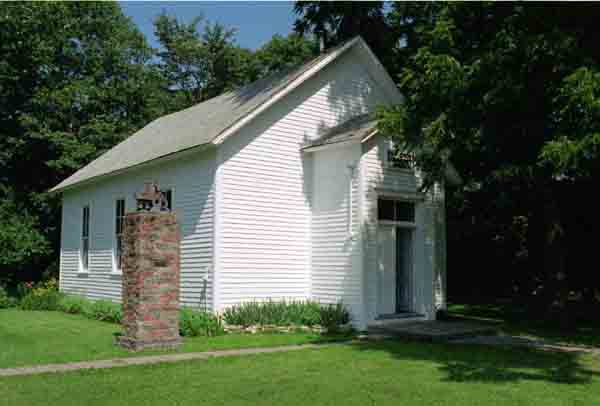
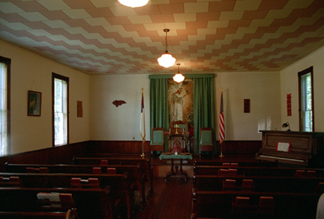
HISTORY OF OAK GROVE EVANGELICAL CHURCH - WEBSTER TOWNSHIP |

|
The Oak Grove Church received its name by
virtue of its location, being surrounded by a beautiful grove of
oak trees. In the early days, it was known as the Pleasant Hill
Sunday school. The period of time in which this particular church
began to hold its services as a worshipping body was about 1855.
The records for the first 50 years of the church cannot be located
(information has been supplied that suggests that the United
Methodist Conference took the books). Because the books are
missing, this account of the early church history is largely due
to the memory of one early resident of this community, George
Schnellbacher.
In the year of 1855, Mr. John Schnellbacher came to Madison County, Iowa from Pickaway County, Ohio. He took up a homestead in Webster Township. Mr. Schnellbacher was an itinerant preacher ordained by the Evangelical Association. He was given a mission to lead a party of Evangelicals to settle in Madison County. He began his preaching in the schoolhouse in the locality. A Sunday School was ever a part of the work which he endeavored to do. After 18 years of local ministry the work grew to the place of such importance that a regular minister was necessary. For this purpose a parsonage was erected in 1873. This structure was a four room frame house. There was no indebtedness on the new home |
Oak Grove Evangelical Church Photos courtesy of Kent Transier |
|||
|
for the preacher. The parsonage received an addition in 1907 under the leadership of Rev. H. W. Hendricks. The parsonage was moved to its present location from the top of the hill to the east in 1951. The work of the church in this community was carried in schoolhouses for nearly 40 years before a church building was erected. Other early minister names after John Schnellbacher included Holdridge, Busse, Honeysmith, Condo, McBride, Macaulley, Caldwell, Yerger, Richardson, Wilkins, Hoover, Gramley, Kale, Wallace, Force, Hummel, Porter, and Hamilton. During the ministry of James Hamilton, in 1889, the church was erected. The church was not a large building but sufficiently large to meet the needs at the time. The dedication ceremony was delivered by Rev. Hooker from Des Moines. Rev. B. H. Niebel was presiding elder in charge at that time. The financial part of the building was all taken care of at the time of the dedication. The church property location was obtained from Andrew M. Hart, a friend of the church. The record of the charter members has not been located but some of the early family names have been recalled. They were Adam Krell, Samuel Krell, Jonathan Wissler, John Schnellbacher, John Welty, Peter Welty, William Elsbury, Andrew M. Hart, Miles Hart, Alfred Shaw, Mosby Brock, William Brock, Tom Kirkland, Joshua Cookly, Mrs. George Wight, and Elisha Tumbleson. Relationships within the church were not always harmonious. In 1894, the church split into two factions and a lawsuit was entered between the two over church property. Eventually, the matter was arbitrated by the Des Moines Conference, Job Yaggy presiding. One faction got the property but after a few months, the two groups came back together as one. The Evangelical Association/Oak Grove Church was more than a religion and a place of worship. More than once in the literature, members were referred to as having come from "the Oak Grove Community." Whether this had extended socio-economic implications is as unknown. There are indications that in the early years, the members stuck to church doctrine and formed a closed-knit society, fraternizing principally among themselves. Services are still being held in this church (as of 2023) and it is now a Community Church. The church is located in Webster Township, Section 14, just south of the Middle River and about a quarter-mile from the Roseman Bridge. __________________
|
||||
| Maintained by the County Coordinator |
|
This page was created on July 10, 2004. This page was last updated Tuesday, 30-Jul-2024 11:55:14 CDT . |