1914
Biographies
B
History of Franklin
County, Iowa by I. L. Stuart. 2 vols. Chicago: S. J. Clarke Pub.
Co., 1914.
Transcribed by Don Turner, former coordinator of this website.
Harold Dudley Baldwin
Harold Dudley Baldwin, a well known druggist of Hampton, was born in this city December 11, 1884, a son of Emmet V. and Sarah Jane (Cook) Baldwin, the former a native of Pennsylvania and the latter of Wisconsin. When the father was eighteen years of age he came to Cedar Falls, Iowa, and for a time engaged in farming in the vicinity of that city. He afterward passed his examination and became a registered pharmacist, establishing a drug store in Hampton in partnership with Dr. J. H. Hutchins. Eventually he purchased his partner's interest and erected a fine brick store, the first floor of which he used as his pharmacy, the second floor being occupied by business offices. Emmet V. Baldwin conducted this enterprise successfully until his death which occurred in August, 1911. He is survived by his wife, who makes her home in Hampton. To their union were born two children: a daughter, who died in childhood; and Harold Dudley, of this review.
Harold Dudley Baldwin acquired his education in the Hampton grammar and high schools and afterward attended the University of Illinois, graduating from that institution in 1908. Immediately afterward he became connected with his father's drug store and after the latter's death assumed charge of the enterprise which he has since conducted. He carries a full line of drugs and sundries and controls a large and representative patronage.
Mr. Baldwin is a member of the Congregational church, is connected fraternally with the Knights of Pythias and the Order of Elks and gives his political allegiance to the republican party. He is a young man of force, ambition and enterprise and will undoubtedly be carried forward into still more important relations with mercantile interests of the community.
~*~
J. M. Barker
It is fitting that after many years of active, persistent and successful effort J. M. Barker should enjoy a period of rest through the evening of life. For many years he was actively engaged in farming but is now living retired, for the fruits of his former toil are sufficient to supply him with all of the necessities and comforts, and some of the luxuries of life. He has now reached the venerable age of seventy-five years, his birth having occurred in Oneida county, New York, on the 5th of May, 1838. He is a son of Miles and Melinda (Brace) Barker, the former a native of New York and the latter of Connecticut. Joab Brace, a brother of the grandfather of our subject, was a Presbyterian minister devoting his life to his holy calling through a half century in one church, a length of service in one pastorate which is rarely equalled in this generation. Some of his children also became identified with the work of the ministry.
Miles Barker was a cooper by trade and also a farmer, devoting his life to the dual occupation. He always continued a resident of the Empire state and there passed away May 16, 1838, when his son, J. M. Barker, was but two weeks old. His widow survived him for more than four decades and died in Illinois, December 29, 1878. In the family were four children: A. B. and Sophia, both now deceased; Martha, the widow of N. Smith, of Chicago; and J. M.
J. M. Barker, reared to the occupation of farming, decided to make it his life work and his early training and experience well qualified him for his later labors. In 1856, when eighteen years of age, he left New York and made his way to Illinois, where he followed farming until 1861. He was thereafter connected with mercantile interests in Chicago for ten years and later was upon the road as a traveling salesman, representing sewing machine supplies. In 1874 he came to Sheffield, Iowa, and purchased one hundred and twenty acres of land and in 1875 purchased one hundred and sixty more. Four years later in 1879 he moved from Chicago to Franklin, Iowa. He added to this property by additional purchases and thereafter continued to carry on general farming more or less successfully on three hundred and forty acres of land which he cultivated and improved, transforming wild land into richly productive fields.
He continued to reside upon the farm until 1896, when he built a fine residence at No. 603 Reeve street, and removed to Hampton, where he now resides. Year by year while upon the farm he carefully cultivated and cared for his crops and annually gathered good harvests of corn, wheat and other cereals. He also raised cattle and hogs. The products of the farm found a ready sale upon the market, and thus year by year he was able to add to his financial resources.
Mr. Barker was united in marriage to Miss Sarah Smith, a native of Illinois, and unto them have been born three children: C. Maude, now deceased; Bertha B., at home; and Cariola, who is in the state library at Iowa City. They have one grandchild, Thelma B. Watt, of Sheffield. Mr. Barker gives his political allegiance to the republican party and although he does not seek nor desire office, keeps well informed on the questions and issues of the day. His religious faith is that of the Congregational church, and he stands at all times in support of progressive public measures having to do with the material, political, intellectual and moral progress of the community.
~*~
William Barry
Among the successful pioneers of Franklin county William Barry occupies a conspicuous position by reason of his progressive work along agricultural lines. Mr. Barry has not only attained individual success but has contributed toward agricultural standards of the state and has always been a leader in accepting new ways and means toward reaching the farmer's goal of success. He was born on the 13th of August, 1845, a son of Edmund and Elizabeth (Kirby) Barry, both natives of County Cork, Ireland. Together they emigrated to America in 1840 and first located in Syracuse, New York, where the father found employment in a salt works. By reason of his ability, close application and faithfulness to duty he soon rose to a prominent position. However, the call of the west had its charm for him and about two years later he departed, making his way to Green county, Wisconsin, where he embarked in agriculture. He at first rented two hundred and forty acres on shares, which he cultivated with such good results that he was later enabled to purchase one hundred and sixty acres. Close application and good judgment resulted in continued prosperity and he increased his holdings until he finally owned eight hundred acres. He was one of the foremost agriculturists of his district in Wisconsin and stood high in the estimation of his friends and neighbors. Mr. and Mrs. Edmund Barry had nine children. Those living are John, who is located on the homestead in Green county; William, our subject; and Frank, who is a business man of Long Beach, California. Both parents died in Wisconsin about 1899, their demise occurring but a short time apart.
William Barry received his early education in the country schools of Wisconsin and had the usual experiences of a farmer lad, beginning early to assist his father in his extensive farming operations. He showed unusual qualifications for this kind of work and applied a number of new ideas in working the farm. While yet assisting his father he made his first investment by buying one hundred acres in Green county, Wisconsin, at the rate of ten dollars per acre, and he later sold this tract at a handsome profit. Shortly thereafter Mr. Barry made his first trip to Iowa, walking from Ackley, this state, to what is now Franklin county, and looking for possible investments in land. Although a friend who had accompanied him purchased property Mr. Barry decided to wait, but in 1870 he returned and with his brother traded a horse as a first deposit on land in Ingham township. There they together bought one hundred and sixty acres of rich prairie land. This was at a time when practically every farmer gave his attention to raising wheat and the first two crops of this cereal were so bountiful that all continued along that line. However, in the third year the wheat turned out to be an utter failure, and while most of the other agriculturists continued in trying to raise the same cereal for several years thereafter Mr. Barry and his brother grew timothy and their hay crop was probably the largest ever seen in their part of the state. They had in the meantime bought cattle to a considerable extent, and while the farmers around them were falling and were forced to give up they succeeded and derived large profits from the cattle business. They disposed of their stock in the Chicago market. Mr. Barry subsequently made numerous and advantageous trades in land, always increasing his holdings, until finally in 1894 he moved to Hampton. He today still owns nearly five hundred acres of land and has ever followed the rule of investing his surplus in good Iowa agricultural property. He has for a number of years been considered an authority on land values and has never risked his capital in dubious investments. He has made his money in Iowa and believes in home investments. His spirit of attachment to the soil has not only brought him prosperity but has left the money where it was made and in that way he has been a great factor in the upbuilding of the prosperous state, of which he is a successful citizen. He has ever shown extraordinary judgment in all business transactions, and his reputation is of the highest on account of his fair methods, which underlie all his business deals.
On February 11, 1873, Mr. Barry married Miss Mary E. Walker, a lady of Kentucky parentage. They have two children: Frank, who is connected with shipping interests in Oregon; and Joseph, at Hampton. The second son was born September 2, 1878, and received his early education in the country and district schools, later graduating from the high school at Hampton. He spent some years in traveling in the west and was also connected with a wholesale house of Spokane for a time. Later he returned to Hampton and is now assisting his father in looking after the properties which they jointly own. He married on November 9, l912, Miss Lulu Ferris, a daughter of Benjamin F. and Adeline (Forrest) Ferris, the former a native of Binghampton, Broome county, New York, and a prominent nurseryman of Hampton. Mrs. Barry's father is a veteran of the Civil war and in 1861 enlisted as a soldier in Company F, First Colorado cavalry, remaining in the service three years and three months. He participated in the battle of Pigeon's Ranch and in that of Apache Canyon, New Mexico. In the first battle he lost his horse, and in the second he received a wound in the leg. However, for the greater part of the time he was engaged in service against the Indians, and in scouting. From 1866 to 1868 he took part in the war which the Mexicans waged against Maximilian and was in the battle in which Maximilian was captured. At the conclusion of the war in Mexico he removed to Texas.
Politically Mr. Barry is a democrat and has always taken a deep interest in the progress of his section. Political honors have .been offered him, but he has always declined preferment of a public character. However, he for years was a trustee of Ingham township. When he arrived here there were twenty-five voters and of these two were democrats, he and his brother bringing the representatives of this party up to the number of four. Mr. Barry has watched the onward march of civilization and has always participated in activities that have made Iowa the foremost agricultural state of the Union. He is highly esteemed and respected in Hampton for what he has done and for what he is. Physically and mentally he appears to be a man many years younger than his record shows, and he is still intelligently interested in all objects which have for their purpose the development and advancement of the people in a moral, intellectual and material way. The honors which are accorded him are highly merited.
~*~
William F. Becker
William F. Becker needs no introduction to the readers of this volume, for he is one of the successful and representative farmers of Osceola township, owning and operating one hundred and twenty acres on section 13. He was born in Dodge county, Wisconsin, September 17, 1870, and is a son of August and Wilhelmina Bertha (Brammer) Becker, natives of Germany, the former of whom came to America in 1868 and the latter in 1861. The father located in Wisconsin and later moved to Butler county, Iowa. He took up his residence in Butler county, Washington township, this state, in 1871 and in 1887 moved to Franklin county, where he passed away July 2, 1889. His wife survived him some years, dying December 23, 1912. To their union were born ten children: William F., of this review; Ida, the wife of J. Aldinger of Rowan, Iowa; a son who died in infancy; Louisa, the wife of F. P. Sailer of Osceola township; a daughter who died in infancy; Bertha, the wife of Fred Sailer of Hardin county; Herman, a resident of Ackley; a son, who died in infancy; Martha L., also deceased; and Olga, the wife of F. Miske of Ackley. After the death of her husband the mother of the subject of this review married F. Bulson, and to this union were born two children: Martha, the wife of H. Lepine, of Hartford, Wisconsin; and Anna, who married F. Uble, also of Hartford.
William F. Becker remained at home throughout the period of his boyhood and youth, was reared to farm labor and early became familiar with the best and most practical agricultural methods. His entire active life has been devoted to farming. At the age of twenty-seven he rented one hundred and twenty acres of land in Butler county and after developing this for two years moved to Franklin county, where he rented one hundred and sixty acres. At the end of one year he bought one hundred and twenty acres on section 13, Osceola township, and here he has since continued to reside, operating the property along practical and modern lines. In addition to general farming he also raises and feeds stock, and has managed his interests so capably and intelligently that he has met with rapid and well deserved success.
On the 8th of April, 1896, Mr. Becker was united in marriage to Miss Maggie Stoher, a native of Franklin county and a daughter of John and Becky (Barger) Stoher, natives of Germany. The father came to America in 1868 and the mother crossed the Atlantic when she was four years of age. They reside in Iowa, the father engaging in stationary engineering. In their family were twelve children: Maggie, the wife of the subject of this review; Edward, deceased; Herman, a resident of Ackley; Hannah, who married William Sauter of Ackley; Henry, deceased; Benjamin, of Marshalltown, Iowa; Edward, who has passed away; John, of Eldora, Iowa; Bertha, who married F. Hintzen, of Mason City; Lizzie, deceased; and Mary. and Taldine, at home. Mr. and Mrs. Becker have two children: Minnie Bertha, born April 30, 1898; and John H., whose birth occurred March 7, 1905. Mr. Becker is a member of the Lutheran church and gives his political allegiance to the republican party. He has held a number of township offices, in all of which he has discharged his duties in a manner creditable to himself and satisfactory to his constituents. He has been carried forward into important relations with agricultural interests of his locality, and his personal characteristics have gained him the lasting regard of those with whom he has come in contact.
~*~
A. W. Beed
A. W. Beed not only occupies a prominent position in financial circles as president of the Franklin County State Bank, but also has the distinction of being the first boy born in Hampton. His natal day was November 11, 1858, his parents being George and Marinda (Dennan) Beed, who came to this county in the year 1856, settling on a farm near Hampton. Their remaining days were spent in this county, and with the pioneer development the father was actively identified. The son was reared upon the frontier with the usual experiences and environments of pioneer life. The public schools afforded him his educational privileges, and he has learned life's lessons well. He was eighteen years of age when he entered the Citizens' Bank, of which his father had been president for a number of years. After a period of identification with the bank in which he was thoroughly mastering the business, he removed to Florida, where he remained for a few years, but in 1902 returned to Hampton and has since been an active factor in the management and. control of the bank of which he is now the president. The institution has made an excellent showing and is one of the strong financial. concerns of this part of the state.
In 1881 Mr. Beed was united in marriage to Miss Alveretta J. Osborne, who was born in Wisconsin, but for some years. prior to her marriage lived in Franklin county, Iowa. They have become the parents of three children: Gail, Edith and George. Theirs is a hospitable home whose good cheer is greatly enjoyed by their many friends. Mr. Beed belongs to the Masonic lodge and chapter and in his life exemplifies the beneficent spirit of the craft. His political support is given to the republican party, and he keeps well informed on the questions and issues of the day, although he does not seek nor desire office. Through the long period of his residence in this county he has become widely and favorably known. He has been an interested witness of all the changes which have occurred as the work of development and improvement has been carried forward and has been a cooperant factor in many movements which have worked for civic betterment and municipal advancement.
~*~
| Charles
Beed
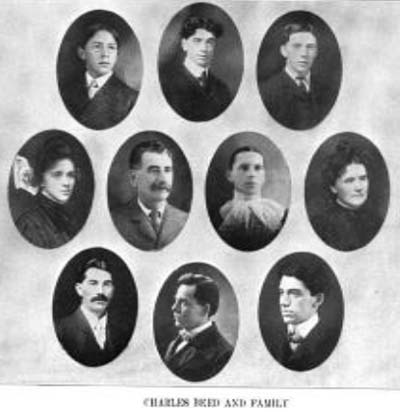
Charles Beed is proprietor of the oldest hardware establishment of Hampton, but is now leaving the management of the business to his son, while he has practically retired, although he still gives supervision to his farm of seven hundred acres in Franklin county. Mr. Beed was born in Devonshire, England, June 20, 1843, and is a son of Thomas and Anne (George) Beed, both of whom were natives of England. They had ten children. At different times members of the family made the voyage to the new world until all were located on this side the Atlantic. The first to come to America was John, the fifth son, who left London in 1853 and took up his abode at Batavia, Illinois. In 1854 Thomas Beed, the third son, arrived in the United States. He was a sailor and had made a number of voyages to the West Indies and to South America. After coming to this country he sailed for a time on the Great Lakes. In 1855 John, the first arrival in America, persuaded his father and mother to emigrate to the new world and on the trip they were accompanied by their only daughter, Mary Sarah Anne, and their youngest son, Bishop C. The eldest brother, William, was at that time in business in England and Charles Beed, subject of this review, and his younger brother Walter, ten years of age, were left at school in England. The parents with the two children mentioned sailed for America, being almost six weeks on shipboard. During the voyage the father had the misfortune to fall down the hatchway of the vessel and broke several of his ribs. For some time his life was despaired of, but he improved and after resting for a week in New York was able to renew the journey to Batavia, Illinois, where he joined his son John. About a year later George, the second son of the family, followed the others to Batavia and a few months afterward James, the fourth son, came to America and also went to Batavia. He was a sailor, as was his brother Thomas, although they sailed in different parts of the world. James made his last voyage to Bombay, East Indies, before leaving his native country of England to come to the new world. Some time in 1856 the father with his sons George, Thomas, John and James came to Iowa to look up a location and made choice of the land now known as the Henry Wolf farm, about three and a half miles northeast of Hampton. In September of the same year George Beed went to Dubuque with a covered wagon to bring the others of the family to the home that the father and his sons were preparing near Hampton. Dubuque was at that time the terminus of the railroad. On the 4th of July, 1857, Charles Beed started for America and on the 1st of May, 1858, William G. Beed, the eldest son of the family, together with his wife and Walter Beed, the eighth son of the family, left the old country, arriving in New York on the 16th of May. They were the only ones of the family who came from England on a steamship, the others making the voyage in sailing vessels. On its next trip the vessel on which William G. and Walter B6ed sailed was burned at sea and out of seven hundred passengers aboard only seventy-five escaped, some being burned to death and others drowned. The one other son of the family, Henry, who was the sixth, went to Australia in 1850 and worked there as a cowboy and afterward engaged in merchandising. He came to Hampton with his family some time in the early '80s, but after remaining in this country for a few years he returned to Australia with his family. Mr. and Mrs. Thomas Beed, the parents, have now passed away, as have their children William G., George, Thomas, John and Henry, leaving as the surviving members: James, who is now living in Waverly, Iowa; Mary S. A., a resident of Charlotte, Michigan; Charles, who is the only one now living in Hampton; Walter, of Minneapolis, Minnesota; and Bishop C., of Kansas City, Missouri. Charles Beed, whose name introduces this review, remained at home with his parents in London until eight years of age, when he was sent to school, there pursuing his studies until he reached the age of fourteen. He was a lad of twelve, when his parents started for America and two years later, on the 4th of July, 1857, he left London for the new world. While going down the Thames river they passed the Great Eastern, then the largest ship ever built. It took from the 1st of November, 1857, until the 30th of January, 1858, to launch it. It was launched broadside instead of stern first. The vessel on which Charles Beed sailed was fifty days in making the voyage, during which time they encountered some heavy storms and also some calms, which greatly delayed. the progress of the sailing vessel. It was on the 20th of August, 1857, that anchor was dropped in the harbor of New York. Charles Beed expected someone to meet him and remained alone on shipboard for three days and nights, but as no one came for him he started alone for Hampton, Iowa, the address on his trunk reading "Hampton, near Maysville, Franklin county, Iowa, United States of America." He reached his parents' home in September, 1857, having completed the trip by stage from a point just a little this side of Dubuque. The family residence was a log cabin about sixteen by twenty feet. There was one story, all in one room, and a garret. There was a window at each end of the room, consisting of six pains of glass, eight by ten inches, which had been brought from Dubuque. The garret constituted the bedroom of the family, nine in all, and a piece of calico served as a curtain to divide the room, the father, mother and sister sleeping in one end, while the boys occupied the other. There was a bedstead for the parents, but the children all slept upon the floor. The house was not plastered, the logs being bare, while the roof was of split oak timber. In the winter there was plenty of covering, some times four inches of it being nice white snow, for the roof was so open that the snow would sift in through the crevices. When spring came Charles Beed had to go to work putting in crops and soon he made a full hand in improving the farm which had been purchased. He remained at home with his parents until December 29, 1866, when he was united in marriage to Miss Lydia A. Haecker. They took up their abode upon a quarter section of land a mile east of the old homestead, and for a number of years Mr. Beed continued its cultivation and improvement. He still owns that property and also some adjoining land. In 1878 he formed a partnership with Charles Pease in the hardware business, in which he continued until a few years ago, when he suffered an accident that permanently disabled him for further business, although for the last few years he has worked to some extent around his farm of sixty-three acres lying within the town limits of Hampton. Unto Mr. and Mrs. Beed were born ten children, of whom two died in infancy, while eight are yet living. Charles Lockwood, the eldest, is conducting the hardware business established by his father. Mersey, the eldest daughter, was born in Hampton, where she has always made her home, being now the wife of Bert Page. Frank, the third child, is living on the old home farm in Ingham township, on which his parents began their domestic life. Louis occupies a farm adjoining the old homestead. Roy is working at the plumber's trade in Waterloo. Victor follows the same in Fort Dodge, Iowa. Ruth T. and Harry are still at home with their parents. The farming interests of Mr. Beed comprise more than seven hundred acres of the rich and productive soil of Iowa. He occupies a fine home at No. 620 South Reeve street, and has reached a financial position that enables him to enjoy the comforts and some of the luxuries of life. He exercises his right of franchise in support of the men and measures of the republican party but is without political ambition or aspiration. He belongs to the Congregational church and is interested in all that pertains to the moral as well as the material welfare of the city in which he lives. He has now compassed the psalmist's span of three score years and ten, but is a vigorous, well preserved man and many more years should yet be accorded him. His life has been one of activity and usefulness, crowned with success, and because of the fact that he has never taken advantage of the necessities of his fellowman in business transactions but has always been straightforward and honorable he is accorded the confidence and friendly regard of those with whom he has been associated. |
~*~
Frank C. Beed
Frank C. Beed, engaging in general farming and stock-raising upon six hundred acres, of which two hundred and sixty acres in Ingham and Mott townships belong to him, is a native of this part of Iowa, born in Hampton, July 2, 1876. He is a son of Charles Beed, of whom further mention is made elsewhere in this work.
At the age of twenty Frank C. Beed turned his attention to farming and eventually purchased his present property, one hundred acres of which lie in Ingham township and one hundred and sixty acres in Mott township. Mr. Beed makes a specialty of raising registered Aberdeen Angus cattle and Poland China hogs and he has been very successful in these lines. He does a large business as a shipper and has gained a reputation as an expert judge of stock values, his opinions being regarded as sound and reliable. He was for some time secretary of the Farmers Elevator at Hansell and is a man of recognized business ability.
On the 21st of December, 1898, Mr. Beed was united in marriage to Miss Daisy Wirt, a native of Franklin county and a daughter of John A. and Minerva Wirt. Her father is a retired farmer living in Hampton. In his family were six children: Florence, the wife of W. W. Shroyer, of Hampton; Jessie M., deceased; Daisy, wife of the subject of this review; John, deceased; James, of Fresno, California; and Elsie, who married J. E. Welker, of Hampton. Mr. and Mrs. Beed have a son, Frank Lyle, who was born March 24, 1905.
Mr. Beed is connected fraternally with the Modern Woodmen of America and the Knights of Pythias and he and his wife attend the Congregational church. He has lived in this part of Iowa during his entire life and has become widely and favorably known, for he is honorable in all business dealings and upright and straightforward in all the relations of life.
~*~
Henry O. Beed
Henry O. Beed, a hardware merchant of Hampton, and one of the native sons of the city, was born January 20, 1873, a son of John and Celma (Rose) Beed, the former a native of England, but the latter of Ohio. At an early period in the development of this state, the father came to Iowa, where he engaged in buying grain to the time of his death. His widow survives. In their family were five children, but three daughters died in infancy. The surviving sister of Henry O. Beed is Mrs. Emma Cogswell, the wife of F. A. Cogswell, of Rockwell, Iowa.
In the public schools Henry O. Beed acquired his early education, which was supplemented by study in a business college at Des Moines. He was graduated therefrom and afterward went to Florida, where he engaged in the orange business for ten years. On the expiration of that period he returned to Hampton and for two years was employed in the feed store of his uncle. He next purchased the hardware business of F. D. Smith in 1902 and has since been proprietor of the store. He carries a large and well selected line of shelf and heavy hardware and has a liberal patronage which he well merits, owing to his honorable business dealing and enterprising methods.
Mr. Beed was united in marriage on the 23d of August, 1893, to Miss Grace E. Ross, a native of Franklin county, and unto them have been born seven children: Eunice, Lloyd, Cecil, Winnifred, Carol, John and Celma, all of whom are yet under the parental roof. Mr. Beed holds membership with the Knights of Pythias and with the Congregational church-associations that indicate much of the rules that govern his conduct and the principles which shape his life. He has served as alderman and is a member of the school board, and the cause of education finds in him a warm and stalwart friend, anxious to do everything in his power to promote the interests of the schools and of public affairs in general. He has a wide acquaintance in Hampton and Franklin counties, and that his life has been well spent is indicated by the number of his friends.
~*~
Edward A. Beemer
Edward A. Beemer, who in an influential way has been for over thirty years identified with farming interests of Franklin county and whose enterprise has contributed much toward the financial betterment of the community, was born in Warren county, Ohio, June 6, 1848. He is a son of William and Evaline (Rhutan) Beemer natives of New Jersey. They went to Wisconsin in 1850 and moved from that state to Illinois, where the father died May 12, 1881. He had survived his wife since 1874. To their union were born nine children: Martha, who married H. J. Millard, of Hampton; Julia Ann, who has passed away; Hannah E. and Rosella deceased; Margaret Elnora, the widow of N. E. Judd, of Rockford, Illinois; Edward A., of this review; two sons, who died in infancy; and Mary, the wife of O. B. Bates, of Hampton.
When Edward A. Beemer was twenty-one years of age he took charge of his father's farm in Illinois, and this property he operated for about six years. At the end of that time he moved to Cherokee county, Iowa, and in 1882 came to Franklin county, where he rented land for one year. At the end of that time he bought eighty acres on section 17, Reeve township, to which he afterward added forty-four acres. This property he still owns and it is in a high state of cultivation and provided with all the requisites for the successful operation of the farm. Mr. Beemer specializes in breeding high-grade, shorthorn cattle and Chester White hogs.
On the 22d of September, 1869, Mr. Beemer was united in marriage to Miss Ellen A. Bates, who died July 27, 1904, leaving two children: Willis E., of Reeve township; and William A., of West Fork township. On the 8th of October, 1907, Mr. Beemer was again married, his second union being with Miss Jennie E. Johnston, a daughter of James J. Johnston, of whom further mention is made elsewhere in this work.
Mr. Beemer gives his political allegiance to the republican party and is a member of the Methodist Episcopal church. He is a man whose industry, honesty and success have made him influential in the affairs of the township, and he commands the respect and esteem of his fellow citizens.
~*~
David Benning
One of Franklin county's most progressive and successful native sons is David Benning, who for a number of years has owned and operated a fine farm of one hundred and sixty acres on sections 9 and 19, Osceola township. He was born in Grant township, this county, September 15, 1875, and is a son of Gottlieb and Amelia (Meinberg) Benning, natives of Germany. The father came to America about 186o and located in Illinois, from which state he enlisted for service in the Civil war. In 1875 he moved to Franklin county, Iowa, and purchased land in Grant township, whereon he resided until his death, which occurred in 1897. His wife survives him and makes her home in Grant township. To their union were. born nine children: Henry and Caroline of Grant township; Emma, the widow of Charles Hofmeister, of Osceola township; Frederick, deceased; David, of this review; Herman and Minnie, deceased; Mary, at home and one child who died in infancy.
David Benning was reared at home and aided in the operation of the home farm until he was twenty-four years of age, becoming in this way thoroughly familiar with the best and most practical agricultural methods. When he began his independent career he rented one hundred and twenty acres and after operating this for five years purchased the farm which he. now owns. This comprises one hundred and sixty acres lying on sections 9 and 19, Osceola township, and Mr. Benning's able management has made it one of the best improved and most highly productive-properties in the locality.
On the 22d of November, 1900, Mr. Benning was united in marriage to Miss Caroline Burkle and they have become the parents of six children: Bertha, born November 19, 1901; David, born July 28, 1903; Sophia, July 11, 1905; Edward, December 11, 1907; Louis, February 28, 1911; and Martha, March 19, 1913. Mr. Benning is a member of the Evangelical Lutheran church and a republican in his political beliefs. He is a man of high character, industrious and enterprising, and his honesty and uprightness have always merited him the confidence and respect of his neighbors.
~*~
Andrew Benson
Andrew Benson is one of those sturdy sons of the Norseland who, like the vikings of old, crossed the ocean to the western hemisphere in search of large opportunities. He has found what he sought and today is the owner of two hundred and forty acres of highly improved farm land on section 23, Oakland township. He was born in Norway, December 5, 1854, a son of Anton and Alice (Oleva) Benson. They were also natives of the land of the midnight sun and came to America about 1877, locating in Wisconsin. There the parents lived until their deaths. They had eleven children: Hans C.; Bertha; Cever and Caroline, deceased; Andrew; Martha, the wife of John Bruhn of Wisconsin; Christian, of Wisconsin; Lilly, who is married and lives in Wisconsin; and three who died in infancy.
Andrew Benson passed his youth in his native land and his beginnings in this country were humble. However, at the age of twenty-seven years he was able to start out independently, renting eighty acres of land. In 1884, when thirty years of age, he came to Franklin county, locating in Hamilton township, where he cultivated leased land for four years. He then bought two hundred and forty acres on section 23 Oakland township, which he now owns, being engaged in general farming and also giving considerable attention to stock-raising. His buildings are kept in good repair and the most modern machinery can be found upon his place. The appearance of his place -indicates the prosperity of the owner and his land is in a good state of cultivation.
On the 17th of March, 1880, Mr. Benson married Miss Caroline Munson a native of Wisconsin, born of Norwegian parents. Mr. and Mrs. Benson have three children: Melissa, the wife of Thomas Hanson, of Reinbeck, Iowa; Alvin, at home; and Kallum, deceased.
Mr. Benson has always interested himself in. township affairs and has given demonstration of his public spirit by accepting a number of township offices, which he satisfactorily filled. For two terms he has been township trustee and also has been road, supervisor and a member of the school board and has taken a deep interest in the cause of education. His religious faith is that of the Lutheran church, to which he gives his moral and material support. Mrs. Benson passed away on March 20, 1900, deeply mourned by the family and a number of devoted friends. She found her last resting place in Otis Grove cemetery. Mr. Benson has achieved success on account of the high qualities of manhood which have ever guided his life. He left his native land with the idea of achieving independence and he has succeeded in the quest.
~*~
James Bergen
Among the young agriculturists of Franklin county is James Bergen, a native of Illinois, who for a number of years has cultivated one hundred and twenty acres on section 10, Oakland township. By employing the most modern methods he has become one of the successful agriculturists of this section. He was born in Bureau county, Illinois, on July 16th, 1870, and is a son of John and Hannah (Shaw) Bergen, natives of Ireland. The parents came to American and made their home in New York city for four years, whence they removed to Massachusetts, where they spent one year. They then sought the middle west, where the father was employed in the pineries and engaged in lumbering for about two years in Michigan. They left that state for Illinois, where Mr. Bergen, Sr., turned his attention to agricultural pursuits and became a well-to-do farmer. He died on the 15th of February, 1913, and his wife still makes her home in Illinois. They were the parents of nine children: Mary J., who married Charles Sabin, of Bureau county, that state; Patrick H., also of Illinois; John and Nellie, twins, the former of Illinois and the latter deceased; James and Sarah, twins, the former our subject and the latter of Illinois; Thomas, who makes his home with James Bergen; George, of Illinois; and one, who died in infancy.
James Bergen was reared under the parental roof and had such school education as was afforded in the neighborhood where he was then residing. He left his home at the age of nineteen, coming to Franklin county with a neighbor, for whom he worked that year. Being careful of his earnings he was enabled in 1900 to buy eighty acres of land in Wright county, which he sold at the end of a year and then acquired title to the one hundred and twenty acres which he now owns on section 10, Oakland township. Mr. Bergen's property is well improved and in a good state of cultivation. He follows the latest methods of farming and has installed the most modern machinery. He also gives his attention largely to stock-raising.
On December 20, 1899, Mr. Bergen married Miss Caroline Johnson, a native of Iowa and a daughter of Martin and Annie Johnson. They have three children: Beulah Blanche, born December 2, 1900; Maynard James, born December 14, 1903; and Luella Belle, February 24, 1906.
Mr. Bergen gives his allegiance to the republican party and fraternally is a Modern Woodman of America. He is a member of the school board and has done valuable work in promoting the cause of education. Such success as has come to him is well merited as it has been built upon honesty, energy and industry. Mr. Bergen is popular in the neighborhood and has made many friends since locating in Franklin county.
~*~
Henry Bicknese
Henry Bicknese, carrying on general farming upon a quarter section of land in Scott township, was born in Germany, June 11, 1851. He came to America in 1868 and located in Chicago, Illinois, where he remained three years. At the end of that time he moved Kankakee and there spent five years, after which, in 1875, he came to Iowa, locating near Hampton, where he engaged in farming. After ten years he returned to Chicago and this time made his home in that city for five years. Upon the expiration of that period he removed to Franklin county, buying a quarter of section 24, Scott township. Upon this property he has since resided and has greatly improved it, providing it with substantial buildings and labor-saving machinery. He has made it productive and valuable and it reflects in every department the care and labor he has bestowed upon it.
On October 13, 1877, Mr. Bicknese married Miss Magdalena Hornburger, a native of France, and they became the parents of seven children: Emma, deceased; Henry, at home; Anna, the wife of J. Gill, of Texas; Minnie and Fred, at home; Sarah, who married Adlbert Beal, of Alden, Iowa and Louisa, at home.
Mr. Bicknese is a member of the Lutheran church and a republican in his political beliefs. He is widely known throughout Franklin county as a progressive farmer and public-spirited citizen and he commands the confidence and respect of the entire community.
~*~
| George
A. Bird George A, Bird, one of the successful and representative farmers of Franklin county, owning three hundred and twenty acres of land on section 30, Mott township, was born in England, April 10, 1864.. He is a son of John and Ann (Beet) Bird, natives of England. The mother died in that country in July, 1910, and is survived by her husband. Eleven children were born to their union: Ruth, of England; George A., of this review; Mary, residing in England; John A., deceased; Maggie and Ada, of England; James, a Methodist minister located at Monona, Iowa; Joseph and Christopher, who reside in England; Harold, engaged in railroad work in Connellsville, Pennsylvania; and a son who died in infancy. George A. Bird was reared in England and at the early age of thirteen began farming, following that occupation there for seven years. He then came to America, locating in Wisconsin, whence after five years he moved to Franklin county, Iowa. He rented a farm here for seven years and at the end of that time bought one hundred and sixty acres on section 30, Mott township. This he has since increased to three hundred and twenty acres., and he has greatly improved the property, erecting substantial barns and outbuildings and providing modern equipment. He engages in general farming and stock-raising, and his success is the natural result of his wise and capable management. On the 25th of August, 1887, Mr. Bird was united in marriage to Miss Mary Fox and to this union have been born three children: Arthur C., of Mott township; and Raymond George and Roy John, twins, at home. Mr. Bird is a member of the Methodist church and gives his political allegiance to the republican party, serving at present as township trustee. He enjoys in a high degree the respect and confidence of his friends and acquaintances and is known as a man of unusual energy, perseverance and ability who is governed by a high sense of honor in all. business and personal dealings. |
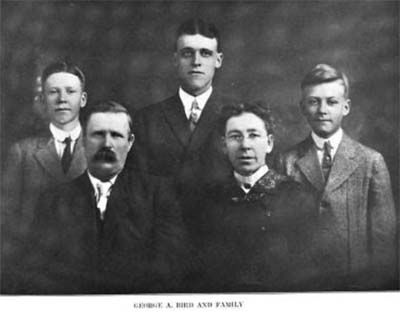 George A. Bird & family |
~*~
J. V. Blackford
J. V. Blackford, engaging successfully in
stock-raising, dairying and general farming upon two hundred and
seventy acres of land in Ingham township, was born in Green
county, Wisconsin, December 1, 1862. He is a son of William and
Jemima (Dennis) Blackford, natives of Pennsylvania, both of whom
have passed away. They were the parents of three children: J. V.,
of this review; Major, of Green county, Wisconsin; and Letty, the
wife of S. C. Atwood, of St. Helena, California.
J. V. Blackford began his independent career as a school-teacher,
engaging in this occupation from the time he was eighteen until
he was twenty-three. In 1886 he came to Franklin county, Iowa,
and here turned his attention to farming, operating rented land
for six years. At the end of that time be bought one hundred and
thirty acres in Ingham township, to which he has since added
until he owns two hundred and seventy acres. Sixty and one-half
acres lie inside .the city limits of Hampton, and this tract Mr.
Blackford operates as a dairy farm, keeping twenty-five milch
cows. His stock-raising interests are extensive and important and
his herds contain some very valuable animals including a yearling
Holstein bull, King Korndike Pontiac Segis, bred in New York and
worth three hundred dollars, and four Holsteins, bred in
Massachusetts and worth three hundred dollars apiece as
yearlings. Mr. Blackford follows always the most progressive and
practical methods in the conduct of his interests and has been
very successful, standing today among the leading farmers and
stock-raisers of his locality.
On the 25th of March, 1885, Mr. Blackford was united in marriage
to Miss Temperance McCammant, and. to this union were born two
children: Maude, the wife- of H. A. Missildine; and Hugh, at
home. Mr. Blackford is a member of the Christian church and is
independent in his political views, serving at the present time
as township clerk. He is a progressive and wide-awake
agriculturist, and his industry and enterprise have not only
enabled him to attain prosperity but have won him a high place in
the respect and confidence of his neighbors.
~*~
Samuel T. Blain
Samuel T. Blain occupies an attractive residence
in Hampton, where he has lived since retiring from active farm
life. He had devoted his energies and efforts for many years
previous to general agricultural pursuits, owning and cultivating
almost five hundred acres of land. Mr. Blain is a native of Ohio,
his birth having occurred in Muskingum county on the 24th of
April, 1853, his parents being John and, Mary (McCamett) Blain,
the former a native of Pennsylvania and the latter of Ohio. John
Blain made farming his life work and thus provided for his family
which numbered five children: Joseph, who is now living in
Chapin, Iowa; William, a resident of Oregon; Samuel, of this
review; John R., a resident farmer of Monroe, Wisconsin; and
Martha, the wife of V. J. Ward, of Plymouth, Iowa. Both parents
have now passed away, the father lying in May, 1909, after
surviving his wife for twenty-one years, her death having
occurred in March, 1888.
On leaving Ohio the family traveled by wagon. to Wisconsin,
Samuel T. Blain being then an infant. He was reared in the latter
state early became actively interested in farming and continued
to assist his father in the development and improvement of the
old home place until twenty-two years of age, when he started out
in life independently by renting land. He came to Franklin
county, Iowa, in 1880 and, two years later purchased one hundred
and twenty acres of land, to which he added from time to time as
his financial resources increased until he was the owner of four
hundred and ninety-five acres in West Fork and Ingham townships.
There he carried on general farming and stock-raising, both
branches of his business proving successful. He divided his farm
into fields of convenient size by well kept fences and the place
presented a neat and thrifty appearance, while good crops were
annually gathered and high grades of stock were found in the
pastures. In 1901 Mr. Blain retired from active farm life and
purchased a fine home in Hampton, which he now occupies, it being
his intention to spend his remaining days here in the enjoyment
of a well earned rest.
On the 11th of March, 1880, Mr. Blain was united in marriage to
Miss Pauline Eitel, a daughter of John G. and Magdalena (Fishes)
Eitel, who were natives of Germany and in 1848 came to America.
They settled in Wisconsin in 1852 and there both passed away. In
their family were seven children: Louis, of Palacios, Texas;
Mary, deceased; Robert, who is living in Marshall, Minnesota;
Mrs. Blain; Lena, the widow of B. W. White, of Hampton; John,
also living in Hampton; and Edward, who makes his home in
Hawkeye, Iowa. Mr. and Mrs. Blain have one child, Pearl Gertrude,
who is the wife of Frank Foughty, of Hampton, and they have two
children, Genevieve Opal and Blaine Blain. In his political views
Mr. Blain is a democrat but has never been an office seeker. He
holds membership with the Modern Woodmen of America, but he has
always preferred the quiet of home and business life to great
activity in other fields. Many sterling traits of character have
gained him high regard and made him widely known.
~*~
Benjamin F. Blake
Benjamin F. Blake, a well known farmer and
stock-raiser of Franklin county, was born on the property he now
rents, on section 27, Osceola township, March 25, 1877. He is a
son of Richard and Elizabeth (Parker) Blake, the former a native
of Iowa and the latter of Canada. The father engaged in the meat
business in Ackley during the early '70s and built up a large and
profitable enterprise. He later added to his activities by
following general farming and stock-raising upon one hundred and
sixty acres of land on section 27, Osceola township. He continued
active in the conduct of his .interests until his death, which
occurred in 1895, his wife surviving him until 1909. To their
union were born seven children: Molly, who married Charles M. C.
Woodland of Redfield, South Dakota; Gertrude, the wife of W. F.
Jacob of Ackley; Benjamin F., of this review; James, of Ackley;
Richard T., a resident of California; Joseph, of Ackley; and
Walter, who resides in Montana.
Benjamin F. Blake was reared upon his father's farm and acquired
his education in the district schools of Osceola township and in
the Academy at Ackley. He took up his father's work after the
latter's death and continued the same until the death of his
mother. which occurred in February, 1909. He then worked for the
estate for a year. In 1912 he rented the home farm, whereon he
has since engaged in general farming and stock-raising,
specializing in the breeding of hogs and horses. He has met with
excellent success and expects eventually to purchase the
homestead. He is today one of the leading representatives of
agricultural interests in his locality.
On the 28th of May, 19l2, Mr. Blake married Miss Julia Barry, a
native of Wright county, this state, and they have become the
parents of a daughter, Mary Elizabeth, born June 16, 1913. Mr.
Blake is a member of the Catholic church and holds membership in
the Knights of Columbus. He is independent in his political views
and served with credit and ability in the office of justice of
the peace. He is not, however, active as an office seeker, for he
prefers to concentrate his attention upon the conduct of his
business interests which, under his able management, are becoming
every day more extensive and important.
~*~
Richard Blake
Richard Blake, who follows general farming and
stock-raising on a fine property in Osceola township, was born on
this farm, May 23, 1856. For almost a quarter of a century he has
been connected with agricultural interests of this locality and
today holds a position in the front ranks of progressive and
successful farmers. He is a son of Richard T. and Sarah (Pickmer)
Blake, the former a native of Scotland and the latter of England.
The father came to America as a young man and, having previously
followed the sea, resumed that occupation as a sailor on the
Great Lakes. He came to Franklin county in 1852 and purchased
land on section 34, Osceola township accumulating eventually six
hundred and eighty acres. He passed away in 1900 and is survived
by his wife, who makes her home in Ackley. They had twelve
children: Louisa, the wife of A. B. Grant, of Iowa Falls; Jane;
Richard, of this review; Frank, a resident of Olympia,
Washington; George, deceased; John, residing in the state of
Washington; Alice, at home; Bessie, the wife of L. A. Hembd, of
Ackley; Katherine, who married D. W. Shroyer, of Hampton;
Charles; Sarah, the wife of William Humke, of Osceola township;
and Nettie, who married James Newell, of Marshalltown.
Richard Blake was reared at home and aided in the operation of
his father's farm until he was twenty-three years of age. He then
purchased a tract of one hundred and sixty acres in Osceola
township and for twenty years thereafter developed that property,
making it one of the productive and valuable farms in the
locality. When he disposed of it he purchased one hundred and
sixty acres of the old homestead and here he has since resided,
engaged in general farming and stock-raising. He follows always
the most progressive and practical methods in the conduct of his
business and his labors have brought excellent results.
On the 26th of September, 1882, Mr. Blake married Miss Christina
Rath, who passed away April 23, 1906, leaving two children:
Clara, the wife of Dr. Rosengren, of Ackley; and Frank T. Mr.
Blake is a member of the Presbyterian church, is connected
fraternally with the Modern Woodmen of America and gives his
political allegiance to the republican party. He is one of the
progressive and successful native sons of Osceola township and is
held in high esteem by the people among whom his entire life has
been spent.
~*~
Herbert E. Boehmler
Herbert E. Boehmler, an extensive landowner in
Franklin county and prominently connected with commercial
interests of Hampton as the proprietor of a large shoe store, was
born in Cedar Falls, Iowa, March 20, 1870, a son of George Henry
and Elizabeth (Segelman) Boehmler, natives of New York. The
parents were pioneers in Iowa and during the early years of their
residence here had to contend with all the struggles and
hardships of a frontier district. The father engaged in the
lumber and grain business in Cedar Falls, where he established
the first elevator. He and his wife became the parents of five
children: George, of Saskatchewan, Canada; Albert, claim adjuster
for the Chicago, Milwaukee & St. Paul Railroad at Cedar
Falls; Harry, engineer on the Illinois Central Railroad at
Waterloo; Carrie, the wife of J. P. Herman, of Des Moines; and
Herbert E., of this review.
Herbert E. Boehmler acquired his early education in the public
schools of Blackhawk county and afterward entered Iowa State
University, where he studied pharmacy. In 1890 he came to
Franklin county and for six years was connected with a Mr.
Baldwin in the drug business. At the end of that time he turned
his attention to the shoe business, purchasing the store which he
has since conducted. He carries a large and well assorted stock
and controls an important patronage, for his business methods are
at all times honorable and his integrity is beyond question. He
owns an attractive home in Hampton and has besides about one
thousand acres of farming land in Franklin county. His large
interests are all carefully and conservatively managed and have
brought him a gratifying degree of success.
On the 20th of March 1895, Mr. Boehmler was united in marriage to
Miss Ione O. Hutchins, and they have become the parents of three
children, Ronald, James and Gwendolyn. Mr. Boehmler is a member
of the Congregational church, is connected fraternally with the
Masonic order and the Knights of Pythias and gives his political
allegiance to the republican party. He is prominent in both
business and social circles and is today regarded as one of the
leading citizens of the community.
~*~
Samuel Bonewitz
Samuel Bonewitz, a progressive and successful
former of Osceola township, operating one hundred and sixty acres
on section 13, was born in Germany, September I7, 1866. He is a
son of John and Mary (Nerdig) Bonewitz, also natives of that
country. The father came to America in 1881 and located in Grundy
county, Iowa. In 1886 he returned to Germany and brought his wife
and children to the new world, this time locating in Franklin
county. He and his wife now make their home in Ackley. To them
were born four children: Samuel of this review; Elizabeth, the
wife of D. Fritzel, of Grundy county; Henry, of Floyd county; and
William, of Franklin county.
Samuel Bonewitz emigrated to America with the family in 1886,
coming directly to Franklin county, Iowa, His entire active life
has been devoted to agricultural pursuits and his knowledge and
experience have been the salient factors in his present success.
He is now renting the home farm of one hundred and sixty acres on
section Osceola township, and carries forward the work of its
development and improvement along practical and modern lines, the
result of his efforts being seen in its excellent condition.
On the 8th of February, 1893, Mr. Bonewitz was united in marriage
to Miss Anna Schnell, a native of Benton county, Iowa, who died
November 14, 1966, leaving five children: Emma Margaret born
November 25, 1893; Katherine Elizabeth, born March 24, 1897;
Marie Louise, born December 15, 1899; Henry W., born April 9,
1902; and John A., born November 3, 1906.
Mr. Bonewitz is a member of the St. John’s Evangelical
church, and gives his political allegiance to the democratic
party. He has rendered the township excellent service as school
director and is at all times progressive and public-spirited in
matters of citizenship, cooperating in all projects for the
betterment of the community. During the period of his residence
here he has won the warm regard and friendship of his neighbors.
~*~
George Booth
Hampton has many retired farmers, for the rich
prairie land of Iowa offers splendid opportunities to the
enterprising, persistent and industrious agriculturist. The man
who has those qualities has every reason to believe that his
labors will be crowned with success, for the alluvial soil yields
excellent returns and the farmer whose efforts are intelligently
directed may always hope to have a period of rest in his later
years, in which to enjoy the fruits of his former toil. Such has
been the record of George Booth, now a well known resident of
Hampton, who was born in England March 11, 1850, a son of William
and Sarah (Ines) Booth, both of whom were natives of England,
where their entire lives were passed. They had a family of seven
children: Lucy, still living in England; George; Anna, Elizabeth,
John and Polly, all residents of England; and Fannie, who was a
twin sister of John and is now deceased.
George Booth spent the period of his boyhood and youth in his
native country and acquired his education there in the public
schools. In 1871 he crossed the Atlantic to the new world with
Lafayette county, Wisconsin, as his destination and there he
engaged in farming, remaining in that state for twelve years. In
1883 he came to Iowa and purchased a quarter section of land in
Franklin county, to which he afterward added one hundred and
twenty acres. He still owns an excellent farm in Hamilton
township but in 1908 retired to Hampton, where he has recently
erected a modern residence-a two story house at the corner of
Franklin and Ninth streets. While upon the farm his work was most
carefully managed and his fields showed the result of intelligent
cultivation and of unfaltering enterprise. His land was divided
by well kept fences, substantial barns and outbuildings sheltered
good grades of stock and improved modern machinery facilitated
the work of the fields.
Mr. Booth was married in 1879 to Miss Sarah Huntington, a native
of England and to them were born four children: Jennie, who is
now the wife of Edward Simmons a resident farmer of Hamilton
township, occupying the old homestead; Freddy, who died at the
age of one year; Guy, who is living on his father's farm of a
quarter section; and Lester deceased. The religious faith of the
family is that of the Methodist church, and Mr. Booth gives his
political support to the republican party. He has served as
school director but has never sought nor desired public office,
preferring to concentrate his energies and attention upon his
business interests which, capably managed, have brought to him
substantial returns. He has never had occasion to regret his
determination to come to the new world, for here he found the
opportunities which he sought and in their improvement has gained
a place among the substantial citizens of the community. He has
many attractive social qualities which have gained him warm
friends, and he deserves to be ranked among the representative
citizens of the community.
~*~
Guy Booth
One of Franklin county's most progressive and
successful native sons is Guy Booth, now operating a farm of one
hundred and sixty acres in Hamilton township in which township he
was born August 30, 1885. He is a son. of George Booth, of whom
further mention is made elsewhere in this work.
Guy Booth acquired his education in the district schools of
Hamilton township and spent one winter studying in Iowa Falls.
His entire life has been spent upon the homestead and this
property he operates renting the same from his father. He engages
in general farming, and because his methods are always practical
and progressive he has met with a gratifying measure of success.
On the 24th of February, 1909, Mr. Booth married Miss Ellen M.
Stinson, a native of Franklin county, and they have become the
parents of a son, Dwight Harold, born February 8, 1912. Mr. Booth
is connected fraternally with the Modern Woodmen of America and
is an attendant of the Methodist church. His political support is
given to the republican party, and he is now serving as school
director in a creditable and able manner. He is a young man of
energy, ambition and enterprise, and his continued success is
assured.
~*~
James W. Boots
One of the fine homes on Bridge street in Hampton
is that occupied by James W. Boots, a retired farmer, who for
many years has been actively identified with agricultural
interests in Franklin county, where he still owns a valuable and
productive farm of four hundred and ten acres, on which he is
extensively engaged in stock-raising, especially the breeding of
fine horses. He was born in Delaware county, Indiana, March 19,
1851, and is a son of Martin and Rebecca (Jones) Boots, the
former a native of Ohio and the latter of West Virginia. The
father was a farmer by occupation and in 1855 came to Iowa,
settling in Franklin county, where he carried on general
agricultural pursuits for a number of years. His wife died upon
the home farm June 1, 1892, after which Mr. Boots established his
home in Geneva, where he died in 1906. In their family were eight
children: Rhoda, deceased; William, a retired farmer living in
Hampton; Martha Jane, the wife of Miles Birkett, of Luverne,
Minnesota; James W.; Mary Elizabeth, the wife of Simon Long, of
Luverne, Minnesota; John M., living in Dumont, Iowa; Malena, the
wife of James Burlingame, of Luverne; and Simeon J., a retired
farmer residing in Hampton.
James W. Boots was but four years of age when brought to Iowa by
his parents, where he spent his youthful days. He is indebted to
the public school system for the educational privileges which he
enjoyed. He remained upon the home farm until he had attained his
majority and then started out in life for himself, choosing as
his life work the occupation to which he had been reared. He now
has four hundred and ten acres in Franklin county and also an
attractive residence on Bridge street in Hampton. His land is
naturally rich and productive, and his farm is one of the well
developed properties of the district, producing splendid crops of
corn and other, cereals. Mr. Boots takes great interest in
blooded horses and has an imported registered coach, Constant,
ten years old. He also has an interest in a Chelperie percheron.
He makes a specialty of breeding and raising fine horses and is
regarded as one of the leading stockmen of the county. His
business has assumed large proportions, and his financial returns
make him one of the substantial citizens of this part of the
state.
On the 4th of April, 1887, Mr. Boots was united in marriage to
Miss Helen Lower and they became the parents of three children:
Vivian Mozelle, a teacher in the public schools, living at home;
Mildred Clare, who died in childhood; and James Milford, a
high-school pupil.
Politically Mr. Boots is a republican, well informed on the
questions and issues of the day and thus able to support his
position by intelligent argument. He has been township trustee
for twenty years and has capably filled other township offices,
the duties of which he discharged with promptness and fidelity.
His fraternal relations are with the Independent Order of Odd
Fellows. Practically a life-long resident of this county, he
possesses the spirit of enterprise and progress characteristic of
the middle west and throughout his entire life has brooked no
obstacles that could be overcome by persistent, earnest and
honorable effort, and thus it is that he has worked his way
steadily upward to success.
~*~
Aeilt Brass
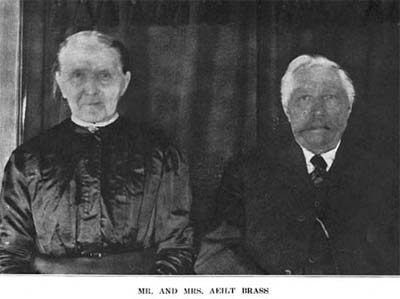
Mr. & Mrs. Aeilt Brass
Aeilt Brass is now living in retirement in Bradford, this county,
after having been for many years influentially identified with
agricultural and stock-raising interests. He was born in Germany,
March 30, 1848, and is a son of W.E. and Hilka (Joesten) Brass,
natives of Germany, where the father passed away. The mother came
to America in 1878 and located in Ogle county, Illinois, whence
in 1880 she moved to Iowa. She located in Butler county, this
state, and later removed to Grundy county, where her death
occurred October 26, 1881. In this family were seven children:
Klaas, deceased; Ehme, of Ogle county, Illinois; Aeilt, of this
review; John also residing in Ogle county; Siebentia, the wife of
Isaac Harkan, of Butler county, Iowa; W.E., who makes his home in
Missouri; and Hilka, the wife of John Roos, of Ogle county,
Illinois.
Mr. Brass remained in Germany until 1880 and then emigrated to
America, locating in Grundy county, where he remained for seven
years. At the end of that time he moved to Hardin county and
thence after two years to Franklin county. He located in Grant
township and bought a quarter section of land here. He afterward
added another quarter of secton 17, Grant township, and upon this
property carried on general farming and stock-raising for many
years, meeting with gratifying and well deserved success as a
result of his practical methods and careful supervision of his
interests. He acquired a comfortable competency and in 1912
retired from active life, moving into Bradford, where he erected
the modern home in which he now resides.
On May 5, 1875, Mr. Brass was united in marriage to Miss Waltje
Arends, a native of Germany, and they have become the parents of
seven children: Wiard, of Kossuth county, Iowa; Frederick, living
near Buffalo Center, Iowa; Klaas, of Grant township; Elizabeth,
the wife of Charles A. Duit, of Grant township; Ehme, of Buffalo
Center; Eppe, of Grant township; and John, also residing in Grant
township.
Mr. Brass is a member of the Evangelical church and gives his
political allegiance to the democratic party. He has been active
in public affairs and has held a number of local offices, serving
as justice of the peace and also as road supervisor. His life has
always been in keeping with high standards, and he justly
deserves the full measure of confidence and respect now
entertained for him by all who know him.
~*~
Andrew F. Brown / aka Anders Fredrick Brunn
Denmark has long been celebrated as one of the
foremost agricultural countries of Europe, and many of its
citizens who have come to America have made a success at this
vocation in the United States. Among these is Andrew F. Brown,
or, as he spelled his name in Danish, Anders Fredrick Brunn, who
owns two hundred and forty acres of valuable land on sections 10
and 11, Morgan township, Franklin county. Mr. Brown was born in
Denmark, November 5, 1857, and is a son of Eller and Maria Brunn,
who were born in Denmark and both of whom are deceased. They had
eight children: Lars and Mary, who have passed away; Hannah, of
Denmark; Martin and Nicolai, deceased; Dorothy, of Denmark; Lena,
who has also passed away; and Andrew F., of this review.
The last named attended school in his native country and at the
early age of sixteen began to farm for himself. He was so
occupied for two years but then took up the miller's trade, in
which occupation he was active for about seven years. Previous to
this period in his career he had for four months served in -the
Danish army. In 1881, when about twenty-four years of age, he
came to America, locating at first in Illinois, where he farmed
for one year. He then found a position in a wire factory,
continuing in that employment for sixteen months, and subsequent
to that period made his way to Hampton, Iowa, again turning his
attention to farming. In 1891 he acquired title to one hundred
and twenty acres of land on sections 10 and 11, Morgan township,
and he was so successful in the cultivation of this tract that he
gradually has been enabled to add to it until he now owns two
hundred and forty acres. All of this land is under high
cultivation, planted to cereals most suitable for soil and
climate. Mr. Brown engages in general farming, giving some
attention to stock-raising. His improvements are excellent and
his buildings in good repair, the appearance of his farm
attesting the prosperity of its owner.
On May 7, 1881, was celebrated the marriage of Andrew F. Brown
and Anna Bohl, a daughter of Hans Peter and Martha Bohl, natives
of Denmark. However, the family was of German origin. Both
parents have passed away. They had seven children: Christina,
deceased; Mrs. Anna Brown; Matilda, of Denmark; Peter P., of
Albert Lea, Minnesota; Hans P., of Oregon; a son who died in
infancy;. and Matt, of Buffalo Center, Iowa. Mr. and Mrs. Andrew
F. Brown had two children: Henry Christian, at home; and Elfreda
Matilda, deceased. The former married Miss Lorena Lackey on June
12, l912, and they have a daughter, Lucille Elfreda. Mr. and Mrs.
Andrew F. Brown also adopted a daughter, Sarah L. M., who is
seventeen years of age.
Andrew F. Brown votes for the republican party and for three
years served as school director of his district. He is a member
of the Lutheran church and has always taken a deep interest in
this organizations Mr. Brown has become a valuable American
citizen and by his labors has contributed toward making Franklin
county one of the richest agricultural districts in Iowa.
~*~
Fred Bruns
Fred Bruns, who owns and operates two hundred
acres of excellent land on section 24, Marion township, was born
in Cook county, Illinois, May 16, 1866. . He is a son of Henry
and Philopena (Gusewelle) Bruns, natives of Germany, who came to
America in 1865 and located in Cook county, Illinois. In 1878
they removed to Franklin county, this state, where the father
engaged in farming until he retired from active life. He now
makes his home with the subject of this review, having survived
his wife, since November 4, 1894. Six children were born to them:
Sophie, deceased; Fred, of this review; Herman Louisa, the wife
of Fred Vahleing, of Marion township; Lena, twin sister of
Louisa, deceased; and August, also deceased.
Fred Bruns came to Franklin county with his parents in 1878 and
he grew to manhood on his father's farm. At the age of
twenty-nine he assumed charge of the homestead which he has since
purchased. He now owns two hundred acres of land on section 24,
Marion township, and has improved it with excellent buildings and
modern equipment, making it one of the model farms of the
locality.
On the 19th of April, 1895, Mr. Bruns married Miss Lena Dohrman,
a daughter of D. and Sophia Dohrman. Mr. and Mrs. Bruns are the
parents of -six children: Ida, whose birth occurred June 16,
1897; William H., who was born July 3, 1898; Anna, whose birth
occurred December 27, 1901; Fred H., born June 4, 1905; Eddie,
born January 15, 1909; and Meta, born September 5, 1912.
Mr. Bruns is a member of the Evangelical church and a republican
in his political beliefs. He stands high in business and social
circles and his long residence here has made him well known
throughout the county.
~*~
William B. Bryan
William B. Bryan a retired farmer living in
Hampton, after many years of close connection with agricultural
interests of Franklin county, was born in George county, Ohio,
July 10, 1837. He is a son of Abraham and Polly (Beardsley)
Bryan, the former a native of New York and the latter of Ohio. In
1870 the parents moved to Franklin county and located in Geneva
township, where the father engaged in farming until his death in
1873. His wife has also passed away. To their union were born
seven children: Orlando; Harrison; Albert; William B., of this
review; George; Mary, a resident of Hampton; and Ann, the widow
of Donald Miller, of Minneapolis, Minnesota.
During the entire period. of his active life William Bryan has
engaged in agricultural pursuits. He acquired valuable land
holdings in Franklin county, accumulating four hundred and thirty
three acres of valuable land which he has since sold. The years
brought him a gratifying degree of success in the conduct of his
farming and stock-raising interests, and eventually he retired
from active life, moving into Hampton, where he has since
resided. He occupies a fine home on Second street and is well and
favorably known in the city.
On the 25th of December, 1866, Mr. Bryan was united in marriage
to Miss Susan Townsend, a native of Illinois and they became the
parents of nine children: George Sherman, a farmer of Allamakee
county, Harry H., deceased; Ernest T., residing in Emmet county;
Ray S., who also resides in Emmet county, Iowa; Wayne, who died
in infancy; Mary Winona, at home; Irving, a resident of Emmet
county; Olive, the wife of C. Sharpe of Hampton; and Earl H., at
home.
Mr. Bryan is a veteran of the Civil war, having enlisted in
Company H, Ninety-sixth Illinois Volunteer Infantry on the 15th
of August, 1862. He served three years and during that time took.
part in various important engagements, receiving three wounds at
the battle of Lookout Mountain. He was mustered out at Nashville,
Tennessee, and received his honorable discharge at Chicago,
Illinois, on the 25th of July, 1865.
He belongs to the Grand Army of the Republic, is a member of the
Baptist church and gives his political allegiance to the
republican party. He has held various positions of public trust
and responsibility and was for nine years president of the board
of Geneva township. He is a man whose industry, ability and
integrity have won for him the prosperity which he enjoys today
and have placed him in the foremost rank as a representative
citizen of the community.
~*~
Ervin Buge
Ervin Buge belongs to the younger generation of
successful agriculturists of Franklin county. He cultivates an
attractive farm of eighty acres, which is nicely improved and
speaks well for his ability and progressiveness. Mr. Buge is a
native son of this county and was born October 31, 1884. His
parents were August and Caroline (Guds) Buge, natives of Germany,
both of' whom came in their youth to America. They were married
in Eldorado, Wisconsin, and resided there for five years before
making their way to Franklin county in October, 1875. They
located on section 13, Morgan township, where the father acquired
eighty acres of land. In 1908 he turned over this property to our
subject. They were the parents of ten children: Otto, of Morgan
township; Amelia, who married Ernst Gaulke, of Morgan township;
Albert, of Coulter; Matilda, the wife of Albert Korth, of Morgan
township; Ida, who married William Bush, of Hampton; Hulda,
deceased; Helena, the wife of H. Stethorn, of Hampton; Louisa,
who married H. McAllister, of Morgan township; Ervin, our
subject; and John, deceased.
Ervin Buge was reared upon the farm which he now owns and in the
acquirement of his education attended the schools of that
neighborhood. As soon as old enough he began to participate in
farm labor, assisting his father, and in 1908 the latter deeded
the home farm to him. It comprises eighty acres and is in a high
state of cultivation. Mr. Buge devotes himself to general farming
and has been very successful along that line, employing the most
modern methods. He is systematic in his work and ever ready to
embrace new ideas. He is a member of the Evangelical church, in
the work of which he takes a laudable interest. Mr. Buge is
popular among the younger people in Morgan township and is highly
esteemed by all who know him because of his high qualities of
mind and character.
~*~
William R. Bunker
William R. Bunker has spent practically his
entire life in Franklin county and for a number of years past has
been connected with agricultural interests as the owner of a fine
farm of two hundred and forty acres on sections 17 and 18, Geneva
township. He was born in New York, December 23, 1860, and is a
son of William and Carrie (Place) Bunker, the former of whom was
killed in the Civil war.
William R. Bunker came to Franklin county when he was two years
of age and has been a resident of this locality since that time.
Since the beginning of his active career he has been connected
with agricultural pursuits and has accumulated valuable landed
holdings, owning two hundred and forty acres of excellent land on
sections 17 and 18, Geneva township. This property he has greatly
improved, providing it with substantial buildings and modern
machinery and neglecting nothing which would add to its
appearance or value. He engages in general farming and
stock-raising and has met with gratifying and well deserved
success.
Mr. Bunker married Miss Benson and they have become the parents
of three children: Alida May, the wife of A. M. Royer, of
Janesville, Iowa; and Frank E. and Floyd R., both of Franklin
county. Mr. Bunker gives his political allegiance to the
republican party but is not active in public affairs, preferring
to concentrate his energies upon his farming interests, which
under his able management have become extensive and lucrative.
~*~
Henry Burmester
Since 1876 Henry Burmester has been closely
connected with agricultural interests of Franklin county and is
now the owner of three quarter sections of land in Mott township.
He was born in Germany, November 4, 1836, and is a son of Henry
and Marguerite (Hartman) Burmester, the former of whom died in
Germany.
Henry Burmester came to America in 1869 and located in Chapin,
Iowa, where for five years he engaged in railroad work. At the
end of that time he moved from the town, and in 1876 he bought a
quarter section of land in partnership with his step-son. His
holdings increased steadily throughout the years which followed,
and he owns today three quarter sections, all well improved and
in excellent condition, reflecting the care and supervision he
has bestowed upon his property. Mr. Burmester follows always the
most practical and progressive methods in the conduct of his
interests, with the result that he is now one of the successful'
and representative farmers of his locality.
Mr. Burmester married Mrs. Anna (Meyer) Gade and they became the
parents of three children: Will; Anna; and an infant, who passed
away in Germany. Mr. Burmester's first wife died in 1882 and in
1883 he wedded Miss Annie Schrader, by whom he had seven
children: Henry and August, at home; Elizabeth, deceased; Emma;
Magdalena; Wilhelmine; and Esther, who has passed away.
Mr. Burmester is a member of the Lutheran church and gives his
political allegiance to the republican party. He has served as
road supervisor and is always interested and active in the
promotion of movements for the general welfare. Throughout a
period of residence in Mott township covering thirty-seven years
he has made many valuable contributions to agricultural
development and has become widely known not only as a successful
farmer but also as a public-spirited and useful citizen.
~*~
Joseph G. Bushyager
Joseph G. Bushyager, who has lived in Franklin
county for more than a half century, is known as one of its
oldest settlers and as one of the few remaining veterans of the
great Civil war. He devoted his attention to general agricultural
pursuits throughout his active business career but during the
past six years has lived retired in Sheffield. His birth occurred
in Pittsburgh, Pennsylvania, on the 30th of August, 1842. His
father, Henry Bushyager, a native of Pennsylvania and a carpenter
by trade, came to Iowa in 1856, settling first in Dubuque and
three years later at Shell Rock, Butler county. In the spring of
1860 he purchased eighty acres of wild land on section 18, West
Fork township (then known as Ingham township), .Franklin county.
He hauled the lumber for his first house from Cedar Falls and
here continued to reside throughout the remainder of his life,
passing away on the 22d of December, 1881. Henry Bushyager was
one of the early trustees of the township and subsequently was
made a member of the county board of supervisors. In Pittsburgh
he had wedded Miss Jane Winters, who died in that city in 1850.
To them were born nine children, five of whom died in infancy.
Martha gave her hand in marriage to Frederick Meyers, an early
settler and old soldier of Franklin county, whose home was
formerly in West Fork township. Mrs. Meyers is now deceased and
her husband makes his home in Kansas. Mary, twin sister of
Martha, became the wife of Captain John Boyd, a soldier of the
Civil war. Pennsylvania remained their home until the time of
their demise. Sarah was the wife of Andrew Dorsey, who also
participated in the Civil war. Both Mr. and Mrs. Dorsey, who
lived in Pittsburgh, have passed away.
Joseph G. Bushyager spent his boyhood in the city of his nativity
and attended the common schools in the acquirement of an
education. After putting aside his textbooks he worked at farm
labor until 186o, when he came to Iowa and joined his father in
Franklin county. His first crop in this state was cut with a
cradle and scythe. In December, 1863, Mr. Bushyager enlisted for
service in the Civil war as a private of Company H, Thirty-second
Iowa Volunteer Infantry. He took part in a skirmish at Fort De
Russy and also in the engagement at Pleasant Hill, on the 4th of
April, 1864, which was the last battle of the Red River raid.
Becoming ill, he was confined in hospitals at Vicksburg,
Jefferson Barracks and at Keokuk, Iowa. In the spring of 1865 he
received an honorable discharge and returned to the farm in West
Fork township. He inherited from his father the old home place of
one hundred and five acres and later purchased an additional
tract of eighty acres in West Fork township as well as a quarter
section of land in Ross township. In the conduct of his general
farming interests he met with excellent success, annually
gathering bounteous crops, which found a ready sale on the
market. In 1907 he put aside the active work of the fields and
took up his abode in Sheffield, where he is now spending the
evening of life in honorable retirement.
In April, 1867, Mr. Bushyager was joined in wedlock to Miss Mary
Leidig, who was born in Pennsylvania on the 18th of October,
1849, her parents being George and Mary (Bushyager) Leidig, the
father a native of Ohio and the mother of Pennsylvania. They came
to Iowa in 1855, settling first in Jackson county, while in 1863
they took up their abode in Clinton township, Franklin county. To
Mr. and Mrs. Bushyager have been born nine children, as follows:
Janette B., who is the wife of William Bell and resides in
Missouri; George L., who wedded Miss Myrtle Scott and resides in
Colorado; Henry B., who makes his home in Chicago; Mary E., who
is a teacher by profession and lives at home; Lucia L., who was
the wife of Lemuel M. Bowman, of Chicago, and died in July, 1913;
Matilda Jane, who gave her hand in marriage to Henry Liekwig, of
Sheffield; Alvin J., residing on the old home farm; Zillah, who
is the wife of Robert Meyer, of West Fork township; and one, who
died in infancy.
Mr. Bushyager exercises his right of franchise in support of the
men and measures of the democracy, believing firmly in the
principles of that party. He served as a school director for many
years. His religious faith is indicated by his membership in the
Methodist Episcopal church, to which his wife also belongs. He
has witnessed the marvelous transformation that has here occurred
as pioneer conditions have given way before the onward march of
civilization, and his memory forms a connecting link between the
primitive past and the progressive present. His record cannot
fail to prove of interest to many of our readers, for he has an
extensive circle of friends and acquaintances throughout the
community.
~*~
Dennis F. Butler
Dennis F. Butler, who since 1885 has owned and
operated a fine farm of eighty acres on section 4, Ingham
township, and who has also another farm of similar extent in West
Fork township, was born in Green county, Wisconsin, September 16,
1867. He is a son of Samuel Butler, of whom further mention is
made elsewhere in this work.
Dennis F. Butler was reared upon the family homestead in Ingham
township and acquired his education in the district schools. In
1885 he purchased eighty acres of land on section 4, Ingham
township, and since that time has cultivated and improved this
property with the result that it is today an attractive and
valuable farm. He has in addition another eighty acre tract in
West Fork township and engages in general farming, his practical
methods bringing him a gratifying and well deserved success.
On the 24th of September, 1899, Mr. Butler was united in marriage
to Miss Cora Ella Esshieger, a native of Franklin county, and
they have become, the parents of five children: Elsie, who was
born May 3, 1902; Viola, born November 27, 1903; Virgil, born
September 11, 1908; and Wilma and Wilson, twins, born 'May 19,
1913.
Mrs. Butler is a member of the Evangelical church. Mr. Butler
gives his political allegiance to the democratic party. His life
has been a busy and useful one and his success is indicated in
the fact of his ownership of one of the valuable farming
properties of the community.
~*~
Samuel Butler
Samuel Butler, a valued and representative
citizen of Hampton, living retired after a period of connection
with agricultural interests of Franklin county dating from 1869,
was born in Muskingum county, Ohio, August 9, 1842. He is a son
of John and Ann .(McCammant) Butler, natives of Pennsylvania, who
came to Iowa about 1875, locating at West Union. The father was a
Baptist minister and also engaged in farming. He died in Kansas,
and his wife passed away in Oklahoma. To their union were born
eight children: Lewis, who died in the army during the Civil war;
Samuel, of this review; Thomas, who has passed away; Rebecca
Jane, the widow of F. Reddinger, of Sealy, Oklahoma; John, a
resident of Jennings, Kansas; Sarah, the wife of Wilmer Seers, of
Missouri; George, of Monroe, Wisconsin; and Zeblin, of Downs,
Kansas.
Samuel Butler's entire active life was given over to agricultural
pursuits. When he was twenty-three years of age he began farming
in Green county, Wisconsin, and there remained for several years.
In the spring of 1869 he came to Franklin county, this state,
locating in Ingham township, where he purchased one hundred and
six and two-thirds acres of land. To this he afterward added from
time to time, his property holdings finally comprising three
hundred and twenty-seven acres. This place he operated for
thirty-two years thereafter, steadily carrying forward the work
of its cultivation and developing it into a valuable and
productive farm. He continued active in its operation until 1901,
when he bought five acres in the northeastern part of the
corporation of Hampton and upon this property erected the
comfortable modern home in which he is now spending his retired
life.
On the 1st of December, 1864, Mr. Butler was united in marriage
to Miss Nancy E. Bailey, a native of Wisconsin, and they have
become the parents of eight children: Annie, the wife of John
Eitle, of Hampton; Dennis Franklin, a farmer in Ingham township;
Isabelle, the wife of A. C. Woodland, also of Ingham township;
Angeline, deceased; Lloyd, of Denver, Iowa; Edith, the wife of L.
E. Rosen, a farmer in Ingham township; Roy, who has passed away;
and Clifford, operating the old homestead. Mr. Butler is a member
of the Baptist church and gives his political allegiance to the
democratic party. He stands high in the esteem of his fellow
citizens, and the success that has come to him is but the just
reward of his own earnest and persistent efforts.
~*~
Henry Buzzell
Since 1890 Henry Buzzell has been prominently
connected with agricultural interests of Franklin county and has
made substantial contributions to general development and
progress through his intelligent management of his fine farm of
two hundred and forty acres on sections 25 and 26, Lee township.
He was born in Cook county, Illinois, June 1, 1852, and is a son
of Daniel P. and Lucina (Henry) Buzzell, the former a native of
Montpelier, Vermont,.born June 27, 1821, and the latter of New
York.. In December, 1852, they removed from Cook county,
Illinois, to De Kalb county, that state, where Daniel P. Buzzell
purchased a farm of eighty acres and continued to reside until
his death, which occurred May 1, 1886. His wife was called to her
final rest on the 29th of March, 1889. To them were born ten
children: Lydia, the deceased wife of A. Cook, of Saratoga,
California; Nathaniel, who has passed away; Henry, of this
review; George, deceased; Orin, of Sycamore, Illinois; Mary, the
wife of Samuel J. Mason, of Iowa Falls; Ira, of Tracy, Minnesota;
Otis, a resident of Sycamore, Illinois; Lottie, of Iowa Falls,
and Ada, the wife of George Bunk, of Hardin county.
Henry Buzzell remained with his parents until he was twenty-five
years of age and then removed from De Kalb county to Kane county,
Illinois, where he remained for one year. At the end of that time
he went to Boone county, Illinois, and after another year
returned to Kane county, where he spent two years. He made his
first purchase of land in 1879, buying eighty acres in Kane
county, Illinois, whereon he resided for two years. In 1881 he
bought one hundred and thirty acres in Boone county, Illinois,
where he resided for nine years or until 1890, when he came to
Franklin county and purchased two hundred and forty acres on
sections 25 and 26, Lee township. Upon this property he has
practically resided since that time with the exception of two
years, from 1892 until 1894, when he returned to De Kalb county
to operate and dispose of his father's homestead. He has steadily
carried forward the work of improvement and cultivation, adding
to his buildings and equipment whenever necessary and making the
farm one of the finest in this locality. In addition to the work
of the fields, he also raises and feeds stock and his interests
along this line are extensive and important.
In January, 1877, Mr. Buzzell married Miss Emily Hawley, a native
of Wisconsin and a daughter of Theodore S. and Sarah (Cramp)
Hawley, the former a native of New York state, born July 4, 1815,
and the latter born in England, March 20, 1826. Mr. Hawley died
in Kane county, Illinois, in 1900, and his wife in May, 1907. Mr.
and Mrs. Buzzell became the parents of five children: Cora, Arvin
and Menzo, deceased; Harry, who was born in Boone county,
Illinois, April 29, 1888, and is at home; and Susie Pearl, the
wife of Louis Newton, a resident of Lee township.
Mr. Buzzell is a thirty-second degree Scottish Rite Mason, being
a member of Masons Home Lodge, No. 192, A. F. & A. M., of
Iowa Falls, and Des Moines Consistory, No. 3, S. P. R. S. He is
also a member of the Modern Woodmen of America and gives his
political allegiance to the republican party, serving at the
present time as township trustee. The course which he has
followed throughout the, period of his residence in Franklin
county commends him to the confidence and good-will of all and he
has an extensive and representative circle of friends. ~*~
This page was last
modified on July 17, 2012
©2012 by IAGenWeb & the various submitters.