|
||||||||
|
|||||||||
Added Ancestry 4/3/2023
[rev. 24 Dec 2008]
DAVID TRIMBLE son of John TRIMBLE
b. abt. 1720 ?Scotland
d. 1799 Bourbon Co, KY
md. btw. 1743-6 Augusta Co, VA
MARY HOUSTON
b. abt. 1725
children:
James TRIMBLE, b. 02 Aug 1747 in Valley of Virginia, Augusta,
Virginia; d. 26 Jun 1815 in Montgomery Co., KY; md. Jane YOUNG 29 Mar 1773 in Augusta Co., VA; d. Unknown.
Thomas TRIMBLE, b. Abt. 1748; d. Bet. 1785 - 1848; md. Abigail GATLIFF Nov 1785 in Greenbrier Co., VA (now WV); d. Bef. 1865.
Nancy TRIMBLE, b. Abt. 1749; d. Bef. 1849; md. Mr. KING; d. Unknown.
John TRIMBLE, b. Abt. 1750; d. 1803; md. Margaret; d. Unknown.
Isaac TRIMBLE, b. 1752 in VA; d. 1816 in Bourbon Co., KY; md. Mary GRAHAM 14 Jun 1787 in Rockbridge Co., VA; d. Unknown.
Mary TRIMBLE, b. 1754; d. Bef. 1854; md. John MCKINNEY 20 September 1785 in Augusta Co., VA; d. Aft. 1820 in Bourbon Co., KY?.
George TRIMBLE, b. 01 Jan 1756 in Augusta Co., VA; d. 14 Dec 1814 in Bourbon Co., KY; md. Jean ARMSTRONG 02 Oct 1792 in Augusta Co., VA; b. 25 Oct 1763 in Augusta Co., VA; d. 26 Aug 1839 in Orange Co., IN.
William TRIMBLE, b. Abt. 1760 in Augusta Co., VA; d. 06 Jun 1840 in Pulaski Co., KY; md. Mary FLEMING 19 Apr 1787 in Greenbrier Co., VA (now WV); b. 14 Apr 1767 in Greenbriar Co., VA; d. Bef. 1872.
David TRIMBLE, b. 1760 in Amherst Co., VA; d. 1828 in Mt. Sterling, Montgomery, KY; md. Lucy LACY 28 Aug 1781 in Alderson, Monroe, (W)VA.
Elizabeth TRIMBLE, b. 1769; d. 1843 in Madison Co., OH; md. Forgus GRAHAM 13 Mar 1787 in Augusta Co., VA; b. 1767 in Rockbridge Co., VA; d. 1836 in Madison Co., OH.
*****
Will of David Trimble
6 September 1798 Bourbon County, Kentucky
In the Name of God Amen. I David Trimble of Bourbon County and state of Kentucky, being in perfect health & sound of judgement and mind and memory and taking into consideration the mortality of man that it is ordained for all men once to die, I do make appoint and ratify this to be my last will and Testament and do hereby disannul and make void all other wills and testaments or testomoneys and legaseas made by me heretofore. That is to say, I first commit my soul to God who gave it my body to be entered in a decent manner at the discretion of my executors hearafter mentioned nothing doubting but I shall receive the same at the last day on the day of judgement when Christ shall call the slumbering to life, and as touching [unreadable]. I design and in the following manner: First, I desire my just debts to be paid out of my estate, first I Give and bequeath to my son George Trimble the plantion or tract of land whereon I now live containing one hundred and two acres to him his heirs executors administrators or assigns forever, only George Trimble shall pay unto my daughter Nancy King her just sum of thirty five pounds good and lawful money of the afforsaid state as her share out of said tract of one hundred and two acres, to be for her use and at her disposal forever. And I give and bequeath to my son Isaac Trimble Son David my sorrel mare to them their heirs forever. Also I give and bequeath to each of my Children, to wit, James, John, and Nancy King to the heirs of James Elliott Deceased, Thomas, David, William George, John McKinney, Isaac and Forgus Grayham, the just and full sum of six shillings good and lawful money of Kentucky to them theirs heirs forever.Also concerning all the money that may be left of mine at my death if any there be, all to be equally divided between my daughter Nancy King and my son William and George Trimble, John McKinney, Isaac Trimble and Also to Fargus Graham to be theirs and at their disposal forever. Furthermore I give and bequeath to my three daughters to wit, Nancy King, Polly McKinney and Betsy Graham, my bed and bedclothing to be divided as follows to wit, Nancy to have all the furniture, that is to say, a pair of double blankets, a single blanket, two sheets, a bolster and pillow, to my daughter Polly McKinney my big rug, to my daughter Betsy Graham my bed and pewter tankered and to be theirs and theirs assigns forever. After the will management of all my affairs and due performance this my last will and testament, I do hereby ordain consitute and appoint James Denneson and James Fraysor to be my whole and sole Executors in law to have this my last will and testament well and truly Executed. In Witness of this my last will and testamony I hereunto see my seal this sixth day of September one thousand seven hundred and ninety eight.
Acknowledged by the said David Trimble as his last will and Testament who at he time of signing here of appeared to us to be of sound mind and perfect memory. Done in our presence and in the presence of each other. David Trimble.
Witnesses: John Boyd, John
Chambers, William Walsh, John McKinney
[rev. 4 Jan 2009]
JOHN TRIMBLE pos. son of David TRIMBLE and Mary HOUSTON
b. abt. 1740 ?of Owl Creek, Highland Co, VA
d. 1802 Mt. Savage, Allegany Co, MD
md. abt. 1764 ?Augusta Co, VA
MARGARET ?ARNOLD ?dau of John ARNOLD and Margaret _____
b. abt. 1745
d. prob. abt. 1820 Allegany Co, MD
children:
Charlotte b. 25 Feb 1765 d. 1 May 1844 md. William SHAW
Henry b. abt 1767 d. aft 1836 md. Margaret SCRITCHFIELD
John b. abt 1769 d. abt Oct 1824 md. Elizabeth ARNOLD
Margaret b. abt 1770 d. 11 Jan 1859 md. John COMBS
Abigail b. abt 1771 d. btw 1830-40 md. Cuthbert COMBS
Catherine b. 22 Sep 1774 d. 19 Aug 1815 md. Kelita POTTER
Sophia b. abt 1776 d. 1856 md. Peter CROW
*****
Allegany Co, MD Records 1795-1806 v. 5 Abstracts of Land Records.
Cresap Chapter, D.A.R. 1969
Deed Bk. B, p. 317 recorded 14 Apr 1797
William Shaw of Allegany Co, Md., sold to John Trimble, Jr., for 92 pounds, Military Lot #3392, plus a piece of vacancy called “Charlotte’s Fancy”, constituting 61 1/2 acres. Charlotte Shaw (nee Trimble) agreed to the sale.
Recording fee: 36 pounds of tobacco.
*****
1800 Federal Census, Allegany Co, MD Series: M32 Roll: 9 Page: 23
John Trimble 0 0 0 0 1 0 0 0 0 1
John Trimble Jun 0 0 1 0 0 1 0 1 0 0
Georges Creek Series: M32 Roll: 9 Page: 27
Wm Shaw 3 2 0 1 0 0 1 0 1 0
Wills Twp Series: M32 Roll: 9 Page: 25
Peter Crowe 1 1 1 0 0 0 0 1 0 0
Christn Kimberly 2 0 1 0 1 2 1 0 0 1
John Coombs 2 0 0 1 0 2 0 0 1 0
John Nimier 0 0 0 1 0 3 2 3 1 0
Henry Porter 0 1 0 0 1 0 1 1 0 1
James Byrnes 0 2 0 0 1 0 0 1 0 1
Cuth Coombs 2 0 0 1 0 2 0 1 0 0
Geo Winters 2 1 0 1 0 4 2 0 1 0
*****
Estate administrations, Allegany Co, MD
John Trimble--no will
Administration of Acct.
9 Aug 1803 Liber A folio 65
14 Feb 1804 Liber A folio 67
13 Aug 1805 Liber A folio 77
*****
Early Allegany County Records 1787-1825
Cresap Chapter, D.A.R., 1964
Administrations
p. 88 April 19, 1800 Robert Clarke Estate:
...Accounts paid to: ...John Trimble
p. 92 August 9, 1803
TRIMBLE, JOHN SR., estate. John Trimble, Jr., administrator.
...Accounts paid to: Micheal Oswalt, appraiser
George Bruce, clerk.
John Holtzman, cryer.
February 14, 1804
TRIMBLE, JOHN SR., estate. John Trimble, Jr., administrator.
Second accounting.
...Accounts paid to: Edward Grimes; John Snediger
p. 95 August 13, 1805
TRIMBLE, JOHN SR., estate. Final Accounting
John Trimble, Jr., administrator.
Margarate [sic] Trimble, widow.
Cuthbert Combs, William Shaw, Kelita Potter, Peter Crow, John Trimble.
*****
Allegany Co, MD Records 1795-1806 v. 5 Abstracts of Land Records.
Cresap Chapter, D.A.R. 1969
Deed Bk. D., p. 9. recorded 9 Aug 1803
Deed made between Henry Trimble of the North Western Territory, eldest son of John Trimble late of Allegany County, deceased, and John Trimble Jr., also of Allegany County, for land in Allegany County known as Lots #3394 and 4019, each containing 50 acres, and 28 acres of land known as “Stoney Battery” conveyed to John Trimble, deceased, by Edward Grymes on November 1, 1794. John Trimble Sr. died intestate and for the sum of 50 pounds current money, John Trimble Jr., bought from Henry Trimble all rights, titles and interest in the above mentioned. Margaret, wife of John Trimble, Sr., relinquished her right of dower unto John Trimble, Jr.
Deed Bk. D., p. 56 recorded 5 October 1803
John Trimble of Allegany County, Maryland and died intestate and left Lots #3393 containing 50 acres; Lot #3394 containing 50 acres and also one entire tract of land called “Stoney Battery” containing 28 acres conveyed by deed from Edward Grimes unto the said John Trimble dated November 1, 1794. Sophia, Margaret, Catherine wife of Peter Crow, and Abigail, wife of Cuthbert Combs, and Margaret, wife of John Combs, all daughters of said John Trimble sold to John Trimble, Jr., for fifty pounds each, their share of the estate.
Deed Bk. D., p. 81 recorded 29 October 1803
Kelita Potter and Catherine his wife, of Allegany County, Maryland, sold to John Trimble, Jr. for fifty pounds, one-childs part of Lots #3393, 3394, and 4017 [sic] containing 50 acres each and one entire tract of land called “Stoney Battery” containing 28 acres. Catherine Potter, daughter of John Trimble, Sr., executor of the estate, as John Trimble, Sr. died inetestate.
Deed Bk. D, p. 90 recorded 28 May 1804
John Tremble, Sr. of Allegany County dying intestate, William Shaw and Charlotte his wife, being the daughter of John Tremble and owner of Lots #3393, 3394, and 4019 sold to John Tremble, Jrs. said lots known as “Stoney Battery” each containing 50 acres.
Deed Bk. D., p. 475 recorded 24 Jan 1806
Bill of Sale: William McMahon of Allegany County sold to John Trimble for $200, one negro girl named Nell, aged about 14 years.
*****
1810 Federal Census, Allegany Co, MD Series: M252 Roll: 14 Page: 29-30
5th Election District
William Shaw 2 0 0 1 0 1 0 2 0 0
Stephen Workman Jr. 4 5 0 1 0 1 0 0 1 0
John Tremble 4 0 0 1 0 1 0 0 1 1 the eldest female is probably his mother Margaret
William Porter 2 0 0 1 0 3 0 0 1 0
Gabl Porter 3 0 0 1 0 2 0 1 0 0
Henry Porter 3 0 0 1 0 0 0 1 1 0
Jno Combs 0 2 0 1 0 2 1 0 1 0 son-in-law of John Trimble, Sr.
Cuthbert Combs 2 0 1 1 0 2 2 0 1 0 son-in-law of John Trimble, Sr.
...
Preacher Shaw 2 2 1 1 0 2 0 0 1 0 ?son-in-law of John Trimble, Sr.
3rd Election District Series: M252 Roll: 14 Page: 17-8
George Shaw 0 0 1 0 0 2 0 1 0 0
...
William Shaw 0 2 1 0 1 2 0 1 0 1
John Shaw 2 0 1 0 0 0 0 1 0 0
Robert Ross 2 1 0 1 0 2 1 0 1 0
William Ross 0 1 1 0 1 0 0 0 0 0
Nancy Reider 1 0 0 0 0 1 0 1 1 0
Kelita Potter 1 1 0 1 0 2 3 0 1 0 son-in-law of John Trimble, Sr.
*****
1820 Federal Census, Allegany Co, MD Series: M33 Roll: 40 Page: 20
5th Election District
John
Trimble 3 3 1 1 0 1 2 0 0 1 1
[rev. 4 Jan 2009]
HENRY TRIMBLE son of John TRIMBLE and Margaret ______
b. abt 1767 ?Allegany Co, MD
d. aft. 1836 ?IN
md. 23 Oct 1798 Allegany Co, PA by Rev. William Shaw
MARGARET SCRITCHFIELD dau of Benjamin SCRITCHFIELD
b. 18 Jun 1776 Frankfort, Hampshire Co, WV
d. aft. 1833 IN
children: [presumed partial]
John b. 1799 ?OH/VA d. btw. 1860-70 md 1) Elizabeth HOFFMAN
2) Sarah FRIEND
Enoch b. 1809 OH d. btw. 1850-60 md. Philinda FINLEY
*****
Allegany Co, MD marriage records
Henry Trimble Margaret Critchfield md. 23 Oct 1798 by Rev. William Shaw
*****
1800 Federal Census, Somerset Co, PA
Series: M32 Roll: 43 Page: 556
Londonderry Twp
Benjamin Critchfield 1 1 0 0 1 0 1 2 0 0
*****
Allegany Co, MD Records 1795-1806 v. 5 Abstracts of Land Records.
Cresap Chapter, D.A.R. 1969
Deed Bk. D., p. 9. recorded 9 Aug 1803
Deed made between Henry Trimble of the North Western Territory, eldest son of John Trimble late of Allegany County, deceased, and John Trimble Jr., also of Allegany County, for land in Allegany County known as Lots #3394 and 4019, each containing 50 acres, and 28 acres of land known as “Stoney Battery” conveyed to John Trimble, deceased, by Edward Grymes on November 1, 1794. John Trimble Sr. died intestate and for the sum of 50 pounds current money, John Trimble Jr., bought from Henry Trimble all rights, titles and interest in the above mentioned. Margaret, wife of John Trimble, Sr., relinquished her right of dower unto John Trimble, Jr.
*****
Belmont Co, OH land records bk. 5, p.
7 Feb 1810
SCOTT, Matthew F Benj. SCRITCHFIELD, et al J-90 S-1 T-6 R-3
/ & Abraham WORKMAN, Henry TRIMBLE
land to James GREENLEE of Jefferson Co. 26 Apr 1803, from estate of Daniel McELHERAN.
WORKMAN bought it from GREENLEE 5 May 1808.
*****
Belmont Co, OH Tax Lists 1811-1816
Pultney Twp
Trimble, Henery 108 acres rge 3 twp 6 sec 1 $.70
Scritchfield, Benjamin 60 acres rge 3 twp 6 sec 2 $.39 [first appears in 1812]
*****
1820 Federal Census, Belmont Co, OH Series: M33 Roll: 86 Page: 136
Pultney Twp
Henry Trimble 0 1 0 3 1 1 1 0 1 1 0
*****
Rush Co, IN marriage records
Enoch Trimble Felinda Findley md. 1 Jan 1828
*****
1830 Federal Census, Rush Co, IN Series: M19 Roll: 26 Page: 266
John Trimble 0 1 0 0 0 1 0 0 0 0 0 0 0 0 1 0 0 0 1 0 0 0 0 0 0 0
Henry Trimble 0 0 0 0 0 0 0 0 1 0 0 0 0 0 0 0 0 0 0 0 1 0 0 0 0 0
Series: M19 Roll: 26 Page: 271
John Trimble 2 1 0 0 0 1 0 0 0 0 0 0 0 0 2 1 0 0 1 0 0 0 0 0 0 0
1830 Federal Census, Shelby Co, IN Series: M19 Roll: 28 Page: 375
Liberty Twp [rough alpha order]
Enoch Trimble 1 0 0 0 1 0 0 0 0 0 0 0 0 0 0 0 1 0 0 0 0 0 0 0 0 0
*****
Shelby Co, IN land records index, Bk. D. 1833-4
Trimble, Enoch Shelby Co, IN 226
Trimble, Henry and Margaret Rush Co, IN 439
*****
Shelby Co, IN land records
purchased 2 Apr 1835
John Trimble 80 acres E1/2SE 12 11N 6E
of Decatur, IN
John Trimble
of Decatur, IN 40.16 acres NWNW 18 11N 7E
Enoch Trimble 40 acres SWSE 17 11N 7E
of Shelby, IN 40 acres NENW 20 11N 7E
80 acres E1/2 SW 17 11N 7E
80 acres E1/2 SE 17 11N 7E
Trimble, John 40 acres NWSE 21 14N 7E
of Shelby, IN
*****
1840 Federal Census, Shelby Co, IN
Series: M704 Roll: 93 Page: 306-7
Noble Twp
adjacent but listed across page boundary
John Trimbol 0 1 0 1 0 0 1 0 0 0 0 0 0 0 0 0 0 0 0 1 0 0 0 0 0 0
Enoch Trimbol 1 2 1 0 0 1 0 0 0 0 0 0 0 0 0 1 0 1 0 0 0 0 0 0 0 0
*****
1848 John Trimble moves to Iowa
*****
Shelby Co, IN marriage records bk. 6
p. 159 Henry H. Trimble Emma M. Carruthers md. 4 Apr 1849 son of John
p. 200 Sarah Trimble George Hughes md. 9 Dec 1849
*****
Davis Co, IA land records--original entries
John Trimble 5-28-1849 320 acres Wyacondah Twp
*****
1850 Federal Census, Davis Co, IA Series: M432 Roll: 182 Page: 310
Bloomfield Twp
dwelling 52 family 52
John Trimble 54 m merchant $1500 IN
Elizabeth Trimble 51 f OH
John Trimble 19 m clerk IN
Henry Trimble 27 m lawyer IN
Ellen M. Trimble 17 f VA
Perry Twp Series: M432 Roll: 182 Page: 253
dwelling 60 family 60
Benjamine Jones 35 m farmer $2500 GA
Margaret Jones 29 f OH dau of John Trimble
Mary Jones 12 f IA
John J. Jones 9 m IA
Henry Jones 6 m IA
Elizabeth Jones 4 f OH
Benjamin Jones 7/12 m IA
1850 Federal Census, Shelby Co, IN Series: M432 Roll: 172 Page: 265
Washington Twp
dwelling 726 family 738
Enoch Trimble 43 m farmer $4000 OH
Filinda Trimble 40 f NY
Sarah A. Hughs 19 f IN
John Trimble 17 m farmer IN
Nathan Trimble 15 m farmer IN
Henry Trimble 12 m IN
Eliza E. Trimble 8 f IN
Mary Trimble 2 f IN
George Hughs 23 m farmer $150 IN
*****
Davis Co, IA marriage records
John Trimble Jr. Jane L. Ficklin md. 22 Jun 1853
*****
South Cemetery Bloomfield, Davis Co, IA
lot 57
TRIMBLE, Elizabeth (Mrs. John) 1800 28 May 1851
TRIMBLE, John J. (Dr.) 1835 05 May 1862
wife Lucy Jane 1835 1852
JONES, Benj 1816 02 Jul 1851
*****
1860 Federal Census, Davis Co, IA Series: M653 Roll: 317 Page: 851
Bloomfield Twp
dwelling 192 family 162
John Trimble 62 mw farmer $150 VA
Sarah “ 37 fw $1500 OH she md 1) James Cipher
Lewis C. Cipher 15 mw OH
Elizabeth “ 11 fw OH
Frank “ 5 mw IA
Series: M653 Roll: 317 Page: 837
dwelling 62 family 57
[in the household of Roscoe Barton; wife Mahala J, age 30, b. IN ]
John Trimble 28 mw physician $1800 $1500 IN
Series: M653 Roll: 317 Page: 835
dwelling 31 family 46
Henry H. Trimble 33 mw lawyer $2000 $4000 IN
Emma M. Trimble 27 fw VA
Palmer
Trimble 10
mw IA
Frank Trimble 6
mw IA
Henrietta Trimble 1/12 fw IA
Matilda Carruthers 65 fw VA
George Carruthers 80 mw PA
1860 Federal Census, Shelby Co, IN Series: M653 Roll: 296 Page: 592
Washington Twp
dwelling 776 family 775
Philanda Trimble 48 fw housekeeper $12600 $1265 NY
Nathan Trimble 23 mw trader IN
Henry I. Trimble 22 mw farmer IN
Eliza E. Trimble 17 fw domestic IN
George Trimble 6 mw IN
dwelling 778 family 777
John Trimble 29 mw farmer $3200 $800 IN
Margaret Trimble 20 fw housekeeper IL
Anna Trimble 9/12 fw IN
Josiah Williams 22 mw month laborer IL
*****
1870 Federal Census, Davis Co, IA Series: M593 Roll: 386 Page: 23
Bloomfield Twp
dwelling 31 family 3
Trimble, Sarah 45 fw farmer $1640 $300 OH
Trimble, Franklin 13 mw works on farm IA
Trimble, Mary J. 9 fw IA
Town of Bloomfield Series: M593 Roll: 386 Page: 15
dwelling 253 family 253
Trimble, Henry H. 43 mw lawyer $20000 $21000 IN
Trimble, Emma M. 34 fw keeping house VA
Trimble, Palmer 19 mw attending school IA
Trimble,
Frank 16 mw attending
school IA
Trimble, Ettie 10 fw attending
school IA
Trimble, Hattie 6 fw
IA
Cruson, Emeline 22 fw domestic
servant IN
Smith, Henry 65 mw laborer Eng
1870 Federal Census, Shelby Co, IN Series: M593 Roll: 357 Page: 380
Washington Twp
dwelling 172 family 172
Trimble, Filinda 54 fw keeping house $7450 $2000 NY
Trimble, Nathan 36 mw $2000 IN
Trimble, Mary 31 fw keeping house NC
Copyright © Davis County IAGenWeb. All rights reserved.
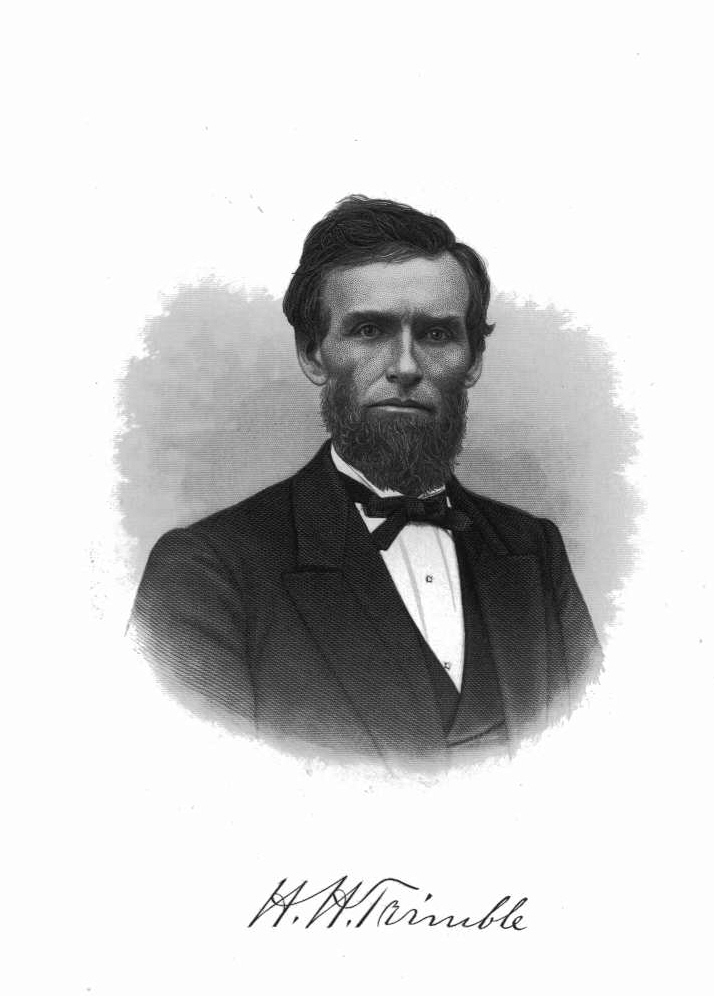 Henry Hoffman Trimble, during his boyhood, his father, who was a carpenter in early life, and afterward a farmer and merchant, lived in succession in Rush, Decatur and Shelby counties, Indiana; his son farming until sixteen years of age. He received his literary education in the preparatory department of Franklin College, and in the State University at Bloomington and Asbury University at Greencastle, all in his native state, graduating from the last named institution on the 21st of July, 1847. He taught more or less while pursuing his studies, and did other kinds of work, defraying his entire expenses. From college Mr. Trimble went directly into the Mexican war, serving one year in the 5th Indiana Volunteers, James H. Lane, colonel. On his return from the war, Mr. Trimble read law, at first with Eden H. Davis, of Shelbyville, Indiana, and afterward with the Hon. Thomas A. Hendricks, teaching during this period the Shelbyville Academy for one year. His father removed to Iowa in 1848, and he followed the next year, continued his law studies, and was admitted to the practice by Hon. J. F. Kinney, of the supreme bench at Keosauqua, on the 29th of April, 1850, taking in a very few years a high position at the bar. He was county attorney from 1851 to 1855, and state senator from 1855 to 1859. In July 1861, Mr. Trimble entered the service as lieutenant colonel of the 3d Iowa Cavalry; served in that position until the 9th of September 1862, when he was discharged on account of a wound he received in the face at the battle of Pea Ridge, Arkansas, on the 7th of March 1862. The ball entered his right cheek, passed through his face, and came out at the bottom of his right ear. It was years before this wound healed, externally; it still discharges slightly, and he suffers from it more or less at all times. At the October election in 1862 Colonel Trimble was elected district judge of the second district and served four years. In 1866 a corporation was organized by the citizens of southern Iowa called the Saint Louis and Cedar Rapids Railway Company, the purpose of which was to extend the North Missouri railway, then being constructed, into Iowa. Judge Trimble was chosen one of the directors, and remained such till September, 1868, when the directors, becoming dissatisfied with the then president, procured his resignation, and the judge was chosen to take his place. The judge remained president of that company until the sale of the road in 1875. He also assisted in building the Burlington and Southwestern railway, and has always taken an active interest in all public enterprises. He is president of the State Bar Association. He is a member of the commandery in the Masonic order. His wife was Miss Emma M. Carruthers, a native of Wheeling, West Virginia; married at Shelbyville, Indiana, on the 5th of April 1849. She is the mother of five children. The eldest son, Palmer Trimble, is married and an attorney-at-law in the firm of Trimble, Carruthers and Trimble, the middle member being Samuel S. Carruthers, a brother-in-law of the judge, and his law partner since 1867. The second son of Judge Trimble, Frank K., is studying with this firm.